OUR PRODUCTS
Uberr Clone AppGojek Clone AppSuper App DevelopmentUberr Eats Clone AppGrocery App DevelopmentHandyman App Like Uberr
inDriver Clone AppDelivery App DevelopmentGlovo Clone AppBolt Clone AppLyft Clone AppCareem Clone App
OUR PRODUCTS

← Back to Blog
Mobile App Development
November 25, 2026
A technical guide to connecting food delivery platforms with ChatGPT and Gemini through APIs, structured menus, order workflows, payments, and operational safeguards.
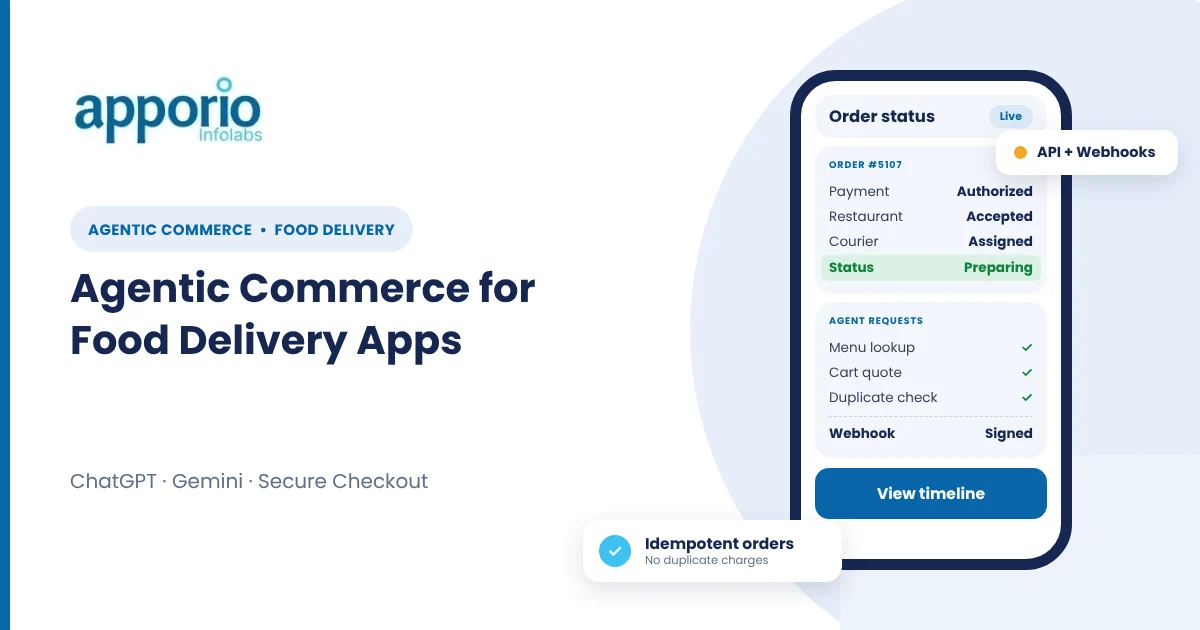
Agentic commerce for food delivery describes a buying workflow in which a customer can discover meals, compare options, customize an order, confirm delivery details, and pay through an AI conversation. The delivery app still performs the operational work, but the customer may begin and complete the transaction from ChatGPT, Gemini, or another supported assistant.
This is not simply a chatbot connected to a restaurant catalog. A production implementation needs machine-readable product data, authenticated actions, real-time availability, reliable payment handling, order-status webhooks, and clear user consent. The assistant must know what it is allowed to do, while the delivery platform remains the source of truth for price, inventory, delivery coverage, and order state.
For an operator, the practical question is not “How do I put my app inside an AI tool?” It is “Which parts of my ordering system can be safely exposed to an external agent, and how should those actions be controlled?” This guide explains the architecture, implementation sequence, benefits, technical risks, and launch practices for building that connection.
The exact integration path depends on the capabilities, approval requirements, APIs, and commerce standards supported by each AI platform. ChatGPT and Gemini should therefore be treated as channels that call your commerce services, not as replacements for your customer, restaurant, courier, or admin applications.
Agentic commerce is a transaction model where software agents interpret a customer’s intent and call approved business actions on the customer’s behalf. In a food delivery use case, an agent may translate “Find me a vegetarian dinner under $25 that arrives before 8 p.m.” into structured searches across restaurants, menus, delivery zones, fees, and estimated times.
The agent does not need direct access to your database. A safer design exposes a controlled set of APIs or tools. Each tool accepts validated inputs and returns limited data. Typical actions include searching restaurants, retrieving menus, checking item availability, calculating the order total, creating a draft cart, requesting payment authorization, placing an order, and retrieving delivery status.
A conventional chatbot mainly provides information from scripted replies or a knowledge base. An ordering agent can request live data and initiate a transaction, so the failure consequences are higher. A stale menu answer is inconvenient; a duplicate charge or incorrect delivery address creates an operational and customer-support problem.
A reliable workflow separates conversation from execution. The AI interprets language and presents choices. Your platform validates every item, price, modifier, address, payment state, and order transition before committing an action. The assistant can suggest an order, but the commerce backend must decide whether the order is valid.
This section reflects public announcements and news reports available in November 2026. Agentic commerce changes quickly, so confirm current capabilities, approval requirements, and regional availability in each platform’s developer documentation before you plan a launch.
Build one platform-neutral commerce API first, then add a ChatGPT app adapter and a UCP adapter at the edge. Keep your own checkout and order backend as the source of truth, because both ecosystems rely on the merchant to price, fulfill, and support the order.
Sources: Instacart, December 2025; TechCrunch, 24 March 2026; Forrester, agentic payments; The Next Web, Google I/O 2026; and BigCommerce, Google agentic checkout. Several are trade press and industry explainers, not official platform documentation. Last reviewed: November 2026.
Food ordering is a strong fit for conversational commerce because customers often express intent in flexible language rather than exact search terms. They may ask for a cuisine, dietary preference, budget, delivery time, distance, or recurring choice. An agent can collect these constraints in a dialogue before presenting suitable options.
This can reduce the number of screens required to begin an order, but it does not remove the need for a well-designed app. Customers still need a dependable way to review the cart, inspect fees, manage addresses, track delivery, request support, and view order history. The conversational channel should complement those capabilities.
The business case also depends on the quality of the underlying marketplace. An assistant cannot solve missing menu data, poor restaurant coverage, inaccurate preparation times, or unreliable dispatch. AI may improve discovery, but fulfillment quality remains an operations problem.
These benefits are conditional. They require consent, accurate data, fast APIs, strong identity controls, and a human escalation route. A conversational entry point is not a substitute for menu operations or delivery capacity planning.
The architecture should be designed around a narrow, auditable contract between the assistant and the delivery platform. Begin with read-only capabilities, then add cart and payment actions after the data and security model has been tested.
Expose structured records for restaurants, cuisine types, opening hours, service areas, menus, item variants, modifiers, allergens, taxes, fees, preparation estimates, and availability. Use stable identifiers for restaurants, menu items, modifier groups, and prices. Human-readable names are not sufficient because similar items may exist across multiple vendors.
Availability should be checked close to checkout. Menu data can be cached for discovery, but the final cart must be revalidated against the restaurant’s current catalog and operating status. The API should return a clear reason when an item, modifier, or delivery zone is no longer available.
A search endpoint should accept structured filters alongside natural-language intent translated by the assistant. Useful fields include location, service radius, cuisine, dietary attributes, maximum total, requested arrival time, rating filters, and restaurant status. Do not allow the model to invent filters that your backend does not support.
Recommendations should return evidence for each result: restaurant name, matching menu items, item price, estimated preparation time, delivery estimate, service fee, and limitations. This makes the answer easier to verify and reduces unsupported claims in the conversation.
The assistant should create a server-side draft cart rather than calculate totals itself. Your pricing service must calculate item prices, modifiers, taxes, delivery fees, promotions, minimum order rules, and any marketplace charges. Return a version or expiration time so the cart can be rechecked before payment.
Every mutation needs an idempotency key. If the assistant retries after a timeout, the platform should return the original cart or order result instead of creating a second order. This is one of the most important differences between a demonstration and a production workflow.
Do not expose raw payment credentials to the model. Use a supported payment flow that keeps sensitive payment data within the payment provider or your secure checkout environment. The customer should see the final items, modifiers, delivery address, fees, tax, total, estimated time, cancellation terms, and merchant before committing the order.
Authentication must connect the AI session to the correct customer account without relying on an email address typed in conversation. Use short-lived tokens, scoped permissions, account linking, and explicit confirmation for payment and order placement. A read-only request should not automatically inherit permission to spend money.
After checkout, the delivery backend should publish order events such as accepted, rejected, preparing, ready for pickup, courier assigned, picked up, delivered, cancelled, and refunded. The assistant can present these events, but it should not infer a status from an old response. The customer-facing app remains the richer interface for maps, courier contact, support, and delivery instructions.
For the fulfillment foundation behind an AI channel, review Apporio’s Delivery App Development offering. The AI channel depends on a complete operations platform, not just a conversational interface.
A staged launch also provides a clean rollback option. If a connector begins returning incorrect prices or status data, disable the affected action without taking down the main delivery app.
The AI layer should never become the owner of menus, prices, inventory, order state, or refunds. It may cache information for speed, but the backend must confirm the current value before a financial or fulfillment action. This principle reduces disputes and makes debugging possible.
Expose meaningful operations such as search restaurants, get menu, create cart, quote order, and place order. Avoid a broad “execute query” endpoint. Narrow tools are easier to authorize, monitor, test, and explain to the customer.
Require confirmation after the final total is known and before the order is placed. If the address, restaurant, item, fee, or total changes, request confirmation again. Do not treat “sounds good” from an earlier part of a long conversation as permanent payment authorization.
An error such as “400 request failed” is not useful to the customer or the assistant. Return safe, specific messages such as “The restaurant stopped accepting orders,” “The selected item is unavailable,” or “The delivery address is outside the service area.” Keep internal stack traces and sensitive details out of the response.
Apply data minimization to prompts, logs, analytics, and support exports. Redact payment credentials, authentication tokens, precise address details where unnecessary, and private restaurant information. Review retention policies and regional privacy obligations before sending customer data to an external AI service. Apporio’s cyber security services can support the security review around identity, API access, and sensitive data flows.
Track tool-call success rate, response time, menu freshness, cart-to-order conversion, payment failure rate, duplicate prevention, cancellation rate, and human escalation. Separate AI interpretation errors from backend failures. The distinction tells the product team whether to improve prompts, schemas, APIs, or operations.
ChatGPT and Gemini differ in supported connectors, authentication, tool formats, approval processes, user permissions, and interface behavior. Build a platform-neutral commerce API and keep platform-specific adapters at the edge. This reduces the cost of changing one assistant integration without rewriting order management.
For teams that need broader AI capability across a marketplace, Apporio’s artificial intelligence services may be considered alongside the existing delivery platform and operational requirements.
| Area | ChatGPT channel | Gemini and Google channel | Shared delivery requirement |
|---|---|---|---|
| Connection model | Build an app inside ChatGPT, and supply product data through ACP where relevant. | Implement UCP so agents can discover, build carts, and check out; AP2 covers payment authorization. | Maintain a platform-neutral commerce API behind each adapter. |
| Checkout today | Native Instant Checkout was moved away from in March 2026; checkout typically runs through the app or the merchant’s own flow. | Checkout in AI Mode and Gemini runs on UCP for eligible products; local food delivery has been announced as a future vertical. | Validate price, availability, address, and order state on every mutation. |
| Customer identity | Link the ChatGPT account session to a delivery customer account through an approved flow. | Use the identity linking approach defined for UCP-based checkout. | Use short-lived, scoped tokens and server-side authorization. |
| Payment | Hand off to your own secure checkout or an approved payment flow. | Plan for AP2-style authorization, usually carried by your payment provider. | Keep payment credentials outside the model context and use idempotency. |
| Availability | Confirm regions, approval steps, and app requirements in OpenAI’s documentation. | US first and expanding; confirm food delivery availability for your countries. | Check target markets before committing to a launch plan. |
| Monitoring | Log tool calls, failures, latency, and customer confirmations. | Log protocol calls, failures, latency, and customer confirmations. | Correlate assistant requests with cart IDs, order IDs, and webhook events. |
The table reflects public information in November 2026 and implementation principles, not a promise that every platform supports every feature in every country. Availability, review requirements, user controls, and technical formats can change. Confirm the current documentation and commercial terms before committing to a launch plan.
Agentic commerce for food delivery is best treated as a controlled extension of an existing ordering ecosystem. The highest-priority work is not a clever prompt. It is dependable menu data, well-defined APIs, secure identity, server-side pricing, payment confirmation, idempotent order creation, and event-driven fulfillment.
Start with discovery and order-status queries, then add cart creation and checkout after testing the failure cases. Keep ChatGPT and Gemini at the interaction layer while your delivery backend remains responsible for business rules and operational truth.
Apporio can support this roadmap through its UberEats Clone, Food Delivery App, Artificial Intelligence, and On-Demand Mobile App Development services. The right scope depends on your existing platform, target market, restaurant network, payment environment, and operational team.
It means a customer can use an AI assistant to search meals, compare restaurants, build a cart, confirm delivery details, and potentially place an order through approved APIs connected to the delivery platform. The platform remains responsible for prices, availability, payment, and fulfillment.
It depends on the platform and region. OpenAI moved away from native Instant Checkout in March 2026, so ChatGPT ordering now typically runs through apps and merchant checkout. Google’s UCP-based checkout in Gemini and AI Mode is rolling out, with food delivery announced as a future vertical. Confirm current availability for your market, and always require explicit customer confirmation before payment.
Payment credentials should remain inside a secure payment provider or checkout flow rather than being exposed to the model. The customer should review the final total and authorize the transaction, while idempotency controls prevent duplicate charges after retries.
A practical first version usually needs restaurant search, menu retrieval, availability checks, delivery-zone validation, cart creation, price calculation, payment authorization, order placement, order status, cancellation, and webhook or event support. Read-only APIs should be implemented and tested before financial actions.
No. Customers still need a complete app or website for maps, receipts, account management, saved addresses, support, order history, and detailed delivery tracking. The assistant is an additional discovery and ordering channel that depends on the core platform.
No. OpenAI moved away from native Instant Checkout in March 2026 and now lets merchants use their own checkout experiences, including through apps in ChatGPT. Confirm the latest status in OpenAI’s documentation.
The Agentic Commerce Protocol (ACP) is an open standard from OpenAI and Stripe for connecting merchants to ChatGPT. The Universal Commerce Protocol (UCP) is Google’s open standard for agent discovery, cart, checkout, and order management, and the Agent Payments Protocol (AP2) covers agent payment authorization. A platform-neutral commerce API makes it easier to support them.