OUR PRODUCTS
Uberr Clone AppGojek Clone AppSuper App DevelopmentUberr Eats Clone AppGrocery App DevelopmentHandyman App Like Uberr
inDriver Clone AppDelivery App DevelopmentGlovo Clone AppBolt Clone AppLyft Clone AppCareem Clone App
OUR PRODUCTS

← Back to Blog
Mobile App Development
October 21, 2026
Where ride-hailing commission caps stand in Kenya and Tanzania, and how to price a taxi app in East Africa that stays profitable for drivers, riders, and the operator.
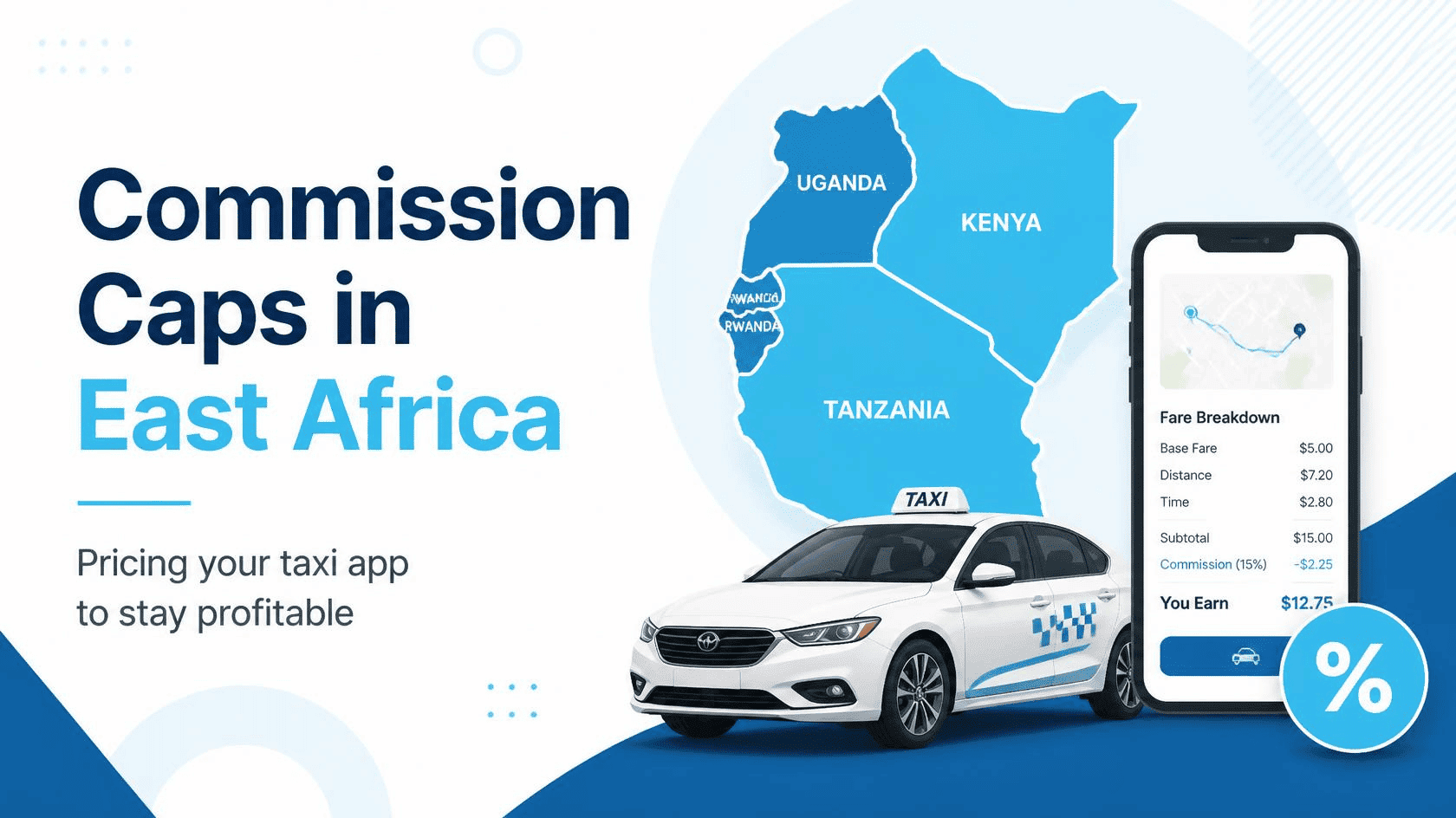
Quick answer: A ride-hailing commission cap limits the share of each trip fare a taxi platform can keep. In East Africa, Kenya introduced an 18% cap in 2022, and Tanzania capped commissions at 15% in 2022 before raising the limit to 25% in early 2023. As of October 2026, Kenya’s cap is under legal review after a High Court ruling, so operators should build a pricing model that stays profitable at 15–20% commission and can be reconfigured quickly when the rules change.
For operators, the cap affects driver recruitment, rider fares, promotional budgets, and the path to profitability. The challenge is not simply choosing a lower or higher percentage. A viable pricing model must account for local transport regulation, mobile money charges, payment settlement time, customer support, mapping, taxes, incentives, refunds, and the cost of keeping enough drivers available during busy periods.
Kenya, Uganda, Tanzania, Rwanda, and other East African markets do not share one uniform operating environment. Commission rules, licensing requirements, driver expectations, payment habits, and competitive pressure differ by country and city. A pricing model that works in Nairobi may not produce the same result in Kampala or Dar es Salaam.
This guide explains where commission caps stand today, works through a trip-level example in Kenyan shillings, and shows how to build a taxi marketplace that stays attractive to drivers and riders while protecting the operator’s margin.
For the technology layer, a structured taxi app development plan should support configurable pricing, market-specific rules, transparent statements, and operational reporting from the first release.
A ride-hailing commission cap is a maximum limit on the share of a trip fare that a platform can deduct from a driver or transport provider. The cap may come from legislation, a regulator, a city authority, an industry agreement, or the platform’s own commercial policy.
For example, if a trip fare is KES 1,000 and the permitted deduction is 18%, the platform can retain up to KES 180. The driver’s gross share is KES 820, although payment fees, taxes, bonuses, tolls, or other agreed deductions may change the final settlement.
Founders should distinguish between three figures:
A cap may apply only to the core trip fare or to a wider set of platform charges. That distinction matters. In Kenya, the regulator treated booking fees added on top of the 18% commission as non-compliant, so a permitted commission percentage should never be read as permission to add other fees without review.
Regulation in the region has moved several times since 2022. The table below summarises the position as of October 2026. Treat it as a starting point and confirm the current rules with local counsel before setting prices.
| Market | Commission rule | Current status |
|---|---|---|
| Kenya | The 2022 Transport Network Companies regulations capped platform commission at 18% of driver earnings per trip. NTSA also treated booking fees charged on top of the commission as a breach. | In September 2026, the High Court found the government had not shown the cap was necessary or proportionate, and gave it 12 months to redo the regulations with public participation and an impact assessment. Treat the cap as under review. |
| Tanzania | LATRA capped commission at 15% in 2022, down from as much as 33%, then revised the limit to 25% commission plus up to 3% booking fee from January 2023. | LATRA also sets guide and minimum fares. Uber stopped operating in Tanzania from 30 January 2026 after a long dispute over fares and commissions. Confirm the latest LATRA tariff order before launch. |
| Uganda, Rwanda and other markets | No ride-hailing-specific commission cap of the Kenyan or Tanzanian kind appeared in our research. | Transport licensing, tax, and consumer protection rules can still affect pricing. Confirm with the local transport regulator and legal advisers. |
Two lessons stand out. First, caps move: Tanzania went from 15% to 25% within a year, and Kenya’s 18% rule is now being reworked. Second, caps reshape the market quickly. When Kenya’s rules took effect in 2022, Uber cut its commission there from 25% to 18% and Bolt from 20%, while local operators such as Little and Yego were already charging less. Any pricing model you launch should keep working if the permitted rate drops by a few points.
Sources: Kenyans.co.ke on the High Court ruling (September 2026), Connecting Africa on Kenya’s 18% cap, and The Citizen on LATRA’s revised commission limit.
Commission limits directly affect the balance between supply, demand, and operating costs. Drivers compare the amount they keep from each trip with fuel, maintenance, insurance, financing, data, vehicle depreciation, and time spent waiting without a passenger. If the payout appears too low, driver churn can rise and availability can fall.
Riders experience the same economics from the other side. Higher fares may help the operator preserve margin, but they can reduce trip frequency or push customers toward informal alternatives. Lower fares may increase demand while creating losses if the platform pays heavy incentives or absorbs payment and support costs.
East African operators also need to account for cash and mobile money such as M-Pesa. A cash-heavy market creates reconciliation, safety, and fraud-control work. Mobile money can reduce cash handling, but transaction fees, settlement timing, reversals, and provider availability still affect the contribution from each trip.
Commission caps also influence investor and management decisions. Gross booking value can look impressive while the platform loses money on every completed ride. A more useful view tracks contribution margin by city, service type, payment method, and time period.
At minimum, monitor:
The example below uses a KES 600 city trip paid by M-Pesa. The cost figures are illustrative assumptions, not market benchmarks; replace them with your own provider quotes and pilot data.
| Line item | At 18% commission | At 15% commission |
|---|---|---|
| Rider fare | KES 600 | KES 600 |
| Platform commission | KES 108 | KES 90 |
| Driver gross payout | KES 492 | KES 510 |
| Payment processing (assumed ~1.5%) | KES 9 | KES 9 |
| Maps, SMS and infrastructure (assumed) | KES 6 | KES 6 |
| Support and refund reserve (assumed) | KES 10 | KES 10 |
| Rider or driver incentive (assumed) | KES 15 | KES 15 |
| Platform contribution per trip | KES 68 (11.3% of fare) | KES 50 (8.3% of fare) |
A three-point drop in commission cuts the platform’s contribution by about a quarter, because variable costs stay the same while revenue falls. In this example, the incentive line is the largest controllable cost, which is why promotions need an owner, a budget, and an end date. The same table, run for short trips, airport transfers, and cash rides, will show which segments carry the business and which need different pricing.
A transparent commission structure does more than satisfy a policy requirement. It creates a predictable operating framework for drivers, riders, finance teams, and customer support. The model should be simple enough for a driver to understand from a weekly statement and detailed enough for the operator to audit.
Drivers are more likely to continue using a platform when they can see the fare, platform deduction, payment charge, incentive, and final payout separately. Clear calculations reduce disputes and give the operator evidence when a driver questions a settlement.
A configurable model allows different rules for cities, vehicle categories, airport trips, scheduled rides, and business accounts. This is more practical than hard-coding one percentage across every service.
When the operator understands its variable costs, it can avoid raising every fare to cover inefficiencies in one segment. Pricing can instead reflect distance, demand, service level, and the actual cost of completing a trip.
Promotions should have a defined payer. A discount may be funded by the operator, the driver, a business customer, or a commercial partner. If the system does not record that responsibility, discounts can quietly consume the driver’s earnings or the platform’s margin.
Separate ledgers for fares, commissions, incentives, refunds, taxes, and payment charges help management understand which parts of the business are profitable. This is especially important when adding motorcycles, executive vehicles, delivery, or corporate transport.
Pricing should begin with a trip-level model, not a target revenue percentage. Build the model in a spreadsheet first, then reproduce the approved logic inside the app and administration system.
A dispatch and settlement system should preserve a record of the calculation used for every trip. This is useful for driver support, regulatory questions, refunds, tax reporting, and internal financial analysis.
Kenya and Tanzania have both changed their rules within a few years. Commission rates, fee rules, and fare tables should be editable by authorised administrators, per country, city, and vehicle type, with every change logged and dated. When a regulator moves the limit, the update should take minutes, not a development sprint.
A single percentage is easy to explain, but it may not suit every service. An operator could assess different structures for standard rides, premium vehicles, scheduled corporate transport, airport trips, or high-volume driver partners, provided the approach complies with local rules and is disclosed clearly.
A rider booking fee, platform fee, or safety fee should not be used to disguise a deduction from the driver. Define each charge, identify its purpose, and check whether local rules require a specific disclosure or limit.
Average performance can hide weak segments. A short trip may have a small fare but still create support and payment costs. An airport transfer may produce a higher fare but involve waiting, access charges, or additional dispatch coordination. Review each category separately.
Cash, M-Pesa and other mobile money, cards, and account billing have different costs and operational risks. The platform should record payment method, settlement status, reversal, and reconciliation outcome for every trip, and payment options should be chosen country by country based on what riders actually use.
A driver statement should show completed trips, gross fares, platform deductions, incentives, cancellations, adjustments, and the final amount due. Avoid presenting only one net number. A detailed statement reduces avoidable tickets and makes errors easier to investigate.
Some drivers and riders may operate with inconsistent data coverage or limited device capacity. Keep core booking, trip status, communication, and settlement flows resilient. Delayed location updates or failed payment confirmations should have clear fallback states instead of creating duplicate trips.
Commission economics can be damaged by fake trips, collusion, repeated promotional use, payment reversals, GPS manipulation, and account sharing. Use device, trip, payment, and behavioural checks proportionately, and define identity, access, and data-protection controls before launch rather than after the first fraud spike.
Not every cost is visible at booking time. Lost items, disputed fares, safety incidents, duplicate charges, and delayed settlements require staff and funds. Set aside a realistic operating reserve instead of treating every collected fee as available profit.
Business accounts can have different billing, reporting, service-level, and payment requirements. They may also reduce dependence on unpredictable consumer demand. However, account management and invoicing costs should be included in the segment’s economics.
Operators planning to add courier, grocery, or service categories should avoid using one commission model for everything. Different categories have different fulfilment costs, provider expectations, and refund patterns. A modular approach makes future expansion easier without weakening the taxi business.
A rival’s commission may reflect a different cost base, funding position, vehicle mix, or regulatory arrangement. Copying the number without copying the underlying economics can create losses or an unattractive driver offer.
The platform’s deduction is revenue, not profit. Payment charges, support, infrastructure, compliance, marketing, incentives, refunds, salaries, and taxes must be removed before assessing the result.
Drivers earn from completed trips, but they spend time positioning, waiting, refuelling, and returning from low-demand areas. A fare that looks reasonable per kilometre may not be attractive per working hour.
Introductory discounts can help test demand, but a permanent discount can conceal weak willingness to pay. Set an end date, measure repeat usage, and check whether the service remains viable when the promotion stops.
Traffic, fuel, trip length, regulations, payment behaviour, and driver supply differ across East African cities. Use local pilot data before expanding the same fare table or incentive plan.
Unexpected changes to payouts often create driver dissatisfaction, support volume, and supply loss. Announce changes in advance where required, show worked examples, and provide a clear effective date.
Rates, caps, service fees, taxes, incentives, and payment rules should be configurable by authorised administrators. Hard-coded values make lawful changes slower and increase the risk of manual settlement errors.
| Pricing model | How it works | Advantages | Risks and controls |
|---|---|---|---|
| Percentage commission | The platform retains a defined share of each completed fare. | Simple to explain and scales with trip value. | May become insufficient on short trips; monitor minimum contribution. |
| Fixed booking fee | The platform charges a fixed amount per completed booking. | Predictable platform revenue and easy driver payout calculation. | Can be disproportionate on low-value trips; disclose clearly. |
| Hybrid model | A capped commission is combined with a permitted booking or service fee. | Balances driver protection with operator cost recovery. | Needs legal review: Kenya’s regulator treated booking fees on top of the 18% commission as non-compliant, while Tanzania’s 2023 rules allow up to 3%. |
| Subscription or access plan | Drivers or fleets pay a recurring amount for platform access, subject to local rules. | Can reduce per-trip deductions and support predictable planning. | Drivers may reject the plan if trip volume is uncertain; offer transparent terms. |
| Business account pricing | Corporate customers receive contracted rates or billing terms. | Supports scheduled demand and centralised invoicing. | Longer payment cycles and account servicing add costs. |
Most operators should test one primary model before adding complexity. A hybrid arrangement may be useful when a cap limits the percentage deduction, but it must be transparent and legally reviewed. The right choice depends on trip volume, average fare, payment mix, driver costs, regulatory conditions, and the level of service provided.
A sustainable taxi platform in East Africa needs more than a permitted commission percentage. It needs a complete trip-level model that protects driver earnings, keeps rider fares reasonable, accounts for payment and support costs, and gives management reliable data for each city and service type.
Start with local legal review, model several demand conditions, stress-test a lower cap, pilot the pricing structure, and revise it using actual settlement and retention data. The technology should make these rules configurable and auditable rather than forcing the operations team to depend on spreadsheets and manual adjustments.
Apporio Infolabs supports this roadmap with its Apporio Taxi Uber Clone Script, taxi app development, and on-demand app development services. These options help founders plan the rider, driver, admin, dispatch, payment, and reporting layers around the commercial model selected for their market, delivered as a white-label product under the operator’s own brand.
When the commission cap is treated as one input in a broader unit-economics system, operators can make better decisions about fares, incentives, expansion, and service quality. The objective is not to charge the highest possible deduction; it is to create a marketplace that can continue serving drivers and riders after launch promotions end.
See how Apporio’s taxi platform handles commission settings, fare rules, driver payouts, and settlement reports. In a free 30-minute session, Apporio’s team will walk you through the rider, driver, and admin apps and map them to your launch country, payment mix, and pricing model.
It sets the maximum share of a completed trip fare that the platform can retain from the driver or transport provider. The exact scope depends on local rules and whether the cap applies to the fare, platform fees, or other deductions.
Kenya’s 2022 regulations capped commission at 18% per trip, but in September 2026 the High Court ruled the cap had not been justified and gave the government 12 months to revise the rules, so it is currently under review. Tanzania capped commission at 15% in 2022 and raised the limit to 25% plus up to a 3% booking fee from January 2023. Confirm the latest position with local advisers before launch.
Calculate the customer fare, subtract the driver payout and every variable cost connected with the trip, then review the contribution margin. Include payment processing, incentives, refunds, customer support, mapping, fraud losses, and taxes where applicable, and rerun the numbers at a lower commission rate.
No. Fuel costs, trip lengths, traffic, regulation, payment behaviour, driver supply, and customer demand differ by city. Use a configurable model and validate local assumptions through a controlled pilot.
That depends on local law. Kenya’s regulator treated booking fees on top of the 18% commission as non-compliant, while Tanzania’s 2023 rules allow up to 3%. Any additional fee should have a clear purpose, appear before booking confirmation, and be reviewed by local legal and tax advisers.
Statements should show completed trips, gross fares, platform deductions, payment charges, incentives, cancellations, adjustments, and the final amount due. A detailed breakdown makes disputes easier to investigate and supports driver trust.
Review it monthly during the early operating period and after major changes to regulation, fuel costs, payment fees, demand, service categories, or incentives. Actual trip-level data should replace launch assumptions as soon as it becomes available.