OUR PRODUCTS
Uberr Clone AppGojek Clone AppSuper App DevelopmentUberr Eats Clone AppGrocery App DevelopmentHandyman App Like Uberr
inDriver Clone AppDelivery App DevelopmentGlovo Clone AppBolt Clone AppLyft Clone AppCareem Clone App
OUR PRODUCTS

← Back to Blog
August 12, 2026
A practical guide to dark kitchen technology, revenue models, operational workflows, essential app features, launch planning, and common mistakes.
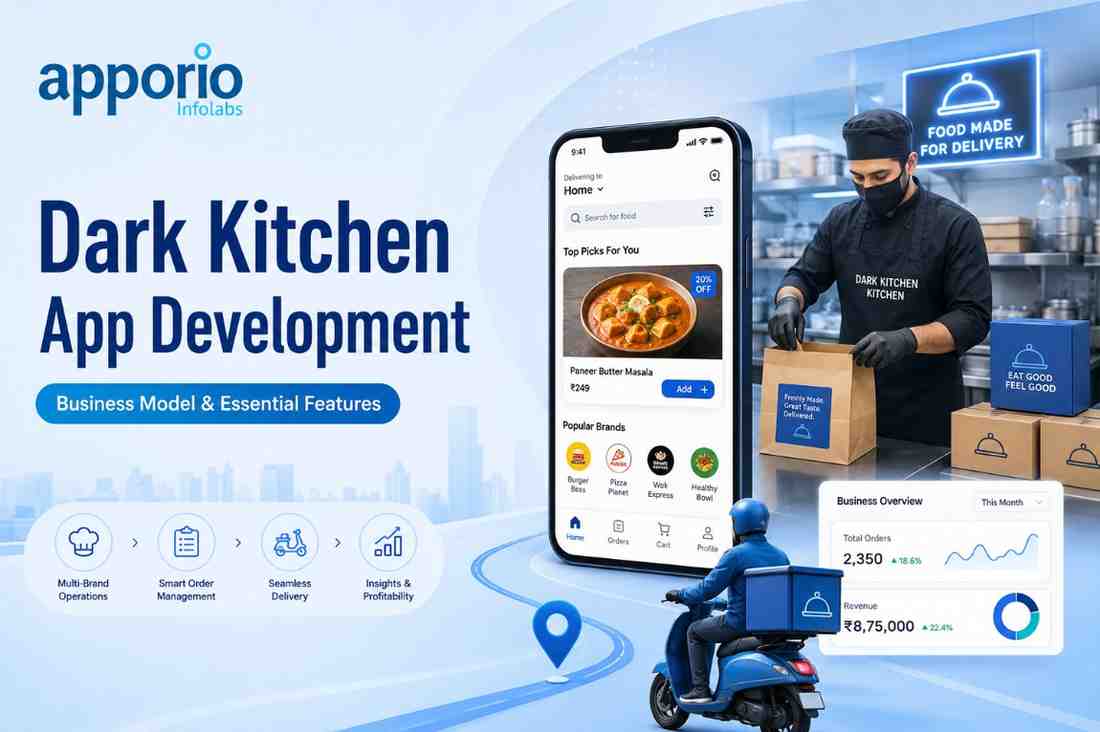
Dark kitchen app development is a commercial decision that combines food production, digital ordering, delivery operations, and customer acquisition in one operating model. A dark kitchen, also called a virtual kitchen or ghost kitchen, prepares food for delivery without depending on a traditional customer-facing dining room.
The app is not simply an online menu. It connects customers, kitchen operators, delivery staff, administrators, and payment systems. The quality of those connections determines whether orders move quickly, kitchen teams receive accurate instructions, and delivery costs remain manageable.
For restaurants, food entrepreneurs, and delivery-first brands, the main question is not only how to build an app. It is how to design a system that fits the chosen kitchen model, target market, menu, delivery radius, pricing structure, and operating capacity.
This guide explains the business model, commercial benefits, core features, launch process, practical best practices, common mistakes, and technology choices to evaluate before selecting a development partner.
A dark kitchen app is a digital ordering platform built for food businesses that prepare meals primarily for delivery or collection. It can support one kitchen, multiple brands operating from one facility, a marketplace of independent kitchens, or a larger food delivery network.
Unlike a standard restaurant application, the platform must coordinate the full order lifecycle. A customer browses a menu and pays. The kitchen receives the order, confirms availability, prepares the food, marks it ready, and hands it to a delivery partner. The customer then receives status updates until completion.
The system usually includes several connected interfaces:
The distinction between a restaurant ordering app and a dark kitchen platform is operational depth. The latter needs tools for kitchen capacity, preparation timing, brand separation, inventory visibility, delivery coordination, and service-area control.
Traditional restaurants carry costs linked to dining-room space, front-of-house staffing, utilities, décor, and location-based foot traffic. A delivery-first kitchen uses a different cost structure. It focuses investment on food production, packaging, technology, marketing, and fulfilment.
This approach can help operators test a concept in a defined delivery area before investing in multiple physical outlets. A business may also run several food brands from one kitchen, provided each brand has a clear menu, identity, pricing strategy, and production process.
The commercial case depends on execution rather than the label attached to the model. A low-rent kitchen does not automatically create healthy margins. Ingredient costs, packaging, discounts, commissions, refunds, delivery fees, customer acquisition, labour, and wasted stock still affect contribution margin.
An app matters because it gives the operator direct visibility into these activities. Useful reporting can show:
For businesses planning a broader marketplace, a food delivery platform can provide a useful reference point for customer, restaurant, courier, and administrator workflows. The final product still needs to be adapted to dark kitchen operations.
A delivery-first concept can be tested in one facility and one service area before the operator considers additional locations. The application supports controlled expansion by allowing administrators to define delivery zones, kitchen coverage, order limits, and local menus.
One kitchen may produce meals for several digital brands. The platform should keep menus, branding, promotions, customer communication, and performance reports distinct while routing confirmed orders to the correct preparation workflow.
When customers order through a business-owned platform, the operator can manage customer communication, loyalty rules, feedback, and promotional campaigns directly. This reduces dependence on third-party marketplaces for every interaction, although external channels may still be useful for acquisition.
Order status, courier assignment, delivery zones, estimated times, and proof of delivery can be managed from one system. This creates a clearer operational record when an order is late, incomplete, cancelled, or refunded.
Digital brands can test limited menus, seasonal products, bundles, and price points without redesigning a physical dining room. Operators should assess each test using order volume, preparation time, food cost, repeat purchase, complaint rate, and delivery performance.
Reports help founders distinguish demand from operational failure. For example, a product with many views but few purchases may have a pricing or presentation problem. A popular item with frequent refunds may indicate poor packaging, stock planning, or preparation capacity.
Many teams begin with customer screens and treat the kitchen as a simple order receiver. That approach creates problems during peak periods. Design the order queue, preparation stages, item modifiers, packaging instructions, and capacity controls with kitchen staff who will use them daily.
A menu should reflect what the kitchen can actually prepare. If an item is unavailable but remains visible, the customer experience suffers and support costs increase. Availability controls should be quick enough for staff to use during service.
Estimated delivery times should account for preparation, courier travel to the kitchen, pickup handling, traffic, and destination travel. Overly optimistic promises may increase first-order conversion but can damage repeat usage through late deliveries.
Customer feedback should identify whether a problem came from preparation, packaging, missing items, temperature, courier handling, or address details. A single overall rating does not provide enough information for corrective action.
Payment success does not always mean the kitchen received a usable order. The system should record payment status separately from order status and provide reconciliation tools for duplicate charges, failed confirmations, partial refunds, and cancelled orders.
A global audience does not mean one universal configuration. Payment methods, address formats, tax treatment, language, delivery expectations, data requirements, and courier practices vary by country. The product should support market-level settings instead of forcing one process everywhere.
Track more than downloads and gross order value. Review conversion rate, average order value, repeat purchase rate, preparation time, delivery time, refund rate, cancellation rate, discount cost, delivery cost, and contribution margin. These measures connect product decisions to business performance.
The platform may later require payment providers, mapping services, accounting tools, kitchen hardware, messaging services, or external delivery partners. Clear interfaces and documented data flows make future changes less disruptive. Apporio’s DevOps consulting service can be considered when planning deployment, monitoring, backups, and release management.
| Business Model | How It Works | Technology Priority | Main Operational Challenge |
|---|---|---|---|
| Single-brand owned kitchen | One operator prepares and sells meals through its own digital channel. | Customer ordering, kitchen workflow, payments, delivery tracking, and reporting. | Building demand while maintaining utilisation and consistent fulfilment. |
| Multi-brand kitchen | Several virtual food brands operate from one facility. | Brand-level menus, order routing, shared inventory visibility, and performance reports. | Preventing production conflicts and keeping each brand distinct. |
| Partner kitchen marketplace | Independent kitchens list menus on a shared ordering platform. | Partner onboarding, commissions, permissions, ratings, dispatch, and dispute management. | Maintaining consistent quality and service standards across partners. |
| Hybrid delivery network | Owned kitchens and external food partners operate within one platform. | Flexible fulfilment rules, partner types, service areas, and reconciliation. | Managing different preparation standards, pricing, and delivery responsibilities. |
The right model depends on capital, kitchen capacity, brand strategy, delivery control, and the level of operational complexity the business can manage. An owned single-brand operation is usually easier to pilot. A marketplace or hybrid model may offer broader selection but requires stronger partner controls and support processes.
When evaluating software, compare the product against the intended model rather than selecting features in isolation. A platform that works for one kitchen may require significant changes for partner onboarding, shared dispatch, multi-brand reporting, or market-level administration.
Dark kitchen app development should begin with the operating model, not only the customer interface. The strongest plans connect menu design, kitchen capacity, delivery coverage, payment processing, support, reporting, and security into one measurable workflow.
Apporio Infolabs can support businesses evaluating a Food Delivery platform, a Delivery App Development solution, and white-label on-demand app development for delivery-first concepts. Its Ubereats Clone is also relevant for teams comparing established customer, kitchen, courier, and admin workflows before defining their own product scope.
Start with one market, a controlled menu, clear delivery rules, and metrics that show whether each order contributes to a sustainable operation. Then use pilot data to decide which brands, locations, integrations, and features deserve further investment.
A dark kitchen app is a digital ordering and operations platform for food businesses that primarily prepare meals for delivery or collection. It can connect customers, kitchen staff, couriers, and administrators through separate interfaces.
The first release should normally include menu browsing, cart and checkout, payment processing, order tracking, kitchen order management, courier assignment, notifications, support workflows, and basic reporting. Advanced features can follow after a controlled pilot.
Yes. A platform can support multiple digital brands from one facility when it provides separate menus, brand settings, order routing, preparation instructions, availability controls, and performance reporting.
It should define service areas, validate customer addresses, assign available couriers, provide pickup and delivery status updates, record proof of delivery, and support reassignment or exception handling when an order is delayed.
A white-label product may suit a business whose workflows match existing food delivery processes and which wants a shorter path to testing. Custom development may be more appropriate when the concept needs unusual kitchen workflows, specialised integrations, or extensive market-specific controls.
Businesses should measure conversion rate, average order value, repeat purchases, preparation time, delivery time, cancellation rate, refund rate, discount cost, delivery cost, order accuracy, customer complaints, and contribution margin.

