OUR PRODUCTS
Uberr Clone AppGojek Clone AppSuper App DevelopmentUberr Eats Clone AppGrocery App DevelopmentHandyman App Like Uberr
inDriver Clone AppDelivery App DevelopmentGlovo Clone AppBolt Clone AppLyft Clone AppCareem Clone App
OUR PRODUCTS
← Back to Blog
Mobile App Development
June 24, 2026
Discover everything you need to know about building a successful food delivery app in 2026. This guide covers market trends, business models, essential features, development costs, technology stack, timelines, and expert tips to help you launch a scalable, profitable platform.
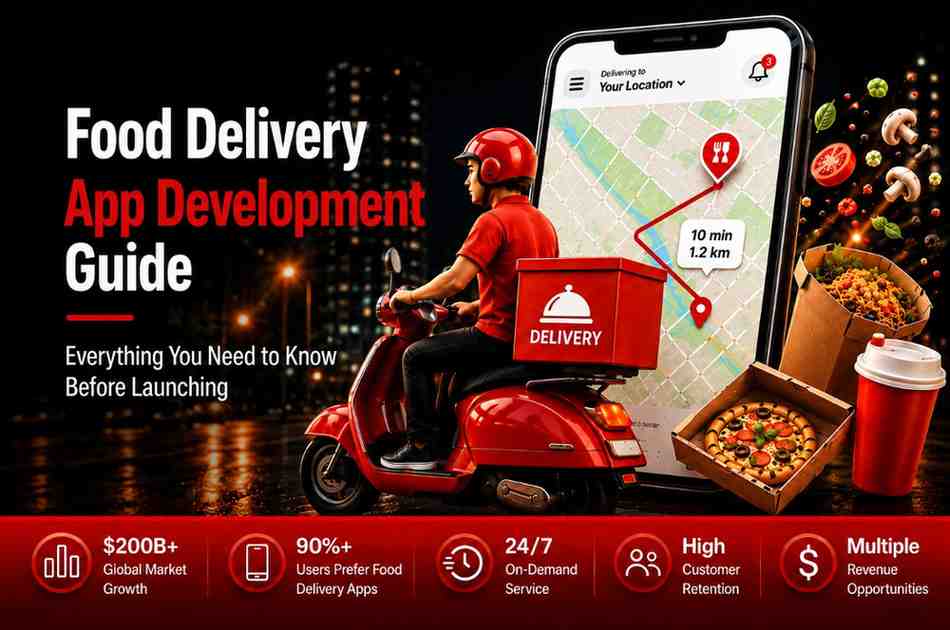
The food delivery industry has evolved from a convenience trend into a fundamental part of modern urban life. With busy professionals, families, and students relying on quick, contactless options, launching your own food delivery app represents a high-potential opportunity in a rapidly expanding ecosystem. Whether you're a restaurant owner aiming to boost direct orders, a startup founder, or an established business diversifying revenue, this guide provides everything you need—from market intelligence and development roadmaps to costs, features, trends, and visuals.
In 2026, customers don’t just crave food—they demand seamless, personalized, and sustainable experiences delivered at the speed of a tap. The real winners build ecosystems that anticipate needs, not just fulfill orders.
Building a successful food delivery platform requires far more than launching a mobile application. At Apporio Infolabs, we've worked with businesses across multiple countries to develop scalable on-demand delivery platforms that handle real-time order management, restaurant operations, secure payments, and business analytics. This practical experience allows us to understand not only the technical requirements but also the operational challenges involved in building a profitable food delivery business.
The global online food delivery market continues its upward surge, propelled by widespread smartphone adoption, urbanization, gig economy expansion, evolving consumer habits, and technological advancements.
Line graph illustrating projected lower and upper estimates with trajectory.
Sources: Fortune Business Insights, Persistence Market Research, Grand View Research.
The rise of cloud kitchens, ghost brands, and subscription-based unlimited delivery plans is transforming supply chains and boosting customer retention.
Building a successful food delivery app needs more than just coding. It requires the right market research, business model, user experience, technology, and launch strategy. Here is a complete roadmap:
Start by understanding your target market. Analyze customer behavior, delivery demand, food preferences, competitor pricing, delivery speed, restaurant availability, and local regulations.
Also identify gaps in existing platforms, such as high delivery charges, poor customer support, delayed orders, limited restaurant options, or weak tracking experience. You can also explore niche opportunities like healthy food delivery, regional cuisine, cloud kitchens, corporate meals, or subscription-based food plans.
Before full development, conduct surveys, interview restaurant partners, study competitors, and test your idea with a small MVP or pilot launch.
Select a business model based on your target audience and investment capacity. Common food delivery app models include:
Aggregator Model: You connect customers with multiple restaurants and earn commission on every order.
Restaurant-Owned Delivery App: A single restaurant or food chain manages direct orders through its own app.
Hybrid Model: You allow restaurants to manage orders while also offering your own delivery fleet.
Revenue can come from restaurant commissions, delivery charges, surge pricing, premium listings, in-app ads, subscription plans, and B2B white-label services.
An MVP helps you launch faster and validate demand without spending heavily from day one. Focus on the most important user journey: search, order, pay, track, and receive food.
Your MVP should include customer app, restaurant panel, delivery partner app, and admin panel. Start with core features like user registration, restaurant listing, menu browsing, cart, online payment, order tracking, push notifications, ratings, and basic analytics.
Advanced features like AI recommendations, loyalty programs, wallet, subscriptions, voice ordering, and advanced offers can be added after launch.
A food delivery app must be simple, fast, and visually appealing. Users should be able to find restaurants, compare dishes, apply offers, place orders, and track deliveries without confusion.
Use high-quality food images, clean navigation, clear CTAs, fast-loading screens, and mobile-first layouts. Accessibility, multilingual support, and A/B testing can further improve user engagement and conversions.
Choose a technology stack that can handle high traffic, peak-hour orders, real-time tracking, secure payments, and future expansion.
Your app should support GPS tracking, payment gateway integration, push notifications, restaurant management, delivery partner allocation, analytics, and cloud hosting. Scalability is important because food delivery demand can increase suddenly during weekends, festivals, lunch hours, and dinner hours.
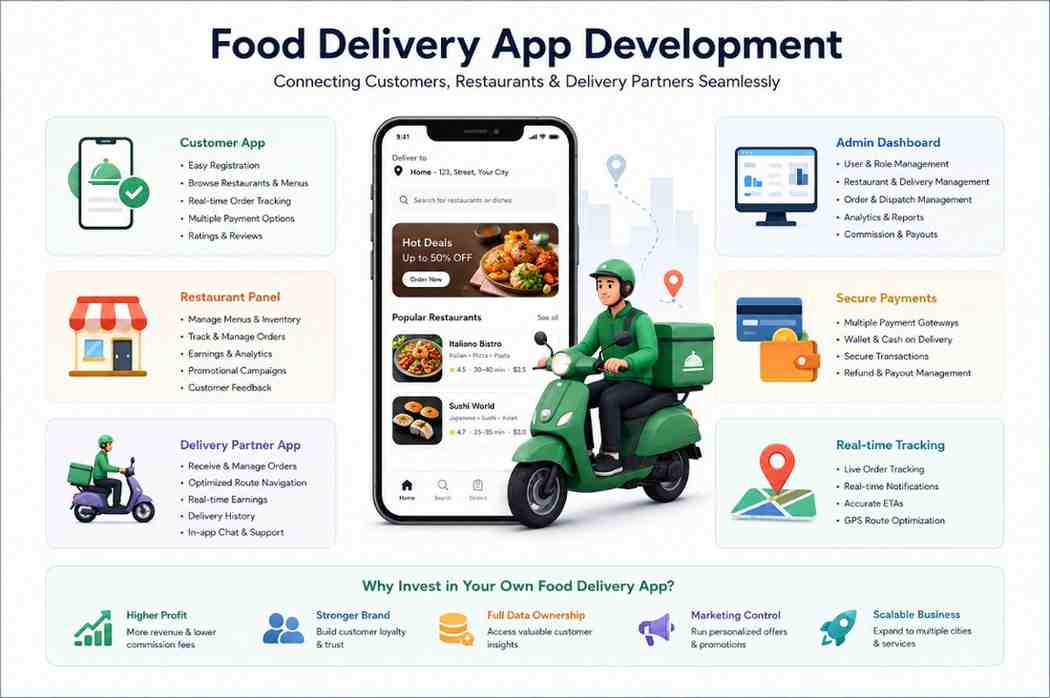
Development usually includes four main parts: customer app, restaurant panel, delivery partner app, and admin dashboard.
Important integrations include maps and GPS, payment gateways, SMS/WhatsApp notifications, email alerts, analytics tools, CRM, coupon engine, and tax or invoice systems. You can develop all modules together or launch in phases depending on your budget and timeline.
Before launch, test the app properly across different devices, screen sizes, operating systems, and network conditions.
Testing should include functional testing, payment testing, order flow testing, GPS accuracy, restaurant panel testing, delivery partner app testing, security testing, load testing, and bug fixing. This step is critical because even a small issue in payment, tracking, or order assignment can affect customer trust.
Start with a beta launch in one city or selected locations. This helps you collect real user feedback, improve operations, fix bugs, and understand demand before scaling.
Use SEO, ASO, social media campaigns, influencer marketing, referral programs, restaurant partnerships, launch offers, and performance ads to attract users. Early marketing should focus on trust, speed, offers, restaurant variety, and ease of ordering.
After launch, monitor important KPIs such as order volume, repeat orders, delivery time, cancellation rate, customer acquisition cost, restaurant performance, delivery partner efficiency, and app retention.
Use this data to improve your app, add new features, expand to new cities, onboard more restaurants, optimize delivery routes, and introduce loyalty programs or subscription plans.
Partnering with a reliable food delivery app development company can help you avoid technical mistakes, reduce development delays, and launch faster. An experienced technology partner can provide ready-made modules, scalable architecture, admin controls, delivery management features, and post-launch support.
A well-planned food delivery app is not just a digital platform. It is a complete ecosystem connecting customers, restaurants, delivery partners, and business owners through a smooth, reliable, and scalable experience.
In 2026, customers expect much more than basic food ordering. The most successful food delivery apps combine convenience, personalization, speed, and intelligent automation to create a seamless user experience. To remain competitive, your platform should cater effectively to customers, restaurants, delivery partners, and administrators while leveraging emerging technologies that drive engagement and profitability.
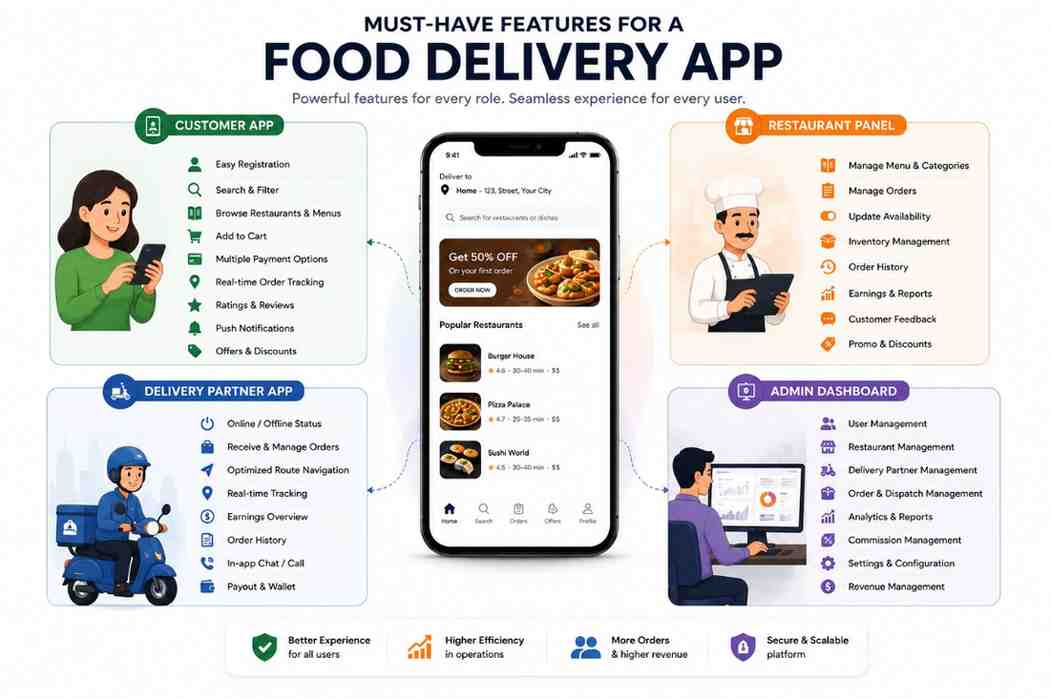
The customer experience is the foundation of any food delivery platform. A smooth and intuitive ordering journey directly impacts user retention and repeat purchases.
Restaurant partners need powerful tools to efficiently manage operations, reduce delays, and maximize revenue.
Efficient delivery operations directly impact customer satisfaction and profitability.
The admin panel serves as the command center of the entire food delivery ecosystem.
Leading food delivery platforms are increasingly differentiating themselves through innovation and customer-centric experiences.
Artificial Intelligence can analyze user behavior, purchase patterns, and preferences to deliver personalized menus, promotions, and ordering experiences.
Eco-conscious consumers increasingly prefer environmentally responsible platforms. Features may include:
Customers can view realistic 3D food previews before ordering, improving confidence and reducing order dissatisfaction.
AI assistants and voice-enabled ordering make the process faster and more accessible, especially for mobile users.
Monthly subscription plans can offer:
Modern consumers prefer a single platform for multiple needs. Many food delivery apps are evolving into super apps by integrating:
Real-time pricing adjustments based on demand, weather, traffic, and delivery availability help maximize profitability while maintaining service quality.
Prioritize security, GDPR/CCPA compliance, and PCI-DSS for payments.
Costs depend on scope, team location, and customizations.
Sources: Industry analyses from Softteco, Folio3.
Cutting corners on development often leads to higher long-term costs through poor user retention and frequent fixes.
Several variables influence the final development cost of a food delivery application.
Building only Android costs significantly less than launching Android, iOS, and Web simultaneously.
Features such as AI recommendations, loyalty programs, subscriptions, multilingual support, and real-time analytics increase both development time and cost.
Payment gateways, Google Maps, SMS providers, WhatsApp APIs, CRM software, and marketing tools require additional development and maintenance.
A custom interface improves customer engagement but requires more design effort compared to template-based solutions.
Enterprise applications supporting thousands of concurrent users require advanced cloud infrastructure, load balancing, caching, and microservices architecture.
Businesses should also allocate approximately 15–20% of the initial development cost annually for maintenance, feature upgrades, bug fixes, server infrastructure, and security updates.
Launching a food delivery app comes with several hurdles. Here’s a detailed look at the major challenges and proven strategies to overcome them:
The market is dominated by big players like Uber Eats, DoorDash, and Swiggy. To stand out, focus on niche differentiation — such as healthy organic meals, regional/ethnic cuisines, eco-friendly packaging, or hyper-local neighborhood service. Invest in superior user experience, faster delivery times, lower fees, and personalized recommendations to build strong customer loyalty.
High operational costs and delays in the final delivery stage can hurt profitability and customer satisfaction. Mitigate this by implementing AI-powered route optimization, real-time traffic analysis, and dynamic dispatching. Build strong partnerships with local delivery fleets, use electric vehicles for sustainability, and offer zone-based pricing or scheduled deliveries to reduce pressure during peak hours.
Acquiring new users is expensive, and retaining them is even harder in a crowded market. Allocate a significant budget for performance marketing, social media campaigns, influencer partnerships, and referral programs. Boost retention through robust loyalty programs, personalized offers, seamless reordering, push notifications, and excellent customer support. Gamification and subscription models (e.g., unlimited deliveries) work exceptionally well for long-term engagement.
Food safety regulations, gig worker labor laws, data privacy (GDPR/CCPA), licensing, and insurance requirements vary by region and can create major roadblocks if ignored. Address these early by consulting legal experts, implementing strict food safety protocols, ensuring transparent driver contracts, and building robust data security and privacy measures into your app from day one.
Poorly designed systems often crash during peak hours or become expensive to maintain as the user base grows. Avoid this by adopting a cloud-native architecture (AWS, Google Cloud, or Azure) with auto-scaling capabilities from the beginning. Use microservices, conduct regular performance audits, and plan for high concurrency, real-time features, and future expansions to minimize technical debt.
Building a successful food delivery app is complex — involving real-time tracking, multi-user panels, logistics integration, scalability, and regulatory compliance. While it may seem tempting to handle development in-house or with a general software team, partnering with a specialized food app development company offers significant advantages that can make or break your project.
The food delivery industry continues to grow rapidly, creating exciting opportunities for startups, restaurants, and enterprises looking to build scalable digital businesses. However, success requires more than just launching an app—it depends on choosing the right business model, building essential features, adopting a scalable technology stack, and continuously improving the user experience.
Throughout this guide, we've explored everything you need to know about food delivery app development, including market trends, development process, must-have features, technology stack, costs, timelines, and future innovations. With the right planning and an experienced development partner, you can launch a platform that delivers long-term value for both your customers and your business.
At Apporio Infolabs, we help startups and enterprises build secure, scalable, and feature-rich food delivery apps for Android, iOS, and the Web. From multi-restaurant marketplaces to custom food delivery platforms, our team delivers modern, high-performance solutions tailored to your business goals with ongoing technical support.
Ready to launch your food delivery business? Book a free demo with our experts to explore our food delivery solution, discuss your requirements, and see how Apporio can help turn your vision into a successful, scalable platform.
Choosing the right development partner is just as important as choosing the right business model. At Apporio Infolabs, we combine years of experience in on-demand application development with modern technologies to deliver scalable, future-ready food delivery solutions.
Our expertise includes:
Costs range from USD 20,000–80,000 for a basic MVP to USD 150,000–300,000+ for an enterprise solution, depending on features and team location. See the cost table and pie chart above for details.
A Minimum Viable Product (MVP) typically takes 3–4 months, while a full-featured app can require 4–12 months.
Core features include user registration, restaurant search, real-time order tracking, payments, and ratings. Advanced features like AI recommendations and sustainability options give a competitive edge in 2026.
Flutter or React Native for frontend, Node.js/Python for backend, PostgreSQL/MongoDB for databases, and integrations with Google Maps and Stripe are highly recommended for scalability and performance.
Yes. With sustained double-digit growth and evolving trends like subscriptions and automation, the market remains highly attractive for well-executed platforms.
Partnering with a specialized food app development company is usually faster, more cost-effective long-term, and reduces technical risks compared to building from scratch.


