OUR PRODUCTS
Uberr Clone AppGojek Clone AppSuper App DevelopmentUberr Eats Clone AppGrocery App DevelopmentHandyman App Like Uberr
inDriver Clone AppDelivery App DevelopmentGlovo Clone AppBolt Clone AppLyft Clone AppCareem Clone App
OUR PRODUCTS

← Back to Blog
October 5, 2026
A practical guide to preparing an on-demand app for GDPR and CCPA requirements, from data mapping and consent to vendor controls, user rights, and incident response.
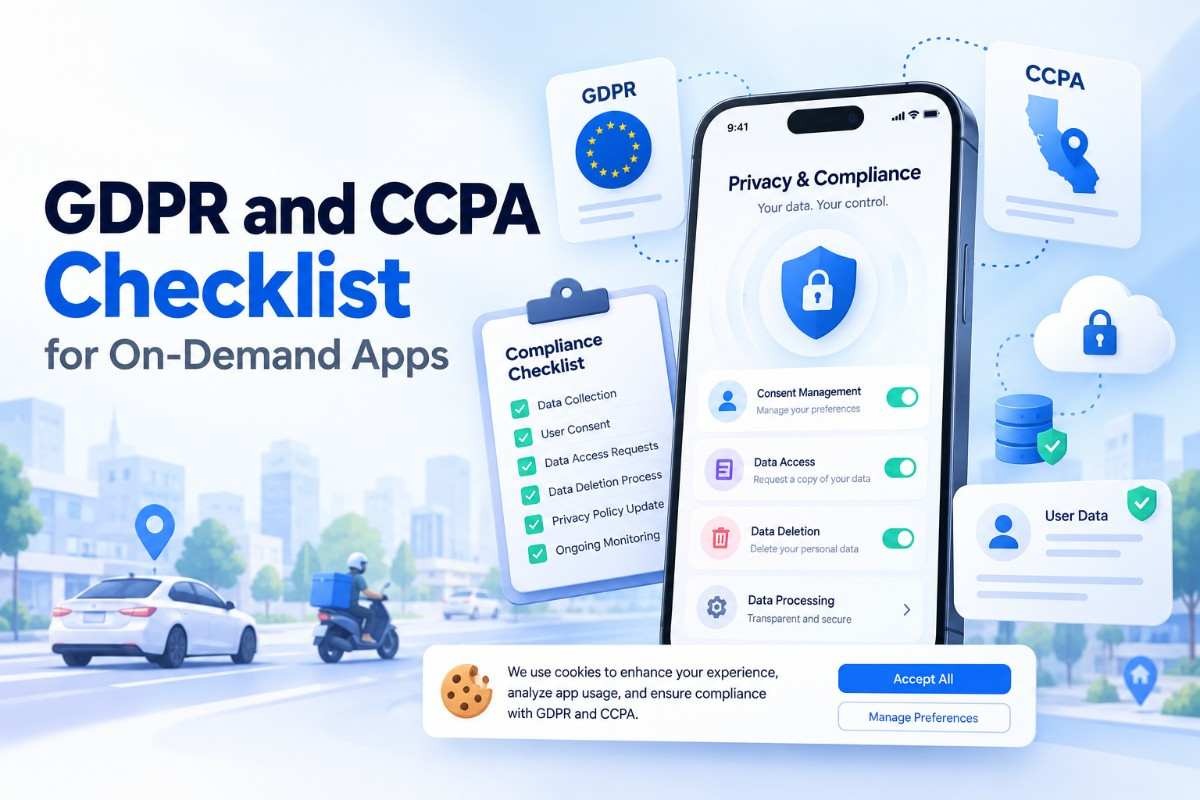
Privacy compliance is an operating requirement for on-demand platforms serving customers, providers, couriers, merchants, or service professionals in the USA and Europe. A useful GDPR CCPA app compliance checklist helps a product team identify what personal data the application collects, why it is needed, where it goes, and how users can control it.
Ride-hailing, food delivery, grocery, handyman, and multi-service apps process more than account details. They may handle live location, phone numbers, addresses, order history, payment references, identity documents, support conversations, device identifiers, and provider verification records. Each data type creates a different privacy and security responsibility.
This guide is designed for founders, product managers, compliance owners, and development teams. It explains the practical controls to plan before launch and maintain after release. It is not legal advice. GDPR and US state privacy laws can apply differently based on the people you serve, your business model, your role in processing, and the location of your operations.
GDPR is the European Union’s General Data Protection Regulation. It applies to organizations that process personal data connected to people in the European Economic Area in circumstances covered by the regulation, including some businesses based outside Europe. It governs lawful processing, transparency, user rights, security, international transfers, processor relationships, and accountability.
CCPA is the California Consumer Privacy Act, as amended by the California Privacy Rights Act. It gives qualifying California residents rights involving personal information, including rights to know, delete, correct, opt out of certain selling or sharing activities, and limit some uses of sensitive personal information. Other US states have introduced their own privacy laws, so a California-only approach may not cover every American market.
For an on-demand app, compliance is not a single privacy policy page. It is a set of product, technical, operational, and contractual controls. The app must present clear notices, collect only necessary information, manage permissions, secure stored and transmitted data, respond to verified requests, and document decisions.
Start by defining roles. Your company may act as a controller or business deciding why and how data is used. A cloud provider, analytics vendor, messaging service, payment processor, or identity verification provider may act as a processor or service provider for specific activities. In a marketplace, the platform, merchant, driver, courier, or service professional may have separate responsibilities.
Role definitions affect contracts, notices, user requests, breach procedures, and international transfer arrangements. Do not assume that a vendor’s standard terms automatically address your obligations. Map each relationship to a specific processing activity and business purpose.
On-demand apps create a detailed record of a person’s movements, purchases, habits, preferences, and interactions. A taxi platform can infer home and work locations from trip history. A grocery app can reveal household routines. A handyman platform may store access instructions or photos of private property. A food delivery service can connect an address with dietary or health-related information.
That level of operational data makes privacy decisions part of product design. A permission request shown at the wrong time can reduce trust. Retaining old location trails increases exposure without improving the service. Sending a user’s phone number to every participant in an order can create unnecessary risk. Compliance work helps teams make these decisions before they become incidents.
Regulatory exposure is also only one concern. Privacy failures can lead to complaints, contract disputes, app-store scrutiny, customer churn, delayed enterprise deals, and expensive engineering work after launch. A documented process gives your team evidence that privacy was considered during planning rather than added after a problem.
For operators expanding across Europe and North America, local requirements can differ. California uses specific terms such as “sale” and “sharing,” while GDPR focuses on lawful bases, data subject rights, processors, and accountability. A shared privacy program should support regional differences instead of forcing one generic notice on every user.
Privacy controls are often discussed as a legal burden, but they also improve how an on-demand business operates. A well-designed program makes data flows visible and reduces unnecessary collection across customer, provider, and admin applications.
These benefits depend on implementation. A privacy policy that does not match application behavior provides little protection. The controls must be tested in customer, provider, dispatcher, merchant, and administrator workflows.
List every personal data field collected by every application and back-office system. Include sign-up forms, booking screens, delivery workflows, chat, support tickets, identity checks, payment records, push notifications, cookies, software development kits, and logs.
For each field, record its source, purpose, storage location, access roles, retention period, sharing recipients, and deletion method. Separate required data from optional data. For example, a delivery address may be needed to complete an order, while contact import may not be needed at all.
Document how information moves from a customer device to APIs, databases, admin dashboards, third-party services, and archival systems. Include data sent to map providers, payment gateways, SMS vendors, email tools, crash reporting services, analytics platforms, and identity verification providers.
Data flow diagrams should include live location. Clarify when tracking starts, how often coordinates are collected, who can see them, whether location is stored after a trip or delivery, and what happens when a user denies background location access.
For GDPR, identify the lawful basis for each processing activity, such as contract performance, legal obligation, legitimate interests, consent, or another applicable basis. Keep the analysis activity-specific. “Improving the app” is usually too broad to explain every form of tracking.
For CCPA, explain the categories of personal information collected, purposes, sources, categories of recipients, retention approach, and applicable consumer rights. Use layered notices: show a concise explanation at the point of collection and provide a fuller privacy notice for people who need more detail.
Consent must be informed, specific, freely given, and recorded where consent is the chosen legal basis. Do not bundle optional marketing consent with the acceptance of essential service terms. Let users withdraw consent through a practical path that is not harder than granting it.
Mobile operating system permissions are separate from legal consent. Request location, camera, contacts, or notification access when the feature needs it. Explain the purpose before triggering the system prompt, and provide a useful fallback when a person declines.
Provide an accessible process for requests involving access, deletion, correction, portability, objection, restriction, opt-out, or limitation where applicable. Verify the requester without collecting excessive new information. Route requests to an accountable privacy or support owner, and record the request, verification result, action, and response.
Deletion needs special planning. Removing a profile from the customer database may not remove invoices, fraud records, dispute evidence, backups, provider records, or legally required financial information. Define what is deleted, anonymized, restricted, or retained under a documented exception.
Protect data in transit with properly configured encrypted connections and protect sensitive data at rest using suitable encryption and key management. Apply role-based access so a dispatcher, support agent, driver, merchant, and developer see only what their work requires.
Use strong authentication for administrators, secrets management for credentials, secure coding practices, dependency updates, vulnerability monitoring, audit logs, and controlled production access. A dedicated cyber security service can help assess these controls, but responsibility remains with the business operating the platform.
Maintain a vendor register covering hosting, maps, payments, analytics, communications, customer support, identity verification, and monitoring. For each provider, review its privacy terms, security commitments, subprocessors, data locations, retention rules, breach notification process, and deletion support.
For European data, assess international transfers and use an appropriate legal mechanism where required. Keep transfer assessments and contractual records with the vendor file. Do not rely on a provider’s marketing claim that it is “privacy compliant” without checking the actual service configuration.
Assign a retention period or review rule to every major data category. Location history, chat content, failed payment records, identity documents, support tickets, and marketing events should not remain forever merely because storage is inexpensive.
Automate deletion or anonymization where practical. Test the process across primary databases, search indexes, object storage, analytics tools, logs, exports, and backups. Document how a restoration event will avoid reintroducing records that should already be deleted.
Create an incident response plan covering detection, containment, evidence preservation, technical investigation, legal assessment, communications, and recovery. Define who can declare an incident and who coordinates engineering, security, legal, support, and executive decisions.
Record relevant facts: affected systems, data categories, people affected, time discovered, containment steps, vendor involvement, and risk assessment. GDPR may require notification to a supervisory authority within a defined period in qualifying circumstances, so obtain professional legal guidance before an incident occurs.
Create privacy acceptance criteria for each feature. A location-based driver matching feature should specify collection frequency, visibility, storage duration, permission behavior, and deletion behavior. A referral feature should define whether contacts are uploaded or only entered manually. This turns privacy from a late review into a normal delivery task.
Default settings should collect and expose the minimum information needed for the service. Avoid public provider profiles containing personal phone numbers. Use masked calling or in-app communication where suitable. Show precise addresses only to roles that need them at the relevant stage of a booking or delivery.
Keep account identifiers separate from event data where the business does not need direct identification. Limit analytics access to aggregated or pseudonymized records when possible. Pseudonymization reduces direct exposure but does not make data anonymous if the person can still be reidentified.
Run privacy and access tests for customers, drivers, couriers, merchants, technicians, support agents, finance staff, and administrators. Confirm that role changes remove old privileges, suspended accounts cannot continue accessing data, and support tools do not expose full payment or identity details unnecessarily.
Define service-level targets, escalation paths, identity verification steps, templates, and approval rules for rights requests. The support team should know the difference between closing an account, deleting eligible data, opting out of marketing, and restricting processing. A request should not depend on a developer manually editing a production database.
Review the data inventory, vendor register, retention rules, permissions, privacy notices, and incident plan at regular intervals and whenever a major feature or market changes. Recheck mobile SDKs after upgrades because their collection behavior, permissions, or terms may change.
For the application layer, document privacy requirements alongside the broader on-demand mobile app development process. This is especially important when a platform includes several service verticals, each with different data needs.
The following comparison is a planning aid, not a substitute for jurisdiction-specific legal advice. Applicability depends on your business, users, processing activities, and current law.
| Area | GDPR | CCPA and CPRA | Product implication |
|---|---|---|---|
| Scope | Can apply to organizations processing personal data connected to people in the EEA, including some organizations outside Europe. | Applies to qualifying businesses and California residents under statutory thresholds and definitions. | Assess users, entity structure, revenue, data activity, and geography before selecting controls. |
| Legal foundation | Requires an applicable lawful basis for each processing purpose. | Focuses on notice, consumer rights, and restrictions involving sale, sharing, and sensitive personal information. | Maintain a processing-purpose register and region-specific privacy workflows. |
| User rights | Includes access, rectification, erasure, portability, objection, restriction, and other rights in applicable situations. | Includes rights to know, delete, correct, opt out of sale or sharing, and limit certain sensitive-information uses. | Provide identity verification, request tracking, response templates, and system-wide search capability. |
| Consent | Must meet strict requirements when consent is used and must be withdrawable. | Opt-out mechanisms are important for covered selling or sharing activities; consent may still be relevant to specific processing. | Separate essential service permissions from optional marketing, analytics, and advertising choices. |
| Security and incidents | Requires appropriate security and may require notification for qualifying personal data breaches. | Requires reasonable security and provides remedies or obligations in specified situations. | Maintain access controls, logging, response plans, evidence, and vendor escalation contacts. |
A strong GDPR CCPA app compliance checklist starts with data mapping and continues through consent, user rights, security, vendor governance, retention, and incident response. The most reliable approach is to build these controls into product requirements, APIs, admin tools, customer support workflows, and release testing.
Apporio Infolabs can support privacy-focused product planning through On Demand Mobile App Development, Cyber Security, and white-label products such as the Gojek Clone App for multi-service platforms. For a focused mobility business, the Uberr Clone model can also be reviewed with location, provider, payment, and customer data requirements in mind.
Before launch, have qualified privacy counsel validate your obligations, notices, contracts, and transfer arrangements for each target market. Then keep the program current as features, vendors, SDKs, and laws change.
Include account details, phone numbers, addresses, live and historical location, order or trip history, payment references, identity documents, provider records, support conversations, device identifiers, cookies, analytics events, logs, and data sent to third-party vendors. Record each item’s purpose, location, access roles, recipients, retention period, and deletion method.
No. A privacy policy is only one part of the program. The app also needs appropriate data collection, consent and permission controls, user-rights workflows, security measures, vendor agreements, retention rules, access restrictions, and incident response procedures that match the policy.
Collect location only for a defined service purpose, request operating-system permission when needed, explain the purpose clearly, limit who can view it, control collection frequency, and set a retention period. Delete or aggregate historical coordinates when they are no longer needed for service delivery, safety, disputes, or another documented purpose.
GDPR includes rights such as access, rectification, erasure, portability, objection, and restriction where applicable. CCPA and CPRA provide rights such as knowing, deleting, correcting, opting out of certain selling or sharing activities, and limiting some uses of sensitive personal information. The exact requirements depend on applicability and the processing activity.
Verify the requester, identify all related records, remove or anonymize eligible data across databases and connected systems, apply documented legal or operational exceptions, and record the action taken. Test the process across backups, analytics tools, support systems, exports, logs, and third-party vendors.
Yes. A privacy professional should assess the company’s role, target markets, lawful bases, consumer rights, notices, contracts, international transfers, retention, and breach obligations. Technical and operational teams can implement the controls, but legal applicability should be validated for the actual business model.

