OUR PRODUCTS
Uberr Clone AppGojek Clone AppSuper App DevelopmentUberr Eats Clone AppGrocery App DevelopmentHandyman App Like Uberr
inDriver Clone AppDelivery App DevelopmentGlovo Clone AppBolt Clone AppLyft Clone AppCareem Clone App
OUR PRODUCTS

← Back to Blog
September 8, 2026
A practical guide to planning, building, and launching a last-mile delivery platform, covering features, operations, technology, monetization, and common mistakes.
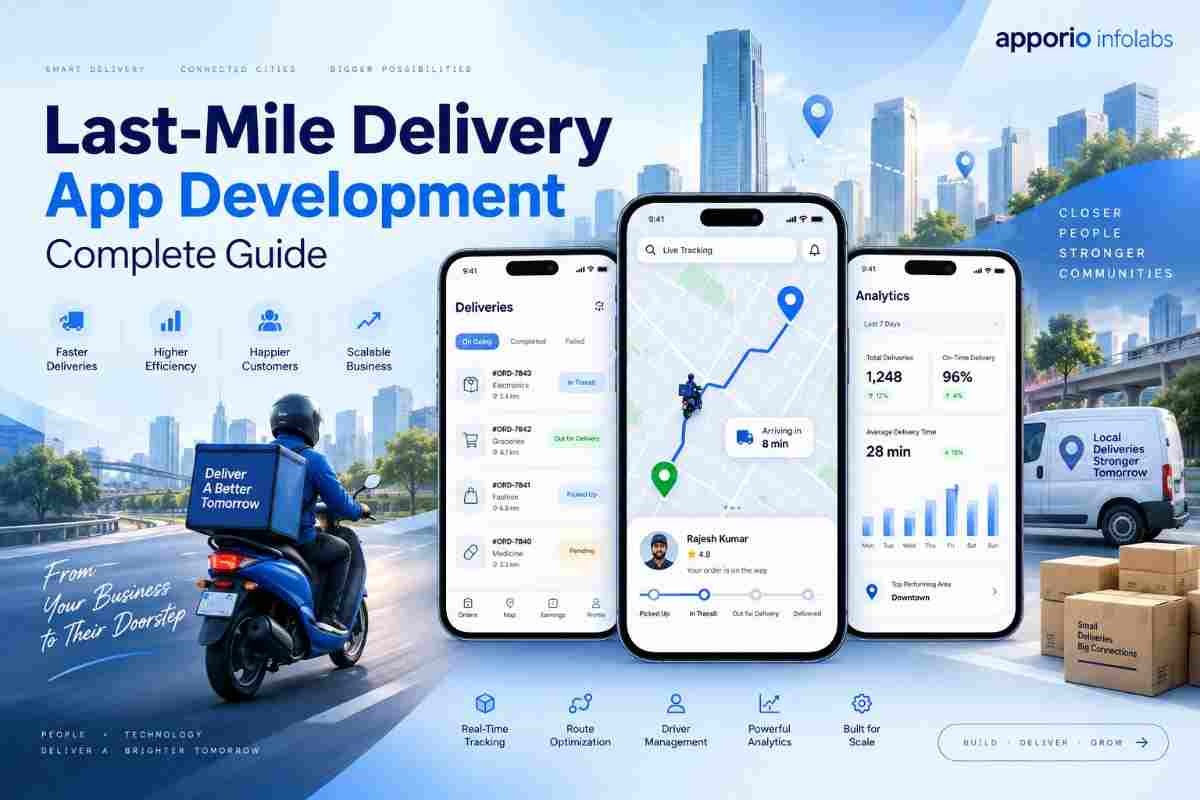
Last mile delivery app development is the process of creating software that manages the final stage between a warehouse, store, restaurant, or fulfillment center and the customer’s delivery address. This stage often creates the most operational pressure because it involves changing traffic conditions, incomplete addresses, missed calls, delivery windows, customer availability, and driver capacity.
For an entrepreneur, the application is not just a customer-facing ordering tool. It is an operating system for dispatching, tracking, payments, delivery proof, support, and performance reporting. The strongest business plans define the delivery model and service area before selecting features or technology.
This guide explains what to build, how the workflow should operate, which features matter at launch, and how to compare a ready-made white-label product with a fully custom platform. It is written for courier companies, retailers, grocery businesses, restaurants, marketplaces, and startups serving local or regional markets.
For a broader delivery operation, delivery app development can combine customer ordering, fleet coordination, and administrative control in one product roadmap.
Last-mile delivery app development creates a multi-sided platform for coordinating deliveries from a local fulfillment point to the final recipient. Most solutions include separate interfaces for customers, drivers or delivery agents, merchants, dispatchers, and administrators.
The customer interface supports ordering, address selection, delivery-slot choices, status updates, payments, and support. The driver application handles availability, assigned jobs, navigation, pickup confirmation, proof of delivery, earnings, and issue reporting. Merchants or warehouse teams prepare orders, update inventory or order status, and hand packages to the assigned agent.
The administrator panel connects these participants. It manages service zones, delivery fees, orders, users, agents, vendors, refunds, promotions, reports, and operational rules. A dispatcher may also need a live map showing active jobs, unassigned orders, delayed stops, and agent locations.
Delivery performance affects revenue, customer retention, labor utilization, and support workload. A delayed or failed drop can create a refund, a second delivery attempt, a merchant complaint, and a negative customer experience at the same time. Centralized software gives operators a consistent way to monitor these events instead of relying on phone calls, spreadsheets, and disconnected messaging tools.
The commercial case differs by sector. A grocery operator may prioritize substitutions, short delivery windows, and inventory visibility. A courier company may need multi-stop routing, parcel dimensions, proof of delivery, and business accounts. A restaurant marketplace may focus on preparation times, driver assignment, and order batching. A retailer may require warehouse handoff, returns, and scheduled delivery.
Before building, calculate the operational variables that determine feasibility:
The application should expose these indicators through dashboards. A polished interface cannot compensate for weak dispatch rules, unclear service zones, or an unsustainable delivery fee structure.
Operators can view incoming orders, agent availability, route progress, and delayed jobs from one administration layer. Manual assignment may still be useful in exceptional cases, but routine work can follow defined rules based on proximity, workload, vehicle capacity, and service priority.
Live status changes reduce the need for customers to call support for basic updates. Notifications can explain when an order is confirmed, prepared, picked up, approaching the destination, delivered, or delayed. The system should also make it easy to send a revised delivery estimate when circumstances change.
Address validation, map-based location selection, delivery instructions, masked calling, and one-time verification can reduce avoidable failed attempts. These functions need operational policies behind them. For example, an agent should know whether a parcel can be left in a safe place or must be returned after a missed recipient.
Reports can show completed jobs, cancellation reasons, agent productivity, average delivery time, revenue, refunds, peak demand, and service-zone performance. These records help a business adjust pricing, staffing, delivery areas, and merchant agreements.
Potential income sources include delivery charges, merchant commissions, subscription plans, business accounts, surge or priority fees, and promotional placements. The right combination depends on the customer segment and the cost of fulfilling each job. A commission-only model may not cover delivery operations in low-density areas.
Start with one clear operating model. Decide whether the platform serves business-to-consumer deliveries, peer-to-peer parcels, restaurant orders, grocery baskets, retail shipments, or several categories. Define who owns inventory, who supplies agents, who handles returns, and who pays for failed attempts.
Choose the launch geography carefully. A smaller service area makes it easier to recruit agents, support merchants, test delivery times, and identify address-quality problems. Expansion should follow measurable demand and operational capacity rather than a large initial map.
Document the actions available to each participant. Customers should not access internal delivery notes. Agents need only the order information required to complete their jobs. Merchants may manage preparation and handoff but should not change financial records without authorization. Role-based permissions reduce accidental changes and support later audits.
The first version should support the complete delivery cycle rather than a long list of disconnected features. A practical MVP can include registration, addresses, order creation, service-zone checks, agent onboarding, job assignment, maps, status updates, payment processing, delivery proof, ratings, notifications, and basic reporting.
Advanced route optimization, loyalty programs, complex subscriptions, predictive demand models, and multiple vendor workflows can be added after real usage data identifies their value. The MVP still needs a dependable admin panel and support process because most early operational issues occur outside the customer screen.
Separate the customer, agent, merchant, and admin experiences while keeping order data consistent across them. Use an API layer to connect mobile applications, web dashboards, maps, payment providers, notification services, and reporting tools.
Plan for location updates carefully. Continuous tracking can affect battery life, privacy, and data costs. The product team should define when tracking begins, how frequently locations are refreshed, who can see them, and when tracking stops. These decisions are as important as the map interface.
Businesses that expect complex routing, multiple service types, or regional expansion can review logistics app development as a related product direction.
Common integrations include mapping and geocoding, payment gateways, SMS or push notifications, email, identity verification, analytics, customer support, and cloud infrastructure. Test each integration under failure conditions. A payment timeout, inaccurate map pin, or delayed notification should produce a clear fallback state rather than leave an order stuck.
Test more than the ideal delivery path. Simulate no available agents, duplicate orders, partial fulfillment, address changes, payment failure, customer unavailability, weak network coverage, vehicle breakdowns, cancellation after pickup, and a driver losing GPS access. Include low-end devices and local payment habits in the test plan.
Begin with a limited number of merchants, agents, and delivery areas. Measure completion time, failed attempts, support contacts, agent acceptance, cancellation reasons, and cost per completed delivery. Use these findings to revise workflows before increasing order volume.
Normal deliveries are easy to demonstrate. Exceptions determine whether the product works in production. Give agents clear choices for damaged packages, wrong items, unavailable recipients, address corrections, and late pickups. Each option should create a traceable record and notify the correct operator.
Estimated arrival times should account for preparation, loading, traffic, stop duration, and route order. Avoid presenting a precise time when the system has limited data. A realistic time range is more useful than an exact estimate that changes repeatedly.
Global audiences do not share one delivery pattern. Some markets depend heavily on cash, while others expect cards, bank transfers, or mobile wallets. Address formats, postal coverage, road quality, language, tax rules, and phone number formats also vary. Build configurable settings instead of hardcoding one country’s process.
Delivery platforms process names, phone numbers, addresses, payment references, and real-time location information. Apply least-privilege access, secure authentication, encrypted data transfer, audit logs, retention rules, and controlled administrator access. A review of cyber security services can help identify application and infrastructure risks before launch.
Do not evaluate the whole platform using one average. Compare dense urban areas with low-density or long-distance zones. Track delivery revenue, agent payout, incentives, payment fees, support cost, refunds, and failed-attempt cost per completed order. This shows where pricing or service boundaries need adjustment.
Delivery rules change frequently. Keep pricing, service zones, cancellation windows, agent eligibility, and notification templates configurable from the administration layer where appropriate. Modular components make it easier to add grocery, restaurant, courier, or retail workflows without rewriting the entire application.
Set up error tracking, API monitoring, database alerts, backup procedures, and deployment controls. A delivery platform must remain available during demand spikes and must recover cleanly when an external service fails. DevOps consulting service is relevant when the team needs structured release and infrastructure practices.
Commercial buyers usually compare speed, control, cost structure, and scalability. No approach is suitable for every operation. The decision should reflect the number of workflows, the launch market, available technical staff, and the need for differentiated processes.
| Approach | Best suited for | Main advantage | Primary limitation |
|---|---|---|---|
| Ready-made platform | Startups validating a focused model | Existing delivery workflows and faster configuration | Less control over unusual processes |
| White-label solution | Businesses needing branded applications | Brand, market, and workflow customization without starting from zero | May require additional work for specialized integrations |
| Custom development | Established operators with complex requirements | Maximum control over architecture and business rules | Greater planning, development, testing, and maintenance effort |
| Hybrid roadmap | Businesses that need a focused launch and later differentiation | Initial core product followed by custom modules | Requires disciplined product planning and integration management |
A white-label route is often practical when the business already understands its target market but does not want to fund every foundational workflow from the ground up. It still requires careful due diligence. Review source-code ownership, deployment options, data access, integration support, security practices, maintenance responsibilities, and the process for requesting changes.
For a company planning several delivery categories, on-demand mobile app development can support a broader roadmap. A grocery-focused operator may instead assess grocery delivery application requirements such as substitutions, inventory, scheduled slots, and recurring orders.
Successful last mile delivery app development depends on operational clarity more than on a long feature checklist. Define the service area, delivery promise, agent model, payment process, exception handling, and unit economics before selecting the build approach. Then launch a focused product that gives customers clear updates, agents practical tools, and operators full visibility over every order.
Apporio Infolabs can support this roadmap through its Delivery App Development, Logistics App Development, On-Demand Mobile App Development, and white-label product capabilities. The right starting point depends on whether you are validating one delivery category, managing multiple merchants, or preparing a broader platform.
It is a digital system that coordinates the final movement of an order or parcel from a fulfillment point to the recipient. It commonly includes customer, agent, merchant, dispatcher, and administrator interfaces.
A practical MVP should include order creation, address and service-zone checks, agent onboarding, assignment, maps, status updates, notifications, payment processing, proof of delivery, support workflows, and basic reports.
There is no single timeline because scope, integrations, platforms, customization, testing, and market requirements differ. A focused white-label configuration generally requires less product-building work than a fully custom system, but both need testing and operational preparation.
A ready-made or white-label platform can suit a startup testing a focused model and needing established workflows. Custom development may be better for complex operations, specialized integrations, or a business that needs complete control over its product architecture.
Address validation, map-based pin selection, delivery instructions, customer notifications, masked communication, rescheduling rules, and proof-of-delivery options can reduce avoidable failures. The business must also define what happens when a recipient is unavailable.
Track completed deliveries, delivery time, failed attempts, cancellation reasons, agent acceptance, support contacts, refunds, revenue, agent payouts, and cost per completed delivery. Review these metrics by service zone and delivery category rather than relying only on a total average.

