OUR PRODUCTS
Uberr Clone AppGojek Clone AppSuper App DevelopmentUberr Eats Clone AppGrocery App DevelopmentHandyman App Like Uberr
inDriver Clone AppDelivery App DevelopmentGlovo Clone AppBolt Clone AppLyft Clone AppCareem Clone App
OUR PRODUCTS

← Back to Blog
September 22, 2026
A practical guide to marketplace app planning, core features, development costs, architecture, monetization, and launch decisions.
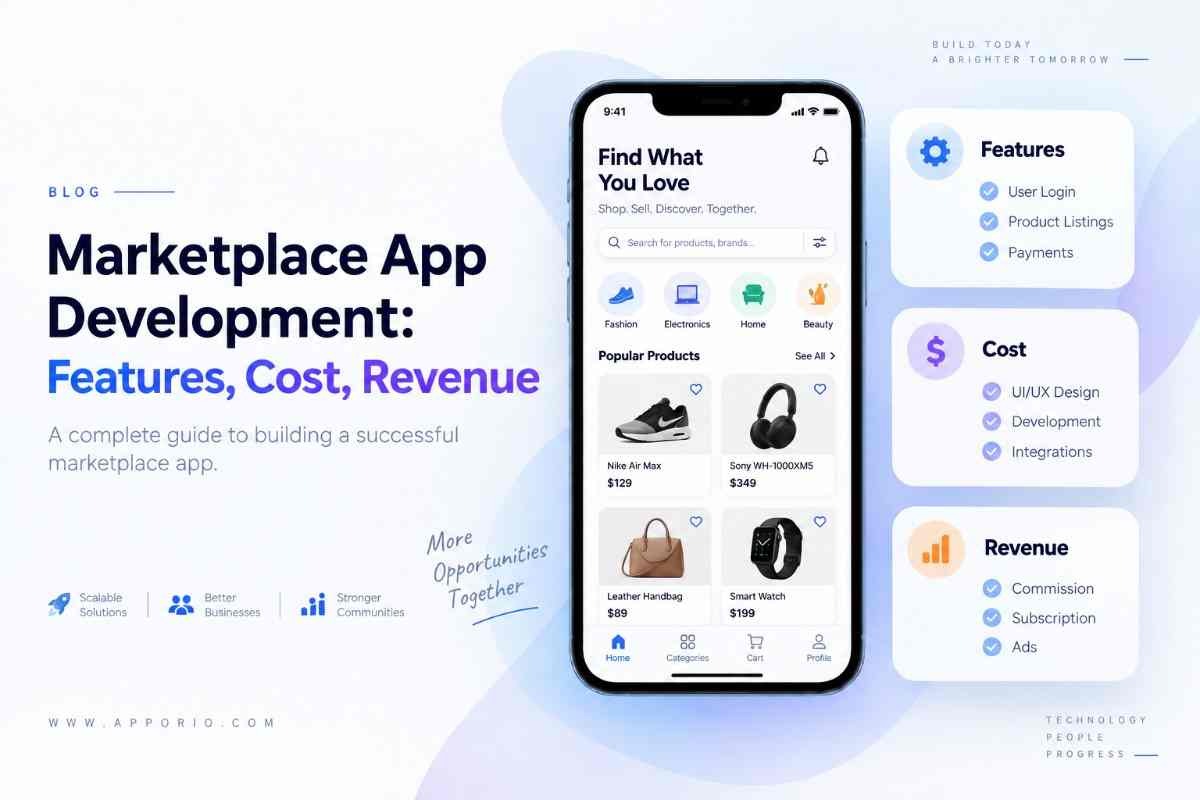
Marketplace app development connects buyers with sellers, customers with service providers, or users with delivery and logistics partners through one digital platform. The product is more than a mobile interface. It must coordinate supply, demand, payments, communication, verification, order or booking workflows, and platform administration.
For founders evaluating a marketplace idea, the main commercial questions are practical: Which features are essential for the first release? How much will the platform cost? Should the business charge commissions, subscriptions, listing fees, or transaction charges? The answers depend on the marketplace category, operating geography, number of user roles, payment requirements, and level of automation.
This guide explains the product decisions behind a marketplace platform. It covers the operating model, core features, cost drivers, revenue options, launch sequence, best practices, common mistakes, and the difference between a ready-made white-label product and a fully custom build.
A marketplace app is a digital platform that allows multiple independent sellers, providers, or businesses to offer products or services to customers. The platform owner usually does not deliver every product or perform every service directly. Instead, the app manages discovery, matching, booking or ordering, payments, updates, and trust between participants.
Common examples include food delivery platforms, grocery marketplaces, home service platforms, ride-hailing services, rental platforms, freelancer marketplaces, and business-to-business procurement systems. Each category has different transaction rules. A food platform needs menus, preparation status, delivery tracking, and restaurant dashboards. A home service platform needs provider profiles, availability, job estimates, scheduling, and completion confirmation.
Most multi-vendor platforms have at least three operational areas:
A delivery marketplace may also require a separate courier application. A service marketplace may need staff scheduling and document verification. Defining these roles early prevents important workflows from being hidden inside a vague feature list.
A marketplace model can help a new business coordinate fragmented supply in one location or niche. Instead of building a large inventory or employing every service professional, the operator creates the technology and operating rules that bring participants together. This can reduce the need for owned physical assets, but it does not remove the need for quality control, customer support, and supply acquisition.
The model is particularly useful where customers face a discovery or trust problem. Independent restaurants may have limited digital ordering infrastructure. Local technicians may rely on phone calls and referrals. Small retailers may need a shared channel for online orders. A platform can standardize profiles, pricing information, availability, payments, and post-transaction feedback.
These advantages are not automatic. A marketplace must solve the chicken-and-egg problem: customers need enough reliable supply, while providers need enough demand to stay active. The launch plan must address both sides.
A well-designed platform provides value to each participant, but the value must be visible in daily operations. A seller should save time or gain demand. A customer should find a suitable option faster or with greater confidence. The operator should be able to manage transactions without relying on spreadsheets and disconnected communication channels.
For broader multi-service businesses, a super app platform can place several marketplace categories within one customer experience. It should be considered only when the business has a clear reason to group those services together.
Feature priorities should follow the transaction lifecycle rather than a generic checklist. The first release needs enough functionality to complete a safe, trackable transaction from discovery to settlement. Advanced automation can follow after real usage data identifies the highest-value problems.
For apps that coordinate physical deliveries, logistics app development capabilities such as assignment, location tracking, delivery status, and proof of completion may be required. A marketplace that includes several on-demand categories may also need cyber security planning for authentication, payment data, access permissions, and audit logs.
There is no responsible single price for building a marketplace platform without defining scope. A basic product catalog and inquiry application requires a different budget from a multi-vendor platform with live tracking, automated settlements, multiple currencies, and separate applications for customers, providers, couriers, and administrators.
The largest cost drivers are usually the number of user roles, platform coverage, transaction complexity, integrations, design depth, and post-launch support. A ready-made white-label foundation may reduce initial engineering effort, while extensive customization increases discovery, development, testing, and maintenance work.
Founders should request a scope-based proposal rather than comparing a headline quote. Ask which applications, integrations, environments, source-code rights, deployment tasks, support terms, and future changes are included. Apporio’s guide to app development costs can help structure that discussion.
Monetization should match the transaction and the value delivered to providers or customers. A platform can use one model at launch and add another after usage patterns become clear. The chosen method should be easy to explain, visible before checkout, and technically supported in the settlement workflow.
Revenue is not the same as profit. The financial model should account for payment processing, refunds, discounts, customer acquisition, provider incentives, support, delivery operations, taxes, and infrastructure. Track contribution margin per transaction before expanding the service area.
A marketplace is not successful because the customer app looks polished while provider operations remain manual. Provider actions should be fast, especially when users are waiting for acceptance or fulfillment. Use clear statuses, actionable notifications, and simple exception handling. If a provider cannot accept a request, the system should communicate that outcome quickly and offer the next appropriate option.
Trust is created through visible information and consistent controls. Display provider details, reviews, service terms, estimated timing, cancellation rules, and support access at the point where users make decisions. Verification should be meaningful for the category. Identity checks, business documents, licenses, or background checks may be relevant, but requirements should be proportionate and legally reviewed.
Show the customer what the platform charges and explain provider deductions in the provider dashboard. Hidden fees create support cases and can reduce repeat usage. If prices change based on distance, timing, demand, or service complexity, explain the calculation in simple language before confirmation.
Global audiences do not use one uniform operating model. Payment preferences, address quality, mobile connectivity, language, tax rules, provider documentation, and customer support expectations vary by market. Plan localization at the data and workflow level, not only through translated labels.
Separate user management, catalog or service management, orders, bookings, payments, notifications, reviews, and reporting into clear modules. This makes future changes easier to scope and reduces the risk that a new category disrupts an existing transaction flow. A modular foundation is especially useful when a business expects to add related services later.
Track metrics that explain marketplace health, not only downloads. Useful measures include provider activation, listing completeness, request acceptance, fulfillment completion, cancellation rate, payment success, support tickets, repeat transaction rate, and contribution margin. These measures show where the marketplace is losing value.
The best delivery approach depends on how distinctive the marketplace workflow is and how quickly the business needs to test demand. No option is universally correct.
| Approach | Best fit | Main advantage | Main trade-off |
|---|---|---|---|
| Custom development | Unique workflows, complex integrations, or strict product requirements | Maximum control over product behavior and architecture | Higher discovery effort, development scope, and long-term maintenance responsibility |
| White-label solution | Standard marketplace or on-demand workflows requiring faster validation | Prebuilt operational foundations can reduce initial build work | Customization may be limited by the product architecture and included scope |
| Hybrid development | Businesses needing proven core workflows with distinctive market features | Combines an existing foundation with targeted customization | Requires careful integration boundaries and clear ownership decisions |
| Mobile-first plus web admin | Consumer transactions managed by an internal operations team | Focuses investment on customer and provider mobile journeys | Some provider or customer workflows may need web support later |
A white-label approach can be practical when the marketplace uses familiar patterns such as ordering, booking, provider management, payments, notifications, and reviews. Custom work becomes more important when the business depends on unusual pricing, regulated workflows, complex inventory, or specialized settlement logic.
Marketplace app development should begin with a defined transaction, a focused launch market, and a clear relationship between customer value, provider value, and platform revenue. Core capabilities include role-based applications, listings or catalogs, search, payments, order or booking management, verification, notifications, reviews, admin controls, and reporting.
Apporio Infolabs can support businesses evaluating a white-label foundation, on-demand mobile app development, and category-specific products such as Food Delivery, Grocery Delivery, and Handyman Services. For a broader multi-service strategy, the Gojekk Clone product and Super App Development service may be relevant after the initial marketplace model is validated.
Choose the approach that fits your workflow, market, budget, and operational capacity. Review the scope carefully, test the transaction lifecycle, and plan for post-launch support before committing to development.
The cost depends on the marketplace category, number of user roles, mobile and web interfaces, integrations, geographic coverage, customization, testing, deployment, and maintenance. A scope-based estimate is more reliable than a generic industry average.
Essential features usually include customer and provider registration, listings or catalogs, search, checkout or booking, payments, notifications, ratings, provider onboarding, order management, admin controls, dispute handling, and reporting. Delivery businesses may also need courier tracking and proof of completion.
Common revenue models include transaction commissions, customer service fees, provider subscriptions, listing fees, promoted placement, delivery charges, software fees, and advertising. The right combination depends on the category, customer expectations, provider margins, and operating costs.
A white-label solution can suit a startup when the business uses established ordering, booking, provider, payment, and administration workflows. The startup should confirm customization limits, source-code and deployment terms, integrations, scalability, and support before choosing it.
Launching in one focused market is often easier to operate because payment methods, language, provider requirements, taxes, support, and supply acquisition are more manageable. A multi-country launch may be appropriate when the team already has local operations and compliance plans.
Test registration, provider approval, search, availability, checkout or booking, successful and failed payments, cancellations, refunds, notifications, location or delivery updates, reviews, admin permissions, low-connectivity behavior, and dispute handling across supported devices.

