OUR PRODUCTS
Uberr Clone AppGojek Clone AppSuper App DevelopmentUberr Eats Clone AppGrocery App DevelopmentHandyman App Like Uberr
inDriver Clone AppDelivery App DevelopmentGlovo Clone AppBolt Clone AppLyft Clone AppCareem Clone App
OUR PRODUCTS

← Back to Blog
August 5, 2026
A practical comparison of restaurant-owned delivery platforms and third-party aggregators, covering costs, customer ownership, operations, technology, and growth decisions.
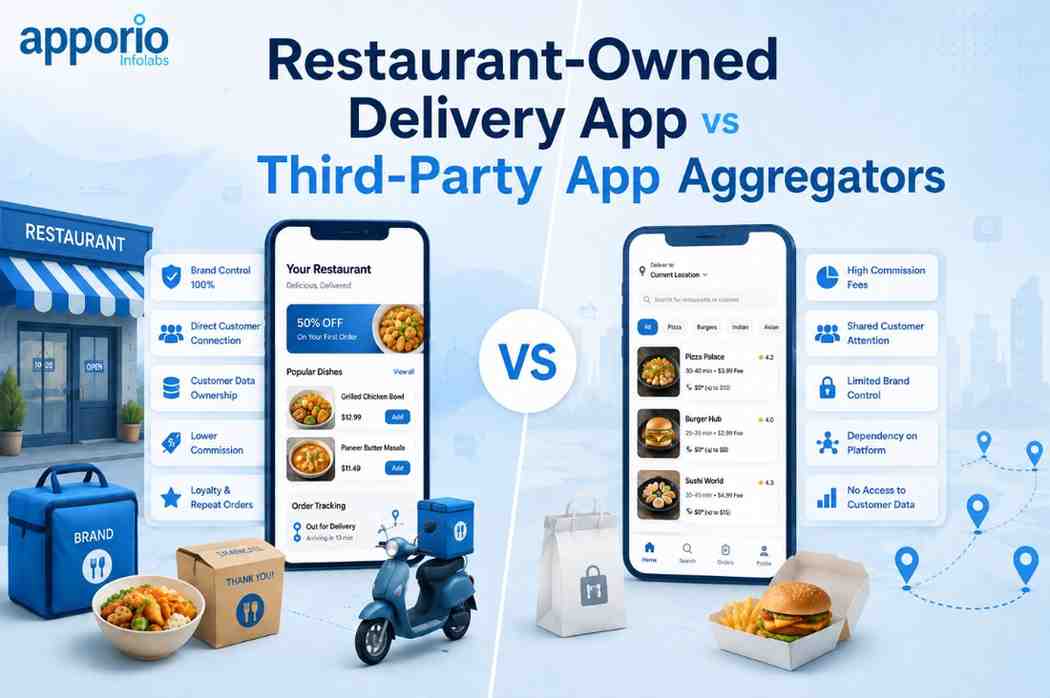
Restaurant operators deciding between a first-party platform and marketplace partnerships need to assess more than delivery fees. The restaurant delivery app vs aggregator decision affects customer ownership, order economics, brand experience, operational control, and the ability to build repeat demand.
Third-party aggregators can provide immediate marketplace exposure, delivery infrastructure, payment processing, and customer acquisition. A restaurant-owned platform gives the business more control over the ordering journey, customer communication, promotions, delivery policies, and first-party data. Neither model is automatically better for every restaurant.
The right choice depends on location, order volume, delivery coverage, kitchen capacity, technology budget, marketing capability, and whether the business wants to remain a single restaurant or grow into a larger food-service brand. Many operators use a mixed model: aggregators for discovery and a branded ordering channel for retention.
This guide compares both approaches from a commercial and product perspective. It also explains how to evaluate the economics before investing in a food ordering platform.
A restaurant-owned delivery app is a branded digital ordering channel controlled by the restaurant or restaurant group. Customers browse the menu, place orders, select delivery or pickup, pay online, and receive order updates through the business's own platform. The restaurant manages the customer relationship instead of relying entirely on a marketplace operator.
The platform may be delivered as a mobile app, a web ordering experience, or both. A full system usually includes a customer interface, restaurant administration tools, delivery management, payment processing, order status updates, promotional controls, and reporting. A single-location restaurant may need a simpler setup than a multi-brand group operating across several cities.
A restaurant does not necessarily need to build every component from the ground up. A white-label or ready-made solution can provide a tested operational foundation that is then configured for the brand, service area, menus, delivery rules, and payment requirements. Apporio's Ubereats Clone is relevant to businesses evaluating a branded food ordering model.
A third-party aggregator brings multiple restaurants into one marketplace. It typically attracts customers through its own app, website, advertising, search presence, promotions, and loyalty mechanisms. Restaurants receive orders through the marketplace and may use the aggregator's delivery network or manage delivery independently, depending on the commercial agreement.
The restaurant gains access to demand that it may not have generated alone. In exchange, it usually accepts marketplace fees, contractual conditions, platform rules, and a relationship in which the aggregator controls much of the customer journey. Specific fees, payment terms, delivery arrangements, and marketing charges vary by provider and market, so operators should review the actual contract rather than rely on general industry assumptions.
Food delivery is not only an order channel. It is a recurring operating system connecting menus, kitchens, customers, drivers, payments, customer service, promotions, and performance reporting. The platform that controls that system also influences how the restaurant learns about demand and how much it can influence repeat purchasing.
Aggregators are often strongest at top-of-funnel demand. They help customers discover restaurants while comparing menus, ratings, delivery times, and prices. That visibility can matter for a new business or a restaurant entering a competitive market. However, the restaurant may be one listing among many, making differentiation difficult.
A first-party platform is often stronger at retention and brand control. The business can design the ordering flow around its menu, communicate directly with customers, build its own offers, and decide how delivery information is presented. The challenge is that the restaurant must create demand and maintain the technology instead of depending on the marketplace's existing audience.
This distinction is important when calculating profitability. A lower apparent acquisition burden does not mean an aggregator order is more profitable, just as owning an app does not mean every direct order is inexpensive. The complete calculation should include commissions, packaging, delivery labor, payment processing, discounts, support, marketing, software, refunds, and repeat-order behavior.
Start by identifying what the delivery channel must achieve. A new restaurant may prioritize discovery and initial order volume. An established chain may prioritize repeat orders, customer ownership, brand consistency, and lower dependence on external platforms. A ghost kitchen or multi-brand operator may need centralized menus and dispatch controls.
Write the objective in measurable terms. Examples include increasing direct-order share, expanding delivery coverage, improving repeat purchase frequency, reducing support friction, or testing a new market. A vague goal such as “get more online orders” makes it difficult to select technology or judge performance.
Build a channel-level model using actual operating assumptions. Include average order value, food cost, packaging, discounts, taxes where applicable, payment processing, marketplace charges, driver cost, support cost, refunds, and marketing expense. For a first-party channel, add software development, hosting, maintenance, app-store activity where applicable, and customer acquisition.
Separate one-time costs from recurring costs. A platform build may be paid upfront or through a commercial arrangement, while delivery labor, payment processing, support, and marketing continue as order volume grows. Run conservative, expected, and high-volume scenarios instead of using one optimistic forecast.
Decide who will deliver each order and how dispatch will work. Restaurant-managed delivery provides control but requires driver recruitment, availability planning, route management, proof of delivery, incident handling, and service-area rules. A marketplace fleet reduces some operational burden but may introduce service constraints and additional charges.
Also define what happens when an order is late, a driver cannot be found, an item is unavailable, a customer changes the address, or a delivery is disputed. These exception workflows often have a greater effect on customer satisfaction than the standard order path.
Do not begin with a long feature list. Prioritize the workflows required for launch: menu management, cart and checkout, payment, order acceptance, kitchen status updates, delivery assignment, customer notifications, support, refunds, reporting, and administrative permissions. Add loyalty, subscriptions, multi-location management, or advanced analytics after the core operation is stable.
A ready-made platform can be suitable when the business needs a shorter product path and established ordering workflows. Custom development may be more appropriate when the business has unusual pricing, complex franchise rules, proprietary logistics, or significant integration requirements. Apporio's Delivery App Development service can be evaluated for a broader delivery operation.
A restaurant-owned app does not generate demand by itself. Plan how customers will find and use it through packaging inserts, receipts, social channels, local search, email, paid campaigns, in-store signage, referral activity, and staff communication. The message should give customers a clear reason to order directly, such as a better menu experience, pickup convenience, exclusive availability, or a relevant loyalty benefit.
Continue using marketplaces if they provide valuable discovery. The goal is not always to remove every external channel. It may be more practical to use marketplaces for new customer reach and the restaurant's own platform for repeat ordering, owned communication, and selected delivery zones.
Direct ordering creates responsibility for customer accounts, addresses, order history, payment events, and support records. Define data access by role, protect administrative accounts, document retention practices, monitor suspicious activity, and use payment providers that support the target market. Restaurants should also review applicable privacy and consumer-protection requirements in every operating region.
Security testing should occur before launch and after major changes. Apporio's Cyber Security service is relevant when the product scope includes customer accounts, payment flows, administration tools, or multiple business locations.
Many restaurants benefit from treating marketplaces and first-party ordering as different channels with different jobs. Marketplaces can support discovery, while the branded platform can support repeat demand and direct communication. Use channel reporting to identify which orders are genuinely incremental and which customers could reasonably be served through the direct channel.
A hybrid plan should not violate marketplace agreements or mislead customers. Review the terms governing packaging messages, customer communication, pricing, promotions, and delivery. The commercial objective is to build a sustainable mix, not to create friction between channels.
Delivery technology must reflect what the kitchen can reliably produce. Set order throttling, item availability, preparation-time updates, delivery zones, and scheduled-order limits based on real operating capacity. If the platform accepts more orders than the restaurant can prepare, faster acquisition will increase complaints and refunds rather than improve the business.
Track preparation time separately from courier wait time. This distinction helps managers determine whether a problem belongs to menu design, staffing, dispatch, driver availability, or customer communication.
Customers need a practical reason to change their habit. Improve menu clarity, display accurate availability, make pickup easy, remember permitted preferences, provide reliable order updates, and simplify reordering. Avoid relying only on permanent discounts, because discount-led demand can weaken contribution margin and train customers to wait for promotions.
Use customer segments carefully. A frequent pickup customer may respond to a convenience message, while a family-order customer may value scheduled delivery or menu bundles. Measure redemption, repeat behavior, and profitability rather than counting promotions alone.
Define how the business handles missing items, incorrect orders, delayed delivery, duplicate charges, cancellations, and refund requests. Give support staff the order information needed to investigate an issue quickly. A clear recovery policy helps protect trust without giving away more value than the situation requires.
Support should be available across the channels customers actually use, but the underlying case record should remain organized. Repeated complaints about one menu item, delivery area, or preparation period should be visible in operational reporting.
Review metrics by channel, location, daypart, menu category, and customer cohort. Useful measures include completed orders, average order value, contribution margin, repeat-order rate, cancellation rate, refund rate, preparation time, delivery time, customer support contacts, and acquisition cost.
Do not judge the first-party platform only by downloads or registrations. A smaller audience with high repeat behavior can be commercially stronger than a large audience that orders once. Likewise, marketplace order volume should be evaluated after all relevant fees, discounts, refunds, and operational costs are included.
Launch in a limited area or with a small group of locations where the restaurant can monitor service quality. Confirm menu synchronization, payment handling, notifications, dispatch, refunds, analytics, and staff permissions before expanding. Apporio's On Demand Mobile App Development offering is relevant when the operating model extends beyond a simple ordering interface.
As the business grows, plan for location-level access, centralized reporting, peak-time capacity, driver supply, customer service staffing, and release management. A platform that works for one restaurant may need different permissions and workflows for a regional group.
| Evaluation area | Restaurant-owned platform | Third-party aggregator |
|---|---|---|
| Customer relationship | Restaurant manages the direct ordering relationship and permitted communications. | Aggregator controls much of the marketplace journey and customer interface. |
| Demand generation | Restaurant funds and manages its own acquisition activity. | Marketplace provides access to existing search and discovery demand. |
| Order economics | More control over channel costs, with technology and operating expenses to manage. | Marketplace fees and related charges apply according to the commercial agreement. |
| Brand experience | Menu, checkout, messaging, promotions, and support can follow restaurant standards. | Restaurant operates within marketplace design, policies, and listing rules. |
| Delivery operation | Restaurant chooses its own delivery model and manages related workflows. | Aggregator may provide courier access, subject to coverage and terms. |
| Data and reporting | Restaurant can design first-party reporting subject to privacy obligations. | Restaurant receives the data and reporting permitted by the platform. |
| Speed to market | Requires product setup, operational preparation, and customer acquisition planning. | Can provide a faster route to marketplace listing and order intake. |
| Long-term control | Creates a branded channel that can support retention and expansion. | Business remains dependent on marketplace policies, visibility, and terms. |
For many operators, the practical answer is not an exclusive choice. Use an aggregator when marketplace discovery or delivery coverage is strategically valuable. Develop a first-party channel when repeat demand, customer ownership, brand experience, or channel economics justify the investment. The balance can change as the restaurant gains locations, data, staff, and delivery capability.
The restaurant delivery app vs aggregator decision should be based on the restaurant's operating model, not on a generic preference for ownership or convenience. Aggregators can provide reach, marketplace discovery, and delivery access. A restaurant-owned platform can provide more control over the customer journey, direct communication, data practices, promotions, and long-term channel strategy.
A sensible evaluation starts with contribution margin, customer acquisition, delivery responsibilities, kitchen capacity, privacy requirements, and the product scope needed for launch. A hybrid approach may be the strongest path for restaurants that want marketplace visibility while gradually building direct repeat ordering.
Apporio can support this assessment through Food Delivery solutions, the Ubereats Clone, white-label deployment, and On Demand Mobile App Development. The right product scope should be shaped around your menus, locations, delivery model, payment requirements, and growth plan. Book Free Demo
A restaurant-owned platform is controlled by the restaurant, including the ordering experience, customer relationship, promotions, and delivery rules. An aggregator lists multiple restaurants and provides marketplace demand, with the restaurant operating under the aggregator's commercial and platform terms.
It can improve order economics by reducing marketplace commissions on direct orders, but profitability is not automatic. Technology, payment processing, delivery labor, support, marketing, refunds, and customer acquisition must be included in the calculation.
Not necessarily. A hybrid strategy can use aggregators for discovery and a branded platform for repeat customers. The restaurant should review contracts, track channel-level margins, and give customers a clear, compliant reason to order directly.
The initial product should support menu management, cart and checkout, online payments, order acceptance, kitchen status updates, delivery assignment, customer notifications, support, refunds, reporting, and administrative permissions. Advanced features can be added after the core order lifecycle is reliable.
Compare completed orders, contribution margin, average order value, repeat-order rate, cancellation rate, refund rate, preparation time, delivery time, support contacts, and acquisition cost. Review the figures by location, daypart, menu category, and customer cohort when possible.
A white-label solution can be configured for a branded ordering operation, but the required scope depends on location permissions, menu management, reporting, dispatch, payment requirements, and customer support processes. These workflows should be confirmed before implementation.

