OUR PRODUCTS
Uberr Clone AppGojek Clone AppSuper App DevelopmentUberr Eats Clone AppGrocery App DevelopmentHandyman App Like Uberr
inDriver Clone AppDelivery App DevelopmentGlovo Clone AppBolt Clone AppLyft Clone AppCareem Clone App
OUR PRODUCTS

← Back to Blog
Mobile App Development
November 16, 2026
A practical guide to Saudi delivery platform compliance, covering TGA licensing, face verification, driver onboarding, data protection, and light transport operations.
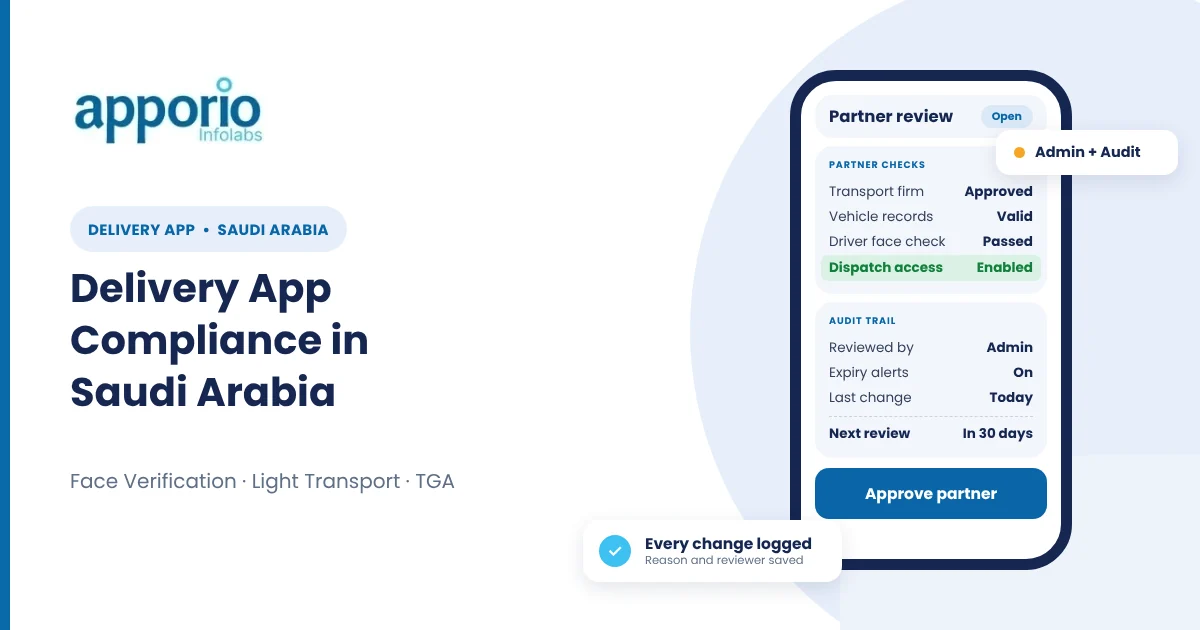
Launching a delivery platform in Saudi Arabia requires more than a customer app, driver app, and dispatch dashboard. Founders must also map the operating model to transport rules, identity controls, data protection obligations, and the requirements that apply to the vehicles and firms performing deliveries. The right compliance plan should be defined before development because licensing assumptions affect onboarding, dispatch, document storage, payment flows, and reporting.
Searches for a delivery app license in Saudi Arabia often describe one permit, but the practical answer depends on what the business does. A marketplace connecting customers with licensed transport providers may have a different compliance path from a company operating its own fleet. Food, parcels, e-commerce orders, and light goods transport can also create different operational responsibilities.
This guide explains how to evaluate those responsibilities without treating software as a substitute for legal approval. It focuses on face verification, light transport firms, driver and vehicle records, platform controls, and the questions founders should ask a Saudi regulatory adviser before launch. It reflects public information reviewed in November 2026, is not legal advice, and requirements can change.
Delivery app compliance is the process of aligning a digital delivery business with the licenses, permits, identity checks, privacy duties, vehicle requirements, and operating controls relevant to its model. It covers both the company behind the platform and the parties that provide delivery services through it.
The first step is to define the operating model precisely. A platform may act as a technology provider, a delivery intermediary, a logistics operator, a fleet owner, or a combination of these. That distinction can affect which entity applies for authorization, who contracts with the customer, who is responsible for the shipment, and which records must be retained.
Saudi regulatory requirements can change and may depend on activity, location, vehicle type, and business structure. The platform should therefore treat this article as a product-planning guide, not as a legal opinion or confirmation that a particular license is sufficient.
The points below reflect public Transport General Authority (TGA) announcements and news reports available in November 2026. Treat them as a starting checklist, not a complete or authoritative list, and confirm every item with TGA or a qualified Saudi adviser before relying on it.
Sources: Saudi Press Agency, 24 January 2024; Saudi Press Agency, 2 April 2024; and Saudi Gazette, 23 June 2026. Last reviewed: November 2026.
Compliance decisions influence the architecture of an on-demand platform. If a regulator, partner, or enterprise customer expects verified driver identities, the product needs a controlled onboarding flow and an audit trail. If vehicles must be linked to approved firms, the database needs company, vehicle, and driver relationships rather than a simple driver profile.
These details are expensive to retrofit. A team that launches with open driver registration may later need to suspend accounts, re-check documents, rebuild dispatch rules, and contact every provider for missing evidence. That creates operational friction and can damage trust with merchants and customers.
A useful principle is to make compliance a product requirement, not a PDF stored outside the system. A manager should be able to see which driver is approved, which vehicle is linked, which documents expire soon, and why a booking was blocked.
Face verification is required for delivery apps under TGA’s regulations, so the product question is how to implement it well. It strengthens identity assurance when it is part of a broader onboarding process, but it should not be presented as proof that a person is suitable to drive or deliver. The business still needs to validate official identity information, employment or partner records, vehicle documents, and any approvals required for the activity.
Security design should cover the entire data path, including the mobile apps, admin panel, storage services, APIs, and third-party verification providers. For access controls, data handling, and application security reviews, Apporio’s Cyber Security service can provide support.
A staged approach helps founders separate regulatory questions from software decisions. The goal is not to collect every possible document. It is to collect the evidence required for the chosen model, protect it properly, and prevent non-compliant accounts from entering live operations.
For the software layer, Apporio’s Delivery App Development offering can be evaluated against these requirements. The important question is not simply whether the product has driver tracking. It is whether the workflow can be configured around the approved Saudi operating model.
Compliance works best when it is visible in daily operations. A dashboard that shows only completed orders is not enough. Managers need a current view of provider eligibility, vehicle assignment, document status, incidents, and verification exceptions.
Not every account or event presents the same risk. A new driver, a driver changing vehicles, and a long-standing provider renewing documents may require different review steps. The business should document those rules and ensure that automated decisions can be escalated to a trained reviewer.
Dispatchers may need a driver name, status, vehicle, and location, but they usually do not need to open the driver’s identity document or face image. Minimize what each role can view. This reduces internal exposure and makes access monitoring more meaningful.
A driver profile should not be treated as a vehicle approval. Store vehicle plate information, ownership or partner relationship, document status, and permitted assignment separately. When a driver changes vehicles, require a new approval event before the vehicle can receive orders.
Receipts, order screens, support messages, and terms should identify the service provider correctly. Avoid claims that the platform has verified more than it actually has. If a third-party firm performs delivery, the customer should receive clear information about the responsible party and support channel.
Define how long identity documents, face verification results, location records, delivery evidence, and support communications are retained. Keep only what is needed for legal, contractual, fraud, accounting, or safety purposes. Retention periods should be reviewed with Saudi privacy counsel, including under the Personal Data Protection Law, and with relevant authorities. Treat face images and verification results as especially sensitive.
The admin panel is a high-value target because it can change driver status, view customer addresses, and access identity evidence. Use strong authentication, permission groups, audit records, secure backups, and a documented process for removing access when staff leave the company.
Real-time dispatch also needs reliable infrastructure. Apporio’s DevOps consulting service can be considered for deployment controls, monitoring, backups, and release processes that reduce the risk of untested compliance changes reaching production.
Many delivery startups treat compliance as a checklist completed immediately before publication. That approach misses the connection between legal responsibilities and product behavior. The following mistakes appear frequently in early platform planning.
These mistakes are avoidable when the product requirements are written alongside the legal and operational requirements. The result is a smaller gap between what the business promises and what its systems can prove.
The right platform design depends on who performs the delivery and who controls the vehicle. The comparison below is a planning aid, not a substitute for confirmation from Saudi authorities or legal counsel.
| Operating model | Main responsibility | Important platform controls | Questions before launch |
|---|---|---|---|
| Marketplace | Connects customers with external providers | Partner approval, provider contracts, driver and vehicle records, face verification, complaint routing | Which party holds the required authorization and performs the transport? |
| Owned fleet | Controls drivers and vehicles directly | Employee or contractor records, fleet documents, assignment rules, face verification, incident handling | Does the company have the permissions and insurance required for its fleet activity? |
| Light transport firm | Performs delivery using light goods vehicles | Firm verification, vehicle classification, cargo information, driver eligibility, face verification | Is the firm TGA-licensed, and which drivers work under it? Are the vehicle type, goods, and routes permitted? |
| Hybrid platform | Combines internal and external delivery capacity | Separate statuses, contracts, payout logic, document rules, audit trails | Can the system show responsibility and eligibility for every order? |
For businesses that want transport and delivery in one broader platform, Apporio’s Logistics App Development can be assessed for fleet, order, and dispatch workflows. A business focused on ride and goods movement may also review the Apporio Taxi Uber Clone Script, provided the final configuration reflects the approved Saudi activity rather than copying another market’s assumptions.
A compliant Saudi delivery platform starts with an accurate operating model. Founders should identify the responsible entities, confirm the applicable transport permissions, verify light transport firms and vehicles, and build face verification as one part of a controlled identity process. Privacy, access control, document expiry, audit logs, and support procedures should be built into the product from the beginning.
Apporio Infolabs can support this planning through Delivery App Development, Logistics App Development, Cyber Security, and white-label on-demand app development. The final licensing position must still be confirmed with current Saudi authorities and qualified local advisers.
It depends on the business model, service category, responsible entity, vehicle type, and transport activity. A marketplace, owned fleet, and light transport firm may have different authorization requirements. Confirm the current route with the relevant Saudi authority and a qualified local adviser.
TGA’s delivery regulations, issued in January 2024, require delivery applications to use face recognition technology to verify a driver’s identity. Confirm the current technical and operational requirements with TGA, and support the process with privacy notices, access controls, retention rules, and manual review.
The platform should consider structured records for companies, drivers, vehicles, identity checks, permits, insurance, expiry dates, approval decisions, suspensions, incidents, and order history. The exact records and retention period should be confirmed for the business model and Saudi requirements.
It may be possible, but the platform must confirm that each partner is authorized for the relevant activity and that its vehicles and drivers meet the applicable requirements. Contracts should define responsibility, while the app should block providers whose required records are missing or expired.
Yes. Licensing assumptions affect onboarding, vehicle assignment, dispatch, customer communication, data storage, and reporting. Defining them before development reduces the risk of rebuilding core workflows after launch.
TGA’s delivery regulations require non-Saudis to work through licensed light transport companies, while Saudis may continue to work in the field. The rule was phased in by region starting in April 2024, so confirm the current phase and your service areas with TGA.