OUR PRODUCTS
Uberr Clone AppGojek Clone AppSuper App DevelopmentUberr Eats Clone AppGrocery App DevelopmentHandyman App Like Uberr
inDriver Clone AppDelivery App DevelopmentGlovo Clone AppBolt Clone AppLyft Clone AppCareem Clone App
OUR PRODUCTS

← Back to Blog
Mobile App Development
The global ride-hailing market is set to hit $716B by 2034. Here's the data-backed case for investing in taxi app development in 2026 — AI dispatch, EV fleets, and the early robotaxi boom.
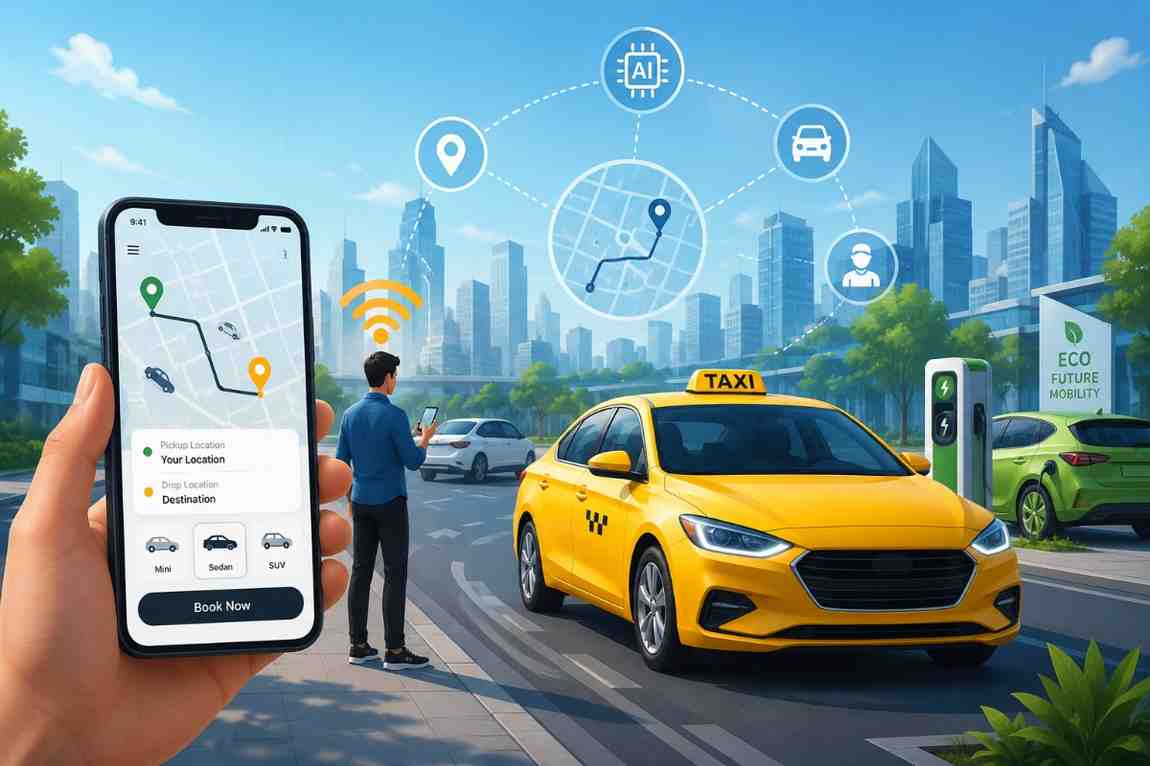
Taxi app development in 2026 isn't a bet on a maturing market — it's a bet on a market that's still compounding at double-digit growth rates, with an entirely new layer of value (AI dispatch, electric fleets, and early robotaxi commercialization) stacking on top.
For founders, fleet operators, and enterprises weighing whether to build a custom platform or launch a white-label Uber clone app, the question isn't whether ride-hailing has room left to grow. The data says it clearly does. Here's what the numbers, the trends, and the next decade actually look like — with sources, so none of this is taken on faith.
Quick answer: The global ride-hailing market is projected to grow from $315.49 billion in 2026 to $716.64 billion by 2034 (10.8% CAGR), while the robotaxi segment alone is forecast to grow from roughly $1.27 billion to over $96 billion in the same window. Combined with maturing white-label platforms and EV-ready fleet demand, 2026 is shaping up as one of the strongest entry points the industry has seen.
Start with the headline figure. According to Fortune Business Insights, the global ride-hailing market was valued at $284.74 billion in 2025 and is projected to reach $315.49 billion in 2026, climbing to $716.64 billion by 2034 — a 10.8% compound annual growth rate (CAGR).
The traditional taxi segment, tracked separately from app-based ride-hailing, is growing at a steadier but still healthy pace. Fortune Business Insights' Taxi Market Report pegs it at $96.31 billion in 2025, rising to $166.43 billion by 2034 (6.2% CAGR). IMARC Group puts the broader taxi market at $255.4 billion in 2025, reaching $383.1 billion by 2034 under a different scope definition.
| Market Segment | Base Value (2025) | Projected Value | Forecast Year | CAGR |
|---|---|---|---|---|
| Ride-hailing (global) | $284.74B | $716.64B | 2034 | 10.8% |
| Taxi (global) | $96.31B | $166.43B | 2034 | 6.2% |
| Taxi (alternative scope) | $255.4B | $383.1B | 2034 | ~4.5% |
Why do the numbers differ between firms? Each research house scopes "taxi" and "ride-hailing" slightly differently — some fold in micro-mobility and corporate transport, others don't. Treat these as directional benchmarks, not a single correct figure. The direction, however, is unanimous: this market is still expanding, and it's expanding faster than most mature digital categories.
Market cycles come and go, but the underlying demand driver behind ride-hailing is structural, not cyclical. According to the United Nations Department of Economic and Social Affairs, 55% of the world's population already lives in urban areas, and that share is projected to reach 68% by 2050. Dense urban living makes private car ownership increasingly impractical — parking costs, congestion, and fuel volatility all push commuters toward on-demand mobility instead.
This matters for anyone evaluating a build decision: you're not investing against a fad that could reverse next quarter. You're investing alongside a multi-decade demographic tailwind that has already carried ride-hailing demand through several economic cycles. Fortune Business Insights attributes Asia-Pacific's market leadership — roughly half of global share — directly to this rising urbanization and digital adoption.
Three forces are converging at once, and together they define what taxi app technology needs to look like through the early 2030s.
AI-powered dispatch is now the baseline, not the differentiator. Predictive demand forecasting, automated driver-rider matching, dynamic surge pricing, and fraud detection — capabilities that used to require an in-house data science team — are increasingly available as built-in modules. That lowers the technical bar for new entrants to compete with established players on efficiency rather than just price. The platforms winning today treat AI dispatch as table stakes, not a premium add-on.
Electric vehicle fleets are becoming the default, not the exception. As cities tighten emissions rules and EV total cost of ownership keeps falling, taxi platforms need to natively support charging-aware routing, range-based dispatch, and EV-specific fleet management rather than bolting it on later. Grand View Research notes that electric vehicles already account for the overwhelming majority of the robotaxi segment by propulsion type — a strong signal of where fleet economics are heading.
Robotaxis are moving from pilot to commercial deployment. This is the trend most blogs in this space haven't caught up to yet. Fortune Business Insights projects the global robotaxi market growing from $1.27 billion in 2026 to $96.31 billion by 2034 — a 71.9% CAGR. Grand View Research estimates an even steeper curve: $0.61 billion in 2025 reaching $147.25 billion by 2033 (99.1% CAGR). These percentages look dramatic because they're starting from a small base, but the underlying signal is real.
Waymo now runs fully driverless service across multiple U.S. cities, and in February 2026 Baidu and Uber — together with Dubai's Roads and Transport Authority — announced the rollout of Apollo Go robotaxis on the Uber app in Dubai, one of Apollo Go's most visible international deployments to date as it expands beyond China and across the Gulf.
None of this means autonomous vehicles replace human drivers within the decade. It means the dispatch logic and fleet architecture you invest in today should be modular enough to onboard autonomous and EV fleets later — without a full rebuild. That single architectural decision is the difference between an expensive teardown in 2030 and a configuration change.
1. White-label platforms have matured past "rigid template." Today's white-label taxi app development solutions function more like configurable platforms — branded passenger and driver apps, regional payment gateways, multi-language support — cutting time-to-market from many months down to weeks. The trade-off between speed and customization that defined the early clone-app era has largely closed.
2. Multi-modal "super apps" are reshaping rider expectations. Consumers increasingly want one app for taxis, bike-share, scooters, and even courier or parcel delivery instead of five separate ones. Grab and Gojek built entire business models on this pattern, and it's now trickling down to regional and city-level platforms.
3. Corporate and B2B transportation is an underbuilt revenue lane. Employee commute management, executive transport, staff shuttles, and scheduled airport transfers are categories most consumer-first taxi apps still treat as an afterthought — even though they carry higher margins and stickier contracts than retail rides.
4. Underserved regional markets remain wide open. Asia-Pacific holds roughly half of global ride-hailing market share, but that dominance concentrates in major metros — leaving real space for localized, regionally-branded apps in tier-2 and tier-3 cities that global players haven't fully penetrated.
5. Smart city investment is creating new integration points. As municipal governments invest in connected traffic systems and IoT infrastructure, taxi platforms that can plug into smart-city data (dynamic routing, traffic-signal feeds, public-transit handoffs) gain an operational edge competitors without that integration won't have.
Market growth only matters if it converts to return, so it's worth being specific about monetization. Most successful platforms layer several of the following rather than relying on one:
A few less obvious revenue lanes are also picking up momentum. The negotiated-fare or "bidding" model — pioneered at scale by platforms like inDrive — lets riders and drivers agree on a price directly, which has proven effective at winning budget-conscious users away from fixed-rate competitors. Micro-mobility add-ons (bike-taxis, e-scooters) and intercity or scheduled long-distance routes also open higher-margin categories beyond standard point-to-point rides, though growth rates for these sub-segments vary too widely across research firms to cite a single reliable figure.
Rather than launching everywhere at once, the strongest playbook for new entrants follows a phased approach:
| Phase | Focus | Key Metric to Track |
|---|---|---|
| Hyper-local MVP | Launch core booking and dispatch in one dense city or niche segment | Driver retention and ride-acceptance rate |
| Feature Escalation | Add AI dispatch, surge logic, and one adjacent service (micro-mobility, bidding, scheduled rides) | Reduced passenger wait times |
| Multi-city Scale | Form B2B/corporate partnerships, roll out EV fleet support, expand regionally | Customer lifetime value and fleet ROI |
This sequencing matters because it lets you validate driver supply and rider demand economics in one market before the cost of multi-city operations and regulatory compliance multiplies. The most common failure mode for new platforms isn't a weak app — it's scaling to five cities before the unit economics work in one.
None of this is a guarantee, and a useful guide on this topic should say so plainly. Competition from established global players is real, but it's best countered with a niche focus and superior local UX rather than trying to out-spend them. Driver acquisition remains the single biggest operational bottleneck for new platforms — strong incentive structures and a frictionless onboarding flow matter more than app polish in the first six months.
Regulatory risk is uneven across markets: driver-classification rules, fare caps, and city-by-city licensing requirements can shift the economics of a market quickly, so building a platform with flexible, configurable compliance features (rather than hardcoded fare logic) reduces the cost of adapting later. And the robotaxi growth curve, while exciting, is starting from a tiny base — it's a multi-year trend to architect toward, not a feature to bolt on this quarter.
It's also worth being honest about the data itself: market-size projections are estimates from research firms, not certainties, and figures vary meaningfully between providers, as the table above shows. Use them as a planning range, not a guarantee.
The ride-hailing and taxi market isn't a story of disruption that already happened — it's a market still compounding at double-digit rates through the early 2030s, with autonomous mobility adding an entirely new growth layer on top. Whether you're a fleet operator going digital, a founder evaluating a white-label taxi app development partner, or an enterprise exploring a multi-service mobility platform, the data points to one conclusion: the window for entering this market hasn't closed — it's just gotten more competitive.
That's exactly why getting the technology foundation right — AI-ready, EV-ready, and built to scale across regions — matters more in 2026 than it did five years ago. If you want to compress months of development into weeks without giving up that architectural flexibility, explore our white-label Uber clone app — branded driver and rider apps, AI-ready dispatch, and modular fleet support, deployment-tested across markets. Book a free demo to see how fast you could be live.
Yes. With the global ride-hailing market projected to grow at a 10.8% CAGR through 2034 and multiple monetization layers available (commissions, subscriptions, corporate contracts, surge pricing), platforms that combine two or three revenue streams tend to be significantly more resilient than commission-only models.
White-label platforms have matured to the point where they offer branded apps, regional payment integrations, and multi-language support out of the box, cutting launch time from months to weeks. Custom builds still make sense for businesses with highly specific dispatch logic or regulatory requirements that off-the-shelf platforms can't accommodate. For most new entrants, a configurable Uber clone app is the faster, lower-risk path to a validated MVP.
Not operationally — robotaxi commercialization is still early and regionally limited. But architecturally, yes: building your dispatch and fleet-management system to be modular now avoids an expensive rebuild when autonomous and EV fleets become a larger share of the market later in the decade.
It depends entirely on your route. A custom build runs into months of development and a larger budget, while a white-label platform lets you launch a branded MVP in weeks at a fraction of the cost — which is why most founders validate demand on a configurable solution first, then invest in custom features once the unit economics are proven.

