OUR PRODUCTS
Uberr Clone AppGojek Clone AppSuper App DevelopmentUberr Eats Clone AppGrocery App DevelopmentHandyman App Like Uberr
inDriver Clone AppDelivery App DevelopmentGlovo Clone AppBolt Clone AppLyft Clone AppCareem Clone App
OUR PRODUCTS

← Back to Blog
October 19, 2026
A technical guide to explainable dispatch, transparent pay calculations, human review, audit logs, and EU governance for ride-hailing and delivery platforms.
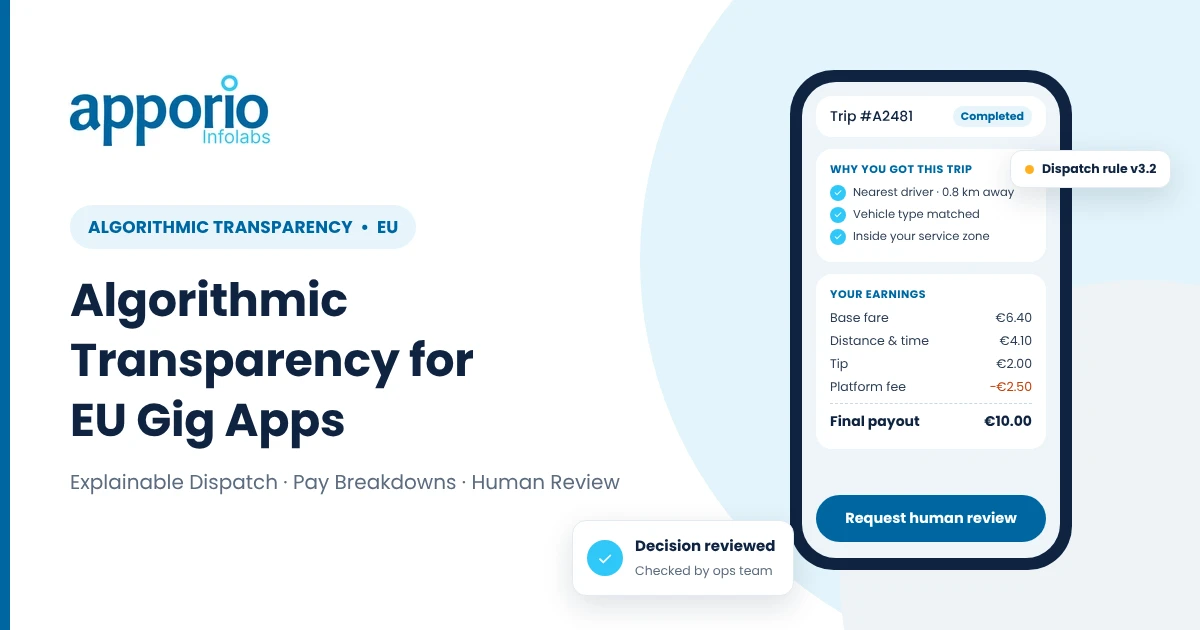
Algorithmic transparency in a gig app means telling drivers, couriers and service providers how automated systems assign work, calculate pay and restrict accounts, and giving them a human route to challenge those decisions. For EU operators it is no longer optional: member states must bring the Platform Work Directive (EU) 2024/2831 into national law by 2 December 2026.
Ride-hailing, food delivery, grocery, and handyman platforms use automated rules to rank requests, select workers, estimate arrival times, apply incentives, and calculate earnings. When those decisions affect access to work or income, workers need understandable information and a practical way to challenge an outcome. That makes explaining how work is assigned and paid a product requirement, not a public-relations exercise.
EU operators face a particularly demanding environment. The Platform Work Directive, GDPR principles, national employment rules, consumer requirements, and emerging AI governance expectations can overlap. The exact obligations depend on the platform's business model, worker classification, country of operation, and the system being used. This article focuses on the technical controls that make those obligations manageable.
The goal is not to disclose source code or publish every model parameter. A usable system explains the factors that matter, records the decision that was made, identifies who can review it, and preserves evidence for audits or disputes. Those controls should be designed before launch because retrofitting them into dispatch and earnings services is expensive and operationally disruptive.
Algorithmic transparency means giving affected people meaningful information about automated or partly automated decisions. In a gig app, this usually covers dispatch, worker ranking, account restrictions, incentive eligibility, ratings, estimated earnings, deductions, and customer or worker risk controls.
Transparency has several levels. A basic notice tells a driver or courier that automated systems are used. A stronger explanation identifies the main factors considered, such as distance, availability, vehicle type, service area, scheduled time, acceptance rules, or delivery capacity. A robust implementation also provides an event history, a pay calculation, a correction process, and human intervention when a decision has significant consequences.
Explainability is not the same as exposing proprietary code. A dispatch service can show that it considered pickup distance, current workload, service constraints, and acceptance status without revealing confidential implementation details. The explanation must still be accurate, specific enough to be useful, and consistent with the decision actually produced.
A useful starting point is an artificial intelligence service review that maps every automated decision to its data inputs, business purpose, responsible owner, and user-facing explanation.
Dispatch and pay algorithms influence a worker's practical ability to earn. A minor-looking rule, such as prioritising a nearby worker or lowering visibility after repeated declines, can affect income across thousands of decisions. If the platform cannot explain the outcome, customer support has little more than a generic response, and workers may view the system as arbitrary.
Transparency also improves operational control. When product teams define the reasons behind a dispatch decision, they often find conflicting rules, stale location data, incomplete worker status, or incentives that produce unintended behaviour. A decision log makes those faults visible. It also helps engineering teams compare model or rule versions without relying on anecdotal complaints.
For EU businesses, the legal analysis should not be reduced to a single checklist. The Platform Work Directive addresses algorithmic management and human oversight in platform work, while GDPR may apply to personal data processing, profiling, access requests, and automated decision safeguards. National implementation can add further requirements. Operators should obtain advice from qualified EU counsel and keep an evidence trail showing how the platform was designed and governed.
These controls should be connected to a broader EU compliance programme, rather than treated as a standalone screen in the worker app.
Directive (EU) 2024/2831 entered into force on 1 December 2024, and member states must bring it into national law by 2 December 2026. Its algorithmic management rules (Chapter III) cover everyone doing platform work, including self-employed drivers and couriers, not only those reclassified as employees.
| Requirement | What it means for your app |
|---|---|
| Limits on data processing (Art. 7) | Don't process data on emotional or psychological state, private conversations, or activity while the worker isn't working or offering work. |
| Impact assessment (Art. 8) | Run a data protection impact assessment on automated monitoring and decision systems. |
| Information on automated systems (Art. 9) | Explain in writing which decisions are automated and the main parameters, by the worker's first working day at the latest and before any major change. |
| Human oversight (Art. 10) | Have people regularly check what automated decisions do to workers. A human must decide any restriction, suspension or deactivation of an account. |
| Human review (Art. 11) | Give workers a named contact for explanations, written reasons for significant decisions, and a response to review requests within a set deadline. |
The details vary by country, so treat this table as a design brief for your product and engineering teams, not as legal advice.
A transparent design creates value for workers, operators, regulators, and engineering teams. It does not remove every dispute. It gives each party better information for resolving disputes and testing whether the system is working as intended.
A worker is more likely to accept an unfavourable result when the platform explains the relevant factors and offers a meaningful review process. “The system decided” is not an explanation. “The request was offered to another available worker because the pickup zone rule and vehicle requirement were not met” is more useful, provided it matches the recorded decision.
Support agents can use a decision timeline instead of manually reconstructing events from unrelated databases. A case may include the task ID, worker status, location snapshot, rule version, offer timestamp, acceptance window, cancellation event, and pay calculation. This reduces repetitive escalations and makes responses more consistent.
A line-by-line earnings statement exposes missing supplements, incorrect distance inputs, duplicate adjustments, or fees applied to the wrong party. The platform can also distinguish an estimate from a final amount, which avoids presenting provisional values as settled pay.
Product teams regularly test dispatch priorities, incentives, and service zones. Versioned decision logs allow a team to compare outcomes and roll back a rule that creates unexpected exclusion or cost. Experiments should have an owner, a stated purpose, a start and end date, and a review of affected groups.
Governance improves when the operator can produce system documentation, access records, model or rule versions, complaint outcomes, and evidence of human oversight. Security controls matter as well, because decision logs contain location, earnings, identity, and operational data. A documented cyber security service assessment can help define access control, retention, encryption, and incident procedures.
Transparency should be implemented as a product and data architecture workstream. The following sequence works across ride-hailing, delivery, grocery, and local service marketplaces.
For a ride-hailing use case, the dispatch layer can be planned alongside taxi dispatch software requirements. The same approach can then be adapted for food delivery, grocery fulfilment, or home services.
Estimated arrival time, projected earnings, and provisional incentives should be visibly labelled. When the final amount changes, show the reason and the event that caused the adjustment. Do not reuse an estimate label for a final settlement or hide changes inside a single total.
A regulator, engineer, support agent, and courier need different levels of detail. Provide a concise explanation in the app, a structured case view for support, and technical records for audit and engineering teams. Translations should preserve the meaning of terms such as gross pay, deduction, adjustment, cancellation, and review.
Reason codes make decisions searchable and measurable. A code should have a controlled definition, not a free-text label that changes between teams. Keep separate codes for ineligibility, no available task, queue position, safety restriction, data error, and manual correction.
Operational databases can be edited as statuses change. A separate event trail should preserve what the system knew and decided at the time. Protect it with strict permissions, timestamps, retention rules, and monitoring. Immutability does not mean keeping personal data forever; retention should follow the platform's legal and operational requirements.
Human review is ineffective if the reviewer can only repeat the automated result. The review console should show relevant evidence, allow a correction or escalation, and require a reason for the final outcome. Access should be limited to trained staff, with reviewer actions logged.
A dispatch model can perform well against a narrow efficiency metric while creating more complaints or reducing access for a particular group. Monitor acceptance opportunities, completed work, earnings adjustments, suspension reversals, support outcomes, and service quality. Metrics should be interpreted with legal and operational context.
Transparency does not require showing another worker's identity, location, earnings, or ranking. Explain the affected person's result using the minimum information needed. Apply role-based access, redact unnecessary fields, and review exports because audit files can become a secondary privacy risk.
These three approaches show the difference between minimal disclosure and an operationally accountable design. The categories are practical maturity levels, not legal classifications. A platform may need controls from more than one level depending on its decisions and market.
| Level | What workers see | Human review | Audit evidence |
|---|---|---|---|
| Basic notice | A notice that automated systems are used, with little detail about specific outcomes | Usually none, or a generic support mailbox | Little or no structured evidence |
| Explainable system | Principal factors, itemised pay components, reason codes and decision history | Support teams can investigate common disputes | Per-case decision logs |
| Governed platform | Everything above, plus advance notice when rules change | Trained reviewers with authority to correct or escalate decisions | Versioned rules, impact testing, access controls, retention rules and complaint metrics, supporting oversight across multiple EU markets |
A basic notice may be a starting point during discovery, but it is weak protection for a platform whose automated decisions affect work access or income. An explainable system improves user communication. A governed platform connects product design, engineering, legal review, security, operations, and customer support into one control framework.
Transparent dispatch and pay design requires more than an explanatory paragraph in a worker app. The platform needs a decision inventory, accurate data mapping, versioned rules, itemised earnings, event logs, human review, access controls, and monitoring. EU operators should also assess the Platform Work Directive, GDPR, national rules, and the exact role of automation with qualified advisers.
Apporio can support this product planning across a Gojek clone for multi-service operations, an Uber clone for ride-hailing workflows, and delivery app development for courier, food or local service marketplaces. The right implementation depends on the decision inventory, worker model, countries served, data architecture, and review process—not on adding a generic AI label.
It means explaining how automated or partly automated systems affect eligibility, task assignment, ranking, pay, incentives, ratings, restrictions, or account access. A useful approach identifies the principal factors, records the decision, shows the pay calculation where relevant, and provides a meaningful human review route.
No. Transparency generally does not require publishing proprietary source code or every model parameter. The platform should provide accurate, understandable information about the main factors behind a decision and retain technical records that authorised reviewers can use to reconstruct the outcome.
It should distinguish estimated and final amounts and show each relevant earning component, such as base pay, distance or time amounts, tips, bonuses, fees, reimbursements, deductions, and corrections. If the total changes, the platform should identify the event and reason that caused the adjustment.
Human review gives workers a route to challenge consequential outcomes, including account restrictions, disputed pay, incorrect eligibility decisions, or flawed data. Reviewers need access to relevant evidence and authority to correct or escalate a decision, with their actions recorded for accountability.
They should inventory automated decisions, map inputs, document purposes, version rules and models, provide user-facing explanations, establish human oversight, test representative scenarios, protect personal data, and monitor complaints and corrections. The technical plan should be checked against the Platform Work Directive, GDPR, national implementation, and legal advice for each market.