OUR PRODUCTS
Uberr Clone AppGojek Clone AppSuper App DevelopmentUberr Eats Clone AppGrocery App DevelopmentHandyman App Like Uberr
inDriver Clone AppDelivery App DevelopmentGlovo Clone AppBolt Clone AppLyft Clone AppCareem Clone App
OUR PRODUCTS

← Back to Blog
Mobile App Development
November 20, 2026
A practical technical guide to dispatching human-driven and autonomous vehicles through one ride-hailing platform without compromising safety, control, or service reliability.
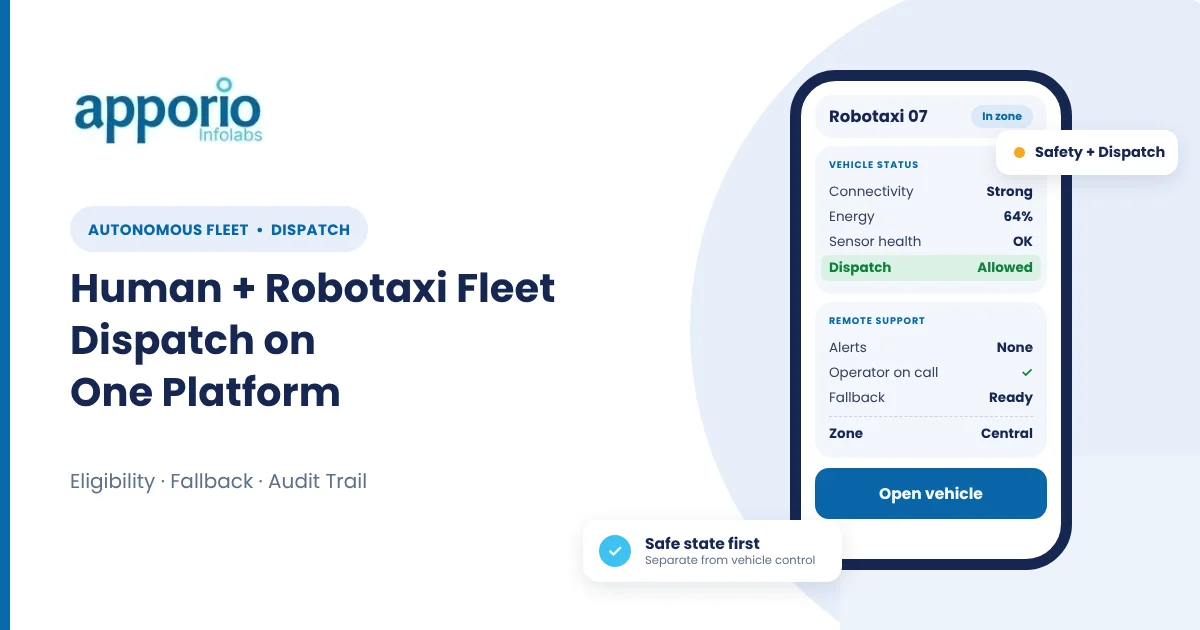
Ride-hailing operators planning for autonomous vehicles face a platform problem before they face a vehicle problem. The dispatch system must coordinate human drivers, autonomous vehicles, remote assistance teams, passengers, payments, and safety procedures in one operating model. An autonomous fleet dispatch platform therefore needs more than a passenger app and a driver app. It requires a fleet control layer that understands different vehicle capabilities and applies the right rules to each trip.
A practical approach is not to replace a human fleet immediately. It is to add autonomous vehicles as another supply type inside an existing mobility marketplace. That allows an operator to test limited routes, manage service interruptions, and maintain coverage with human drivers when an autonomous vehicle cannot accept a request. This guide covers both driverless and supervised deployments; in some, a safety operator is still onboard, and the platform has to represent that state.
This guide explains the architecture, dispatch logic, operational controls, and rollout practices required for a mixed fleet. It focuses on product decisions that affect real operations: eligibility, location accuracy, fallback handling, remote support, audit logs, payments, and regional compliance.
An autonomous fleet dispatch platform is a multi-sided mobility system that matches passengers with vehicles capable of completing trips with limited or no onboard human driving. It is often described as an autonomous ride-hailing platform. In a mixed-fleet model, the same system can dispatch conventional taxis, private-hire vehicles, and autonomous vehicles according to service area, trip type, vehicle condition, and operating policy.
The passenger experience may look similar across vehicle types, but the back-office logic is different. A human driver can respond to a call, interpret an unusual pickup point, and make a judgment during a road incident. An autonomous vehicle depends on its onboard driving system, its operational design domain (ODD), connectivity, remote assistance process, and defined escalation rules. The ODD is the set of mapped areas, road types, conditions, and times the vehicle is approved to operate in.
For that reason, vehicle type should be treated as a first-class data attribute. The platform should store whether a vehicle is human-driven or autonomous, its approved service zone, passenger capacity, accessibility options, battery or fuel status, sensor health, connectivity state, and current operational mode.
A mixed-fleet system also needs clear state transitions. A vehicle may be available, reserved, en route, waiting, carrying a passenger, paused, undergoing inspection, or unavailable because of a technical alert. Dispatch decisions should use these states rather than relying only on a driver's online toggle or a vehicle's last GPS position.
Autonomous vehicles will not initially operate under the same conditions as conventional vehicles. Their operating area may be limited to selected districts, road classes, weather conditions, time windows, or mapped routes. Passenger demand, however, will not respect those boundaries. A rider may request a trip that begins inside the approved zone but ends outside it, or a vehicle may become unavailable because of a connectivity or safety event.
A unified dispatch system gives the operator one source of truth for those decisions. It can identify which supply is eligible, present accurate vehicle information to the passenger, and send the request to a human driver when the autonomous option is unsuitable. This reduces the need to operate disconnected booking systems that create inconsistent pricing, trip records, and customer support workflows.
Example: A rider requests a trip that starts in Zone A, inside the approved area, and ends in Zone B, outside it. The system checks the autonomous vehicle's ODD and finds the destination ineligible, so it offers a human driver for the whole trip or, where local policy allows, a handoff point at the zone boundary. The passenger sees one booking, one fare estimate, and one support record, while the trip log records why the robotaxi was excluded.
The model also matters for service continuity. Human drivers can cover demand during peak periods, unusual events, road closures, or autonomous fleet maintenance. Autonomous vehicles may handle repeatable routes or scheduled trips when their operating conditions are appropriate. Dispatch becomes a capacity planning tool rather than a simple nearest-vehicle algorithm.
Operators should still avoid treating autonomy as a shortcut to lower operating complexity. New responsibilities appear, including vehicle readiness checks, remote intervention procedures, incident review, passenger education, and closer monitoring of map and sensor data. The software must make these responsibilities visible to the control team.
A shared dispatch layer creates practical advantages when it is designed around operating rules rather than vehicle branding. The benefits come from consistent records, controlled allocation, and clear exception handling.
Start with a fleet registry that distinguishes human-driven and autonomous supply. Add attributes that affect dispatch, including passenger capacity, wheelchair access, luggage space, service zone, operating hours, energy status, inspection status, and connectivity. Eligibility should be evaluated at request time because vehicle conditions change continuously.
Use a shared lifecycle for booking, matching, acceptance, arrival, pickup, in-trip operation, completion, cancellation, and support. Then add vehicle-specific events where needed. For example, an autonomous trip may include a remote assistance request, while a human-driven trip may include driver arrival confirmation. The common lifecycle keeps reporting and payment records consistent.
The marketplace dispatch service should decide which vehicle is suitable. It should not directly replace the vehicle's onboard control or autonomous driving system. Instead, the platform exchanges approved trip details, pickup instructions, route constraints, and status events through a controlled integration layer. This separation reduces the risk of mixing commercial dispatch logic with safety-critical vehicle functions.
Before assignment, the system should validate whether the requested origin, destination, route, time, and conditions fall within the vehicle's approved ODD. If any rule fails, the request should move to another eligible fleet type or require human review. The passenger should receive a clear status rather than waiting for a vehicle that cannot legally or technically complete the trip.
A fallback is not only a canceled autonomous trip. The platform should support reassignment before pickup, a safe stop during a trip, remote assistance, passenger support, and transfer to a human vehicle where local policy allows it. Each action should create an auditable event and show the responsible team, timestamp, reason, and next step.
Fare calculation, authorization, refunds, receipts, complaints, and insurance-related records should reference one trip identifier. This prevents a support agent from searching across disconnected systems. Local payment methods and currency rules can vary by market, but the financial event model should remain consistent.
Before public launch, test demand spikes, GPS errors, connectivity loss, passenger no-shows, map mismatches, road closures, low battery, vehicle faults, and support escalation. A limited pilot should measure operational workload as well as trip completion. A system that completes trips but requires constant manual intervention may not be ready to expand.
Autonomous passenger service typically needs approval from the transport authority in each jurisdiction, and the requirements, permitted areas, and conditions differ widely. Treat the points below as design requirements, and confirm the rules with the relevant authority and qualified local advisers before launch.
Successful mixed-fleet dispatch depends on disciplined operating design. The following practices are useful when converting a conventional ride-hailing product into a system that can support autonomous supply.
These practices can be added to a mature taxi dispatch foundation rather than built as a completely separate product. Teams that already run a taxi dispatch foundation, such as Apporio’s taxi dispatch software, can extend it with fleet types and eligibility rules, while autonomous integrations would require separate discovery, testing, and compliance work.
Mixed-fleet projects often fail because teams focus on the passenger interface and postpone operational edge cases. The main risks are predictable and can be addressed during product planning.
A proven ride-hailing product can reduce the amount of marketplace work required, but it does not remove the need for autonomous vehicle validation. Teams should document which functions are ready, which require customization, and which depend on third-party fleet systems before committing to a launch plan.
The two fleet types share the same commercial marketplace, but they differ in control, eligibility, and exception management. The comparison below highlights the product implications without assuming that one model is suitable for every market.
| Operating Area | Human-Driven Fleet | Autonomous Fleet | Shared Platform Requirement |
|---|---|---|---|
| Trip acceptance | Driver accepts or rejects the request. | Vehicle system or operating policy confirms eligibility. | One assignment record with vehicle-specific acceptance events. |
| Pickup handling | Driver can interpret passenger instructions and local conditions. | Pickup may require a defined curb point or boarding process. | Location validation, passenger guidance, and support access. |
| Route operation | Driver responds to traffic and road changes. | Vehicle operates within its approved ODD. | Route eligibility, status updates, and exception escalation. |
| Incident response | Driver reports or requests help. | Remote support and technical escalation may be required. | Event logs, human review, and reassignment or safe-stop workflows. |
| Availability | Shift, driver status, location, and vehicle condition. | System health, connectivity, energy, map coverage, and safety status. | Capability-based availability rules and fleet monitoring. |
| Settlement | Driver payout and platform fee are calculated after the trip. | Fleet owner, operator, and platform settlement may use different terms. | One trip ledger with fleet-specific financial attributes. |
This model shows why a conventional driver status field is not enough for a robotaxi-ready system. The platform needs an extensible fleet schema and an event-driven dispatch process that can add new vehicle capabilities without changing the passenger's basic booking journey.
Building an autonomous fleet dispatch platform is primarily a dispatch, safety, integration, and operations challenge. The strongest starting point is a shared marketplace that treats autonomous vehicles as a controlled fleet type alongside human drivers. Capability-based matching, ODD validation, fallback workflows, support tooling, security controls, permit tracking, and auditable trip events should be designed before expanding vehicle coverage.
Apporio Infolabs can help businesses evaluate a mixed-fleet roadmap through its Taxi Uber Clone Script, Taxi Dispatch Software, and white-label on-demand app development. For broader mobility products, its On-Demand Mobile App Development service can support passenger, fleet, admin, payment, and operations planning. Autonomous vehicle integrations still require separate technical, legal, safety, and vehicle-system validation.
Yes. A unified system can treat each vehicle type as a different supply category with its own eligibility, operating area, status, and exception rules. The passenger, payment, and support records can remain connected through one trip lifecycle.
The platform generally needs approved vehicle identity, location, availability, trip status, operating-zone eligibility, connectivity state, energy or fuel status, and relevant fault or readiness events. The exact data contract depends on the vehicle provider and local operating requirements.
The system should identify the reason, prevent an unsuitable assignment, and apply a defined fallback. That may mean assigning a human driver before pickup, requesting remote support, placing the vehicle in a safe state, or escalating the trip to an operations team, depending on the situation and local rules.
A conventional taxi application may provide useful passenger, driver, payment, and dispatch foundations, but robotaxi operations need additional vehicle integrations, capability rules, monitoring, remote support workflows, safety events, and compliance review. The existing product should be assessed before any autonomous deployment plan is finalized.
Start with a limited operating zone, a small approved vehicle group, defined service hours, and clear fallback coverage from human drivers. Test location accuracy, assignment, passenger instructions, incident handling, payment reconciliation, and support workload before expanding routes or vehicle volume.
Autonomous passenger service typically needs approval from the transport authority in each jurisdiction, and the requirements vary. The platform should store each permit's scope, such as zones, hours, approved vehicles, and expiry dates, as data that dispatch enforces. Confirm the rules with the relevant authority and a qualified local adviser before launch.