OUR PRODUCTS
Uberr Clone AppGojek Clone AppSuper App DevelopmentUberr Eats Clone AppGrocery App DevelopmentHandyman App Like Uberr
inDriver Clone AppDelivery App DevelopmentGlovo Clone AppBolt Clone AppLyft Clone AppCareem Clone App
OUR PRODUCTS

← Back to Blog
Mobile App Development
November 9, 2026
A practical guide to building a bike taxi platform for boda boda, okada, and moto-taxi operators, including features, safety, payments, monetization, and launch planning.
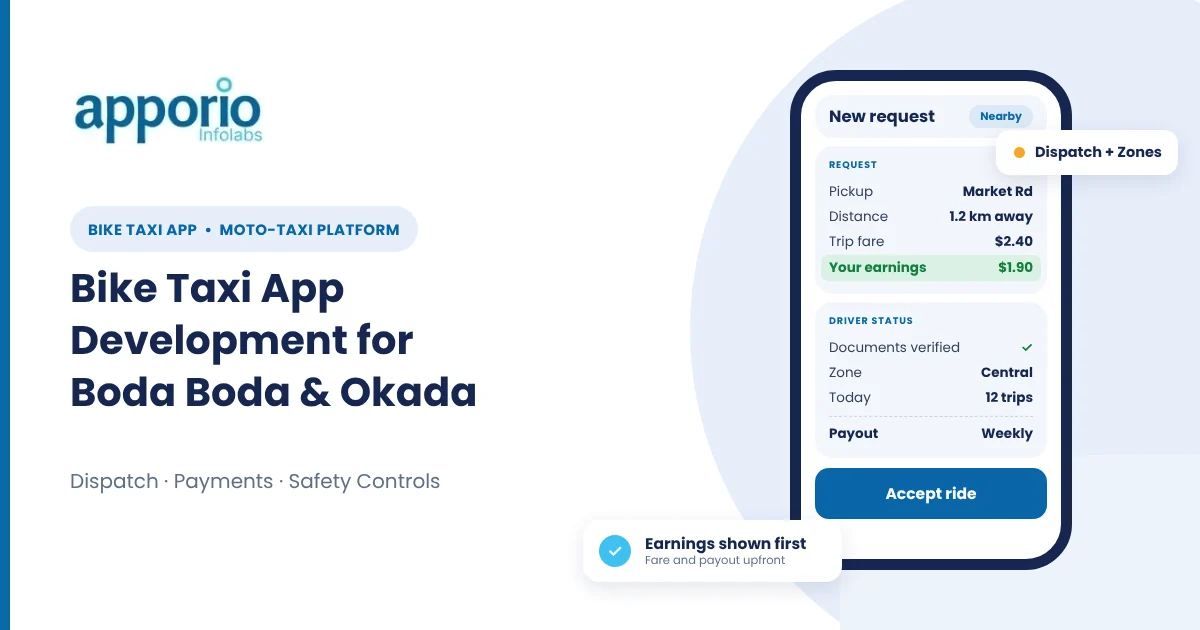
Bike taxi app development is becoming a practical route for entrepreneurs serving dense cities, peri-urban communities, and markets where motorcycles can move faster than cars. Boda boda services in East Africa, okada operations in West Africa, and moto-taxi businesses in other regions share a common need: a reliable digital system for requesting rides, assigning drivers, calculating fares, and managing safety.
The opportunity is not limited to copying a passenger booking screen. A commercial platform must fit local transport rules, mobile-money habits, road conditions, driver onboarding standards, and the way customers actually request trips. The strongest projects begin with a narrow service area, a clear operating model, and a dispatch workflow that works during busy periods.
This guide explains the product decisions behind a motorcycle ride-hailing platform. It covers the customer, driver, and admin sides; essential features; market-specific considerations; common implementation errors; and how a white-label product can reduce the amount of work required before a local launch.
Bike taxi app development means creating a digital platform that connects passengers with motorcycle drivers for on-demand trips. The system usually includes a passenger app, a driver app, an administration dashboard, backend services, mapping tools, payment integration, notifications, and reporting.
A passenger enters a pickup point and destination, reviews an estimated fare, requests a ride, and tracks the assigned driver. The driver receives trip requests, accepts or rejects jobs, navigates to the passenger, starts and ends the trip, and views earnings. Operators use the admin panel to approve drivers, configure service zones, monitor active rides, resolve disputes, and review financial activity.
The same core product can support different local names and operating models:
The software should not assume that every market uses the same fare structure or driver relationship. Some operators use commission per completed trip. Others may test driver subscriptions, flat booking fees, or a hybrid model. Those choices affect the admin logic, reporting, and payment workflows from the beginning.
Motorcycle taxis solve a specific mobility problem: moving one passenger through congested roads with a vehicle that usually has lower space requirements than a car. That advantage does not automatically create a profitable platform. The operator still needs enough drivers in the right zones, a consistent customer experience, and controls that reduce fraud and safety incidents.
Digital dispatch improves visibility compared with informal street-side arrangements. Customers can request a ride from a known location, see driver information, receive trip updates, and access a record of the journey. Operators gain data about demand by area, peak request periods, cancellation rates, and driver activity.
The model can also support local transport businesses that already have a network of riders but lack central booking infrastructure. A focused launch can begin with a few neighborhoods, business districts, campuses, or transport corridors rather than attempting to cover an entire country.
Before selecting a product, founders should validate several operational questions:
A well-designed motorcycle booking system creates benefits for three groups: passengers, drivers, and operators. These benefits come from better coordination, not from adding every possible feature at launch.
Start with one city or service zone and document its transport rules, customer segments, major pickup points, payment behavior, and competitor practices. Decide if the service will focus on daily commuters, students, workers, tourists, airport passengers, or short-distance neighborhood trips.
Then define how drivers join, how fares are calculated, how disputes are handled, and how money moves between passengers, drivers, and the platform. These decisions are product requirements, not details to postpone until after development.
The passenger app should make booking and trip tracking clear. The driver app should prioritize request handling, navigation, trip status, and earnings. The admin dashboard should provide tools for verification, dispatch oversight, pricing, support, settlements, and reporting.
Operators should map the complete ride lifecycle: request created, driver matched, driver accepted, driver arriving, trip started, trip completed, payment confirmed, and receipt issued. Every status needs an appropriate response when a driver cancels, a passenger becomes unreachable, GPS is inaccurate, or payment fails.
The minimum viable product should include registration, location selection, fare estimation, driver matching, ride status updates, navigation support, payments suited to the market, ratings, trip history, notifications, and administrative controls.
Safety should be part of the initial release. Driver identity, vehicle details, emergency contact options, trip sharing, support access, and incident reporting are more important than decorative features. The exact controls should be reviewed against local law and operating conditions.
Payment design should reflect how people actually transact. Cash may remain important even when mobile money or cards are available. The system should record the selected payment method, confirm successful transactions, flag failed payments, and prevent duplicate charges.
Pricing may use a base fare, distance, time, waiting, minimum charge, zone pricing, or demand adjustments. Operators should be able to change rules through controlled admin settings rather than requesting a code change for every pricing experiment. Review Apporio’s Payment Gateways options when planning mobile-money, card, and cash flows.
Testing should cover weak network connections, low battery, inaccurate map pins, cash payments, driver cancellations, duplicate ride requests, GPS drift, and peak demand. A platform that works only on a stable office Wi-Fi connection is not ready for field use.
Run a controlled pilot with a limited driver group. Watch the time from request to acceptance, the accuracy of pickup locations, failed payment cases, support volume, and the reasons for cancellations. Use those findings to adjust workflows before expanding the service zone.
A small area with available drivers usually produces a better first experience than a large map with long wait times. Define service zones around real demand clusters, then expand when driver availability and completed trips support the next area.
Collect the documents required for the market, verify driver identity, record motorcycle information, and define approval states. Do not treat registration as approval. The admin team should be able to request corrections, suspend an account, and review verification history.
Location updates should not consume unnecessary data or battery. The app should handle temporary disconnections and show a useful status rather than silently failing. Drivers should be able to recover a trip after closing and reopening the application.
Matching can consider distance, driver availability, service zones, vehicle type, and driver status. Operators should understand why a request was assigned or left unmatched. Clear rules help support teams investigate complaints and help drivers trust the platform.
A low rating is not the same as a safety incident. Provide a dedicated reporting flow for harassment, reckless driving, fraud, assault, or identity concerns. Serious reports should trigger a defined review and account-action process.
Customers and drivers need a visible way to report payment problems, pickup disputes, cancellations, and lost items. Create response categories, escalation rules, refund authority, and service-level targets. An app cannot compensate for an unmanaged support queue.
The platform handles names, phone numbers, location data, identity documents, trip history, and payment references. Apply access controls, secure storage, audit logs, and sensible data retention. Apporio’s Cyber Security service can support application and operational risk reviews.
A white-label starting point can provide a tested base for passenger, driver, and admin workflows while leaving room for brand, market, and policy changes. Custom development may be appropriate when the business has unusual dispatch rules, regulatory requirements, or a wider multi-service roadmap. Apporio also provides on-demand app development for businesses that need a tailored implementation.
There is no single correct way to enter the motorcycle taxi market. The right approach depends on the number of cities, the uniqueness of the operating model, available capital, and how quickly the business needs to test demand.
| Approach | Best suited for | Main strengths | Key considerations |
|---|---|---|---|
| White-label ride platform | Startups and local operators testing one market | Faster starting point with established core workflows | Market-specific changes, integrations, and support scope must be confirmed |
| Custom platform | Businesses with unusual rules or complex regional operations | Greater control over workflows, architecture, and integrations | Requires more planning, product decisions, testing, and ongoing maintenance |
| Manual dispatch with a digital booking layer | Very small pilots and early validation | Lower initial operational complexity | Limited automation, reporting, scalability, and real-time coordination |
| Multi-service platform | Operators planning rides alongside other on-demand services | One broader customer and provider ecosystem | More complex operations, support, pricing, and service management |
Founders evaluating a ride-hailing base can start with Apporio’s Taxi Uber Clone Script. A business planning rides alongside several local services can also review the Super App Development offering, provided the initial operating scope remains manageable.
Bike taxi app development requires more than passenger booking screens. The platform must coordinate drivers, fares, maps, payments, verification, support, safety, and local operating rules. A focused pilot gives the business a practical way to test demand, driver supply, service zones, and unit economics before broader expansion.
Apporio Infolabs can support this roadmap through its Taxi Uber Clone Script, On-Demand Mobile App Development service, and Super App Development offering. The best starting point depends on whether the priority is a focused motorcycle taxi launch, a tailored operating model, or a wider multi-service platform.
It is the creation of a platform that connects passengers with motorcycle drivers for on-demand trips. It normally includes passenger and driver apps, an admin dashboard, mapping, dispatch, payments, notifications, safety controls, and reporting.
Yes. The core booking and dispatch workflow can support all three models, but the implementation should be configured for local terminology, regulations, payment methods, fare rules, driver requirements, and service zones.
The first release should normally include registration, location selection, fare estimates, driver matching, ride status updates, navigation support, local payment methods, trip history, notifications, ratings, driver verification, support, and admin controls.
A white-label product can provide a practical base for testing one market, while custom development is more suitable when the business has unusual dispatch rules, regulatory requirements, or a complex multi-market roadmap. The decision depends on scope, budget, timing, and the amount of customization required.
Useful controls include driver identity and vehicle verification, visible driver details, trip tracking, emergency contact options, trip sharing, dedicated incident reporting, account suspension tools, and a defined investigation process. Local legal and transport requirements should guide the final design.
Operators should monitor request-to-acceptance time, completed rides, cancellation reasons, driver availability, repeat usage, payment success, support cases, average trip value, and performance by service zone. These measures provide a clearer view of platform health than downloads alone.