OUR PRODUCTS
Uberr Clone AppGojek Clone AppSuper App DevelopmentUberr Eats Clone AppGrocery App DevelopmentHandyman App Like Uberr
inDriver Clone AppDelivery App DevelopmentGlovo Clone AppBolt Clone AppLyft Clone AppCareem Clone App
OUR PRODUCTS

← Back to Blog
Mobile App Development
November 18, 2026
A practical guide to launching a GCC car rental platform with regional payments, fleet controls, renter identity checks, pricing, compliance, and scalable operations.
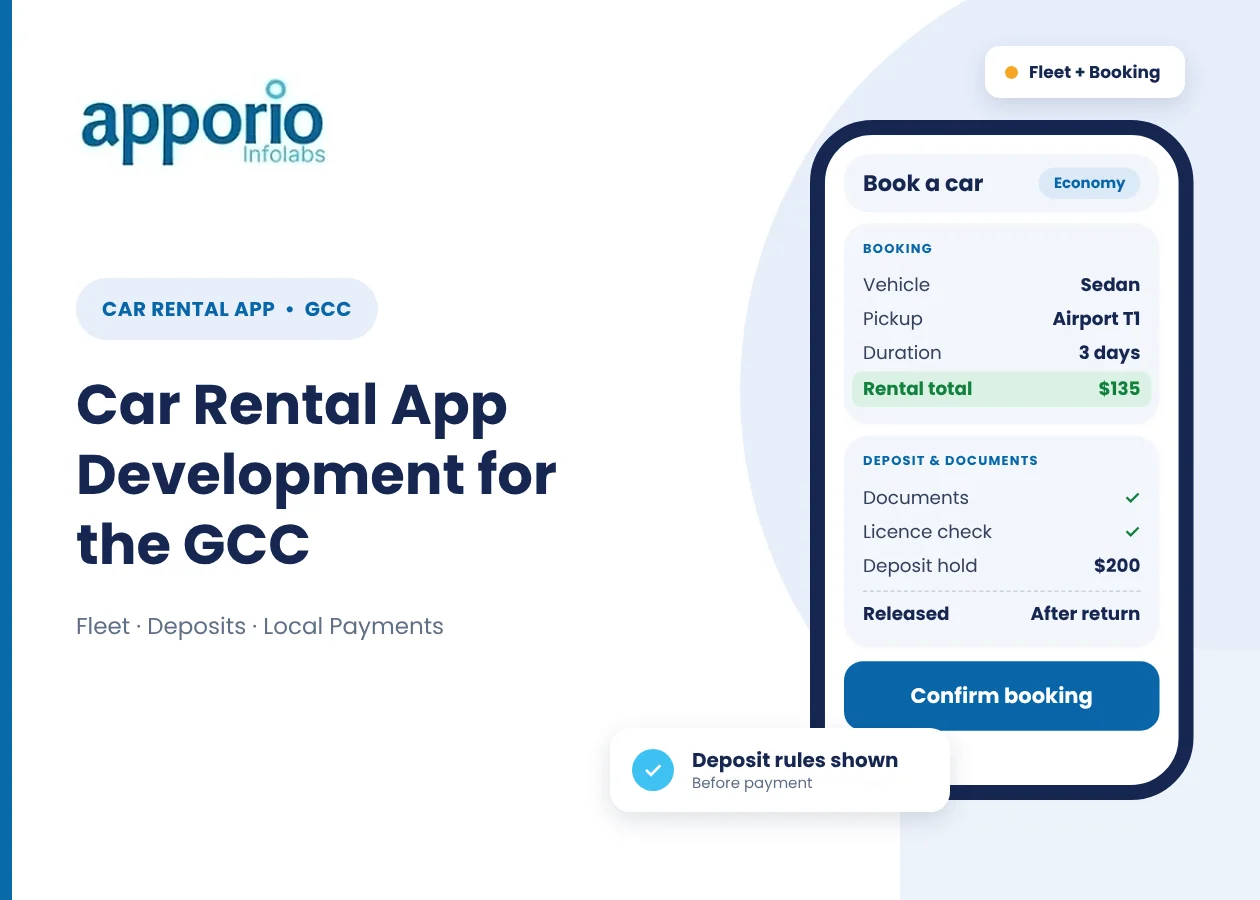
The GCC car rental market serves tourists, residents, corporate teams, airport passengers, and businesses that need short-term vehicle access. A mobile platform can bring reservations, vehicle availability, payments, identity checks, extensions, and support into one operating system. However, a booking interface alone is not enough. Operators must account for country-specific regulations, insurance requirements, vehicle handover, deposits, multilingual customers, and local payment preferences.
Car rental app development for the GCC should begin with the operating model, not the screen designs. Decide whether the platform will manage an owned fleet, onboard independent rental companies, or combine both. Then define the booking rules, documents, pricing, cancellation policy, and responsibility for vehicle damage. This guide explains the product decisions, technical components, launch steps, and mistakes founders should review before selecting a development partner.
The strongest commercial approach is usually a focused launch in one city or customer segment. A business can start with airport rentals, monthly corporate leasing, premium vehicles, economy cars, or local tourism demand. The first release should support the core transaction reliably while leaving room for additional cities, fleet partners, and services.
A GCC car rental platform is a digital marketplace or fleet management system that allows customers to search, reserve, pay for, collect, use, extend, and return vehicles. Depending on the business model, the platform may include separate applications for renters, fleet owners, drivers or delivery staff, and administrators.
The customer side normally handles vehicle discovery, filters, date selection, pickup location, rental terms, document submission, deposits, payment, booking status, and support. The fleet side manages vehicle records, availability, mileage, maintenance, insurance documents, pricing, damage reports, and handover status. The administration panel controls users, partners, disputes, refunds, promotions, commissions, and reporting.
GCC requirements make this different from a simple reservation website. The product may need Arabic and English interfaces, country-specific identity verification, local address formats, VAT treatment, regional payment methods, airport pickup workflows, and clear rental agreements. The rules also vary between markets, so the application should be configurable rather than hard-coded for one jurisdiction.
Car rental demand in the GCC is connected to several use cases rather than one type of customer. International visitors may need airport-to-hotel transportation or a vehicle for several days. Residents may require a replacement car, a weekend vehicle, or a monthly rental. Companies may need vehicles for employees, field teams, and visiting executives. Each segment expects different prices, documents, payment rules, and support arrangements.
A digital platform helps operators coordinate these differences in a structured way. Availability can be connected to booking dates, vehicles can be assigned to locations, and staff can see which reservations require inspection or handover. Customers can receive booking confirmations and return instructions without relying on repeated phone calls.
The business case also depends on utilization. A vehicle that remains idle produces no rental revenue while still creating insurance, depreciation, financing, and maintenance costs. Better visibility into availability can help operators identify underused vehicles, adjust prices by demand period, and move inventory between locations. These decisions still require operational judgment; software does not replace fleet planning.
Commercial buyers should also consider market fragmentation. Some customers prefer established rental brands, while others compare independent suppliers, monthly plans, and peer-to-peer options. A platform can present a more organized selection, but trust signals are essential. Transparent deposits, clear mileage limits, verified vehicle data, inspection records, and responsive support matter as much as search functionality.
Centralized inventory shows which vehicles are available, reserved, in transit, under inspection, or unavailable for maintenance. This reduces the risk of double-booking and gives managers a clearer view of supply by branch, city, and vehicle category.
Customers can select dates, pickup points, vehicle types, protection options, and add-ons in one flow. Automated confirmation reduces manual entry for staff and provides a record of the commercial terms accepted by the renter.
The platform can separate rental charges, security deposits, extensions, penalties, refunds, and additional fees. This distinction is important because a deposit is not the same as revenue. Payment workflows should also account for failed transactions, partial refunds, authorization holds, and reconciliation.
Regional payment planning deserves early attention. The payment provider must support the countries served, settlement currency, refund process, card authentication, and applicable business requirements. Review Apporio’s Payment Gateways options when comparing this part of the build.
A marketplace model needs tools for supplier onboarding, document review, commission rules, vehicle approval, booking acceptance, and payout tracking. These controls help the operator maintain consistent standards while allowing partners to manage their own inventory.
Every booking should preserve its timeline: search, reservation, payment, pickup, extension, complaint, inspection, return, and refund. Support staff can then investigate disputes using transaction history rather than relying only on customer recollection.
A rental platform may later connect with airport transfers, chauffeur bookings, corporate mobility, or ride-hailing. Expansion should follow validated demand and operational capacity. Businesses considering a separate ride-booking service alongside rentals can review Apporio’s Taxi Uber Clone Script.
Rules differ between GCC countries and change over time. The examples below come from public guides, rental company information, and news reports available in November 2026. Use them to shape the product questions you ask, and confirm each item with the relevant regulator or a local adviser for every country you launch in.
Sources: Gulf News, driving in the UAE as a tourist; House of Saud, Saudi Arabia car rental guide; RentRadar, UAE to Saudi rental rules; and Alpha Consultancy, Saudi logistics licensing. Several are rental company or consultancy guides, not regulator publications. Last reviewed: November 2026.
Country, language, currency, tax, document, and policy settings should be configurable. This allows the same product foundation to support different markets without creating a separate codebase for every country. Arabic translation also requires more than replacing English labels; layouts, date formats, numbers, error messages, and customer support content should be reviewed in context.
Customers should know exactly what is included in the displayed price. Show rental duration, mileage allowance, deposit, taxes, insurance or protection terms, fuel policy, delivery charges, late fees, cancellation conditions, and required documents before payment. Ambiguous pricing creates support cases and damages trust.
The physical handover is where many rental disputes begin. The product should support pickup instructions, renter and staff identification, timestamped condition reports, photos, mileage, fuel or charge level, signatures, and return confirmation. If delivery is offered, the workflow should identify who is responsible for the vehicle during transit.
Rental platforms process identity documents, contact details, payment information, booking history, and sometimes sensitive location data. Use role-based access, secure storage, audit logs, controlled document retention, and clear deletion policies. Apporio’s Cyber Security service can help teams assess application and infrastructure risks before launch.
Useful reporting includes fleet utilization, revenue by vehicle, average rental duration, cancellation rate, extension rate, payment failure rate, deposit disputes, maintenance downtime, partner performance, and support response time. App downloads alone do not show whether the rental operation is working.
Customers may arrive through search, a travel partner, a QR code, or a repeat booking. The experience should work reliably on current Android and iPhone devices, with readable forms and low-friction document uploads. If separate native applications are part of the product plan, review Apporio’s Android app development and iPhone app development services.
Before expanding beyond the first city, establish minimum standards for booking success, payment completion, support response, vehicle availability accuracy, inspection completion, and refund processing. Expansion should follow evidence from the pilot rather than a fixed assumption about demand.
The right delivery approach depends on how much the business needs to change the operating model. A white-label foundation can reduce initial product work when the required booking and administration flows are close to an existing on-demand structure. Custom development is more suitable when the business has unusual insurance, corporate, partner, pricing, or fleet requirements. A marketplace build adds supplier onboarding, commissions, payouts, and quality controls.
| Approach | Best fit | Main consideration | GCC planning question |
|---|---|---|---|
| White-label foundation | Focused launch with standard booking needs | Faster configuration but limited structural changes | Can the default workflow support local documents, deposits, and handover? |
| Custom platform | Distinct fleet, pricing, compliance, or corporate requirements | Greater control with more discovery and testing | Which rules are unique enough to justify custom workflows? |
| Marketplace platform | Multiple rental companies or vehicle suppliers | Requires partner controls and payout management | Who verifies vehicles, contracts, availability, and service quality? |
| Hybrid model | Owned fleet combined with external supply | More flexible supply with higher operational complexity | Which bookings are fulfilled by the business and which by partners? |
Commercial investigation should compare more than development quotes. Review ownership of source code, hosting responsibilities, maintenance, payment integration, analytics, deployment support, security practices, change-request handling, and post-launch assistance. Ask the provider to demonstrate the administrator workflow, not only the customer screens.
A successful GCC rental platform connects customer demand with reliable fleet operations. The core priorities are accurate availability, clear pricing, secure document handling, regional payments, practical handover workflows, and support for local business rules. Start with one market and a defined customer segment, validate the complete rental cycle, then expand the product based on operational evidence.
For businesses evaluating car rental app development, Apporio can help scope the wider product roadmap through its On-Demand Mobile App Development and Custom App Development services, with Cyber Security and Payment Gateways support. Parts of Apporio’s ride-hailing foundation, such as maps, payments, and admin patterns, can be reused where they fit, but a rental platform needs its own booking, deposit, inspection, and fleet workflows. The final scope should reflect your fleet model, launch country, compliance needs, and expansion plan rather than a generic feature checklist.
A practical first release should include registration, vehicle search, availability, date selection, booking, document upload, payment, deposit handling, notifications, booking management, fleet records, inspection details, and an administration panel. Arabic and English support, local payment options, and configurable country rules should be assessed during planning.
An owned-fleet model provides more control over vehicles, pricing, maintenance, and service quality. A marketplace model can offer broader inventory but requires supplier onboarding, vehicle verification, commission rules, payouts, and partner support. A hybrid model can combine both approaches when the operator has enough capacity to manage the added complexity.
The platform should treat rental charges, security deposits, extensions, penalties, and refunds as separate transaction types. It should record authorization, release, deduction, partial refund, and the reason for each adjustment. The exact payment flow depends on the chosen provider and applicable local rules.
Inspections create a documented record of vehicle condition at pickup and return. Photos, mileage, fuel or charge level, timestamps, notes, and renter confirmation can help reduce disputes about damage, missing equipment, or late returns.
Yes, but the product should be designed with configurable country settings for language, currency, tax, documents, policies, payments, and operational permissions. Each country still requires separate legal and business review because rental, insurance, identity, and transport requirements may differ.
Ask how the provider handles source code ownership, hosting, security, payment integration, multilingual interfaces, fleet workflows, administrator access, testing, maintenance, analytics, deployment, and change requests. Request a demonstration of booking, deposit, inspection, refund, and partner-management scenarios rather than reviewing only marketing screens.
Examples include deposit and traffic fine handling, driving licence recognition by country and residency, minimum rental age, insurance, cross-border driving restrictions, and operator licensing. These differ by country, so confirm each with the relevant regulator or a local adviser before launch.