OUR PRODUCTS
Uberr Clone AppGojek Clone AppSuper App DevelopmentUberr Eats Clone AppGrocery App DevelopmentHandyman App Like Uberr
inDriver Clone AppDelivery App DevelopmentGlovo Clone AppBolt Clone AppLyft Clone AppCareem Clone App
OUR PRODUCTS

← Back to Blog
September 16, 2026
A practical guide to carpooling platforms covering essential features, development cost factors, monetization, operations, safety, and launch planning.
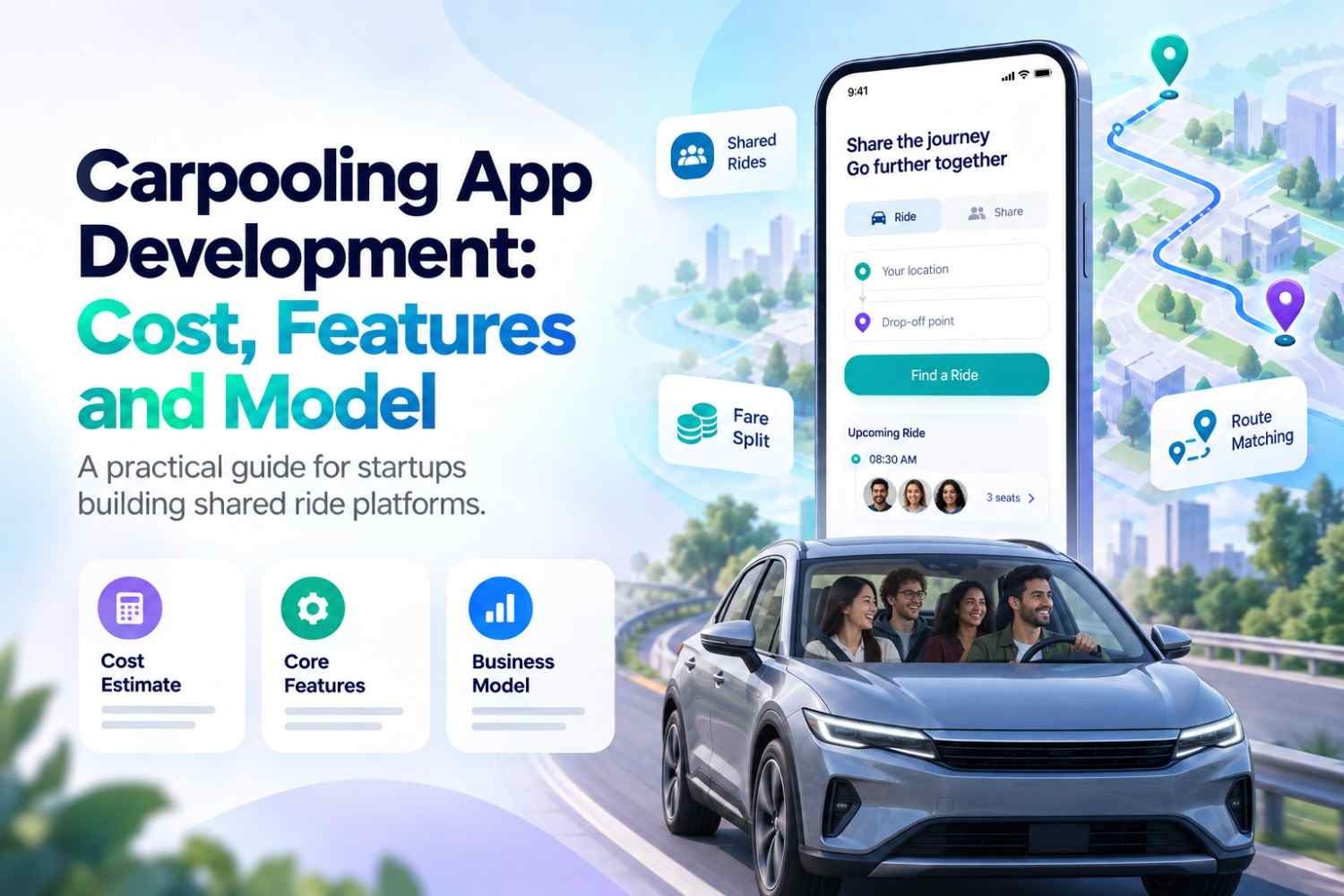
Carpooling app development involves more than placing riders and drivers on a map. A viable platform must coordinate recurring journeys, match people with compatible routes, calculate shared fares, protect personal information, and give operators enough control to manage disputes and cancellations. These requirements make a carpooling product different from a standard taxi-booking app.
The commercial opportunity is strongest in clearly defined travel communities. Examples include employees commuting to business districts, students travelling to campuses, airport workers sharing shifts, or residents connecting suburbs with limited public transport. Starting with one use case gives the marketplace a practical supply-and-demand boundary instead of asking an entire city to adopt a new service at once.
This guide explains the product scope, core features, cost drivers, business models, implementation stages, and mistakes that can damage the service after launch. It is written for founders comparing a ready-made platform with a custom build, and for established transport operators adding shared rides to an existing booking business.
A ready-made carpooling clone can provide a starting product structure, while branding, service rules, payment methods, geography, and operating workflows still need careful planning.
A carpooling app is a digital marketplace that allows people travelling in a similar direction to share a vehicle and divide the trip cost. Depending on the model, a driver may publish a planned journey and offer empty seats, or a passenger may request a trip and the platform may find a suitable driver or group of passengers.
The key distinction is intent. Ride-hailing usually responds to an immediate passenger request, while carpooling often coordinates a planned journey. The system therefore needs more than real-time driver availability. It must consider departure windows, pickup flexibility, route overlap, seat capacity, luggage, recurring schedules, and the trust relationship between participants.
Shared transportation is a two-sided marketplace with a difficult early-stage problem: passengers need enough relevant rides, and drivers need confidence that seats will be filled. A broad launch can create empty search results, which discourages passengers, while recruiting drivers without reliable demand can create wasted trips.
A focused operating area helps solve this problem. An operator might begin with a university corridor, a group of office parks, an airport route, or a regional intercity connection. The product can then support recurring schedules and repeat bookings, which are more predictable than purely on-demand demand.
The model also changes how the business thinks about pricing. A shared trip does not need to compete only on speed. It can compete on predictable departure times, lower passenger cost, convenient pickup points, verified participants, and reduced driving burden. The platform must still ensure that the fare structure is clear and complies with local transport, insurance, tax, and consumer protection requirements.
The first release should contain the functions needed to complete a safe booking, not every feature found in a large mobility marketplace. The product normally has a passenger app, a driver app, and an administrator dashboard. Some businesses may use one mobile application with role-based access, but separate workflows still need to be designed and tested.
Location data, identity records, and payment details require careful handling. A documented cyber security service plan should cover access control, secure storage, logging, incident response, and protection of administrative accounts.
There is no responsible single price for building this type of product without a defined scope. The final budget depends on the number of applications, supported platforms, interface complexity, integrations, geography, compliance requirements, and whether the operator starts from an existing product base or commissions a new system.
A practical estimate should separate initial build cost from ongoing operating cost. Hosting, maps, payment processing, identity verification, customer support, maintenance, monitoring, legal review, and user acquisition can continue after the first release. Omitting these items produces an attractive development estimate but an incomplete launch budget.
Before requesting proposals, prepare a feature priority list, target market, user roles, payment requirements, compliance assumptions, and launch workflow. Comparing like-for-like proposals is easier when every vendor receives the same scope. Apporio’s on-demand mobile app development service can be assessed against these requirements during product discovery.
A carpooling operator can earn from transactions, access, business partnerships, or supporting services. The right choice depends on whether the platform is optimising for frequent commuting, long-distance travel, employer transport, or a wider mobility ecosystem. Revenue should not be designed separately from user behaviour because excessive fees can reduce repeat bookings.
A marketplace should begin with one primary revenue stream and measure its effect on booking completion and repeat use. Adding several charges at launch can make the fare difficult to understand. Payment operations can be supported through suitable payment gateways, subject to country availability and provider requirements.
Successful implementation depends on decisions made before coding. The sequence below keeps product risk visible and prevents a large feature list from replacing market validation.
The strongest products treat marketplace operations as part of product design. A technically complete application can still fail if users cannot find a relevant ride, drivers do not understand payouts, or support teams lack the authority to resolve exceptions.
Focus on a small number of routes or communities first. A passenger who sees several useful options is more likely to return than one who searches a large map and finds nothing. Recruiting supply should follow the travel patterns of the initial segment, including departure times and recurring weekdays.
Show the total price, platform fee, taxes where applicable, and refund conditions before confirmation. If the price is shared among passengers, explain what changes when a seat is added, removed, or cancelled. Clear calculations reduce disputes and make partner negotiations easier.
Use the minimum information needed for verification and safe operations. Give users control over profile visibility, communication, and trip sharing. Administrators should have role-based access, activity logs, and procedures for handling identity documents and reports.
Commuters often repeat the same trip. Recurring ride schedules, saved routes, reminders, and booking templates reduce manual work for both sides. The system should still allow a user to skip a date or pause a schedule without deleting the entire arrangement.
Drivers and passengers may travel through areas with poor mobile coverage. Important booking details should remain available in a practical offline state, while the application queues non-critical updates and clearly shows when information was last refreshed.
Automated testing, deployment controls, error monitoring, backups, and documented environments make future changes safer. Teams planning native Android and iPhone releases should define ownership for platform updates, store submissions, and urgent production fixes. Apporio can also support Android app development and iPhone implementation as part of the technical scope.
Most early problems are not caused by a missing visual effect. They come from unclear operating rules, weak marketplace planning, and workflows that assume every trip will follow the happy path.
Founders usually compare a new custom build with a ready-made starting point or an existing taxi-oriented product. The correct choice depends on how different the business rules are from standard ride booking and how quickly the operator needs to test a focused market.
| Approach | Best suited to | Strengths | Trade-offs |
|---|---|---|---|
| Ready-made carpooling base | Founders validating a focused marketplace | Faster product foundation and established core workflows | May require configuration or additional work for local rules and integrations |
| Custom shared-mobility platform | Operators with distinctive regulations or complex matching | Greater control over architecture, workflows, and specialised features | More discovery, design, development, testing, and maintenance work |
| Taxi booking platform adapted for sharing | Existing transport businesses adding scheduled shared trips | Can build on familiar dispatch, location, and booking concepts | May need substantial changes for seat inventory, recurring rides, and driver-published journeys |
| Super app expansion | Businesses already offering several on-demand services | Shared mobility can sit beside other customer and payment journeys | Requires modular planning, service prioritisation, and more complex administration |
A carpooling product can later sit within a broader super app development roadmap, but adding more services should follow proven user demand. Expanding the menu before the core transport workflow is reliable can make support, analytics, and product ownership harder.
Carpooling app development is a marketplace and operations project as much as a software project. The product must match planned routes, handle seats and schedules, provide clear fares, verify participants, protect data, and give staff practical tools for exceptions. Cost depends on these decisions, along with platform coverage, integrations, compliance, and the level of customisation.
For founders, a focused launch segment and a controlled pilot are usually more useful than a large geographic promise. Apporio Infolabs can help evaluate a Carpooling Clone, extend an existing transport workflow through Taxi App Development, or plan a broader platform with Android, iPhone, payment, security, and administration requirements. Relevant Apporio offerings include Carpooling Clone, on-demand app development, Cyber Security, and Gojekk Clone for businesses planning multi-service expansion.
Discuss the target market, required features, operating rules, and launch priorities before selecting the implementation route.
The cost depends on product scope rather than one universal figure. The main variables include passenger and driver workflows, administrator tools, Android and iPhone coverage, map services, payment and payout integrations, identity verification, recurring rides, compliance requirements, and custom design. Ongoing hosting, support, maintenance, and third-party service charges should also be included in the launch budget.
The essential functions are registration, profiles, driver verification, ride publishing, trip search, route and pickup details, matching, seat management, booking, payment, notifications, communication, ratings, support, and an administrator dashboard. Recurring schedules are especially useful when the initial audience consists of regular commuters.
Common revenue streams include commissions on completed trips, passenger service fees, driver subscriptions, corporate commuting plans, sponsored placement, and membership passes. A new platform should begin with a clear primary revenue stream and check how fees affect booking completion, repeat use, driver participation, and support volume.
Ride-hailing usually matches an immediate passenger request with an available driver. Carpooling commonly coordinates a planned trip in which a driver publishes a journey or several passengers share a route. As a result, carpooling requires stronger support for schedules, route overlap, seat capacity, recurring travel, and shared fare calculations.
A ready-made base can suit a startup testing a defined market with standard booking and marketplace workflows. Custom development is more appropriate when the business has distinctive matching rules, complex compliance needs, unusual payment flows, or a long-term architecture requirement. The decision should follow a documented MVP and operating model rather than development speed alone.
Safety measures can include identity and driver verification, vehicle and document checks, controlled profile visibility, in-app communication, trip sharing, emergency reporting, ratings, moderation, account suspension, secure administration, and clear incident procedures. Requirements vary by market, so the product should be reviewed against local transport, insurance, privacy, and consumer protection rules.

