OUR PRODUCTS
Uberr Clone AppGojek Clone AppSuper App DevelopmentUberr Eats Clone AppGrocery App DevelopmentHandyman App Like Uberr
inDriver Clone AppDelivery App DevelopmentGlovo Clone AppBolt Clone AppLyft Clone AppCareem Clone App
OUR PRODUCTS

← Back to Blog
August 19, 2026
A practical guide to the inventory, order, picking, delivery, analytics, and control features quick commerce operators need in a dark store platform.
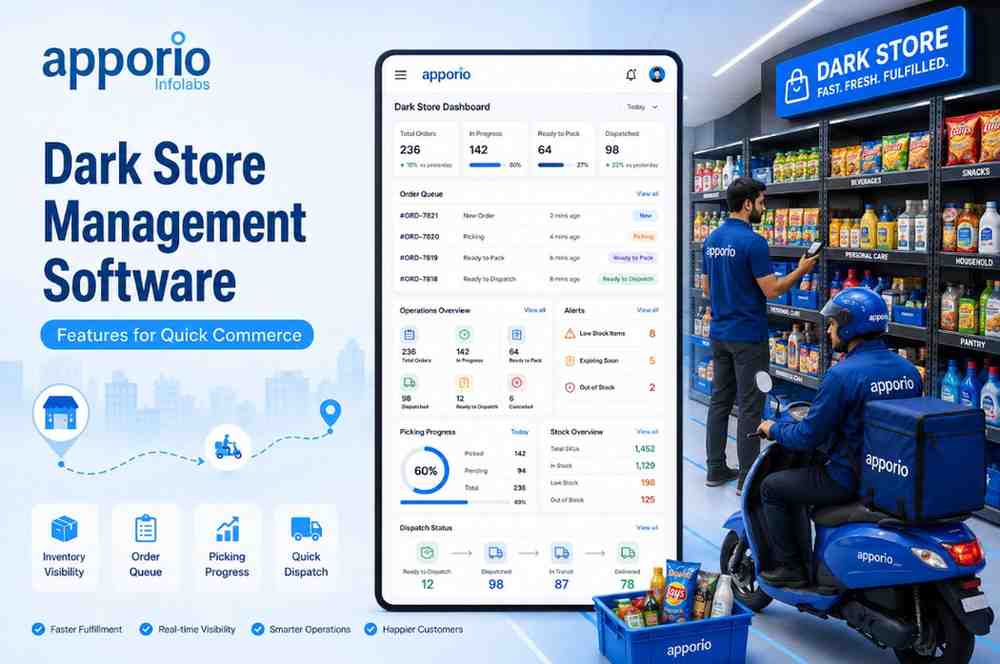
Quick commerce depends on a tightly controlled operating process. Customers may see a simple grocery order screen, but the business must coordinate catalog data, stock levels, picking, packing, dispatch, payments, and customer communication within a short service window. dark store management software provides the operational layer connecting these activities.
For founders evaluating a quick commerce platform, the main question is not whether the system has an attractive customer app. The more important question is whether the technology can help a compact fulfillment location process orders accurately as volume increases. A delayed stock update or poorly designed picking workflow can create substitutions, refunds, cancelled orders, and higher delivery costs.
This guide explains the functions to assess before selecting or building a solution. It covers store operations, customer-facing capabilities, delivery coordination, reporting, integrations, and the implementation decisions that affect performance across different countries and operating models.
Apporio’s quick commerce app guide provides additional context on dark stores, delivery operations, and development considerations.
A dark store platform is a digital system used to operate a retail fulfillment location that does not serve walk-in shoppers. Staff receive online orders, locate products inside the store, pack them, and hand them to delivery personnel. The software coordinates this process while showing customers accurate product availability and order status.
The platform normally includes an admin panel, store dashboard, inventory controls, picker workflow, customer application or web interface, delivery management, payment support, and reporting. These components can be deployed as one connected system or integrated with existing commerce, warehouse, accounting, and logistics tools.
This workflow is different from a conventional online grocery model where a customer order may be picked from a large supermarket or supplied by an independent retailer. A dark store requires more direct control over shelf layout, replenishment, staff roles, and order throughput.
Fast delivery is the visible promise of quick commerce, but speed is produced inside the fulfillment operation. Every minute spent correcting an inaccurate stock record, searching for a product, waiting for a packer, or finding a delivery worker affects the final customer experience.
Centralized operational data helps the business identify where time and margin are being lost. For example, an operator can compare picking time by store, cancellation reasons by product category, delivery delays by zone, and stock variance by shift. These insights are more useful than a single average delivery number because they point to specific process changes.
Store technology also matters when an operator expands into new cities or countries. Each market may require different payment methods, tax rules, delivery zones, currencies, languages, and product units. A platform that supports configuration rather than hard-coded assumptions is easier to adapt to those differences.
The system should therefore be evaluated as an operations product, not only as a shopping application. A polished interface cannot compensate for poor inventory controls or slow store execution.
The strongest solutions connect customer demand with fulfillment capacity. The following capabilities deserve priority during commercial evaluation because they directly affect order accuracy, service reliability, and operating visibility.
The platform should support product creation, category management, variants, pack sizes, units of measurement, pricing, discounts, taxes, images, and store-specific availability. Inventory adjustments should be traceable so managers can distinguish sales, wastage, returns, damaged stock, manual corrections, and supplier receipts.
Multi-location inventory is particularly important. The same product may be available in one dark store but unavailable in another. Store-level stock, safety thresholds, reorder points, and reserved inventory should be represented separately rather than treated as one generic number.
Managers need a single view of new, accepted, picking, packed, dispatched, delivered, cancelled, refunded, and failed orders. Allocation rules can consider delivery radius, stock availability, store workload, and opening hours. The system should also allow authorized staff to reassign an order when the selected location cannot fulfill it.
A picker interface should show the product name, quantity, image, location or shelf reference, and any special instructions. The worker should be able to mark an item as found, unavailable, damaged, or substituted. Customer approval may be required before a replacement is added, depending on the business policy.
These controls reduce common errors such as missing items, incorrect quantities, and unauthorized replacements. They also create a record that customer support can use when investigating a complaint.
Dispatch functionality should show order readiness, delivery zones, available drivers, assignment status, and estimated delivery progress. Location tracking can help operations teams identify stalled deliveries, while delivery confirmation records help close orders accurately.
Businesses that need a broader fulfillment layer can review Apporio’s delivery app development offering when planning the connection between store operations and last-mile service.
The customer experience should support relevant payment methods for the target market, including card, digital wallet, cash where appropriate, and other locally supported options. Payment status must remain synchronized with order status so staff can identify authorized, failed, pending, refunded, and disputed transactions.
Push notifications, SMS, or email can communicate order confirmation, picking progress, substitution requests, dispatch, delivery, and refunds. The message system should avoid sending a delivery confirmation before the order is actually completed.
Useful dashboards cover order volume, average picking time, packing time, cancellation rate, stock variance, substitution rate, refund value, delivery performance, repeat purchase behavior, and sales by store or category. Staff permissions should also be separated. A picker does not need access to financial settings, while a finance manager may not need to alter inventory quantities.
Choosing a platform begins with operational design, not with a list of attractive screens. Map the real process first, then test whether the product supports it without excessive manual work.
A vendor demonstration should show the complete workflow rather than only the customer checkout. Ask to see the picker screen, store dashboard, inventory correction process, dispatch queue, refund process, and reporting view. These areas reveal whether the product has been designed for day-to-day operations.
Technology performs best when the physical store and digital workflow are designed together. The following practices help operators maintain consistency as order volume grows.
Place frequently purchased items in locations that reduce walking distance, but do not optimize only for individual product popularity. Consider products often bought together, temperature requirements, fragile items, and packing sequence. Shelf labels and consistent location codes help new staff find items without relying on one experienced worker.
Define how the system handles damaged goods, expired stock, returns, shrinkage, supplier receipts, and manual corrections. Use stock counts on a planned schedule and investigate repeated variances by product, shift, or store. Inventory accuracy is a process responsibility, not only a software setting.
Measure the time from order acceptance to picking start, picking completion to packing, and packing to driver handoff. If the final delivery time is the only metric, managers cannot tell whether the problem is inside the store or on the road.
Delivery areas should reflect traffic, road access, weather patterns, driver availability, and order density. A small radius may be appropriate in a congested urban district, while a larger zone may work in a lower-density area. Service promises should be based on observed operating capacity rather than a marketing target.
Set clear customer rules for replacement products, price differences, approval windows, and refunds. A substitution flow that requires too many steps can delay fulfillment, while an uncontrolled flow can create complaints and payment disputes.
Store managers should review a short operational dashboard at the start and end of each shift. The dashboard can highlight unfulfilled orders, low-stock products, late handoffs, failed deliveries, refunds, and unusual cancellation patterns. Reports become useful when they lead to an assigned action.
Store staff need a defined process for temporary internet loss, device failure, payment service downtime, or delivery tracking interruptions. Offline procedures, retry handling, status reconciliation, and support escalation should be tested before launch. DevOps planning can be supported through Apporio’s DevOps consulting service.
Many quick commerce projects struggle because the initial scope focuses on customer acquisition while underestimating fulfillment complexity. Avoiding these mistakes improves the quality of both the software and the business plan.
These problems are easier to prevent when operations staff, finance owners, customer support, delivery managers, and technical teams participate in requirements planning. The platform should reflect how the business actually works.
Not every operator needs the same level of complexity on the first day. The right scope depends on store count, order volume, delivery ownership, product range, and the number of countries being served.
| Capability | Single-store Pilot | Multi-store Operation | Multi-market Platform |
|---|---|---|---|
| Catalog and Pricing | Central catalog with basic categories and promotions | Store-level availability and price controls | Localized currencies, taxes, languages, and product rules |
| Inventory | Stock adjustments and low-stock alerts | Location-based inventory and replenishment records | Cross-store visibility, transfers, and advanced planning |
| Order Handling | Manual store assignment with core status tracking | Allocation based on stock, zone, and workload | Configurable allocation rules across markets |
| Picking and Packing | Digital picking list and item confirmation | Shelf references, substitutions, and shift monitoring | Standardized workflows with market-specific policies |
| Delivery | Basic assignment and delivery confirmation | Dispatch queue, tracking, and zone management | Multiple delivery partners, service rules, and performance reporting |
| Reporting | Orders, sales, cancellations, and refunds | Store productivity, stock variance, and delivery metrics | Market comparison, role dashboards, and consolidated analytics |
A pilot should not be treated as a smaller version of an undefined product. It should prove the critical operating assumptions: whether the catalog is manageable, whether staff can pick accurately, whether delivery capacity matches demand, and whether the chosen service area supports the intended economics.
Quick commerce software must coordinate the physical store, customer order, inventory record, picker, payment process, and delivery handoff in one operational flow. The most important evaluation points are inventory accuracy, store allocation, picking and packing controls, exception handling, delivery visibility, market localization, reporting, and security.
Businesses planning this model can assess Apporio’s Grocery Delivery product, Delivery App Development, and On Demand Mobile App Development services as part of their technology planning. The final scope should be based on the store model, launch market, delivery capacity, integrations, and measurable operating requirements.
For a practical review of dark store workflows and the right platform structure, explore Apporio’s grocery delivery app option and discuss the requirements with its team. dark store management software should be selected as an operational foundation, not simply as a storefront feature. Book Free Demo
It coordinates online orders, store-level inventory, product picking, packing, dispatch, delivery updates, payments, refunds, and operational reporting for fulfillment locations that do not serve walk-in customers.
The essential starting set includes catalog management, store-level inventory, order allocation, digital picking, packing confirmation, substitution handling, payment processing, delivery assignment, notifications, and basic reporting.
Yes, a suitable platform can manage multiple locations when it supports separate inventory, store operating hours, service zones, pricing rules, staff permissions, order queues, and location-based allocation.
It reduces errors through current inventory records, digital picking lists, product confirmation, shelf references, substitution workflows, packing checks, and an audit trail for stock or order changes.
Usually, the core order, inventory, picking, packing, payment, and delivery workflows should be stabilized first. Forecasting and other advanced automation are more useful after the business has reliable operational data.
They should test the full order lifecycle, including store allocation, low stock, unavailable products, substitutions, payment failure, refunds, delayed delivery, staff permissions, reporting, and temporary connectivity problems.

