OUR PRODUCTS
Uberr Clone AppGojek Clone AppSuper App DevelopmentUberr Eats Clone AppGrocery App DevelopmentHandyman App Like Uberr
inDriver Clone AppDelivery App DevelopmentGlovo Clone AppBolt Clone AppLyft Clone AppCareem Clone App
OUR PRODUCTS

← Back to Blog
August 18, 2026
A practical guide to launching a quick commerce platform, covering dark stores, inventory, delivery operations, essential features, monetization, and development costs.
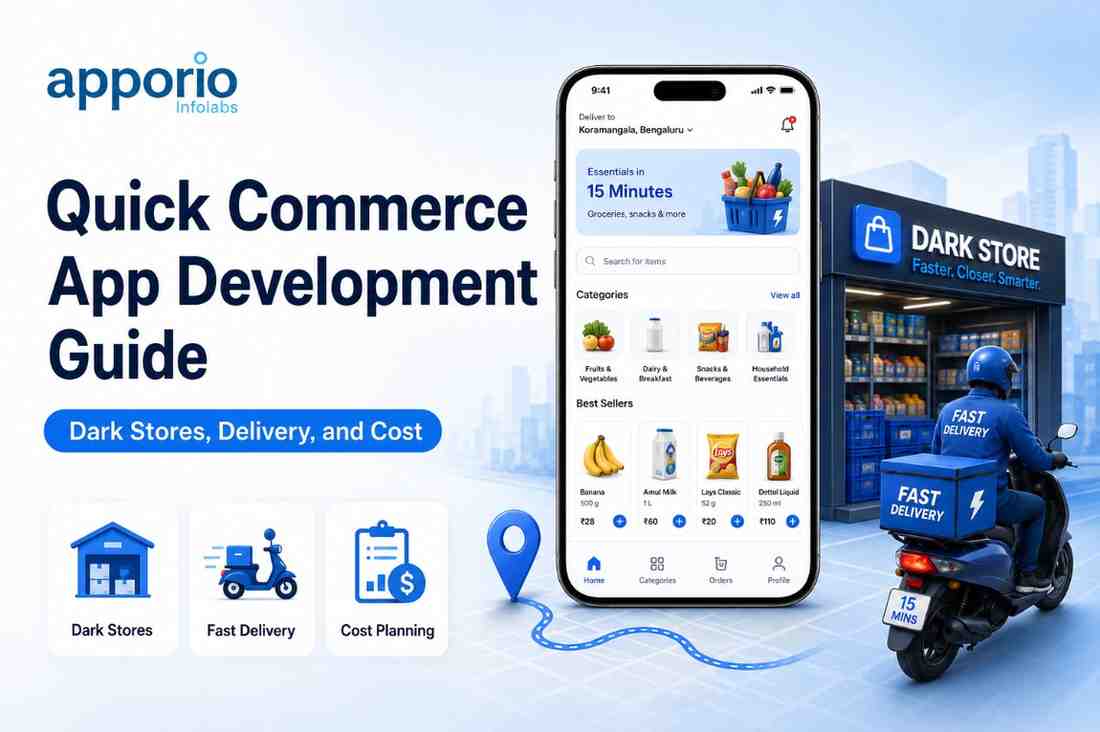
Fast grocery and convenience delivery depends on more than a polished mobile interface. The operating model must connect local inventory, dark stores, order processing, dispatch, delivery staff, payment collection, and customer support in one workflow. That is why quick commerce app development requires product planning across software and physical operations.
The commercial opportunity is strongest in dense urban areas where customers value short delivery windows and predictable stock availability. However, speed creates operational pressure. A platform needs accurate inventory data, compact delivery zones, efficient picking routes, and dispatch rules that prevent riders from travelling too far for small orders.
This guide explains how the model works, which features matter, how to plan a first release, what affects the budget, and where businesses commonly make costly mistakes. It is written for founders, retailers, logistics operators, and entrepreneurs evaluating a white-label or custom launch.
Quick commerce app development is the process of creating a digital ordering and delivery platform for rapid delivery of groceries, household supplies, personal care products, snacks, and other frequently purchased items. Unlike a marketplace that sends orders to independent retail stores, this model commonly uses dark stores or micro-fulfilment locations controlled by the operator.
A dark store is a retail facility designed for online order fulfilment rather than walk-in shopping. Its shelves are arranged around order-picking speed, product demand, and delivery geography. When a customer places an order, the system identifies the closest location with sufficient stock, assigns the order to a picker, verifies the basket, and passes it to dispatch.
The platform usually includes several connected interfaces:
The central challenge is synchronisation. A product shown as available must remain available through checkout, picking, and handover. If stock data is delayed, the customer experience suffers even when the application itself works correctly.
Rapid delivery changes the commercial relationship between a retailer and its customers. A conventional grocery purchase may be planned around a weekly shopping trip. A quick commerce order is often triggered by an immediate need: missing breakfast items, a household essential, a late-night snack, or a last-minute personal care product. The application must support this behaviour with fast discovery, reliable availability, and simple repeat ordering.
For operators, the model also creates a direct data layer. Order history can show demand by neighbourhood, hour, category, weather condition, and promotion. That information can inform purchasing and store placement, but only if the inventory, order, and delivery records are structured consistently.
The model matters for several practical reasons:
Before development begins, founders should validate order density, average basket size, delivery radius, product mix, and local labour costs. A short delivery promise is difficult to support in a region with dispersed addresses or weak mapping data.
A well-planned platform can improve both customer convenience and operational control. The benefits do not come from adding every possible feature. They come from reducing friction at the points where an order can fail: product discovery, payment, fulfilment, dispatch, and delivery confirmation.
When the operator manages dark stores, the catalogue and fulfilment process can be designed together. Stock thresholds, expiry tracking, category restrictions, and low-inventory alerts help reduce cancellations. Real-time or near-real-time updates are especially important for high-demand products.
Orders can be routed to the nearest suitable location instead of manually assigned to a distant shop. A picker workflow can group tasks, display shelf positions, and flag unavailable products before dispatch. This reduces unnecessary communication between customers, store staff, and riders.
Push notifications, SMS, or email updates can explain each stage: order received, picking started, packed, rider assigned, and delivered. Clear status information reduces support tickets because customers do not need to guess where an order is.
Administrators can compare demand by zone, product category, delivery period, and store. These reports help determine whether to add a new dark store, adjust the service boundary, change rider shifts, or revise the product catalogue.
The same foundation can support groceries, pharmacy-related products where legally permitted, prepared food, household goods, or local specialty items. Each category requires its own compliance, handling, and catalogue rules, so expansion should follow operational readiness rather than app navigation alone.
Businesses evaluating a broader service portfolio can also review Apporio’s Super App Development offering, although a focused grocery launch is usually easier to operate and measure at the beginning.
The first release should cover the complete order cycle. A customer-facing application without strong fulfilment and administrative tools will create manual work behind the scenes. The following feature groups are more important than decorative interface elements.
A staged approach helps a business test the operating model before investing in broad geographic coverage. Software decisions should follow the service design, not the other way around.
For companies that need several delivery types or a more complex fleet, Logistics App Development may be a relevant capability to assess during technical planning.
There is no responsible single price for this type of product without a defined scope. The budget depends on the number of applications, custom workflows, integrations, operating countries, design depth, infrastructure, and post-launch support requirements.
The main cost drivers include:
To compare proposals properly, ask vendors to separate one-time development, third-party charges, hosting, maintenance, support, and future change requests. A low initial quote may exclude operational dashboards, testing, deployment, or integration work needed for real orders.
Quick delivery is an operational promise, so product decisions should be tied to measurable service conditions. The strongest implementations begin with a narrow, testable operating model and improve it through real order data.
Happy-path ordering is easy to demonstrate. Production reliability depends on what happens when stock is missing, a card fails, a rider is delayed, a customer changes an address, or an order contains a restricted item. Define these cases before development and give staff clear resolution controls.
Stock should be reserved or revalidated at the right point in the transaction. If several customers can buy the same final unit because updates are delayed, the business will create substitutions, refunds, and dissatisfaction. The correct approach depends on the inventory system and order volume, but the risk should be tested explicitly.
A small radius is not automatically profitable. Operators should consider traffic, building access, weather, rider availability, parking, and delivery density. A map distance that looks short may still create a long real-world trip.
Track search-to-cart conversion, checkout completion, payment success, picking duration, order accuracy, dispatch delay, delivery time, cancellations, refunds, repeat purchases, and support contacts. These metrics show where improvement work will have the greatest operational effect.
Customer, rider, picker, and administrator roles should not share the same permissions. Use authentication controls, audit records, secure credential handling, and restricted access to personal information. Security should be part of the system design rather than a final inspection.
Product names, pack sizes, images, shelf locations, allergen details where relevant, and substitution rules should be maintained as structured data. Clean catalogue information improves picking accuracy and reduces customer questions.
The application stack should support monitoring, updates, integrations, and future team ownership. Cross-platform development can reduce duplicated work in some cases, while native components may be justified for device-specific requirements. The right choice depends on the target platforms and product complexity.
Many failed launches are caused by business-process gaps rather than missing visual features. These mistakes are avoidable when the team tests the full service before opening it to a large market.
The best product route depends on how much of the operation is standard, how quickly the business needs to validate demand, and whether the operator owns inventory and fulfilment.
| Model | Fulfilment Control | Development Scope | Best Fit |
|---|---|---|---|
| White-Label Rapid Delivery Platform | Operator-led or configured partner workflow | Existing foundation with branding, configuration, and selected changes | Founders testing a focused market with standard ordering and delivery needs |
| Custom Dark Store Platform | High control over stores, inventory, pricing, and dispatch | Designed around unique processes, integrations, and expansion requirements | Retailers or logistics operators with complex internal systems |
| Marketplace Delivery Platform | Partner stores control much of the inventory | Merchant onboarding, catalogue management, commissions, and delivery coordination | Businesses aggregating local retailers rather than operating their own stores |
| Hybrid Model | Combination of owned fulfilment and external merchants | Multiple workflows with separate rules for stock, pricing, and delivery | Operators expanding after proving one fulfilment model |
A white-label approach can be practical when the core workflow is familiar and the priority is market validation. Custom work becomes more important when the business needs specialised inventory, pricing, warehouse, or dispatch rules. A marketplace model may reduce direct inventory responsibility, but it introduces merchant quality, catalogue accuracy, and partner coordination challenges.
A successful quick commerce platform connects customer ordering with the physical realities of dark stores, product availability, picking, dispatch, rider capacity, and support. The development budget should reflect that full operating system rather than only the mobile interface.
Start with a defined service zone, a manageable catalogue, reliable payment and inventory workflows, and measurable delivery operations. Apporio Infolabs can support this type of launch through Delivery App Development, the Uber for Grocery Delivery App, Logistics App Development, and white-label on-demand app development services. For businesses assessing quick commerce app development, the next step is to map the operating model and request a scope based on real fulfilment requirements. Book Free Demo
A dark store is a retail location designed for online order fulfilment rather than walk-in shopping. Staff pick and pack customer orders there, usually within a defined delivery zone.
Important features include location validation, product search, catalogue and inventory management, cart and checkout, payment processing, order tracking, picker workflows, rider dispatch, refunds, support tools, and operational analytics.
The cost depends on the number of applications, custom workflows, integrations, operating countries, platform coverage, security requirements, and support scope. A reliable estimate requires a defined product and fulfilment plan.
A white-label foundation may suit a startup validating a focused market with standard ordering and delivery requirements. Custom development is more suitable when the business needs specialised inventory, pricing, warehouse, dispatch, or integration workflows.
Use accurate inventory updates, realistic service boundaries, clear picking instructions, controlled substitutions, rider status tracking, address validation, payment verification, and defined refund and support procedures.
Yes, the same foundation may support household products, personal care items, snacks, or other categories. Each additional category should be reviewed for catalogue structure, storage, handling, legal, and fulfilment requirements.

