OUR PRODUCTS
Uberr Clone AppGojek Clone AppSuper App DevelopmentUberr Eats Clone AppGrocery App DevelopmentHandyman App Like Uberr
inDriver Clone AppDelivery App DevelopmentGlovo Clone AppBolt Clone AppLyft Clone AppCareem Clone App
OUR PRODUCTS

← Back to Blog
September 17, 2026
A practical guide to dynamic seat inventory, route scheduling, booking holds, operator controls, synchronization, and scalable architecture for bus booking platforms.
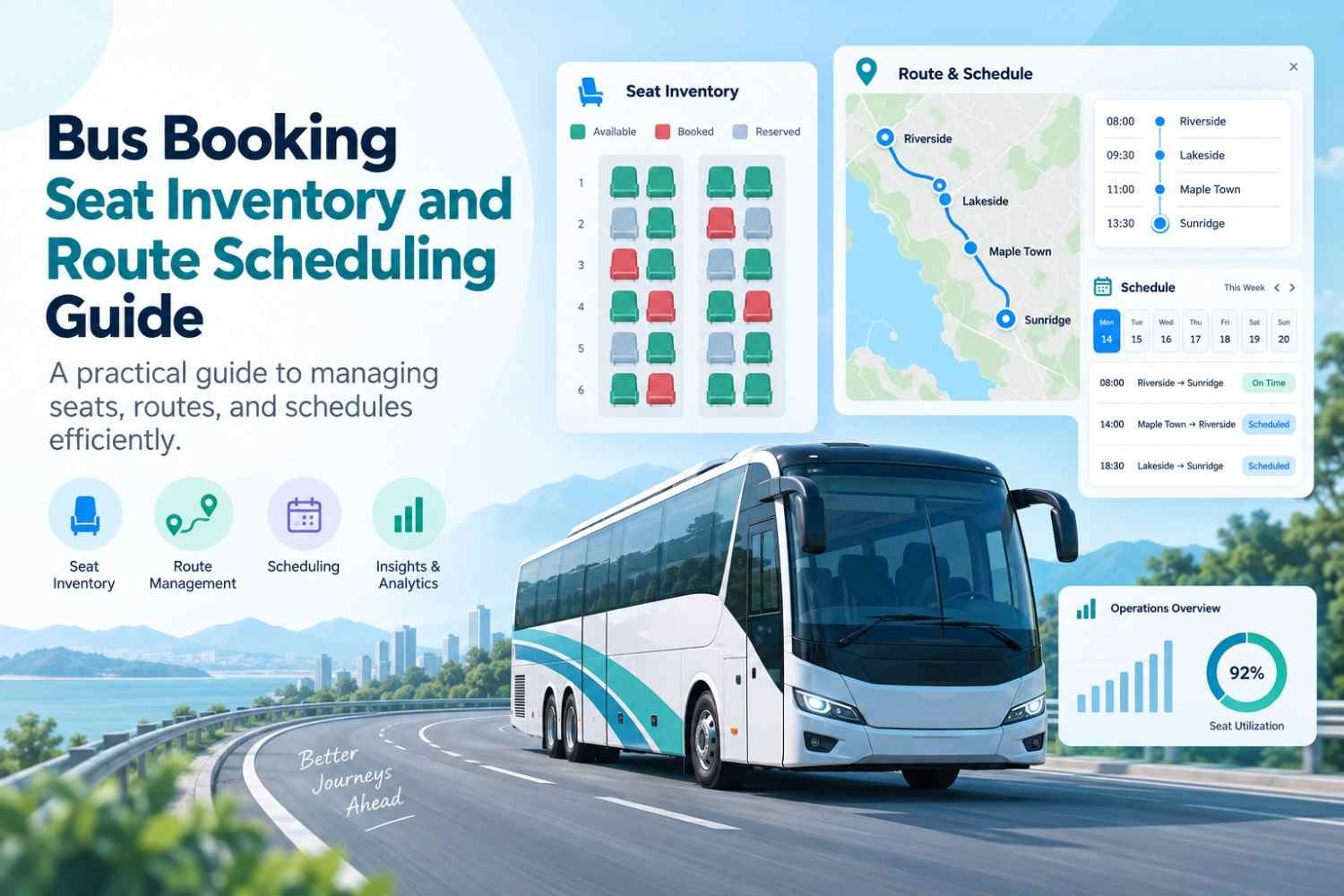
A bus booking seat inventory system must do more than display available seats. It has to maintain one reliable view of capacity while passengers search, operators edit schedules, agents make bookings, and payment events arrive at different times. A seat shown as available on one screen but sold on another creates double bookings, refunds, support work, and customer distrust.
Route scheduling adds another operational layer. A bus may operate on multiple days, visit several stops, use different vehicles, change departure times, or have seats restricted for particular boarding points. The platform therefore needs a structured model for routes, trips, vehicles, seat layouts, booking states, and schedule exceptions.
This guide explains the product and technical decisions behind dynamic inventory and route planning. It is written for transport entrepreneurs, bus operators, marketplace teams, and companies evaluating bus booking app development for a local, regional, or international market.
Dynamic seat inventory is the real-time management of seats that can be searched, held, booked, cancelled, released, or blocked. The inventory is connected to a specific trip rather than only to a bus model. This distinction matters because the same vehicle may run different routes, have different boarding points, or be replaced by another vehicle.
Route scheduling is the configuration of recurring and one-time trips. It defines where a bus starts, which stops it visits, when it departs, how long each leg is expected to take, and when bookings close. A route is a reusable template. A trip is a dated operational instance created from that template.
Bus inventory is more complex than a simple count of seats. In many services, passengers do not travel from the first stop to the final stop. A seat can be sold multiple times during one journey, provided the booking intervals do not overlap. A basic “available versus sold” counter cannot represent this correctly.
Schedule accuracy also influences the entire booking journey. Search results, fare calculation, seat selection, notifications, driver instructions, manifests, and settlement reports depend on the same trip record. If each area maintains separate timing or availability data, operational discrepancies appear quickly.
For a business serving multiple operators, these problems multiply because each partner may follow different seat layouts, cancellation rules, boarding practices, and settlement cycles. A central operational model with configurable rules is more practical than hard-coding one operator’s workflow.
A dynamic model improves the commercial and operational parts of a bus marketplace at the same time. It gives passengers clearer choices while giving operators more control over capacity and service planning.
Availability can be calculated for a selected origin and destination instead of showing a single total for the full route. This supports intermediate boarding points and reduces the risk of selling overlapping journeys.
Segment-based selling allows one seat to serve different passengers on different legs. Operators can also add extra trips when demand rises, change the assigned vehicle, or release previously blocked seats after an operational review.
Administrators can create recurring trips, edit a single departure, pause a route, or apply a holiday exception without rebuilding the complete catalog. This reduces the need for engineering support for ordinary operations.
Passengers see the same seat map, boarding information, fare, and trip status across search, checkout, ticketing, and notifications. Consistency is particularly important when bookings are available through an app, website, station counter, and third-party agent.
Trip-level data supports practical reporting: occupancy by departure, revenue by route, cancellation rate, seat utilization by segment, no-show patterns, and operator settlement amounts. These reports help teams decide where to add capacity or revise schedules.
Bus operators can manage only the routes, vehicles, and trips assigned to them. Role-based access limits accidental changes and creates a clearer audit trail for edits, cancellations, refunds, and manual seat blocks.
The booking workflow should separate search, temporary reservation, payment confirmation, and final ticket issuance. Treating all four events as one action makes timeout handling and payment recovery difficult.
Two users can select the last available seat almost simultaneously. The final booking operation must therefore use a transaction or another reliable concurrency control method. The database should recheck the seat interval immediately before confirmation, not rely only on the availability shown during search.
Idempotency is also important. If a payment callback is sent twice, the system should not create two tickets. Each payment and booking event needs a unique reference that can be safely processed more than once.
Strong implementation begins with operational rules, not screen design. Before development, document how operators sell seats, change buses, handle passengers who board late, and process cash or agent bookings.
Store inventory against a dated trip and vehicle assignment. A general route-level seat count is insufficient because capacity, timing, and reservations change from one departure to another.
For each reservation, store the origin stop and destination stop. Availability logic should identify overlapping intervals. For example, a booking from Stop 2 to Stop 4 should prevent another booking from Stop 3 to Stop 5 on the same seat, while allowing a booking from Stop 4 to Stop 6 if the business rules permit turnover at Stop 4.
Use clear states such as available, held, confirmed, cancelled, expired, blocked, checked-in, and completed. Every transition should have an authorized actor, timestamp, reason where applicable, and audit record.
Planned arrival and departure times support search and ticketing. Actual times support operations and reporting. Keeping both prevents a delay from rewriting the original schedule and confusing passengers reviewing their booking history.
The passenger app should not be the only source of inventory changes. Admin users, operators, station agents, call-center staff, and integrations may all create or modify bookings. Every channel must use the same reservation service and validation rules.
Events can notify mobile apps, dashboards, ticketing services, and communication tools when a booking is confirmed or cancelled. However, event delivery should not replace the authoritative inventory check. Notifications may be delayed; the booking database must remain the source of truth.
Some stations or driver environments may have intermittent internet access. Define how offline manifests are downloaded, how agent bookings are synchronized, and how conflicts are reviewed. Do not allow offline edits to overwrite confirmed online bookings without a reconciliation process.
Use appropriate access controls, secure API communication, audit logging, and carefully scoped administrative permissions. A review of payment gateways should cover refunds, asynchronous callbacks, local payment methods, and settlement reporting rather than only the checkout screen. Security testing and operational monitoring should be included from the beginning; Apporio also provides cyber security services for this type of review.
Search traffic often rises around holidays, weekends, and popular departure times. Caching route schedules can reduce read load, but seat availability should be validated against current transactional data. Monitoring should track booking latency, failed holds, expired holds, callback delays, and database contention. Teams evaluating infrastructure may also review DevOps consulting as part of the deployment plan.
Most inventory failures come from simplifying a transport operation that is inherently segment-based and multi-channel. The following mistakes are common during early product planning.
The right inventory approach depends on route complexity, sales channels, and the number of operators supported. A small fixed-route service may begin with a simpler model, while a marketplace usually needs segment-level controls from the first release.
| Approach | How it works | Suitable for | Main limitation |
|---|---|---|---|
| Static seat count | Tracks only the total number of seats remaining. | Single-stop or fixed destination services. | Cannot represent seat availability between multiple stops. |
| Trip-level seat map | Tracks individual seats for each dated departure. | Operators with defined vehicle layouts. | Needs additional logic for intermediate stops. |
| Segment-based inventory | Tracks seat occupancy across origin and destination intervals. | Multi-stop routes and regional bus marketplaces. | Requires careful overlap validation and transaction control. |
| Multi-channel inventory | Connects app, website, agents, counters, and operator tools to one booking service. | Growing platforms with several sales channels. | Requires synchronization, permissions, and reconciliation workflows. |
For many commercial platforms, trip-level seat maps combined with segment-based availability provide a useful foundation. Multi-channel support should be added as soon as bookings are created outside the passenger app, because disconnected sales channels create inventory conflicts regardless of the interface quality.
Dynamic inventory and route scheduling are central operating capabilities for a dependable bus booking product. The platform should treat each departure as a distinct trip, calculate availability by travel segment, expire unpaid holds, validate concurrent bookings, and give operators controlled tools for schedule exceptions and vehicle changes.
For teams planning a bus booking seat inventory system, Apporio Infolabs can support the product through Bus Booking App Development, white-label on-demand app development, Android App Development, and DevOps Consulting Service. The final scope should reflect the operator model, route structure, payment environment, sales channels, and compliance requirements of the target market.
Dynamic seat inventory is the real-time management of seats for a specific dated trip. It supports availability, temporary holds, confirmed bookings, cancellations, blocked seats, and seat release as booking states change.
The platform stores the passenger’s origin and destination stops and checks whether the selected seat is occupied during that interval. A seat can be sold to different passengers on non-overlapping legs of the same journey.
The server must recheck availability during the final booking transaction and use reliable transaction or concurrency controls. Temporary holds need expiry timestamps, and repeated payment callbacks must be handled idempotently.
Yes. Authorized operators or administrators can manage schedule exceptions such as delays, cancellations, added trips, changed vehicles, and revised departure times. The system should preserve planned and actual times and notify affected passengers.
It should if the business accepts bookings through those channels. Agents and counters need to use the same authoritative reservation service so that manual sales immediately affect online availability and manifests.
The first version should cover route and stop setup, dated trip creation, vehicle seat layouts, segment availability, temporary holds, payment confirmation, ticket issuance, cancellations, operator access, and basic manifests. More advanced integrations can follow after the operating workflow is validated.

