OUR PRODUCTS
Uberr Clone AppGojek Clone AppSuper App DevelopmentUberr Eats Clone AppGrocery App DevelopmentHandyman App Like Uberr
inDriver Clone AppDelivery App DevelopmentGlovo Clone AppBolt Clone AppLyft Clone AppCareem Clone App
OUR PRODUCTS

← Back to Blog
September 18, 2026
A practical 2026 guide to ecommerce app budgets, feature costs, technology choices, integrations, maintenance, and selecting the right development approach.
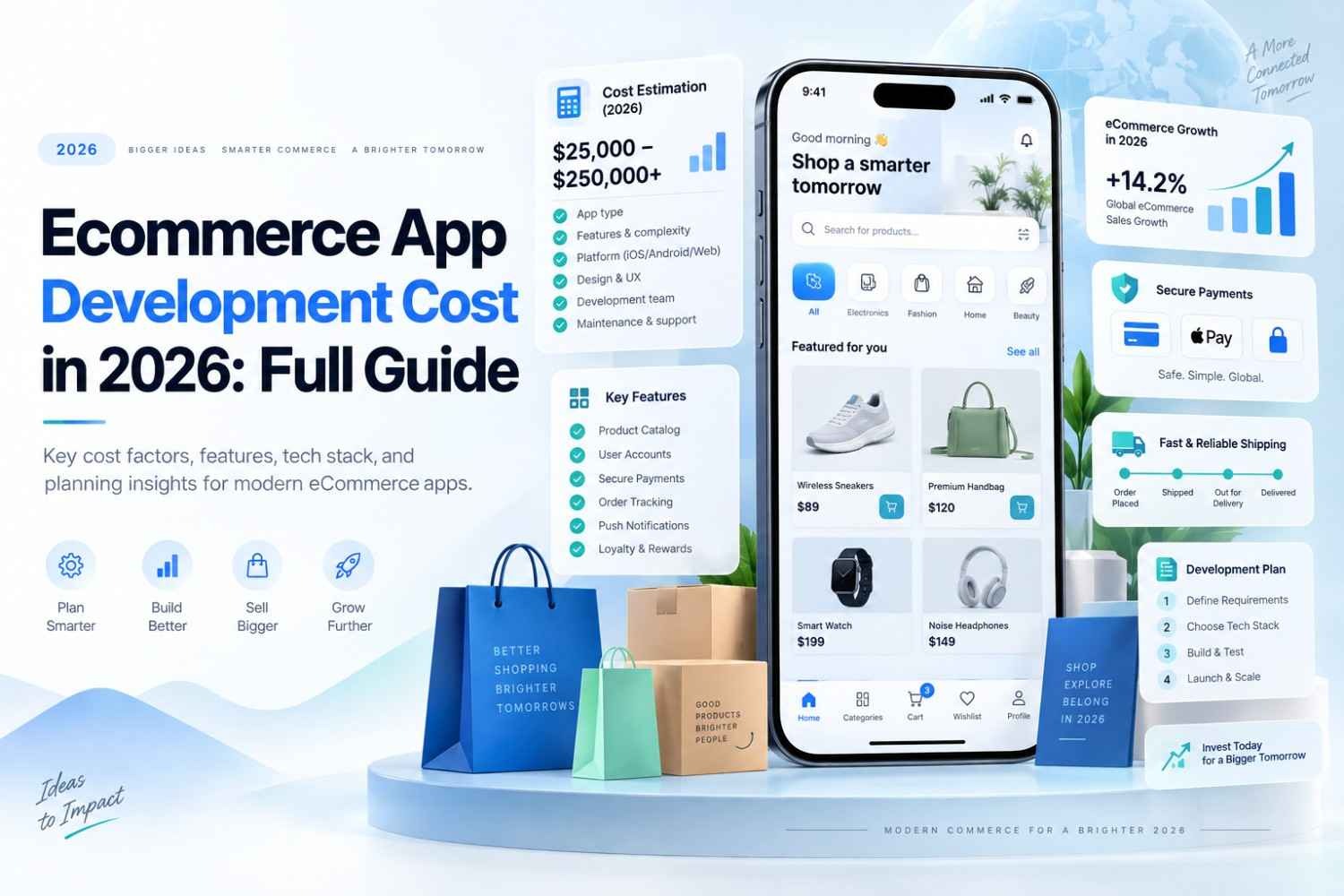
The ecommerce app development cost in 2026 depends less on the number of screens and more on the operating model behind the product. A basic shopping app with a catalog, cart, checkout, and order tracking has a different budget from a multi-vendor marketplace with seller dashboards, commissions, delivery workflows, promotions, and regional payment methods.
For a USA or global launch, the budget also changes according to platform coverage, localization, data protection, inventory complexity, third-party services, and post-launch support. A realistic estimate must separate product discovery, design, development, testing, deployment, and ongoing operations.
This guide explains the main cost drivers, compares common development approaches, and gives a practical planning process. It is designed for founders and established businesses deciding between a focused MVP, a white-label foundation, and a larger custom commerce platform.
For businesses that already know their sales model but need technical execution, Ecommerce Application Development can provide a relevant starting point for evaluating scope and implementation requirements.
An ecommerce application is a digital sales system, not just a mobile storefront. It connects customers with products, merchants, inventory, payments, fulfillment, support, and business reporting. The customer-facing app is only one part of the platform.
The scope becomes larger when the business supports multiple sellers, warehouses, currencies, tax rules, languages, fulfillment partners, or country-specific payment methods. A single-brand retailer can often begin with a narrower architecture, while a marketplace must design for separate roles and financial flows from the start.
Commerce applications may also include a responsive website, customer support tools, recommendation logic, loyalty features, subscription billing, and integrations with enterprise resource planning or warehouse systems. These additions should be treated as separate scope items rather than assumed to be included in a basic quote.
Underbudgeting is one of the most common causes of delay in digital commerce projects. Teams often estimate the customer app but overlook admin operations, product data migration, payment verification, refunds, shipping exceptions, tax treatment, and marketplace payouts.
A budget is useful when it reflects the complete operating workflow. For example, an app may display an order as “shipped,” but the business still needs a process for partial shipments, failed delivery, canceled items, address changes, refunds, and customer complaints. Each exception affects backend logic and administration tools.
Planning these areas early helps founders compare proposals on the same basis. A lower initial quote may exclude essential operational tools, while a larger quote may include features that are not needed to validate the business model.
There is no single price that applies to every commerce product. The following variables usually have the greatest effect on the project budget.
A single-vendor store has one product owner and one primary inventory source. A multi-vendor marketplace must manage seller onboarding, product ownership, commission rules, vendor payouts, dispute handling, and separate permissions. That additional logic affects the app, backend, admin panel, and testing effort.
Catalog browsing and checkout are comparatively straightforward. Advanced capabilities such as product variants, configurable bundles, wishlist synchronization, recurring orders, store credit, loyalty points, product reviews, live chat, personalized recommendations, and subscription management require additional design and backend work.
Building separate native applications for iOS and Android can increase development and maintenance effort because each platform has its own codebase and release process. Cross-platform development can reduce duplication, but the decision should consider performance, device capabilities, payment behavior, and long-term maintenance. Apporio offers Android App Development and iPhone App Development services for teams evaluating platform-specific delivery.
Design costs depend on whether the project uses an existing interface system or requires original research, brand work, user flows, prototypes, usability reviews, and accessibility checks. Commerce design must make search, product comparison, delivery information, returns, and payment details easy to understand.
Payments, shipping, tax, customer relationship management, inventory, analytics, email, push notifications, identity verification, and support systems all affect scope. Each integration requires authentication, data mapping, error handling, monitoring, and testing. Payment options can be reviewed through Apporio’s Payment Gateways resource.
Security work includes access controls, secure authentication, encrypted data transmission, audit logs, dependency updates, backup procedures, and vulnerability checks. The application should also handle failed payments, duplicate requests, expired sessions, and service outages without creating incorrect orders.
After launch, the platform needs cloud hosting, monitoring, database management, bug fixing, operating system updates, dependency upgrades, analytics review, and support. These are recurring expenses and should be included in the business plan rather than treated as unexpected costs.
A carefully scoped application creates value beyond adding another sales channel. It gives the business more control over customer journeys, operational data, and repeat purchasing activity.
The business benefit depends on execution. An application with many features but poor search, slow checkout, weak inventory accuracy, or unclear delivery information will create support costs rather than improve the customer experience.
A structured estimation process produces a more useful budget than asking for a price based only on a title or feature list. Use the following sequence before requesting final proposals.
At the end of this process, the team should have a release plan, assumptions list, integration inventory, and feature acceptance criteria. Those documents are more valuable for estimating than a general request for a “fully featured” application.
Cost control does not mean removing every advanced feature. It means investing first in the workflows that determine whether customers can find products, pay successfully, receive orders, and return when necessary.
Define what the first version must prove. The hypothesis might involve demand in one region, a specific product category, a vendor acquisition model, or a delivery promise. Features that do not help test that hypothesis can be planned for a later release.
Separate catalog, customer accounts, orders, payments, fulfillment, promotions, and reporting into clear modules. A modular structure makes it easier to replace a payment provider, add a new fulfillment partner, or introduce a seller portal without rewriting unrelated areas.
Product availability should not rely on a single “in stock” label. Define states such as available, reserved, backordered, substituted, canceled, returned, and refunded where the business requires them. Clear state management prevents customer-facing errors and reduces manual reconciliation.
Do not add every available payment, shipping, or marketing service at launch. Select providers that cover the initial market and document how the platform will handle outages, delays, failed webhooks, and provider changes.
Quality assurance should cover discount conflicts, partial refunds, duplicate payments, wrong addresses, empty carts, low stock, failed delivery, canceled orders, and interrupted network connections. These cases often expose more serious problems than a standard checkout test.
Incomplete images, inconsistent attributes, poor category mapping, and unclear delivery information reduce conversion regardless of the technology. Assign ownership for catalog standards before importing products into the application.
Define events for searches, product views, add-to-cart actions, checkout starts, payment failures, purchases, returns, and cancellations. Without consistent event tracking, the team cannot identify where customers leave the funnel or which operational problems need attention.
Use least-privilege access, secure secrets management, strong session controls, audit trails, and regular dependency updates. A dedicated Cyber Security review can help identify risks before the platform handles meaningful customer and payment data.
Many budget overruns come from planning gaps rather than difficult code. These mistakes are avoidable when the business treats the application as an operating system for commerce.
These issues are particularly costly when discovered after app-store submission or a live marketing campaign. A written scope, clickable prototype, technical discovery phase, and acceptance criteria reduce this risk.
The right approach depends on how much differentiation the business needs and how quickly it must validate demand. No option is automatically best for every retailer or marketplace.
| Approach | Best suited to | Main strengths | Key limitations |
|---|---|---|---|
| Custom development | Businesses with unusual workflows or complex integrations | Maximum control over architecture, user experience, data, and roadmap | Higher initial effort and greater responsibility for maintenance |
| White-label foundation | Startups and operators validating a defined commerce model | Faster starting point, established workflows, and room for branding and configuration | Some platform constraints may apply, and custom changes still require planning |
| Ready-made platform | Businesses needing standard storefront functionality | Lower technical ownership for common store operations | Recurring platform fees, limited control, and possible integration restrictions |
| Hybrid approach | Companies combining standard commerce with differentiated operations | Uses existing components while reserving custom work for important business processes | Requires careful integration ownership and consistent data governance |
When comparing providers, review the backend, admin panel, documentation, source-code ownership, hosting arrangement, integration support, release process, and maintenance terms. Also ask how changes are handled after launch. A platform that looks affordable but makes every small adjustment dependent on a vendor can become expensive over time.
Businesses combining retail with delivery, local services, or multiple on-demand categories may also assess a broader Super App Development approach. That route should be selected only when the operating model genuinely requires multiple service verticals.
The ecommerce app development cost in 2026 should be estimated from the business model, launch market, user roles, integrations, operational exceptions, security requirements, and post-launch support plan. A focused MVP can validate demand, while a white-label foundation can provide established commerce workflows. A custom build is more appropriate when the company has complex processes or needs deeper control over the product roadmap.
Apporio Infolabs can support businesses evaluating white-label app development and on-demand app development for commerce-led platforms. The right starting scope may include a customer shopping experience, administration tools, payment integration, inventory workflows, and delivery operations that match the first market instead of an oversized global release.
Review the operating model, document the essential workflows, compare proposals by inclusions and exclusions, and reserve resources for security, maintenance, and iteration. For a project discussion with Apporio’s team, Contact Us.
There is no universal price because the budget depends on business model, features, platforms, integrations, geography, design depth, security, and maintenance. A single-vendor MVP generally requires less work than a multi-vendor marketplace with seller payouts, complex fulfillment, and multiple regional payment methods.
A practical first release usually includes customer registration, product catalog, search, product details, cart, checkout, payment processing, order history, status updates, notifications, customer support access, and an admin panel. The exact scope should reflect the first market and the business hypothesis being tested.
A white-label foundation may reduce initial development effort when the business model fits existing workflows. However, branding, integrations, custom rules, data migration, testing, hosting, support, and future modifications still affect the total budget. The decision should be based on required flexibility and total ownership cost.
Common exclusions include third-party payment and shipping fees, cloud hosting, app-store accounts, product data migration, advanced analytics, security audits, legal compliance work, post-launch support, and major changes requested after approval. Each proposal should state these items clearly.
A marketplace normally needs separate experiences for customers, sellers, and administrators because each role has different permissions and workflows. A delivery operation may also need a driver or fulfillment interface. These components can share backend services while presenting role-specific screens.
Start with one market, a defined product category, essential order and payment workflows, a manageable number of integrations, and clear acceptance criteria. Defer advanced loyalty, personalization, subscriptions, and complex international rules until customer demand and operational data justify them.

