OUR PRODUCTS
Uberr Clone AppGojek Clone AppSuper App DevelopmentUberr Eats Clone AppGrocery App DevelopmentHandyman App Like Uberr
inDriver Clone AppDelivery App DevelopmentGlovo Clone AppBolt Clone AppLyft Clone AppCareem Clone App
OUR PRODUCTS

← Back to Blog
Mobile App Development
November 4, 2026
A practical guide to driver advances and merchant credit for ride-hailing, delivery, grocery, and multi-service platforms.
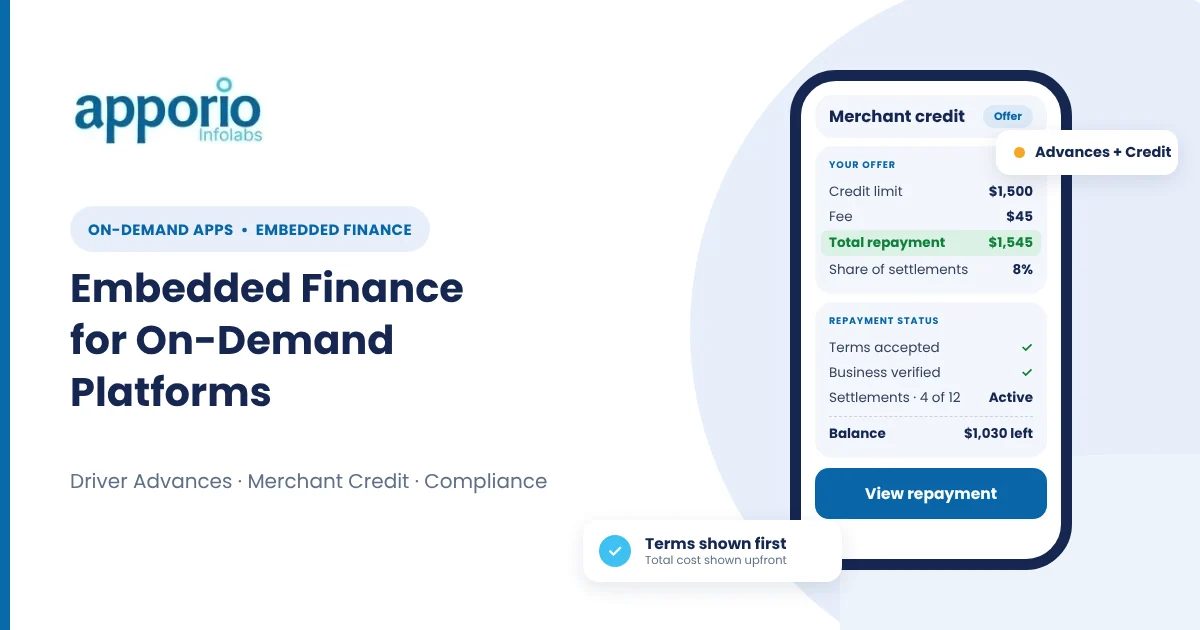
Driver cash flow and merchant working capital can directly affect marketplace reliability. A driver who cannot cover fuel or vehicle costs may accept fewer trips. A restaurant or grocery seller with limited cash may struggle to replenish stock, fulfill orders, or promote products. Financial services placed inside an operating platform can address these constraints at the point where the need appears.
Embedded finance for on-demand apps connects operational activity with financial products such as driver advances, merchant credit, digital wallets, payouts, and repayment deductions. The platform does not need to become a bank. Instead, it can coordinate eligibility, applications, disbursements, repayment events, and reporting through licensed financial partners and payment providers.
The commercial opportunity is not simply adding a loan button. It requires careful underwriting data, transparent terms, reliable payment processing, privacy controls, and rules that protect platform participants from unaffordable deductions. This guide explains how to design these services for ride-hailing, food delivery, grocery delivery, handyman services, and multi-service businesses.
Embedded finance is the integration of financial services, such as driver advances, merchant credit, wallets, and payouts, directly into a non-financial app. In an on-demand platform, drivers and merchants access these services inside the app they already use, while licensed partners handle regulated activities like lending and holding funds.
Embedded finance means placing a financial service inside a non-financial customer journey. In an on-demand marketplace, the relevant journey may include driver onboarding, merchant registration, order fulfillment, wallet management, or scheduled payouts. A driver might view an advance offer after building a verified earnings history. A merchant might request working capital from its business dashboard after several weeks of completed orders.
The application should show the product as part of the existing workflow, not as an unrelated external website. The user can see eligibility, terms, repayment schedule, consent requirements, and status without switching between multiple systems. Behind the interface, the platform may connect to a lender, payment gateway, identity provider, credit data source, and accounting or reconciliation system.
This model differs from simply accepting card or mobile-money payments. Payment processing moves money for a transaction; embedded financial products add credit, advances, wallets, or payout services around that transaction.
On-demand platforms depend on supply availability and merchant capacity. Financial pressure often appears operationally before it appears in a formal credit application. A driver may reduce online hours. A restaurant may reject orders because ingredients are unavailable. A grocery seller may carry fewer products. When a platform can identify these signals responsibly, it can present relevant financial support at a useful time.
The value also comes from better context. A lender outside the platform may not see completed trips, order volumes, settlement patterns, cancellation rates, or seasonal demand. A platform can share permitted data through a controlled integration, allowing the financial partner to make a more informed decision. This does not remove lending risk, and it does not justify using every piece of user data. Consent, data minimization, and explainable decisions remain essential.
Financial services can also improve platform economics, but the business case must be measured carefully. Relevant metrics include repeat usage, driver online hours, merchant order acceptance, repayment performance, support contacts, fraud losses, and contribution margin after partner fees. A high take-up rate does not mean success if users experience unaffordable deductions or the platform carries excessive credit risk.
For operators building a broader ecosystem, finance can connect several services. A wallet may support ride payments, food orders, grocery purchases, and provider payouts. A multi-service structure can be planned through Super App Development, provided each financial workflow remains understandable and properly governed.
Start with the purpose, target user, advance or credit limit, term, repayment method, fees, eligibility rules, and customer support path. A driver advance based on completed earnings is different from a merchant loan for inventory. Combining both under one generic product can create confusing terms and weak risk controls.
The platform must determine who lends the money, who performs identity checks, who holds customer funds, who handles collections, and who reports required information. In many markets, lending, money transmission, electronic money, and payment processing are regulated separately. Obtain local legal advice before launch instead of copying a workflow from another country.
Useful inputs may include account age, completed jobs, earnings history, cancellations, refunds, settlement regularity, merchant sales, and identity verification status. Data must be accurate, relevant, and collected with suitable notices and permissions. A platform should also define what happens when data is missing, disputed, stale, or affected by a system outage.
The user should see the amount received, fees, total repayment, expected deduction, due dates, consequences of late payment, and the name of the responsible financial provider. Avoid presenting an approval as guaranteed income. Give the user enough time and information to accept or decline without pressure.
Funds may move to a bank account, mobile-money account, or platform wallet, depending on local rules and partner capabilities. Every disbursement needs a unique reference. Reconciliation should match the loan or advance record with gateway settlements, refunds, chargebacks, deductions, and the final payout.
Automated deductions can reduce missed payments, but they should not remove all of a participant's income. Define minimum payout thresholds, hardship handling, failed deduction logic, dispute workflows, and human review. Pausing deductions may be appropriate during certain disputes or verified operational errors.
Track approval rates, acceptance rates, repayment performance, average deduction, complaints, fraud alerts, support resolution time, and participant activity after disbursement. Review results by location, service type, tenure, and risk group to identify unfair or impractical outcomes.
The trip or order ledger records operational events. The finance ledger records disbursements, fees, repayment obligations, adjustments, and balances. They must exchange controlled events but should not be treated as the same record. This separation makes refunds, reversals, partial repayments, and accounting reviews easier to handle.
Repayment should respond to confirmed settlement events, not assumptions about future earnings. A completed ride, delivered order, refund, or cancellation may change the amount available for deduction. Keep an audit trail showing which event triggered each calculation and who or what approved an adjustment.
Do not hide the total cost behind a link or dense legal text. Show principal, fees, repayment amount, deduction frequency, and remaining balance in plain language. Provide downloadable statements and a contact route for questions. Clear presentation reduces avoidable support tickets and disputes.
A platform operating in Africa, Southeast Asia, Europe, or North America may need different bank, card, mobile-money, or payout flows. Currency, settlement timing, tax treatment, identity checks, and consumer protection rules vary by market. The product should use configurable rules rather than hard-coding one country's assumptions.
Payment integrations should be selected around coverage, settlement reliability, webhooks, refunds, reconciliation, and compliance support. Review Apporio's Payment Gateways options when mapping these requirements to your payment architecture.
Protect account access with strong authentication, session controls, device monitoring, rate limits, and alerts for unusual behavior. Encrypt sensitive information in transit and at rest, restrict staff access, and retain audit logs. Security testing should cover wallet balances, payout changes, repayment edits, support tools, and administrative roles, not only the customer-facing screens.
Financial workflows also need privacy governance. Define retention periods, deletion rules, consent records, access requests, and third-party data sharing. For application and infrastructure controls, Apporio's Cyber Security service can support planning and testing.
If eligibility depends on marketplace activity, explain the main factors in a way the user can understand. Provide a review or appeal path for incorrect data. Avoid using sensitive attributes or indirect proxies without a documented legal and ethical assessment. Automated decisions should have monitoring and human escalation, especially when they affect access to income-related services.
Begin with a small, clearly defined participant group and conservative limits. Validate the end-to-end process from application to repayment, including failed payments, refunds, account closure, fraud review, and customer complaints. Raise limits only after operational evidence supports the change.
These errors are usually product and governance failures rather than interface problems. They should be addressed during discovery, partner selection, architecture planning, and pilot testing.
There is no single structure suitable for every marketplace. The right model depends on licensing, capital availability, risk appetite, geography, and the level of control the operator wants over the user experience.
| Model | Who Provides Capital | Platform Role | Main Strength | Main Risk |
|---|---|---|---|---|
| Referral model | External lender | Introduces qualified users and shares permitted data | Lower balance-sheet exposure | Less control over approval and servicing |
| Managed partner model | Bank, fintech, or lending partner | Owns the in-app journey, data flow, and operational coordination | More consistent user experience | Greater compliance and integration responsibility |
| Platform-funded advance | Platform or its financing entity | Sets terms, disburses funds, and manages collections | Direct control of product design | Capital, credit, and regulatory exposure |
| Wallet and payout model | Partner-held customer funds | Provides balances, transfers, and settlement tools | Improves payment visibility and payout convenience | Custody, fraud, and reconciliation complexity |
A referral model may suit an early validation phase, while a managed partner arrangement can support a more integrated experience. Platform-funded products need especially careful capital planning and legal review. Wallet services may be useful even when the operator does not offer credit, because they solve payout and settlement problems independently.
For ride-hailing operators, a taxi platform such as Apporio Taxi Uber Clone Script can provide a base for mapping driver earnings, trip events, and payout workflows. Food and grocery operators need comparable controls around order status, merchant settlement, refunds, and delivery completion.
The first release should focus on a narrow financial use case and a small number of payment routes. A practical MVP may include participant verification, eligibility display, consent capture, offer acceptance, wallet or bank disbursement, repayment tracking, statements, support tools, and admin reporting. Avoid adding several credit products before the basic ledger and reconciliation process has been tested.
The next phase can add configurable limits, partner dashboards, risk monitoring, dispute management, multi-currency support, and improved settlement automation. A platform serving multiple services may then connect financial accounts across rides, deliveries, grocery orders, and handyman bookings. Teams defining this broader product and integration roadmap can explore Apporio's On Demand Mobile App Development service.
Before development, prepare a requirements document covering:
After launch, review the pilot weekly at first. Product, finance, operations, compliance, engineering, and customer support should examine the same reconciled data. That cross-functional review is more useful than relying on a single adoption dashboard.
Financial services can help an on-demand marketplace address real operational constraints, but the product must be designed around responsible money movement rather than a promotional credit feature. Driver advances need transparent deductions and hardship handling. Merchant credit needs sensible limits, settlement visibility, and repayment terms tied to business reality. Both require partner accountability, privacy controls, secure architecture, reconciliation, and human support.
For operators planning embedded finance for on-demand apps, Apporio can support the wider product foundation through its Super App Development, Taxi Uber Clone Script, Food Delivery App, Grocery Delivery App, and on-demand app development capabilities. Start with one market, one partner structure, and one clearly defined financial use case. Test the complete lifecycle before expanding limits or adding new services.
It is the integration of financial products such as driver advances, merchant credit, wallets, and payouts into a ride-hailing, delivery, grocery, handyman, or multi-service platform. The app coordinates the user journey while a licensed partner may provide lending, payment, or regulated account services.
A qualified driver receives an approved amount based on defined eligibility rules, often using verified platform activity and earnings data. The amount is disbursed to an approved account or wallet, and repayment may be collected from future settlements. The app should show total repayment, deduction timing, fees, and dispute options before acceptance.
Merchants may use working capital for inventory, equipment, packaging, staffing, or approved marketing activity. The suitable purpose depends on the merchant's business model and local rules. Credit limits should reflect realistic sales and repayment capacity instead of simply maximizing the amount offered.
Not necessarily, but the answer depends on the country and the exact activities performed. Lending, holding customer funds, issuing electronic money, payment processing, and credit reporting can have different regulatory requirements. The platform should obtain local legal advice and define responsibilities with licensed partners before launch.
The core technology usually includes user verification, consent records, a marketplace ledger, a separate finance ledger, payment gateway integrations, wallet or payout handling, repayment rules, reconciliation, reporting, security controls, and support tools. The system must also manage refunds, failed payments, chargebacks, reversals, and disputes.
Measure more than applications and disbursements. Review repayment performance, net revenue after partner and fraud costs, participant activity, merchant order acceptance, payout reliability, complaints, support resolution, unfair-outcome indicators, and compliance incidents. A successful pilot should improve operations without creating unaffordable deductions or uncontrolled risk.