OUR PRODUCTS
Uberr Clone AppGojek Clone AppSuper App DevelopmentUberr Eats Clone AppGrocery App DevelopmentHandyman App Like Uberr
inDriver Clone AppDelivery App DevelopmentGlovo Clone AppBolt Clone AppLyft Clone AppCareem Clone App
OUR PRODUCTS

← Back to Blog
Mobile App Development
November 11, 2026
A technical guide to connecting battery-swap infrastructure with EV ride-hailing dispatch, covering station data, routing, driver workflows, APIs, and operational controls.
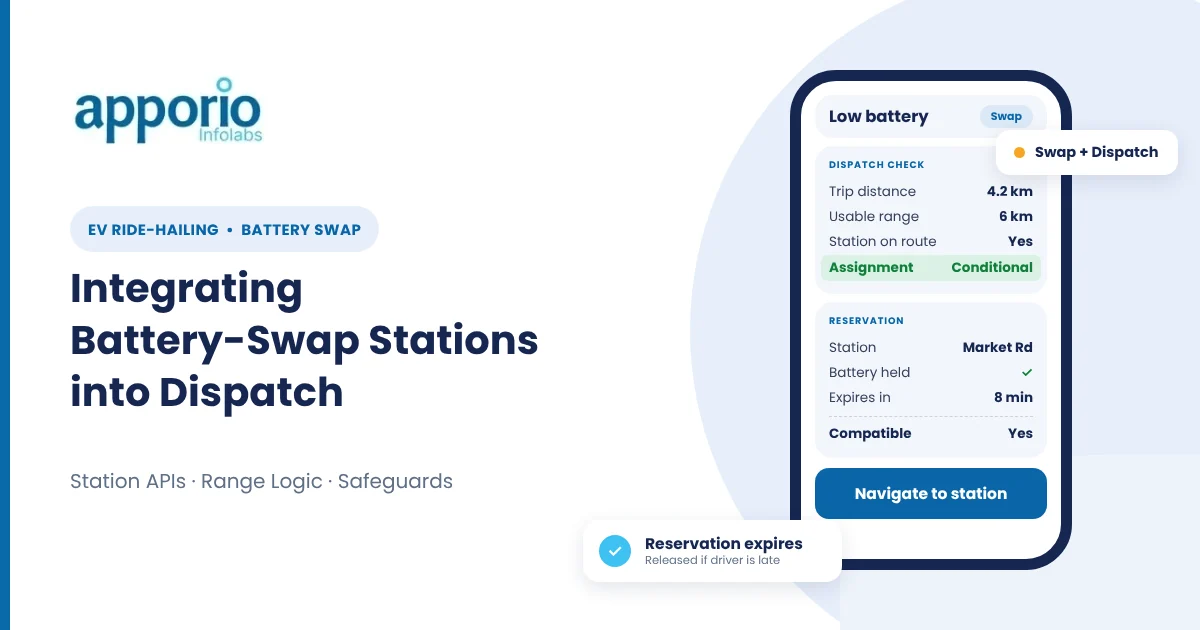
An EV ride-hailing platform cannot treat battery availability as a driver-only concern. For electric two-wheelers, the next available battery can affect trip acceptance, estimated arrival time, fleet utilization, and the number of vehicles available in a service zone. Dispatch software must therefore understand both ride demand and energy availability.
Battery swapping adds a second operational network to a ride-hailing platform. The system must track vehicles, riders, drivers, batteries, swap cabinets, station queues, inventory, charging status, and service areas. If these data streams remain disconnected, a driver may receive a trip while having insufficient range or while being too far from a functioning swap point.
This guide explains how to design the integration at a product and systems level. It focuses on the dispatch workflow, station APIs, data models, routing decisions, exception handling, and operational controls needed by founders, transport operators, product managers, and engineering teams.
A practical starting point is to map the ride lifecycle and battery lifecycle together instead of adding swapping as a separate screen after the dispatch system has already been built.
EV ride-hailing battery-swap dispatch is a system that assigns trips while considering the current and expected energy state of an electric vehicle. It connects the ride request engine with battery and station data so the platform can decide which driver should receive a trip, when a recharge stop is needed, and which station can support that stop.
In a conventional taxi platform, dispatch commonly evaluates distance to pickup, driver status, vehicle type, service zone, trip preferences, and estimated arrival time. An electric fleet requires additional variables:
The integration can be built through a station operator API, an Internet of Things gateway, or scheduled data synchronization. The correct method depends on the station hardware and the quality of data it exposes. If live inventory is unavailable, the dispatch system must show the limitation and use conservative rules rather than presenting stale availability as fact.
The ride platform can be based on taxi dispatch software, but the energy layer needs its own data model, event handling, permissions, and monitoring.
Battery swapping changes the operational definition of vehicle availability. A driver marked online may not be ready for another ride if the battery cannot cover the expected trip and the next practical swap station is congested. Dispatch decisions that ignore this constraint can create cancellations, longer pickup times, driver downtime, and poor station utilization.
The issue becomes more important in markets where electric motorcycles and scooters serve short urban trips at high daily utilization. A small error in range estimation can repeat across several trips. The result is not simply a lower battery percentage; it can create a chain of missed assignments and unplanned stops during demand peaks.
Integrating stations with dispatch helps operators coordinate three resources:
The integration also produces better operational visibility. Managers can compare trip demand with station usage, identify zones where battery supply is insufficient, and detect repeated station failures. These insights support decisions about station placement, inventory levels, driver incentives, and fleet expansion.
For a new platform, this is also a product-scope decision. A basic ride marketplace may only need a manual station directory at first. A larger fleet with frequent swaps may require reservation logic, live station telemetry, automated alerts, and dispatch constraints from the first production release.
Plug-in charging keeps the battery inside the vehicle, so the driver waits while it charges. Battery swapping replaces a depleted pack with a charged one, which can shorten vehicle downtime but depends on compatible batteries, station inventory, and a battery logistics process. Many operators use a mix: swapping for high-utilization vehicles and plug-in charging for overnight or lower-utilization needs. Dispatch should treat each as a separate energy option with its own wait time, availability, and cost.
The strongest benefit is not a new map marker. It is the ability to make dispatch decisions using the actual operating condition of the electric fleet. The following benefits depend on accurate data and clearly defined rules.
These benefits should be measured with operational metrics rather than general engagement figures. Useful measures include energy-related cancellation rate, average swap duration, station wait time, successful swap percentage, trips per vehicle shift, and the percentage of dispatch decisions made with current battery data.
Start by documenting how the fleet will use batteries. Determine whether each driver owns a battery, receives a battery from the operator, or exchanges batteries through a subscription or fleet program. Record the compatible vehicle models, station operators, service zones, opening hours, payment rules, and procedures for damaged or missing batteries.
This decision affects permissions and accounting. A driver-owned battery may require different replacement and fault workflows from an operator-managed battery. The product team should also define what happens when no compatible station is available within the vehicle's safe operating range.
A station record should include a unique identifier, coordinates, address, operating status, supported battery types, total cabinet capacity, charged inventory, empty slots, maintenance state, and last synchronization time. Do not display a station as available if its data is old beyond the agreed freshness threshold.
A battery record should include its identifier, compatibility class, current status, charge state, assigned vehicle if applicable, last station, transaction history, and fault status. Common states include available, reserved, in transit, installed, depleted, charging, quarantined, and unavailable.
Use an integration layer between the ride platform and station operator systems. The layer should normalize different station responses into a consistent internal format. It should also manage authentication, retries, rate limits, timeouts, duplicate events, and version changes in external APIs.
Useful actions include checking station status, reading battery inventory, reserving a battery, starting a swap, confirming completion, cancelling a reservation, and reporting a failed transaction. If the station operator only supports batch updates, label the data as synchronized rather than live and apply conservative dispatch rules.
Dispatch should calculate more than the distance to the passenger. A practical scoring model can consider pickup distance, predicted trip distance, current usable range, route elevation, traffic, passenger load, station access, station inventory, and expected swap time.
The engine does not need to reject every trip near a battery threshold. It can classify assignments as safe, conditional, or unsafe. A conditional assignment may be accepted when a compatible station is on the route or when a battery reservation has been confirmed. An unsafe assignment should be excluded unless an operations manager overrides the rule.
The driver application should show current battery status, estimated remaining range, recommended swap stations, station compatibility, operating hours, inventory confidence, and expected service time. The driver should be able to navigate to a station, reserve a battery when supported, confirm the old battery handover, and report a failed or damaged transaction.
Keep the workflow usable while the vehicle is stationary. Important warnings should be short and actionable. For example, the application can state that a station has no compatible charged batteries, rather than simply showing a red status icon with no next step.
Passengers do not need every battery telemetry detail, but they need an accurate service expectation. If a swap is required before pickup, the platform should adjust the driver's ETA or reassign the ride. Operations staff need a dashboard showing station outages, low inventory, failed swaps, vehicles below safe range, and trips affected by energy constraints.
Test the integration with simulated events, not only successful swaps. Cover network loss, stale inventory, station closure, battery mismatch, reservation expiry, duplicate completion events, driver cancellation, vehicle location errors, and a battery that becomes unavailable after assignment. Each scenario should produce a defined fallback, audit record, and user message.
Good results depend on operational rules as much as software components. The following practices reduce avoidable errors in a live fleet.
For the application layer, teams should define the required taxi app development scope around these workflows rather than around a generic list of screens. The station integration, dispatch rules, and exception paths should be included in acceptance testing.
Battery swapping involves handling and storing high-energy battery packs, so safety processes must be part of the dispatch design and not left only to station hardware. The exact requirements depend on the country, city, battery type, and station operator, and should be confirmed with qualified local advisers before launch.
Battery-swap projects often fail at the boundary between hardware operations and marketplace software. The following mistakes create avoidable complexity or unreliable dispatch results.
Another frequent mistake is measuring only ride completion. A platform may complete trips while creating excessive station queues or battery degradation. Operational reporting should connect ride metrics with energy and infrastructure metrics.
There is no single integration level for every operator. The right choice depends on fleet size, station ownership, API maturity, and the cost of dispatch errors.
| Approach | Data Used | Best Fit | Main Limitation |
|---|---|---|---|
| Manual station directory | Station locations, hours, and compatibility entered by operations staff | Early pilots and small fleets | No reliable live inventory or automated energy-aware assignment |
| Periodic synchronization | Scheduled station status, inventory, and battery updates | Operators with limited external API support | Data may be stale during demand peaks or station outages |
| Live station API integration | Near-real-time inventory, reservations, transactions, and faults | Growing fleets with networked swap infrastructure | Requires strong API reliability, monitoring, and fallback logic |
| Full energy-aware dispatch | Live station data combined with range, route, demand, and vehicle state | High-utilization fleets and multi-zone operations | Higher implementation complexity and more data quality dependencies |
A staged approach is usually easier to operate. Start with station discovery and driver reporting, then add synchronized inventory, reservations, and automated dispatch constraints as data quality improves. The architecture should allow these layers to be added without rewriting the ride marketplace.
Teams that need reliable deployment pipelines should also plan for observability, rollback procedures, environment separation, and integration testing. A station API change should not silently alter assignment behavior in production. DevOps consulting can help define these controls alongside the application release process.
Battery swapping should be treated as part of the dispatch system, not as a separate convenience feature. A dependable EV ride-hailing platform must connect vehicle range, station availability, battery compatibility, route conditions, and driver workflows before making assignment decisions.
The safest implementation path begins with a clear operating model, normalized station and battery data, conservative range rules, short reservations, visible exception handling, and staged testing. Operators should measure energy-related cancellations, swap wait times, station reliability, and vehicle utilization alongside conventional ride-hailing metrics.
Apporio Infolabs can provide the ride-hailing foundation for this type of platform through its Taxi Uber Clone Script, Taxi Dispatch Software, Taxi App Development service, and On-Demand Mobile App Development service. Battery-station integrations are scoped separately, based on the fleet model, station hardware or operator APIs, target market, and required level of automation.
It adds battery state, estimated range, station compatibility, inventory, reservation status, and expected swap time to the assignment decision. A driver can then be assigned based on whether the vehicle and energy plan can support the trip.
The integration should ideally provide station location, operating status, compatible battery types, charged inventory, empty slots, faults, reservations, swap transactions, and timestamps showing how current each response is.
Yes. A pilot can begin with a manually managed station directory or periodic synchronization. The platform should clearly mark data freshness and avoid treating old inventory information as live availability.
It should combine battery state with vehicle capacity, route distance, traffic, passenger load, road conditions, temperature where available, and a configurable safety buffer. Manufacturer maximum range should not be used as the sole dispatch input.
The system should release or invalidate the reservation, notify the driver, find another compatible station or battery, and re-evaluate the assigned trip. The event should be recorded for operations review and station reliability reporting.
Start with one vehicle type, a limited service zone, and a small number of stations. Validate data freshness, swap completion, range assumptions, and driver workflows before adding hard dispatch restrictions or expanding to more zones.