OUR PRODUCTS
Uberr Clone AppGojek Clone AppSuper App DevelopmentUberr Eats Clone AppGrocery App DevelopmentHandyman App Like Uberr
inDriver Clone AppDelivery App DevelopmentGlovo Clone AppBolt Clone AppLyft Clone AppCareem Clone App
OUR PRODUCTS
← Back to Blog
Mobile App Development
July 10, 2026
EV taxi app development features, technologies, costs, and benefits for managing electric fleets with smarter dispatch and analytics.
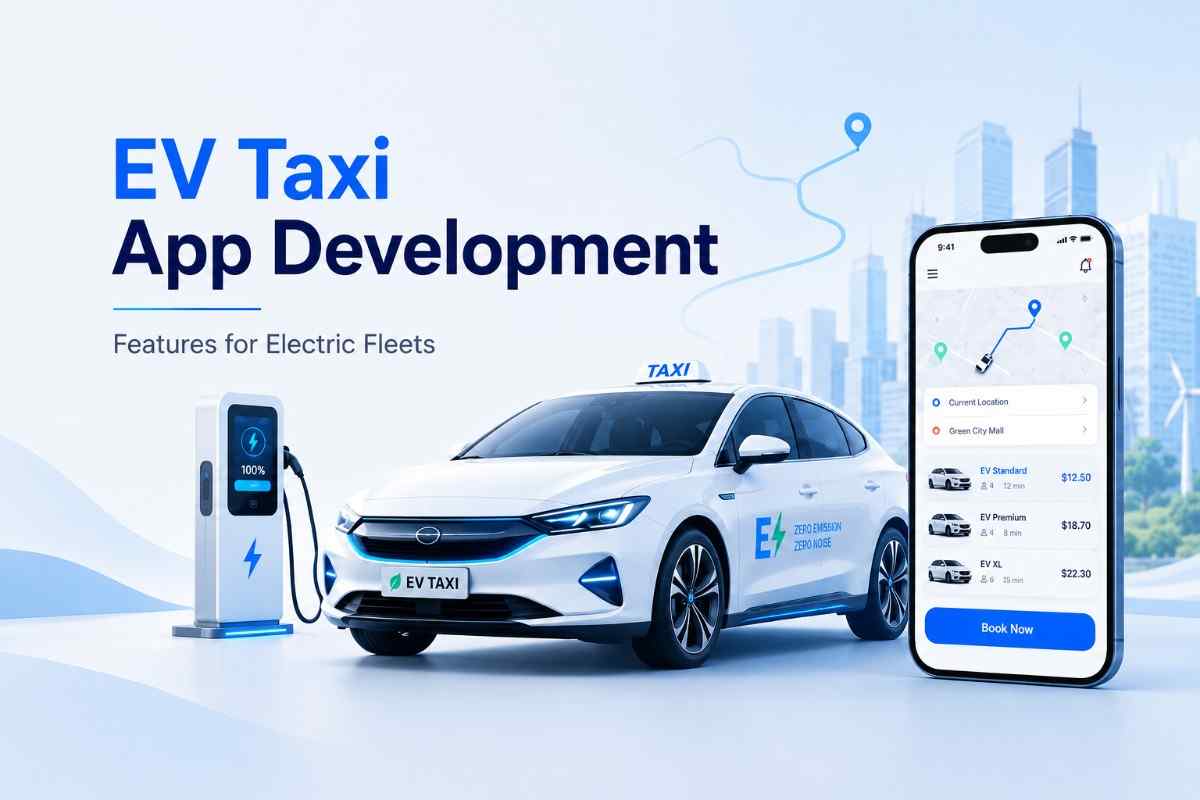
Electric vehicles are becoming an important part of commercial mobility. Taxi operators, airport transfer businesses, corporate transportation providers, and ride-hailing startups are exploring electric fleets to reduce fuel dependence, modernize operations, and respond to changing customer expectations.
According to the International Energy Agency, global electric car sales exceeded 20 million in 2025, increasing by approximately 20% from 2024. Electric cars represented 25% of all new cars sold worldwide. In 2026, global electric car sales are projected to reach 23 million and account for approximately 28% of total car sales.
This growth creates an important opportunity for mobility businesses. However, operating electric taxis is not the same as adding another vehicle category to a conventional taxi application.
An electric fleet must continuously manage battery levels, charging schedules, available range, charger compatibility, electricity costs and vehicle downtime. A conventional dispatch system that assigns the closest driver may send a low-battery vehicle on a long trip and leave the driver without enough range to reach a charging station.
That is why businesses entering electric mobility need purpose-built EV taxi app development rather than a standard ride-booking application with a basic EV filter.
A well-designed EV taxi platform connects ride booking, battery-aware dispatch, charging management, route planning, driver operations and fleet analytics within one integrated system. Businesses can combine these capabilities with a customizable taxi app development solution to build an operating model around their vehicles, target city and charging infrastructure.
The figures now use one consistent IEA data series. The 2025 total is described as more than 20 million, rather than rounded to 21 million, while the 2026 projection remains 23 million.
An EV taxi app is a ride-booking and electric taxi fleet management software platform designed specifically for battery-powered taxis.
Like a conventional taxi platform, it usually includes a rider application, driver application, dispatcher panel, administrative dashboard, online payments, navigation, and trip reports.
The key difference is that an EV taxi app treats energy as an operational resource.
The system should know whether a vehicle has enough usable battery to reach the passenger, complete the trip, maintain a minimum safety reserve, and travel to a compatible charging station afterward.
A complete EV fleet management app may also integrate with vehicle telematics, charging networks, private depot chargers, electricity-rate data, and route-planning services. This gives operators a unified view of rides, vehicles, batteries, chargers, and operating costs.
A traditional taxi application may technically allow an electric vehicle to accept bookings. However, it cannot always determine whether that vehicle is operationally suitable for the trip.
Specialized electric vehicle dispatch software must look beyond proximity. It should identify the vehicle that can complete the ride without creating avoidable charging delays, range anxiety, or service interruptions.
The platform should display the current battery percentage, estimated usable range, charging status and minimum operating reserve for every electric vehicle.
Depending on the fleet, this data may be collected through OEM integrations, telematics hardware or connected-vehicle APIs. Vehicle platforms can expose information such as charging status and EV port data, although the precise information available depends on the vehicle manufacturer, hardware and permissions.
The system should generate alerts when a vehicle approaches its minimum battery threshold or consumes significantly more energy than expected.
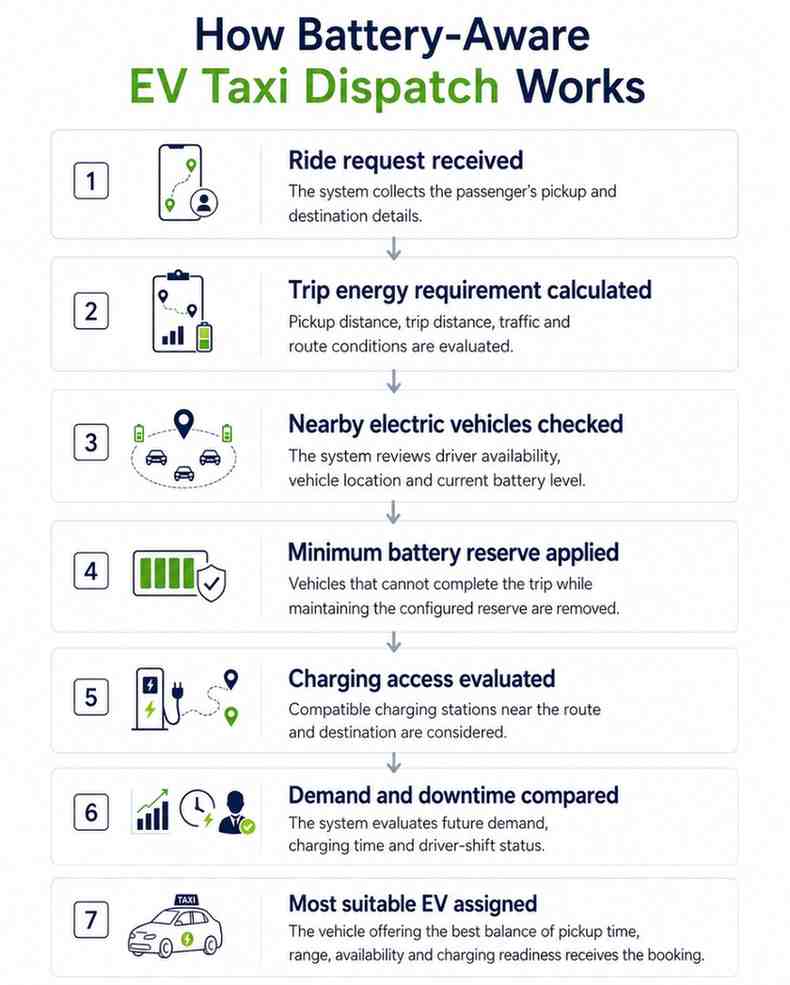
Battery-aware dispatch is the most important EV-specific feature.
Instead of assigning a ride only to the nearest driver, the system should evaluate:
For example, a vehicle with 30% battery may be suitable for a short city ride but unsuitable for an airport transfer. The dispatch engine should identify this before sending the request to the driver.
Businesses can connect this logic with customizable taxi dispatch software to automate vehicle allocation and reduce dependence on manual dispatch decisions.
The vehicle’s displayed range should not be treated as a guaranteed figure.
Real energy consumption can change according to traffic, weather, road elevation, passenger load, driving behaviour, speed and air-conditioning use. An EV fleet management app should continuously compare estimated consumption with actual trip performance.
Over time, the platform can use this information to develop more accurate range estimates for individual vehicles, routes and service zones.
Drivers should be able to locate suitable charging stations from within the driver application.
The charging interface should provide information such as:
Where the charging-network provider supports it, the application may also enable drivers to reserve a charging slot, begin a charging session, make payment and report a faulty charger.
Charging should be planned around fleet demand rather than left entirely to individual drivers.
The system can recommend charging when ride demand is low, electricity is less expensive or a vehicle has sufficient idle time before its next scheduled booking. It can also prevent too many vehicles from becoming unavailable simultaneously.
For depot-based fleets, smart scheduling should consider the number of chargers, charger capacity, site power limits, required departure time and target battery level.
Businesses operating private charging stations need a centralized charging-management layer.
The Open Charge Point Protocol provides open communication between charging stations and charging-management systems. It supports interoperable and scalable charging infrastructure while reducing dependence on one proprietary charger ecosystem. Newer OCPP versions also offer improved smart-charging and energy-management capabilities.
An integrated admin panel can show which charger is available, occupied, offline or experiencing a fault.
The navigation system should determine whether a vehicle can complete a journey without charging.
For longer bookings, it may recommend charging before pickup, during the journey or after drop-off. The selected charging stop should be compatible with the vehicle and should not create an unreasonable passenger delay.
This capability is particularly useful for airport transfers, intercity transportation, corporate bookings and scheduled trips. Navigation systems can include EV charging stations as route waypoints when creating multi-destination journey plans.
Drivers need clear recommendations rather than complex battery calculations.
The application can provide instructions such as:
The workflow should also support station check-in, queue information, charging-session records, payment receipts and charger-fault reporting.
The administrative dashboard should give dispatchers a complete view of the electric fleet.
Vehicles can be classified as available, on trip, travelling to a charger, waiting to charge, charging, offline or under maintenance.
Important dashboard metrics include average battery level, charger occupancy, energy cost per trip, charging downtime, trips rejected because of battery limitations, fleet utilization and revenue per available vehicle hour.
Electric vehicles generally have fewer routine mechanical maintenance requirements than conventional vehicles, but battery condition, tyres, brakes, charging ports, cooling systems and charger reliability still need monitoring. Fleet operators should also understand vehicle warranties and provide training for drivers and maintenance teams.
The platform can report electric kilometres, electricity consumed, estimated emissions and energy cost per vehicle.
However, sustainability claims must use a transparent methodology. Electric vehicles produce no tailpipe emissions, but electricity generation may still create emissions depending on the energy source.
For corporate reporting, purchased electricity is generally accounted for under Scope 2 emissions. The GHG Protocol provides guidance for measuring and reporting emissions associated with purchased electricity and other acquired energy.
A scalable EV taxi platform requires a modular technology architecture.
The core system may include Android and iOS applications, a web-based admin panel, cloud hosting, real-time databases, geolocation, route optimization, payments, communication tools and reporting dashboards.
The EV-specific layer may include:
The platform should separate its booking, dispatch, payment and charging modules. A modular system makes it easier to add new vehicle models, charging networks and operating regions without rebuilding the entire application.
Apporio’s existing taxi app features include rider, driver and administrative capabilities that can form the base of a customized electric mobility platform.
Study average daily mileage, trip length, peak demand, driver shifts, parking duration, and charging availability.
Determine whether the platform will support company-owned vehicles, leased EVs, independent drivers, corporate transportation, or a mixed fleet.
Assess public charging access, private charger requirements, electrical capacity, parking space, charging speed, and future fleet expansion.
Charging infrastructure planning can involve equipment selection, ownership models, payments, regulations, data collection, parking, safety, and maintenance.
Choose the telematics system, charging networks, map provider, payment gateways, notification services, and analytics tools.
The first version should prioritize:
Launch with a limited number of vehicles and a defined service zone. Measure range accuracy, charging downtime, failed-trip scenarios, and driver adoption.
Use real operational data to improve dispatch rules, range prediction, charging schedules, and demand forecasting before expanding to additional cities.
The cost of developing an EV taxi platform depends on its features, integrations, operating regions, and level of customization.
The following are indicative planning ranges in U.S. dollars, not fixed quotations:
The final cost may be affected by:
A configurable platform can reduce development time compared with creating every booking, dispatch, payment, and fleet-management component from the ground up.
For additional context, businesses can review Apporio’s guide to taxi app development cost strategies.
Electric taxi operations require more than a rider-booking application. Operators need a connected system that understands vehicle range, battery reserves, charger availability, demand patterns and charging downtime.
Apporio Infolabs provides customizable taxi app development services covering rider applications, driver operations, fleet management, dispatch, payments, live tracking and administrative controls. These modules can be adapted to support the specific requirements of an electric or mixed taxi fleet.
Whether the business operates city taxis, airport transfers, corporate transportation or a regional ride-hailing platform, the solution can be configured around its vehicle categories, operating zones, languages, currencies and business rules.
Ready to build an EV-ready taxi platform?
Book a free consultation with Apporio Infolabs and discuss the technology, integrations and fleet-management features required for your electric mobility business.
EV taxi app development is not simply about adding electric cars to a ride-booking platform. It is about coordinating mobility and energy in real time.
A capable system must determine which vehicle should accept a trip, how much energy the journey requires, when and where the vehicle should charge, how charging affects customer demand, and whether the fleet is actually reducing operating costs and emissions.
Businesses that build these capabilities from the beginning can create a more reliable, measurable, and scalable electric mobility operation.
With a customized Apporio taxi solution, operators can combine booking, dispatch, payments, fleet control, charging intelligence, driver management, and analytics within one platform—and prepare their business for the next phase of urban transportation.
taxi app be converted into an EV taxi app?Yes. An existing platform can be upgraded if its architecture supports telematics, charging APIs, EV-specific dispatch, and battery reporting. The dispatch engine and fleet dashboard often require the largest changes.
Battery-aware dispatch is one of the most important features because it connects vehicle allocation with battery level, trip distance, minimum reserve, and charging availability.
Yes. A mixed-fleet platform can apply separate dispatch, fuel, energy, maintenance, and reporting rules to electric, hybrid, and conventional vehicles.
Not necessarily. Operators can use public charging networks, private depot chargers, or a combination of both. Private infrastructure provides more control, while public charging can extend geographic coverage.
The application can support charger reservations when the charging-network provider offers the necessary API and reservation functionality.
A basic configurable MVP may require approximately three to five months. A highly customized system involving telematics, OCPP, several charging networks, and predictive analytics may require six to twelve months or longer.


