OUR PRODUCTS
Uberr Clone AppGojek Clone AppSuper App DevelopmentUberr Eats Clone AppGrocery App DevelopmentHandyman App Like Uberr
inDriver Clone AppDelivery App DevelopmentGlovo Clone AppBolt Clone AppLyft Clone AppCareem Clone App
OUR PRODUCTS

← Back to Blog
August 18, 2026
A practical guide to grocery delivery app development cost, essential features, integrations, business models, and launch planning for global markets.
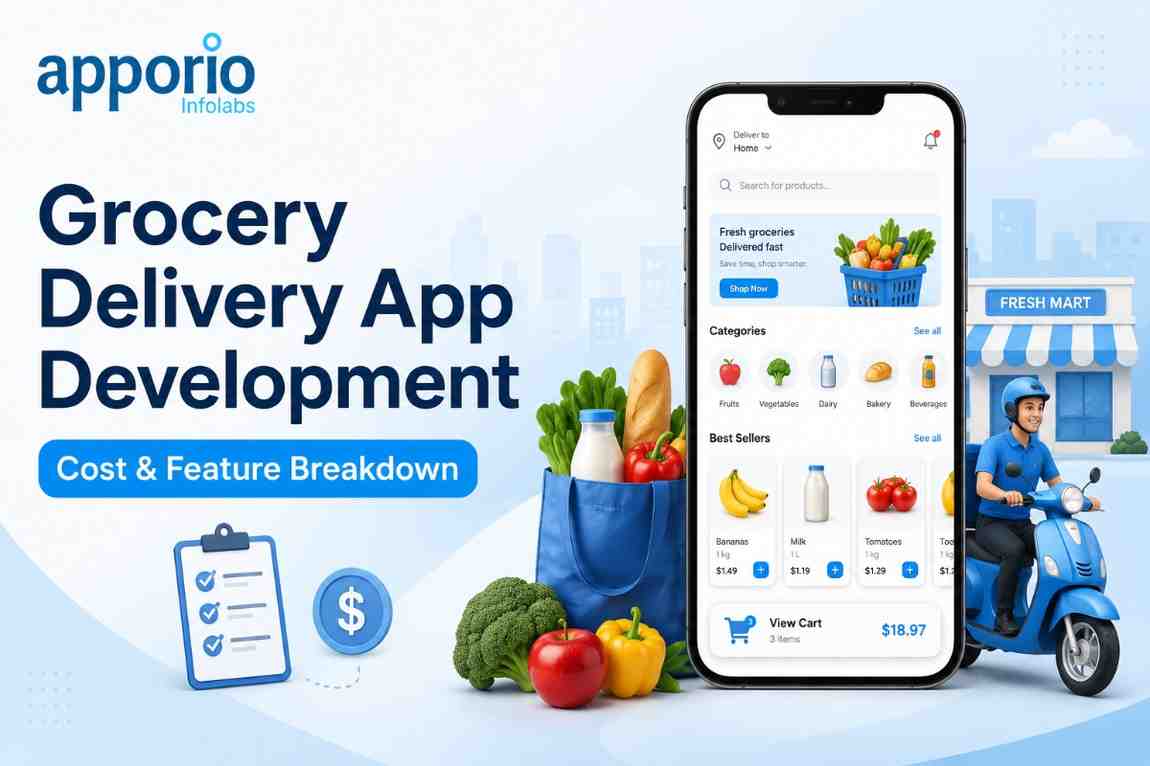
The grocery delivery app development cost depends less on the shopping interface and more on the operating model behind it. A marketplace connecting customers with supermarkets requires different workflows from a single-store app, while quick-commerce operations add dark-store inventory, delivery zones, and tighter dispatch controls.
For a commercial project, the right question is not simply “How much does an app cost?” It is “Which version should be built first, which operational problems must it solve, and which features can wait?” A realistic budget needs to account for customer, store, delivery, and admin applications, plus payment processing, location services, cloud infrastructure, testing, and post-launch support.
This guide breaks down the main cost drivers, essential capabilities, development stages, technology decisions, and common mistakes. It is designed for founders, retailers, supermarket groups, and entrepreneurs planning a grocery delivery platform in Africa, Southeast Asia, Europe, North America, or another regional market.
Grocery delivery app development involves creating a digital ordering and fulfillment system for household products, fresh food, packaged goods, and everyday essentials. The platform usually has several connected parts rather than one standalone mobile app.
Customers browse categories, search for products, review prices and availability, add items to a cart, select a delivery slot, pay, and track the order. The experience must also handle substitutions, unavailable products, refunds, discounts, and repeat purchases.
Retailers need tools to upload products, manage stock, update prices, accept orders, prepare baskets, approve substitutions, and communicate with customers or delivery staff. A multi-vendor marketplace may give each seller a separate account and dashboard.
Couriers receive delivery requests, view pickup and drop-off details, navigate to the correct location, update order status, and record completion. The workflow should support proof of delivery and clear handling of failed or rescheduled deliveries.
Operations teams use the back office to manage users, stores, products, service areas, commissions, delivery fees, promotions, disputes, and reports. Admin controls are especially important when orders involve substitutions, partial refunds, or several delivery zones.
Apporio’s Uber for Grocery Delivery App is relevant to this operating model because grocery ordering requires coordination between shoppers, retailers, delivery workers, and platform administrators.
Budget planning affects the product’s scope, launch market, staffing model, and ability to respond to real customer behavior. Spending too little can leave critical operational gaps, while building too much before testing demand can tie up capital in features that users do not need.
Grocery platforms also have more cost variables than many standard ecommerce applications. Inventory changes quickly, product weights may vary, delivery windows create scheduling pressure, and order accuracy affects refunds and repeat usage. A platform that looks simple in a customer demo can require substantial work in the backend and operations dashboard.
Founders should separate build cost from business operating cost. Development covers design, coding, testing, deployment, and technical support. Operating expenses may include warehouse staff, pickers, couriers, packaging, customer support, payment fees, insurance, marketing, and local compliance. These expenses are not interchangeable.
A clear scope also helps compare custom development with a ready-made or white-label approach. A prebuilt foundation can reduce initial engineering work, but customization, integrations, branding, market-specific workflows, and future support still require careful assessment. The lowest initial quote is not automatically the lowest total cost of ownership.
A digital grocery channel can support several business models, from a single retailer ordering system to a regional marketplace. Its value comes from connecting product discovery, payment, fulfillment, and delivery data in one operating process.
These benefits only appear when the app reflects actual grocery operations. A polished interface cannot compensate for inaccurate inventory, weak order preparation workflows, or unreliable delivery status updates.
The customer app should begin with registration, location selection, product browsing, search, filtering, product details, cart management, checkout, order history, and delivery tracking. Address management should support map selection, apartment details, landmarks, and delivery instructions.
Grocery-specific features include substitution preferences, out-of-stock notices, weighted products, minimum order rules, delivery slot selection, scheduled orders, coupons, ratings, support requests, and digital invoices. These functions increase development effort because they affect pricing, inventory, checkout, and post-order workflows.
Store users need catalog management, category controls, product images, pricing, tax settings, stock updates, preparation status, and order acceptance. Inventory may be updated manually, through a point-of-sale system, or through an external inventory service.
Substitution handling deserves special attention. The store should be able to suggest an alternative, while the customer can approve it, reject it, or set a preference before checkout. The system must also calculate differences in price and manage partial refunds where necessary.
The delivery app requires courier registration, document review, availability status, delivery request notifications, pickup instructions, navigation, status updates, earnings records, and delivery history. A courier should not receive an order without enough information to identify the store, customer, package, and time window.
The admin panel controls users, stores, delivery workers, service zones, fees, promotions, orders, refunds, support tickets, and reports. Role-based access is useful when finance, customer support, store operations, and system administrators should not all have the same permissions.
External services can include maps, push notifications, analytics, cloud storage, identity verification, customer support, payment processing, and tax systems. Payment availability varies by country, so the integration plan should be based on the launch market rather than copied from another region. Apporio’s Payment Gateways page can help frame this part of the technical discussion.
An MVP should cover the complete transaction, not merely the customer interface. Customers must be able to find products, place an order, pay, receive updates, and get support. Stores and couriers need enough functionality to fulfill that order correctly.
Defer features such as complex loyalty tiers, advanced recommendation engines, multi-country tax configurations, and extensive partner portals unless they are essential to the first business model. A smaller but operationally complete release produces more useful feedback than a broad prototype that cannot process real orders.
Separate the roadmap into launch, stabilization, and expansion phases. The launch phase may support one payment region and a limited set of stores. Stabilization can address refunds, substitutions, dispatch rules, analytics, and support workflows. Expansion can then add languages, cities, sellers, and new payment methods.
Cross-platform development can reduce duplicate work when one codebase supports Android and iOS, but native development may be appropriate when device-specific behavior or complex performance requirements justify it. Apporio provides Android App Development and iPhone App Development services, so the decision can be made around audience, budget, and product requirements.
Do not treat stock as a static product attribute. The system should define how often availability is updated, what happens when an item disappears after checkout, and who approves substitutions. These rules prevent avoidable support costs and customer dissatisfaction.
The platform handles personal data, addresses, order history, payment events, and sometimes identity documents for delivery workers. Use role-based permissions, secure authentication, protected APIs, audit records, and controlled access to administrative functions. Apporio’s Cyber Security service is relevant when reviewing application and infrastructure risks.
Post-launch work may include operating-system updates, payment changes, bug fixes, cloud monitoring, security patches, analytics improvements, and new business rules. A project budget that covers only initial coding gives an incomplete view of the investment required to operate the platform.
| Approach | Best Suited For | Initial Scope | Main Cost Consideration |
|---|---|---|---|
| Ready-made or White-label Platform | Founders testing a market quickly | Prebuilt customer, admin, store, and delivery workflows with selected customization | Customization limits, integrations, branding, and ongoing support |
| Custom MVP | Businesses with distinct operational requirements | Purpose-built core ordering and fulfillment functions | Higher discovery, design, engineering, and testing effort |
| Single-retailer Application | Supermarkets or grocery chains | One catalog, store network, and fulfillment process | Inventory, POS, loyalty, and internal system integrations |
| Multi-vendor Marketplace | Businesses aggregating independent sellers | Customer, seller, courier, and admin ecosystems | Seller onboarding, commissions, catalog variation, disputes, and settlement |
The best option depends on operational differentiation. If the business needs a unique fulfillment process, complex inventory rules, or deep enterprise integrations, custom work may be justified. If the priority is validating demand with a controlled service area, a white-label foundation may reduce early engineering effort.
Compare proposals by included applications, integrations, source code or ownership terms, deployment responsibilities, testing scope, maintenance coverage, and customization boundaries. A quote without a feature and responsibility matrix is difficult to evaluate accurately.
Grocery delivery app development cost is shaped by the number of user roles, inventory complexity, delivery model, market integrations, platform choices, and post-launch support plan. A focused first release should process the complete journey from product discovery to payment, store preparation, courier delivery, refund, and customer support.
Apporio can support this planning through its Grocery Delivery solution, Uber for Grocery Delivery App, on-demand app development, and white-label app development capabilities. The next step is to map your launch market, operating model, required integrations, and phased feature list before selecting a delivery approach. Book Free Demo
The grocery delivery app development cost varies according to platform scope, customer and partner applications, inventory workflows, delivery operations, payment integrations, market requirements, customization, and maintenance. A precise estimate requires a defined feature and integration list.
A practical MVP should include registration, location and address management, product catalog, search, cart, checkout, payment, delivery slot selection, order tracking, store order management, courier status updates, admin controls, notifications, refunds, and customer support workflows.
A ready-made or white-label solution may reduce initial engineering effort because core workflows already exist. The total investment still depends on branding, customization, regional payments, integrations, deployment, support, and any changes required by the operating model.
These roles need different permissions and workflows. They may be delivered through separate applications, responsive web interfaces, or a combination of both. The correct structure depends on the number of stores, couriers, markets, and internal teams.
Payment gateways, maps and geolocation, inventory or point-of-sale systems, push notifications, analytics, cloud services, identity checks, and customer support tools can affect scope. The impact depends on provider availability, API quality, transaction rules, and the launch country.
Ask for a detailed scope, included user roles, integration list, technology plan, testing approach, deployment responsibilities, ownership terms, maintenance coverage, security controls, and a process for handling future changes. Also request a phased roadmap rather than evaluating only the initial quote.

