OUR PRODUCTS
Uberr Clone AppGojek Clone AppSuper App DevelopmentUberr Eats Clone AppGrocery App DevelopmentHandyman App Like Uberr
inDriver Clone AppDelivery App DevelopmentGlovo Clone AppBolt Clone AppLyft Clone AppCareem Clone App
OUR PRODUCTS

← Back to Blog
Mobile App Development
August 11, 2026
A practical guide to building a Grubhub-style food delivery platform, covering customer, restaurant, driver, admin features and monetization.
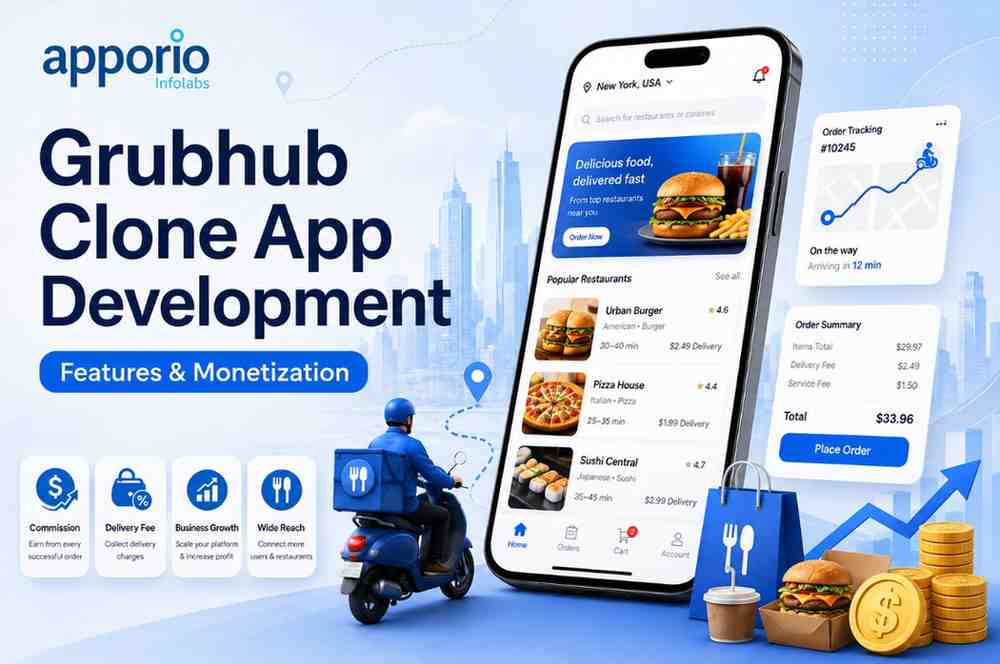
Grubhub clone app development is a commercial opportunity for entrepreneurs who want to launch a branded food delivery marketplace in the USA. The product connects customers, restaurants, delivery drivers, and platform administrators through coordinated mobile and web interfaces.
However, copying the visible layout of an established service is not enough. A viable platform needs accurate delivery estimates, restaurant onboarding tools, payment handling, order-status communication, customer support workflows, and controls for managing margins. The build also needs to account for US market conditions such as sales tax configuration, card payments, tipping, delivery zones, local restaurant operations, and city-by-city supply growth.
This guide explains what the product includes, how the operating model works, which features deserve priority, and how a delivery marketplace can generate revenue. It is intended for founders comparing a ready-made white-label product with a fully custom build.
Apporio’s Grubhub Clone App provides a relevant starting point for this business model. The important decision is not simply selecting a script. It is defining the launch market, order economics, service standards, and product scope before development begins.
A Grubhub-style platform is a multi-sided marketplace for ordering meals from restaurants through an app or website. Customers browse menus, add items to a cart, select delivery or pickup, pay online, track the order, and provide feedback. Restaurants receive orders through a merchant interface, confirm preparation times, update item availability, and monitor payouts.
Drivers or delivery partners use a separate application to accept assignments, navigate to the restaurant, collect the order, and complete delivery. The administrator manages users, restaurants, drivers, commissions, disputes, promotions, service areas, payments, and operational reporting from a central dashboard.
The product is more than a menu directory. Its core function is coordinating several time-sensitive events:
For a USA launch, the operator should also decide whether the service focuses on one city, a defined cuisine category, suburban delivery, campus areas, corporate meals, or a broad restaurant marketplace. A focused market usually creates a clearer supply and delivery strategy than launching nationwide from the first day.
Food delivery marketplaces compete on local density rather than app downloads alone. A customer is more likely to return when the platform lists enough relevant restaurants, shows dependable delivery times, and resolves problems promptly. Restaurant partners also need a reasonable flow of orders and clear payout reporting before they commit staff and menu data to another channel.
This creates a two-sided acquisition challenge. The operator must recruit restaurants and delivery capacity while also giving customers a reason to use the new service. A product with good software but thin local supply can struggle, while a focused launch with fewer restaurants may work if the selection fits a specific neighborhood or customer segment.
The business matters because it can give entrepreneurs control over:
Founders should still model customer acquisition cost, restaurant acquisition cost, driver incentives, payment processing, refunds, support labor, insurance, and local marketing. Gross order value is not the same as platform profit. The marketplace becomes healthier when each delivery zone can support reliable order density and acceptable contribution margin.
A strong product separates the needs of customers, restaurants, drivers, and administrators. Each interface should expose the actions that user needs most often instead of placing operational controls behind unnecessary screens.
Restaurant tools determine whether partners can operate the platform without constant manual assistance. Partners need a dashboard for accepting or rejecting orders, adjusting preparation time, pausing orders during busy periods, editing menus, managing working hours, and reviewing performance.
The interface should also provide order history, payout statements, promotion participation, customer feedback, and basic sales reporting. Menu updates must be reflected accurately because unavailable items can create substitutions, cancellations, refunds, and customer complaints. For larger restaurant groups, location-level controls can help managers maintain separate menus and opening hours.
The driver experience should keep the workflow simple while providing the information needed to complete each assignment. Core functions include availability status, delivery requests, pickup details, navigation, customer contact controls, delivery instructions, proof of delivery, earnings, and completed-order history.
Dispatch rules should account for driver distance, estimated pickup time, vehicle type where relevant, delivery zones, and current workload. Automatic assignment is useful, but administrators should retain tools for reassignment and escalation when a restaurant is delayed or a driver becomes unavailable.
The administration layer controls the marketplace. Staff should be able to approve restaurants and drivers, configure commissions, manage service areas, monitor live orders, adjust fees, review disputes, issue refunds, create promotions, and export financial records.
Useful reporting includes orders by zone, average preparation time, cancellation rate, delivery duration, restaurant acceptance rate, driver utilization, customer repeat rate, refund volume, and revenue by fee type. These reports support operational decisions better than download totals or vanity metrics.
The most reliable delivery projects begin with operational decisions, not screen design. A founder should document the marketplace rules before asking a development team to estimate the work.
Technical choices should support the operating plan. Native Android and iPhone applications may be appropriate when platform-specific behavior matters, while a shared codebase can reduce duplicated development effort. Apporio provides both Android App Development and iPhone App Development services for teams planning both platforms.
Every feature should map to a real stage in the order lifecycle. Track when the customer places the order, when the restaurant confirms it, when preparation begins, when the driver arrives, and when delivery is completed. Consistent status events make customer communication, support, analytics, and settlement more dependable.
Customers should see taxes, service charges, delivery charges, discounts, and tips before submitting an order. Clear pricing reduces checkout abandonment and gives support teams a stronger reference when customers question the total. The platform should also maintain an internal breakdown for refunds and partner reconciliation.
An estimate should consider restaurant preparation time, driver travel, traffic conditions where available, and the distance between pickup and drop-off. Displaying an optimistic time may increase initial conversion but can create late deliveries and poor ratings. The team should measure the difference between promised and actual delivery time by restaurant and zone.
Restaurants need tools for pausing orders, marking items unavailable, changing preparation times, and managing busy periods. Without these controls, the marketplace may continue accepting orders that the kitchen cannot fulfill. Partner usability is a direct service-quality issue.
Common monetization options include a commission on completed orders, customer delivery fees, service fees, sponsored restaurant placement, subscription plans, and promotional campaign fees. Each model should be tested against local competition and restaurant margins rather than applied as a fixed assumption.
Measure monetization with completed orders, net revenue per order, refund-adjusted revenue, repeat rate, delivery cost, support cost, and contribution margin. A high commission rate may produce short-term platform revenue while making restaurant retention harder.
US operations may involve state and local tax rules, consumer disclosures, employment classification considerations, accessibility expectations, marketing consent, payment compliance, and privacy obligations. The exact requirements depend on the business structure and locations served. Product teams should obtain qualified legal and accounting advice instead of treating software configuration as a substitute for compliance work.
Many marketplace launches fail because the team treats the application as the whole business. The software is important, but restaurant supply, driver coverage, support procedures, and financial controls determine whether customers receive a consistent service.
Founders generally compare a white-label product, a custom build, and a limited MVP. The right option depends on budget, differentiation requirements, internal technical capability, and the urgency of testing a local market.
| Approach | Best suited for | Main advantage | Key consideration |
|---|---|---|---|
| White-label food delivery product | Founders testing a defined market | Existing marketplace workflows and faster product configuration | Confirm customization, ownership, integrations, maintenance, and support terms |
| Custom platform | Businesses with distinctive operations or complex integrations | Greater control over workflows, design, and future product direction | Requires more planning, testing, development, and ongoing technical management |
| Limited MVP | Teams validating demand in one city or niche | Smaller initial scope and focused operational learning | Must still include reliable ordering, payment, dispatch, tracking, and support |
A practical evaluation should cover more than the demo interface. Ask how the system handles restaurant rejection, driver reassignment, partial refunds, commission changes, service-area restrictions, failed notifications, and data exports. Review the admin workflow because that is where many marketplace decisions are made.
Also compare the recurring responsibilities after launch. Hosting, monitoring, bug fixes, operating-system updates, payment changes, app-store requirements, analytics, backups, and security reviews all influence the total cost of ownership. A lower initial build price may not be the lower-cost option if essential operational work is excluded.
A successful food delivery marketplace requires a dependable order lifecycle, strong restaurant tools, practical driver dispatch, transparent pricing, secure payments, and a revenue model that works for all participants. Start with one defined US market, validate the supply and delivery operation, and expand the product only after the core workflow produces reliable service data.
Apporio can support this plan through its Grubhub Clone App, Food Delivery product, and on-demand app development services. These options can help founders assess a white-label starting point, define custom requirements, and prepare the platform for customer, restaurant, driver, and administrator operations.
Book Free Demo
A complete platform usually includes customer ordering, restaurant menus and order management, driver dispatch and delivery tracking, payment processing, notifications, ratings, support tools, and an administrator dashboard for managing users, partners, fees, promotions, refunds, and reports.
Common revenue sources include commissions on completed restaurant orders, customer delivery charges, service fees, sponsored restaurant placement, subscriptions, and promotional campaign fees. The mix should be tested against restaurant economics, delivery costs, refunds, support expenses, and customer behavior.
A focused city or delivery zone is usually easier to manage at the beginning. It lets the operator build restaurant supply, recruit drivers, monitor delivery performance, control support volume, and learn customer behavior before expanding into additional markets.
An MVP should include account registration, restaurant discovery, menus, cart and checkout, payment, order status updates, driver assignment, delivery tracking, notifications, restaurant controls, customer support, and an admin dashboard. Advanced loyalty and recommendation features can follow after the core order flow is reliable.
Review customization options, product ownership, source-code access, hosting, maintenance, security practices, payment integrations, app-store support, data exports, and the team’s ability to test operational exceptions such as refunds, restaurant rejection, late preparation, failed payments, and driver reassignment.

