OUR PRODUCTS
Uberr Clone AppGojek Clone AppSuper App DevelopmentUberr Eats Clone AppGrocery App DevelopmentHandyman App Like Uberr
inDriver Clone AppDelivery App DevelopmentGlovo Clone AppBolt Clone AppLyft Clone AppCareem Clone App
OUR PRODUCTS

← Back to Blog
September 2, 2026
A practical guide to building a home services marketplace, covering essential features, development costs, provider operations, monetization, and launch strategy.
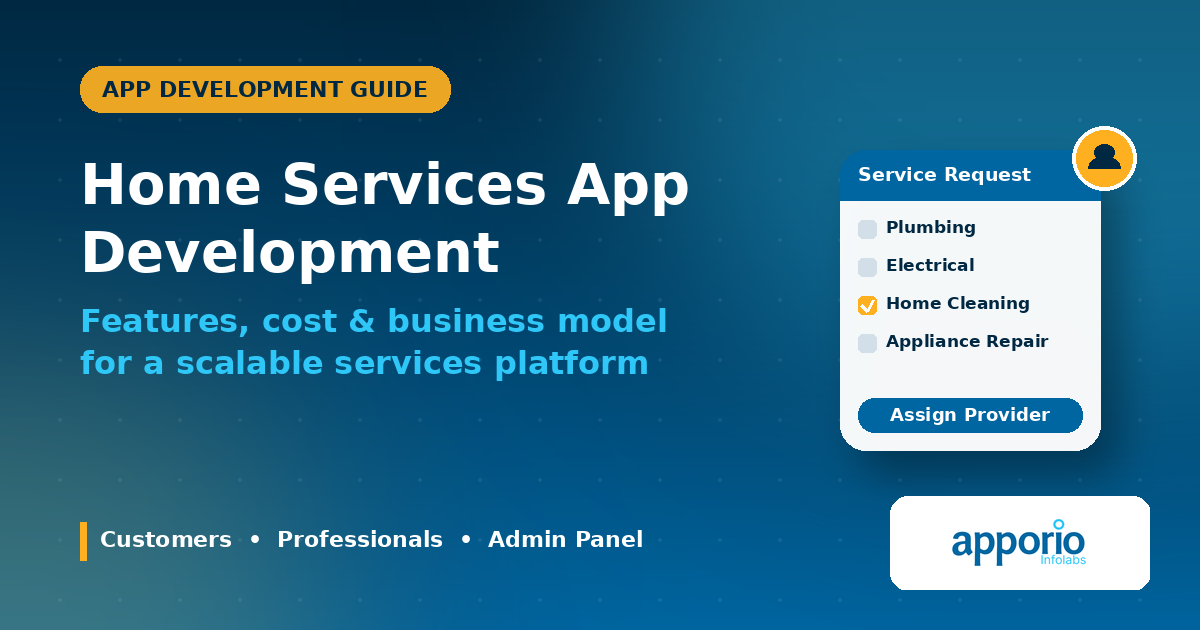
Home services app development helps entrepreneurs create digital marketplaces for plumbing, electrical work, cleaning, appliance repair, painting, beauty treatments, moving, and other services delivered at a customer’s location. The app connects customers with service professionals, manages bookings, supports payments, and gives operators control over quality and availability.
Commercial demand is only one part of the decision. The harder questions concern provider supply, service-area density, pricing, cancellations, insurance, customer support, and the technology needed to coordinate every job. A polished customer app cannot compensate for weak provider operations or unclear service standards.
This guide explains the product structure, essential features, cost factors, revenue options, launch process, and mistakes that can affect profitability. It is intended for founders assessing a single-service marketplace, a regional platform, or a broader on-demand app solution.
Home services app development is the process of creating a mobile and administrative platform for booking, assigning, delivering, and reviewing services performed at a customer’s home or workplace. Most platforms have at least three operational interfaces: a customer application, a professional or provider application, and an admin panel.
The customer selects a service, enters an address, chooses a time slot, reviews the estimated price, and confirms the request. A provider receives the job, checks the scope and location, accepts or rejects the assignment, travels to the site, updates job status, and records completion. The admin team manages users, categories, commissions, disputes, service zones, payments, and reporting.
The correct model depends on local labor regulations, provider availability, average order value, repeat frequency, and how much control the business wants over fulfillment.
Household services are operationally fragmented in many markets. Customers may rely on personal recommendations, informal listings, phone calls, or social media messages. A digital marketplace gives them a searchable catalog, visible availability, booking records, payment options, and a support channel. For professionals, it can provide structured demand, route information, digital earnings records, and a way to build ratings.
The commercial case depends on repeat behavior rather than downloads alone. Cleaning, maintenance, pest control, lawn care, and beauty services can generate recurring orders if the platform delivers reliable quality. Emergency categories may have high urgency but lower booking frequency. Founders should evaluate each category by contribution margin, not just popularity.
These measures help determine if a category should be expanded, redesigned, or removed. They also make conversations with a development partner more concrete because product decisions can be tied to operating needs.
A well-designed platform can improve the experience for all participants, but the benefits come from connected workflows rather than isolated features. The customer, professional, and operations team must see consistent booking information throughout the job lifecycle.
The operator gains a central system for managing service areas, categories, pricing, commissions, provider documents, complaints, refunds, and performance. Automation can reduce repetitive coordination, but human support remains important for complex jobs, disputes, safety incidents, and quality failures.
The first release should support the full transaction from service discovery to settlement. A feature is valuable only when it improves conversion, fulfillment, quality, or financial control.
A practical launch plan reduces the risk of building features before the operating model is validated. Start with one geography and a small number of categories where supply can be recruited and monitored.
Not every service should use the same booking flow. A standard home cleaning may use a fixed price based on size and duration. A water-heater repair may require a diagnostic visit and a quote. A platform should support both patterns instead of forcing every provider into a single rate structure.
Showing a time slot that no professional can fulfill creates avoidable cancellations. Availability should account for working hours, existing jobs, travel time, service duration, geographic zones, and provider leave. If exact scheduling is not possible at launch, display broader windows rather than false precision.
Use category-specific checklists, completion evidence, customer confirmation, and structured complaint reasons. A rating alone does not explain whether the problem was lateness, workmanship, price, behavior, or missing equipment. Better data supports fair provider coaching and faster dispute resolution.
Customers should understand the base charge, platform fee, taxes, add-ons, inspection charge, discounts, and final amount. For quote-based jobs, explain what the quote covers and whether a second visit or extra materials may create additional charges.
Home-service platforms handle addresses, phone numbers, access notes, identity documents, payment events, and sometimes photos of private spaces. Apply role-based access, secure data handling, limited retention, audit logs, and clear consent practices. A review of cyber security services may be appropriate before handling sensitive customer and provider data.
Choose infrastructure that can support separate customer, provider, and admin workflows without making every category dependent on one tightly coupled release. Apporio’s DevOps consulting service can be considered for deployment processes, monitoring, backups, and controlled updates.
Founders generally compare a ready-made foundation, a fully custom build, and a marketplace assembled from multiple third-party tools. The right option depends on the amount of differentiation required, available capital, technical ownership, and launch urgency. Cost should be considered alongside future change requests and maintenance responsibility.
| Build option | Initial scope | Best fit | Main trade-off |
|---|---|---|---|
| White-label foundation | Prebuilt customer, provider, and admin workflows with branding and configuration | Founders testing a market or launching a standard service marketplace | Unusual workflows may require customization |
| Custom development | Product architecture and workflows designed around specific business rules | Businesses with differentiated operations, compliance, or complex pricing | More discovery, development, testing, and maintenance effort |
| Third-party assembly | Separate tools for booking, payments, messaging, dispatch, and reporting | Teams with strong technical ownership and integration capacity | Data consistency, vendor dependency, and integration maintenance |
| Admin-first pilot | Limited customer interface supported by strong manual operations | Teams validating demand and category economics before wider automation | Higher manual workload and limited customer scale |
The cost of home services app development depends on the number of interfaces, service categories, scheduling rules, pricing model, payment requirements, security controls, geographic coverage, and level of customization. A credible budget should include discovery, design, development, testing, deployment, infrastructure, support, and future changes rather than focusing only on the initial app build.
For a standard provider marketplace, Apporio can help assess a white-label route through Taskrabbit Clone App, a broader multi-service direction through Gojek Clone App, or a tailored project through on-demand app development services. The strongest proposal will connect features to provider economics, service quality, payments, and launch geography.
Define the category, validate supply, select the right workflow, and pilot operations before expanding. To discuss a suitable product path for your market, contact Apporio Infolabs.
There is no reliable single price without defining the scope. Costs vary according to customer, provider, and admin interfaces; service categories; fixed or quote-based pricing; scheduling; payment integrations; security; platform coverage; and customization. A requirements workshop is needed for a meaningful estimate.
The core features are service discovery, address validation, scheduling, pricing or quotes, provider onboarding, job assignment, status tracking, payments, reviews, notifications, support, refunds, and admin reporting. The first release should prioritize the complete booking and fulfillment workflow.
Common revenue models include a commission on completed bookings, customer service fees, provider subscription plans, lead fees, featured placement, and markups on managed services. The appropriate mix depends on average order value, repeat frequency, provider economics, and the amount of operational support provided.
Use fixed prices when the service scope is repeatable and easy to describe. Use inspection or provider quotes when materials, property conditions, or job complexity vary. Some businesses use both models across different categories.
Separate customer and provider workflows are usually practical because each group needs different screens, permissions, notifications, and actions. An admin panel is also necessary for managing providers, bookings, payments, disputes, categories, and reports.
Start with one service area and a limited category set. Recruit and verify providers, define pricing and cancellation policies, configure payments and support, run a controlled pilot, measure fulfillment and contribution margin, then expand after the initial operation is stable.

