OUR PRODUCTS
Uberr Clone AppGojek Clone AppSuper App DevelopmentUberr Eats Clone AppGrocery App DevelopmentHandyman App Like Uberr
inDriver Clone AppDelivery App DevelopmentGlovo Clone AppBolt Clone AppLyft Clone AppCareem Clone App
OUR PRODUCTS

← Back to Blog
Mobile App Development
August 31, 2026
A practical guide to launching a multi-service platform in Africa, covering market selection, payments, architecture, operations, monetization, and growth.
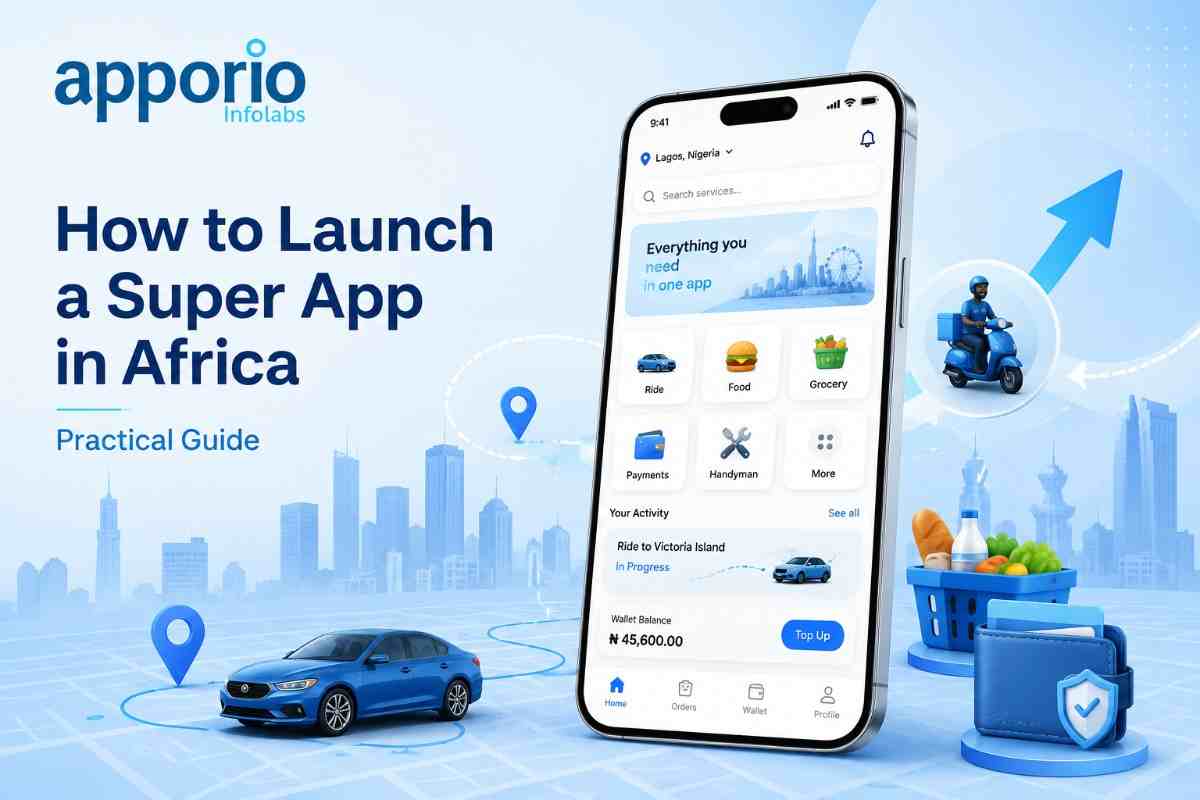
Africa is not one uniform technology market. Payment preferences, mobile data access, regulations, transport patterns, languages, and purchasing power vary significantly between countries and cities. That makes super app development Africa a market-planning exercise as much as a software project.
A multi-service platform can combine transport, food delivery, grocery delivery, home services, payments, and other daily-use products inside one customer experience. However, launching every service at once creates operational and financial pressure. The stronger approach is to begin with one high-frequency service, prove demand in a defined location, and add adjacent services after the operating model is working.
This guide explains the decisions African founders should make before commissioning an app. It covers market selection, product scope, payments, technology, compliance, service operations, monetization, and mistakes that can delay adoption.
Super app development means creating a single digital platform that gives customers access to multiple services through one account, one brand, and a connected set of workflows. The platform normally includes separate service modules while sharing common capabilities such as authentication, location, notifications, customer support, analytics, and payments.
For an African launch, the product must account for local conditions from the beginning. Users may switch between mobile data networks, use entry-level Android devices, prefer mobile money, or experience intermittent connectivity. Drivers, merchants, and service professionals may also need simple interfaces that work quickly in busy environments.
Apporio’s Super App Development offering is relevant when a business needs this modular structure rather than several disconnected applications.
The commercial case depends on solving repeated, local problems rather than copying a foreign app category. In many African cities, customers may need transport, prepared food, household supplies, and trusted service professionals within the same week. A platform that addresses these needs can build more frequent usage than a product limited to one occasional transaction.
There is also an operational reason to connect services. Customer support, identity management, notifications, promotions, and payment reconciliation can be shared. That does not remove the complexity of each vertical, but it can reduce duplication when the platform is designed properly.
These benefits are potential outcomes, not automatic results. They depend on local service density, execution quality, pricing, support, and the ability to maintain reliable supply.
A multi-service product can be commercially attractive, but its benefits should be evaluated against the founder’s resources and operating territory. A startup serving one city may gain more from a focused product than from a large platform with inactive service tabs.
Customers can use one account and one familiar brand for several needs. A consistent checkout, support process, and order history reduce the need to learn multiple applications. Convenience is meaningful only when service availability, delivery estimates, pricing, and payment status are clear.
Retention improves when the platform gives customers a practical reason to return. Food, grocery, transport, and handyman services have different purchase cycles, so a combined product can create several return points. Product teams should track repeat use by service rather than treating all activity as one generic metric.
Shared identity, notifications, customer support, analytics, and administration can be developed as common components. This avoids rebuilding the same functions for every service. The service modules still need separate rules for dispatching, catalogs, pricing, availability, and fulfillment.
A modular product lets the operator add a new category after validating demand. For example, a ride-hailing launch may later add food delivery or grocery delivery in the same city. Expansion should follow evidence such as customer requests, provider availability, order economics, and support capacity.
A regional operator can design around local languages, payment methods, neighborhood boundaries, and service habits. This may provide a stronger position than a generic product that assumes every customer has the same device, bank access, and delivery expectations.
Launching a multi-service product requires decisions in a deliberate sequence. Software development should begin after the commercial model, operating area, and first service have been defined.
The best product decisions usually come from operational detail. A polished interface cannot compensate for missing providers, payment failures, inaccurate locations, or unresolved complaints.
Keep screens lightweight, reduce unnecessary data transfers, and make important states visible when a connection drops. Customers should know whether an order was submitted, a payment is pending, or a request still needs confirmation. Provider applications should avoid workflows that require constant high-speed connectivity.
Android devices cover a broad range of price points, so test on lower-cost hardware as well as newer phones. App startup time, memory use, image sizes, battery impact, and background location behavior should be measured. A later iPhone release can use the same product rules while receiving platform-specific interface testing. Apporio provides Android App Development and iPhone development services for businesses planning both platforms.
Every transaction should have a clear status: initiated, authorized, completed, failed, refunded, or under review. Build retry and reconciliation processes instead of assuming that every payment event arrives once and in order. Payment providers should be assessed for country coverage, settlement terms, dispute handling, and integration support. Apporio’s Payment Gateways page is a useful starting point for evaluating this part of the build.
Address accuracy can be difficult in areas where formal street addressing is incomplete or inconsistent. Allow map pins, landmarks, saved instructions, phone confirmation, and provider notes where appropriate. Do not rely on GPS alone for delivery or pickup decisions.
Show provider names, ratings, service details, estimated prices, cancellation terms, and support channels before confirmation. Verification procedures should match the risk of the category. Transport and home services require particular attention to identity, incident reporting, and customer protection.
Limit access to personal information, encrypt sensitive data in transit and at rest, log administrator actions, and define retention rules. Security testing should cover customer accounts, provider accounts, payment callbacks, APIs, and administrative permissions. Apporio’s Cyber Security service is relevant when security assessment is part of the delivery plan.
Before expanding, review metrics such as completed requests, cancellation rate, provider acceptance, payment success, support resolution time, repeat usage, and contribution margin. The precise targets should be based on the service and market rather than copied from another company.
Many multi-service launches struggle because the founder treats the product as a collection of screens instead of a coordinated marketplace and operations system.
Not every African startup needs a full multi-service platform on day one. Comparing the available models helps founders match product scope with capital, team capacity, and market evidence.
| Launch Model | Best Suited For | Main Advantage | Main Risk |
|---|---|---|---|
| Single-Service App | Founders validating one clear problem | Focused operations and simpler customer education | Lower usage frequency if the service is occasional |
| Marketplace App | One category with several provider groups | Strong category depth and clearer supply management | Dependence on one revenue stream |
| Multi-Service Platform | Operators with adjacent demand and supply capacity | Shared accounts, infrastructure, and cross-service usage | Higher operational and technical complexity |
| White-Label Starting Point | Businesses seeking a faster product foundation | Existing workflows can reduce initial build effort | Customization, ownership, and scaling limits must be reviewed |
A modular white-label foundation can be practical when the provider offers source access, documented integrations, deployment support, and a clear customization process. Founders should still validate performance, security, payment coverage, data ownership, and long-term maintenance before signing an agreement.
Apporio’s Gojekk Clone product can be evaluated by businesses planning a multi-service model. It should be assessed against the target country, launch category, required payment methods, provider workflow, and expansion plan rather than selected only because the platform has many modules.
Launching a multi-service platform in Africa requires a focused market entry plan, dependable local payments, provider supply, practical customer support, and technology that can expand without becoming difficult to maintain. Begin with one city and one anchor service, validate the operating workflow, then add food delivery, grocery delivery, or handyman services when demand and supply justify the move.
For founders evaluating super app development Africa, Apporio can support the product foundation through its Gojekk Clone, Food Delivery, Grocery Delivery, and Handyman Services offerings. Review the platform against your country-specific requirements, operating model, and budget before selecting the launch scope.
Book Free Demo
The best first service depends on the selected city, customer demand, provider availability, payment behavior, and operating capacity. Transport, food delivery, groceries, and handyman services can all work as anchor categories, but the launch should begin with the service that has the clearest local demand and manageable fulfillment.
No. A startup should usually launch one focused service in a limited area, validate customer and provider workflows, and add adjacent categories after service quality, support, payment handling, and unit economics are understood.
The platform should support the payment methods customers use in the selected country. Depending on the market, this may include cards, bank-based payments, mobile money, cash collection, or other locally available methods. The business must also plan refunds, failed transactions, settlement, and provider payouts.
Modular architecture separates shared capabilities such as accounts, notifications, support, and analytics from service-specific rules. This allows a business to add categories without rewriting the entire product, while keeping transport, delivery, grocery, and handyman workflows distinct.
Before expansion, review completed requests, cancellations, provider acceptance, payment success, support resolution time, repeat usage, active provider coverage, and contribution margin. Also test the product on lower-cost devices, slower networks, and real local addressing conditions.

