OUR PRODUCTS
Uberr Clone AppGojek Clone AppSuper App DevelopmentUberr Eats Clone AppGrocery App DevelopmentHandyman App Like Uberr
inDriver Clone AppDelivery App DevelopmentGlovo Clone AppBolt Clone AppLyft Clone AppCareem Clone App
OUR PRODUCTS

← Back to Blog
August 10, 2026
A practical guide to planning, building and launching a food delivery marketplace for UK and European customers, restaurants and delivery partners.
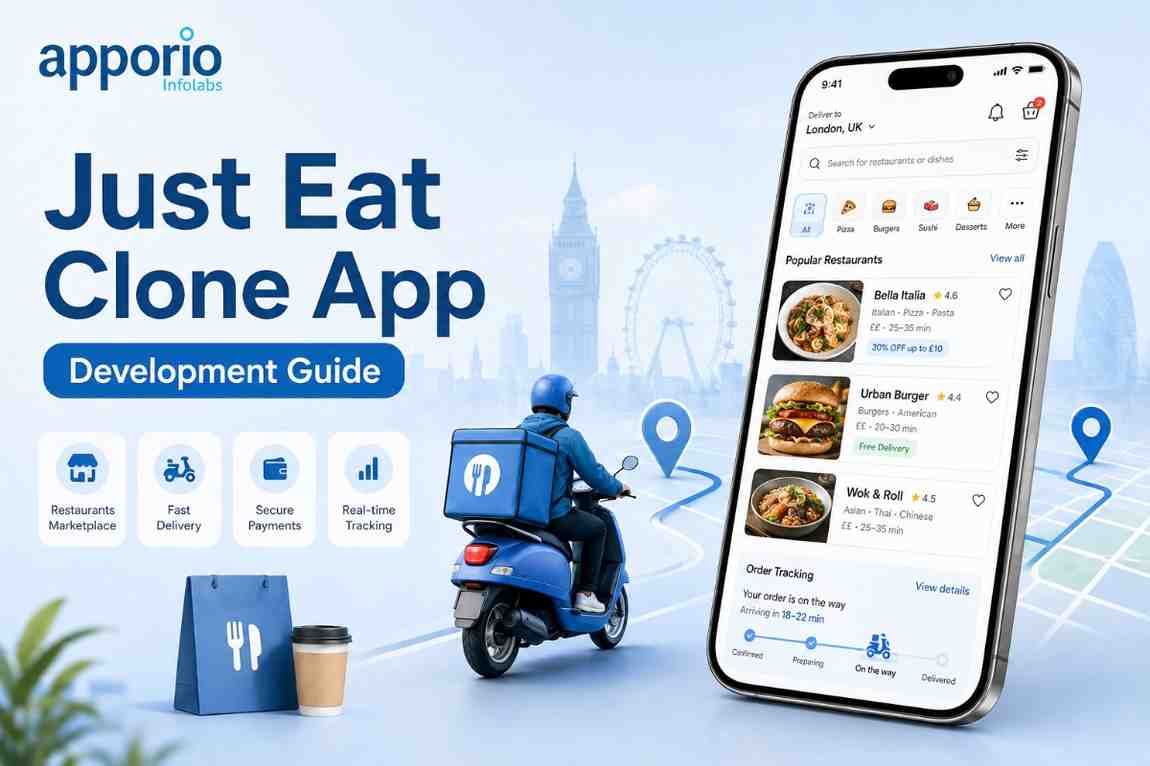
Building a food delivery marketplace for the UK or Europe involves more than copying a restaurant listing interface. The platform must coordinate customers, restaurants, delivery partners, payments, order status, refunds and local operating rules in one system. That makes Just Eat clone app development a commercial product decision rather than a simple app design project.
For founders, the main questions are practical: what should the first release include, how will restaurants receive and manage orders, which payment methods should be supported, and how can the business make money without damaging customer retention? A ready-made food delivery product can provide a starting point, but the business model, market coverage and operational workflows still need careful planning.
This guide explains the components, development stages, monetisation options, compliance considerations and common mistakes involved in launching a Just Eat-style marketplace. It is written for entrepreneurs evaluating a white-label solution, a custom build or a staged launch in the UK and European markets.
For a broader view of the category, review this food delivery app development guide alongside the product decisions below.
Just Eat clone app development involves creating a multi-sided food ordering marketplace with separate experiences for customers, restaurants, delivery partners and administrators. The word “clone” should describe the operating model, not a direct copy of another company’s branding, code, content or protected design.
The customer application typically supports location-based restaurant discovery, menus, item customisation, basket management, checkout, order tracking, reviews and support. Restaurant tools handle onboarding, menu updates, opening hours, order acceptance and preparation status. Delivery tools help drivers manage availability, collection details, navigation and proof of delivery when the business operates its own logistics network.
An administrative dashboard connects these roles. It gives operators control over users, restaurants, delivery zones, commissions, promotions, payouts, complaints and reporting. Without this back-office layer, the marketplace becomes difficult to manage as order volume increases.
The operating model can differ by market. A platform may act as a marketplace while restaurants arrange their own delivery, provide a managed delivery network, or support both approaches. That decision affects the product scope, support processes, insurance considerations, delivery pricing and unit economics.
The commercial opportunity is not created by the interface alone. It comes from coordinating local restaurant supply and customer demand while keeping each order operationally viable. A platform that attracts customers but cannot maintain accurate menus, reliable delivery estimates or responsive support will quickly create dissatisfaction on both sides.
UK and European markets also contain important differences. Payment preferences, tax treatment, delivery geography, languages, restaurant density and consumer expectations vary by country and sometimes by city. A business entering London, Dublin, Berlin or Paris cannot assume that one operating playbook will fit every location.
Local competition is another reason to define a clear market position. A new platform may focus on independent restaurants, a specific cuisine, underserved neighbourhoods, corporate ordering, lower commission structures or a smaller city where service quality can be controlled. The product should support that position rather than attempt to serve every restaurant category from the first release.
These decisions should be documented before finalising screens and technical specifications. They determine which dashboards, integrations, permissions and reporting tools the first release actually needs.
A white-label product can reduce the amount of work required to establish the basic marketplace structure. Instead of designing every workflow from the ground up, a founder starts with established roles and operational patterns, then adapts the product to a particular brand and market.
This approach is useful when speed of validation matters. A business can test restaurant acquisition, customer demand and delivery economics before committing to a large custom engineering programme. It also gives the team a working foundation for conversations with restaurant partners and investors.
Apporio’s Justeat Clone App is relevant to this model because the product is designed around a food ordering marketplace. It should still be evaluated against the intended launch geography, payment requirements, branding needs, integrations and operational model rather than treated as a complete market strategy.
There are limits. A white-label starting point does not remove the need for quality assurance, data protection planning, payment configuration, restaurant onboarding and post-launch maintenance. It also does not guarantee product-market fit. Those outcomes depend on execution in the chosen market.
The first release should support a complete order journey, not just restaurant discovery. A customer must be able to find an available restaurant, select valid items, pay successfully, receive a realistic estimate and obtain support if something goes wrong.
Apporio’s Ubereats Clone can also be reviewed as a comparable food delivery product when assessing marketplace workflows and feature scope.
A structured delivery plan reduces rework. The sequence below is suitable for founders comparing a ready-made platform with a more tailored build.
For businesses requiring a broader operational foundation, on-demand mobile app development services can support planning across customer, provider and admin applications.
Good product decisions in this category are closely tied to operations. The most useful practices focus on accuracy, trust, compliance and the ability to expand without redesigning the entire system.
Use delivery zones that reflect actual restaurant coverage rather than drawing a large service area for marketing purposes. A smaller area with dependable estimates is usually easier to operate than a wide area with frequent delays. Include configurable opening hours, preparation buffers, holiday closures and temporary restaurant pauses.
Show item totals, delivery charges, service fees, discounts and the final payable amount before payment confirmation. Unexpected charges create support demand and can reduce repeat ordering. Restaurant commission rules should also be documented clearly so partners can assess the commercial relationship.
The platform may process names, addresses, phone numbers, order history, payment references and location data. UK and European operators should take advice on applicable data protection obligations, retention periods, consent, access controls and data-subject requests. Apporio’s cyber security services may be relevant when reviewing application and infrastructure risks.
Restaurant partners need dependable order alerts, accurate menu controls, payout visibility and a support route. Onboarding fewer restaurants carefully can produce better menu quality than signing up a large number of businesses with incomplete information. Create a process for checking opening hours, delivery coverage, item availability and contact details.
Useful early metrics include restaurant activation, menu completeness, checkout conversion, payment failure rate, order acceptance, cancellation reasons, delivery time variance, refunds, repeat ordering and support contacts. Downloads are a distribution measure, not proof that the marketplace works.
Use readable typography, clear contrast, descriptive labels and predictable navigation. If the launch includes multiple European markets, plan translations and currency formatting at the data and content level. Translating visible buttons alone is not enough if restaurant menus and customer support remain available in one language.
Food delivery projects often fail because the business expands the feature list while leaving basic operational questions unresolved. The mistakes below are preventable with early product and process decisions.
Founders usually compare a ready-made white-label product, a fully custom build and a restaurant-owned ordering system. Each option suits a different level of operational complexity and investment capacity.
| Option | Best suited to | Strengths | Limitations |
|---|---|---|---|
| White-label marketplace | Startups validating a city or niche | Existing marketplace workflows, controlled initial scope and faster product configuration | May require configuration or additional work for unusual local requirements |
| Custom marketplace | Businesses with distinctive workflows or complex integrations | Greater control over architecture, user journeys, rules and integrations | More planning, testing, maintenance and product management responsibility |
| Restaurant-owned ordering system | Single brands or restaurant groups | Direct customer relationship and control over menus, ordering and fulfilment | Less marketplace variety and greater responsibility for customer acquisition |
| Hybrid marketplace | Operators combining restaurants and managed logistics | Can support different restaurant delivery models within one service | More complex permissions, payouts, delivery operations and support workflows |
The right choice depends on the intended launch area, restaurant acquisition plan, delivery responsibility, integration requirements and internal technical capacity. A detailed discovery process should identify which parts can use a standard product configuration and which require tailored development.
A successful food delivery marketplace needs a complete order lifecycle, reliable restaurant operations, transparent pricing, appropriate payment support and strong administration. The first release should focus on completing orders consistently in a defined UK or European market before expanding into additional cities, services or advanced personalisation.
Apporio can support this roadmap through the Justeat Clone App, Ubereats Clone, Food Delivery solutions and broader on-demand app development services. Assess the product against your restaurant model, delivery responsibilities, compliance needs and launch objectives before selecting the implementation path. For a practical product discussion, Book Free Demo
It is a multi-sided marketplace connecting customers with restaurants for online ordering. Depending on the business model, restaurants may manage delivery themselves or the platform may coordinate delivery partners.
The first version should support restaurant discovery, menus, basket management, checkout, payments, order status, restaurant order handling, notifications and an admin dashboard. Delivery partner tools are required when the platform manages fulfilment.
Common revenue streams include restaurant commissions, customer delivery fees, service fees, promoted listings and promotional partnerships. The selected mix should be tested against restaurant acceptance and order-level economics.
It can be a suitable starting point when the product supports the required payment methods, language, currency, delivery rules, data controls and branding. The operator must still review local compliance and configure the service for the chosen market.
Restaurant-managed delivery can reduce operational complexity, while platform-managed delivery provides greater control over fulfilment. Supporting both models is possible but requires clear permissions, status flows, pricing and support processes.
Launch with a defined delivery area and a selected restaurant group. Test real order scenarios, payment failures, cancellations, unavailable items, delivery delays, refunds and customer support before expanding coverage.

