OUR PRODUCTS
Uberr Clone AppGojek Clone AppSuper App DevelopmentUberr Eats Clone AppGrocery App DevelopmentHandyman App Like Uberr
inDriver Clone AppDelivery App DevelopmentGlovo Clone AppBolt Clone AppLyft Clone AppCareem Clone App
OUR PRODUCTS

← Back to Blog
October 13, 2026
A practical guide to launching a taxi and boda boda platform in Uganda, covering mobile money, driver operations, safety, technology, and market expansion.
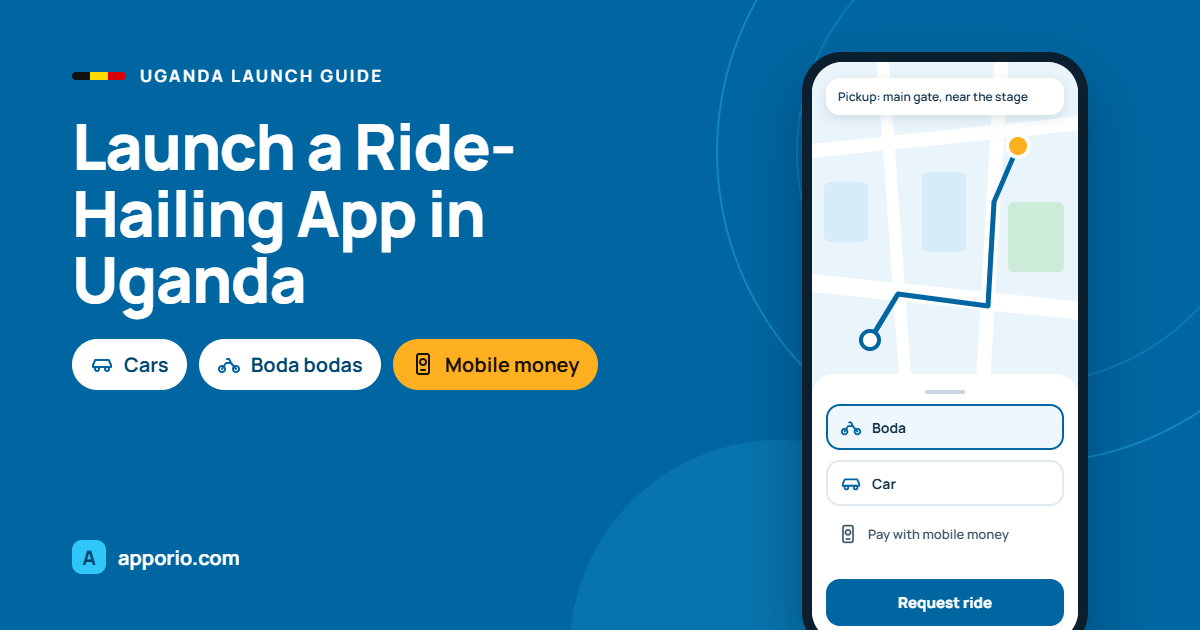
Uber stopped operating in Uganda on September 2, 2026, ending about a decade of service that began in Kampala in 2016 (background on Uber's exit). Riders still need to move around the city, and drivers still need trips. Bolt, inDrive, SafeBoda, and Faras are competing for that demand, which leaves room for a local operator that handles Ugandan conditions better: landmark-based pickups, boda boda safety, and mobile money payments.
Launching a ride-hailing app in Uganda takes more than copying a passenger booking interface. The platform must work for private cars, boda bodas, drivers with different levels of smartphone experience, and customers who pay with MTN Mobile Money or Airtel Money rather than cards. It also needs operating procedures for Kampala traffic, Entebbe airport trips, night rides, driver verification, fare disputes, and areas with inconsistent connectivity.
Quick answer: To launch a ride-hailing app in Uganda, start in one area (usually Kampala), decide whether you will run cars, boda bodas, or both, recruit and verify drivers before marketing, integrate MTN Mobile Money and Airtel Money alongside cash, and run an invite-only pilot. You need a passenger app, driver app, and admin panel with category-specific fares, onboarding, and safety rules.
This guide covers the product, compliance, technology, payment, and launch decisions to make before commissioning development. If you are still choosing between markets, read our comparison of local ride-hailing opportunities in Nigeria and Uganda first. This guide focuses on Uganda only, and shows where a white-label foundation such as the Apporio Uber Clone App fits into the plan.
A ride-hailing platform connects passengers with nearby drivers through mobile applications and an administration panel. The passenger requests a trip, the system identifies eligible drivers, a driver accepts the request, and both parties receive trip updates until the ride ends. The platform then records the fare, payment status, rating, and support history.
For Uganda, the product should not treat every ride as a standard car trip. Boda bodas need different vehicle information, safety controls, pricing rules, and driver documents. Cars may serve airport transfers, corporate accounts, scheduled trips, or longer intercity journeys. Each category can have its own availability, service area, commission, and dispatch logic.
The product is therefore a dispatch and marketplace operation, not just a consumer app. Driver supply, customer support, payment reconciliation, and local transport rules affect the user experience as much as the interface does.
A Ugandan mobility service must be designed around local trip behavior. Kampala has dense traffic, changing pickup conditions, and busy commercial areas where a map pin may not identify the correct entrance. A passenger may describe a landmark, building, stage, or gate instead of a formal street address. The app should allow an editable pickup note and provide a driver-passenger call or chat option when the location needs clarification.
Boda bodas improve access in congested areas, but they also create additional safety and operational requirements. The platform should collect vehicle and driver details, display the registered vehicle category and plate, and provide a process for reporting unsafe conduct. The business should define which roads, districts, or trip types suit each category instead of treating all vehicles as interchangeable, and confirm current rules with the Kampala Capital City Authority (KCCA) and the Ministry of Works and Transport.
Mobile money is equally important. Most Ugandan riders and drivers use MTN Mobile Money or Airtel Money, so a payment design that assumes card ownership excludes a large share of users and creates settlement problems for drivers. Confirm the selected providers, transaction fees, callback behavior, refund process, reconciliation reports, and fallback handling before development is completed. Apporio's payment gateway options can be reviewed as part of that discussion.
Competition shapes the plan too. Riders already have Bolt, inDrive, SafeBoda, and Faras on their phones, so a new app needs a specific reason to be opened: faster pickups in a defined zone, safer boda trips, better corporate service, or fairer driver terms. A marketplace can also fail from weak supply rather than weak demand. If a passenger waits too long or the fare estimate changes unexpectedly, early users will not return, so the launch should begin with a defined service area and a measurable driver availability plan.
A local platform can compete through operational focus rather than trying to serve every possible trip from day one. A carefully scoped product gives the business more control over driver quality, payment behavior, service zones, and customer support. It can also become the foundation for additional transport or on-demand services later.
These benefits depend on execution. A feature only creates value when drivers understand it, passengers can use it under real network conditions, and the operations team can resolve exceptions quickly.
Choose one city or a limited group of neighborhoods before planning nationwide coverage. For most founders this means central Kampala and nearby areas, with Entebbe airport runs added as a separate trip type if demand supports it. Map the intended pickup zones, hotels, business districts, residential areas, and restricted locations, and decide whether the first release supports immediate rides, scheduled bookings, or both. A smaller area makes it easier to build driver density and measure waiting time.
Decide whether the first release includes cars, boda bodas, or both. For each category, document required driver information, vehicle information, fare rules, passenger capacity, operating zones, and safety procedures. Do not add a category simply because the interface can display it; the operations team must be ready to verify and support it.
Interview passengers, employers, hotels, universities, boda stage chairpersons, driver groups, and fleet owners. Identify frequent trip types, acceptable wait times, payment preferences, and common complaints about existing apps. At the same time, confirm how drivers want to receive requests, how commissions should be communicated, and which incentives are financially possible.
The minimum viable product should include passenger registration, driver registration, vehicle category selection, pickup and destination entry, fare estimation, driver dispatch, live trip status, call or chat, ratings, support tickets, and payment recording. The administration panel must be part of the first release because transport operations cannot be managed reliably from the customer app alone.
Plan for both MTN Mobile Money and Airtel Money, either directly or through a payment aggregator. Confirm each provider's API, authentication requirements, transaction callbacks, failed-payment responses, reversal process, and settlement reports. For cash trips, record the expected fare, driver collection status, commission, and dispute outcome. A payment marked successful in the passenger app should still be checked against the provider's server response.
Create a repeatable onboarding process. Collect identity details (such as the National ID), driving permit, vehicle records, insurance information where applicable, emergency contacts, and profile photos based on the business's legal and safety requirements. Set document expiry reminders and define what happens when information is missing, expired, or disputed.
Start with a small driver group and invited passengers. Test pickups at busy landmarks, payment failures, cancellation flows, low-balance phones, poor GPS readings, support escalation, and end-of-day settlement. Measure completed trips, driver acceptance, cancellations, passenger wait time, payment failures, complaints, and repeat bookings. Our guide to marketplace liquidity explains how to read these numbers by zone and hour.
Add new zones, vehicle categories, or scheduled services only after the initial operation has stable processes. The city expansion process should account for driver supply, support coverage, marketing cost, payment readiness, and local transport requirements before you move beyond Kampala.
Product decisions should reflect how trips actually happen on the ground. A polished app cannot compensate for unclear dispatch rules, inaccurate pickup locations, or slow support. These practices reduce avoidable friction during the first operating months.
Keep the first interface simple. Drivers often use the app while moving between jobs, so trip alerts, navigation, earnings, and availability should be easy to find. Extra features can come after the core booking loop is reliable.
Many transport app launches struggle because the business treats software delivery as the whole project. The marketplace needs a supply plan, a payment process, and a support operation that are tested together.
Another common mistake is choosing a technology package without checking ownership, customization rights, maintenance arrangements, integrations, and deployment responsibilities. A white-label foundation reduces initial build effort, but the buyer should still confirm what can be changed and who handles updates.
Founders usually choose between a custom build, a white-label foundation, or a narrower pilot product. The right option depends on budget, launch urgency, expected differentiation, internal technical capacity, and the complexity of local integrations.
| Approach | Best fit | Advantages | Trade-offs |
|---|---|---|---|
| Custom development | Businesses with unusual workflows or long-term technical plans | Maximum control over product logic, integrations, and brand experience | More discovery, testing, maintenance, and delivery responsibility |
| White-label taxi platform | Founders validating a market with proven booking requirements | Faster starting point for passenger, driver, and admin workflows | Customization and integration limits must be checked in advance |
| Focused MVP | Operators launching in one area with a limited vehicle mix | Smaller scope makes pilot measurement and operational learning easier | Additional categories and advanced automation may come later |
| Multi-service platform | Businesses with transport demand plus a clear expansion plan | Can organize several on-demand services under one account | More complex operations, support, pricing, and quality management |
For many startups, the practical decision is not simply custom versus ready-made. It is which functions must be differentiated at launch and which standard workflows can be configured. Mobile money integration, service zones, driver verification, reporting, and support escalation deserve detailed review before signing a development agreement.
A successful ride-hailing launch in Uganda starts with a controlled service area, clear vehicle categories, verified drivers, reliable dispatch, and mobile money reconciliation. Cars and boda bodas can run in one marketplace, but they need distinct operating rules. The first release should prioritize completed trips, safe service, accurate records, and fast issue resolution over a long feature list.
Apporio supports this with its white-label Uber clone app, taxi app development, and on-demand app development services. A Gojek clone is worth considering once the transport operation is validated and there is a clear case for adding other services.
Book a free demo to see the passenger, driver, and admin apps configured for cars, boda bodas, and mobile money.
You need a passenger app, driver app, admin dashboard, dispatch workflow, mobile money and cash payment handling, a driver verification process, a customer support operation, a service-zone plan, and a documented approach to local transport and data protection requirements.
Yes. One marketplace can support both categories when the system allows separate vehicle profiles, fare rules, onboarding requirements, service zones, safety procedures, and reporting for each type.
Offering both serves different customer preferences, but each payment type needs clear status tracking. Mobile money requires provider confirmation and reconciliation, while cash trips need collection and commission records.
Plan for MTN Mobile Money and Airtel Money, the two providers most Ugandan riders and drivers use, either through direct integrations or a payment aggregator. Confirm transaction fees, callback reliability, refunds, and driver payout options with each provider before launch.
The first MVP should include passenger and driver registration, vehicle categories, pickup and destination entry, fare estimates, dispatch, live trip status, driver-passenger contact, ratings, support tickets, payment recording, and admin reporting.
Recruit drivers within the initial service area, verify their identity and vehicle information, explain commissions and payment procedures, train them on the driver app, and run an invite-only pilot before public promotion.
Uber's exit in September 2026 freed up riders and drivers, but Bolt, inDrive, SafeBoda, and Faras are still active. A new app has room when it serves a defined zone or segment better, for example safer boda trips, corporate accounts, or fairer driver terms, rather than competing on discounts alone.
It can be suitable when the startup wants a proven booking foundation and needs to focus on local operations. Before choosing one, confirm customization rights, mobile money integration, security controls, reporting, deployment responsibilities, and ongoing maintenance.