OUR PRODUCTS
Uberr Clone AppGojek Clone AppSuper App DevelopmentUberr Eats Clone AppGrocery App DevelopmentHandyman App Like Uberr
inDriver Clone AppDelivery App DevelopmentGlovo Clone AppBolt Clone AppLyft Clone AppCareem Clone App
OUR PRODUCTS

← Back to Blog
September 29, 2026
A practical guide to avoiding costly planning, product, technology, testing, marketing, and operational mistakes when launching your first mobile app.
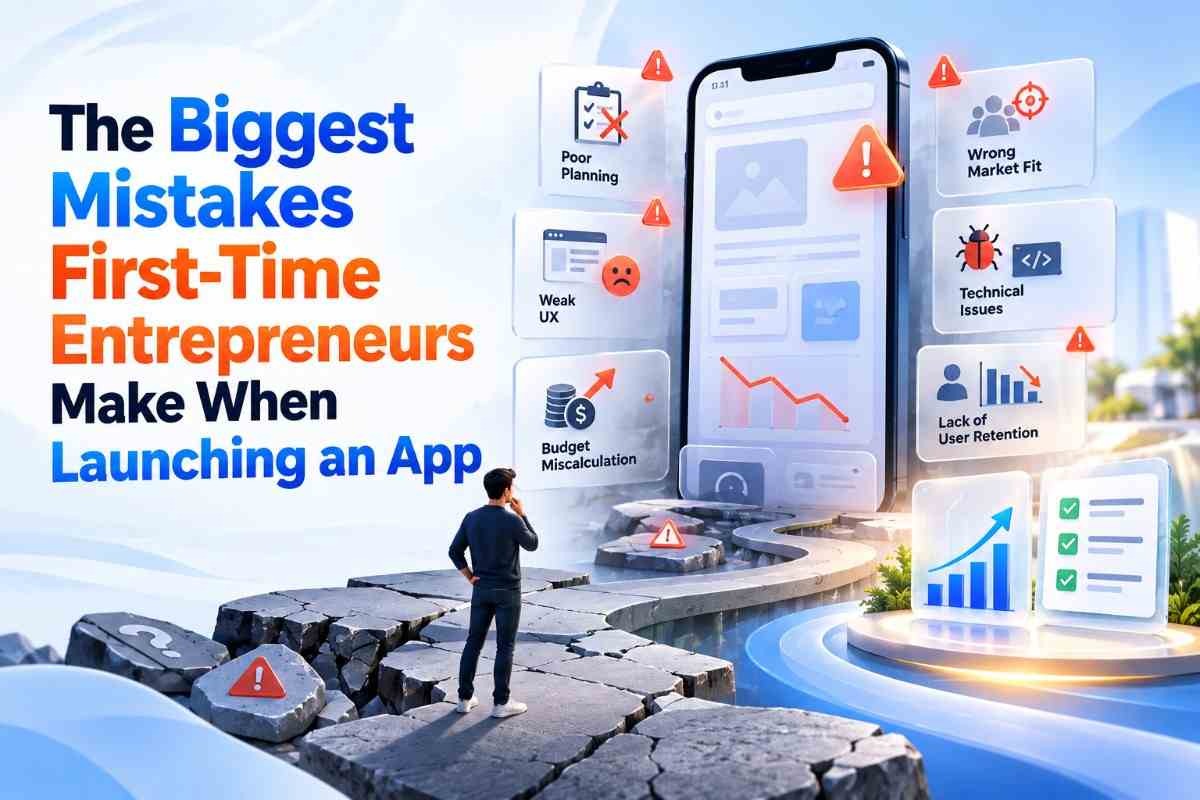
Launching an app requires more than turning an idea into working software. First-time founders must validate demand, define a business model, choose a development approach, prepare operations, and acquire early users. The most damaging app launch mistakes entrepreneurs make usually happen before the first version reaches an app store.
Many founders begin with a long feature list, select a technology based on popularity, or treat marketing as a task for after development. Those choices create avoidable costs. A technically functional application can still fail if customers do not understand its value, providers are not available, payments do not work in the target market, or support processes are missing.
This guide explains where new founders commonly lose time and budget. It focuses on decisions that apply across ride-hailing, food delivery, grocery delivery, handyman services, marketplaces, and multi-service platforms. The objective is not to remove all risk. It is to make the important risks visible early enough to manage them.
For founders building a service marketplace, reviewing an on-demand app strategy before development can help connect product decisions with real operating requirements.
App launch mistakes are planning, product, technical, commercial, or operational errors that reduce the chance of a successful release. They include building the wrong product, serving an undefined audience, ignoring platform rules, underestimating support, and launching without a way to measure user behavior.
Some errors are visible immediately. For example, a broken registration flow or an unreliable payment gateway can prevent users from completing their first transaction. Others appear later. An application may work during a small test but struggle when orders, driver locations, provider availability, notifications, and admin activity increase at the same time.
Recognizing these categories matters because a problem in one area often affects the others. A vague customer segment produces vague requirements. Vague requirements cause scope expansion. Scope expansion delays launch, reduces testing time, and consumes the budget available for marketing and operations.
An app is not only a mobile interface. It is a service system involving customers, administrators, service providers, payment partners, notifications, databases, policies, and support staff. A decision that looks minor in the interface can affect the entire operation.
For example, a food delivery business needs restaurant onboarding, menu management, order status updates, delivery assignment, refunds, and customer support. A ride-hailing platform needs driver verification, location tracking, fare rules, trip status, safety controls, and dispatch logic. A handyman marketplace needs provider profiles, service categories, scheduling, job acceptance, and dispute handling.
When founders skip these workflows, the team often relies on spreadsheets, chat messages, or manual fixes. That may work for a small pilot, but it makes response times inconsistent and hides the real cost of each transaction. Operational gaps also damage trust faster than a missing cosmetic feature.
The solution is not endless planning. It is structured planning that separates assumptions from confirmed requirements and identifies the workflows that must work on day one.
Preventing common mistakes gives a new venture more than a cleaner release. It improves the quality of decisions made after launch because the team can distinguish product problems from operational problems. A clear baseline also makes it easier to decide which features deserve investment.
A defined minimum viable product, or MVP, limits the first release to the smallest set of capabilities needed to test the business model. This does not mean creating an unfinished product. It means prioritizing the central customer journey and postponing secondary functions until usage justifies them. The difference between an MVP and a weak product is deliberate prioritization.
A focused application is easier to test with a small group of customers and service providers. The team can observe registration, search, booking, checkout, fulfillment, cancellation, and support without confusing feedback with unrelated features. Founders can also use a user feedback process to record patterns instead of reacting to individual opinions.
When every major transaction is mapped, the founder can estimate revenue, commissions, payment charges, provider payouts, refunds, delivery expenses, and customer acquisition costs. These are not guaranteed forecasts, but they expose whether the model needs higher prices, different coverage, or another revenue stream.
Clear consent, account controls, data handling, refunds, and payment communication reduce avoidable customer concerns. Security should be considered during product planning, not added as a final checklist. A dedicated cyber security review can help identify risks around authentication, access permissions, and sensitive information.
A practical launch plan moves from evidence to scope, then from scope to controlled delivery. The sequence below works for both single-service applications and larger on-demand platforms.
This staged approach creates useful learning without exposing the entire business to an untested workflow. It also gives developers and operations staff a shared definition of what “ready” means.
The brief should describe the target users, launch market, service promise, revenue model, core workflows, platform requirements, and success measures. Add a list of assumptions that still need validation. This document becomes a reference when new feature requests appear and helps prevent the project from drifting toward whoever asks most recently.
Use three groups: required for the first transaction, useful after initial validation, and experimental. Account creation, request management, payment, notifications, provider operations, and admin controls often belong in the first group for transactional apps. Advanced loyalty, complex personalization, and multiple service categories may be better tested later.
Founders often focus on the customer app because it is visible. The business may depend just as much on dashboards and provider tools. Administrators need to manage users, orders or bookings, pricing, disputes, content, payouts, and reports. Providers need practical ways to accept work, update status, manage availability, and receive relevant notifications.
Payment preferences vary by country and customer segment. Confirm supported gateways, settlement timing, currency handling, refunds, failed transaction behavior, and reconciliation. Document what happens when a payment succeeds but the order or booking status does not update. A payment integration is a business-critical workflow, not merely a button on the checkout screen.
Measure load times, API response behavior, image sizes, location refresh frequency, notification delivery, and battery impact. Test on lower-cost devices and slower networks when those conditions are common in the target market. App performance problems are often caused by oversized media, excessive requests, inefficient queries, or poorly controlled background activity.
Decide who owns source code, hosting accounts, app store accounts, analytics, domain access, payment credentials, and backups. Use version control, documented environments, access permissions, and a rollback plan. A DevOps consulting service can help structure deployment, monitoring, and release procedures when the internal team lacks this experience.
Create answers for account issues, payment failures, late fulfillment, cancellations, refunds, provider disputes, and safety concerns. Set a response owner and escalation path. Early users judge a new service by how it handles failure, not only by how the ideal journey looks in a demo.
Downloads do not show whether the business works. Track the funnel from installation to registration, first request, completed transaction, repeat use, and referral where relevant. For marketplaces, monitor both sides: customer demand and provider activity. Define measurement events before launch so the team does not have to reconstruct missing data later.
Personal enthusiasm is not evidence of market demand. Interviews, landing-page tests, provider conversations, competitor research, and small manual pilots can reveal whether the problem is frequent and valuable enough to support a business. Validation should test behavior and willingness to act, not only whether people say the concept sounds interesting.
Borrowing familiar interaction patterns can reduce user education, but copying another company’s feature list does not reproduce its supply network, brand, pricing, or local knowledge. Adapt the workflow to local regulations, payment habits, service availability, language, and customer expectations.
Multi-service platforms are operationally complex. Each category can require separate provider rules, pricing, fulfillment, support, and quality controls. Starting with one strong category or a tightly connected group of services often produces better operational learning than launching a broad catalog with limited supply.
Price comparisons are useful only when the proposals describe the same deliverables. Check whether the quote includes customer and provider applications, administration, backend work, integrations, testing, deployment, documentation, maintenance, source-code access, and post-launch support. A low initial quote may exclude work that the business cannot avoid.
Apps may handle identities, addresses, locations, payments, messages, and business records. Weak passwords, excessive permissions, exposed credentials, insecure APIs, or poor access control create technical and legal risk. Define what data is collected, why it is needed, who can access it, and how accounts can be removed.
A marketplace cannot serve demand with an empty provider network. Recruit and verify enough drivers, restaurants, stores, technicians, or other providers for the pilot area. Explain availability expectations, commissions, payouts, cancellation rules, and support channels before inviting customers.
Release is the beginning of measurement and iteration. Plan maintenance, bug fixes, store updates, analytics reviews, customer interviews, and operational reporting. A launch calendar should include what happens during the first week, first month, and first product review cycle.
There is no single best delivery model for every founder. The right choice depends on how much differentiation the business needs, how quickly assumptions must be tested, and how much technical ownership the team can manage.
| Approach | Best suited for | Main advantage | Main risk to assess |
|---|---|---|---|
| Custom development | Distinct workflows or complex integrations | Greater control over product behavior and architecture | Higher discovery, development, and maintenance demands |
| White-label solution | Founders testing a proven on-demand model | Faster path to a branded operating product | Confirm customization, ownership, integrations, and support terms |
| Ready-made foundation | Businesses prioritizing a defined core workflow | Can reduce the effort needed for common transactional functions | Check whether the foundation fits local operations and future changes |
| Manual pilot before software | Unvalidated concepts or narrow launch areas | Tests demand and fulfillment assumptions with limited technical cost | Manual results may not represent scaled technical performance |
Founders should compare more than development speed. Review how each option handles data ownership, upgrades, third-party services, app store compliance, security updates, analytics, and migration. Ask for a clear explanation of what can be configured without rebuilding the product.
For an on-demand venture, Apporio’s MVP decision guide can support a more structured discussion about scope, cost, timing, and expansion. For broader multi-service ambitions, a super app development approach should still begin with a focused service and modular growth plan.
The first app does not need every possible feature. It needs a clear customer problem, a workable operating model, reliable core workflows, appropriate technical foundations, and a process for learning from real usage. The strongest founders treat validation, testing, support, security, and measurement as product work rather than separate administrative tasks.
Apporio Infolabs helps entrepreneurs evaluate and build on-demand products through On Demand Mobile App Development, Super App Development, and white-label products such as Uberr Clone and Gojekk Clone. The suitable route depends on the service category, launch market, integration requirements, and level of customization needed.
Review the assumptions, define the MVP, test the complete transaction, prepare supply and support, then expand only when the evidence supports it. Avoiding the most expensive app launch mistakes entrepreneurs make gives the business a more controlled starting point.
The most common mistake is starting development before validating a specific customer problem and operating model. Founders should confirm the target audience, launch area, supply availability, pricing assumptions, and core transaction before approving a large feature list.
Usually, a focused MVP is more practical. It should include the functions needed to complete and manage the main transaction, while secondary services and advanced features can wait until user behavior and operational data show that they are needed.
They can interview target customers and providers, run a landing-page or waitlist test, research competitors, and operate a small manual pilot. These methods help test demand, pricing, service coverage, and fulfillment assumptions before significant development spending.
Transactional apps depend on more than the customer interface. Administrators need to manage users, bookings or orders, pricing, disputes, and reporting. Providers need tools for onboarding, availability, job acceptance, status updates, and payouts. Without these workflows, daily operations become difficult to control.
Compare the proposed scope, ownership terms, source-code access, integrations, testing process, deployment responsibilities, security practices, documentation, maintenance, and support. Do not compare headline pricing without confirming that each proposal covers the same deliverables.
Track registration, activation, first requests, completed transactions, failed transactions, repeat usage, cancellations, support contacts, provider acceptance, fulfillment time, and relevant acquisition costs. These measures reveal whether the product and operating model are working together.

