OUR PRODUCTS
Uberr Clone AppGojek Clone AppSuper App DevelopmentUberr Eats Clone AppGrocery App DevelopmentHandyman App Like Uberr
inDriver Clone AppDelivery App DevelopmentGlovo Clone AppBolt Clone AppLyft Clone AppCareem Clone App
OUR PRODUCTS

← Back to Blog
September 24, 2026
Compare MVP and full-scale app development across cost, timeline, features, risks, and scaling requirements before choosing a launch strategy.
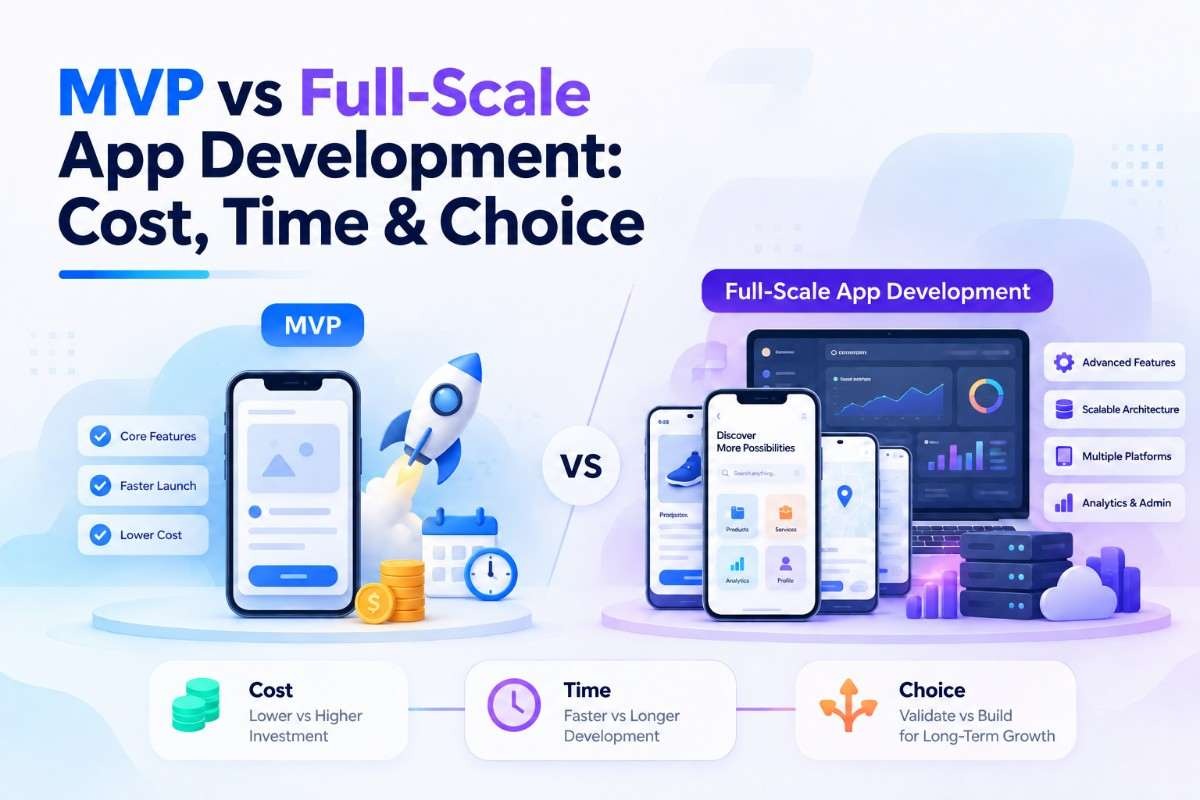
Choosing between MVP vs full scale app development affects more than the first development invoice. It determines how quickly you can test demand, how much operational complexity your team must handle, and how easily the product can adapt after real users provide feedback.
An MVP is a deliberately limited version built around one primary customer problem. A full-scale application supports a broader operating model from the start, including deeper workflows, multiple user roles, integrations, reporting, automation, and stronger administration. Neither approach is automatically better. The right choice depends on market uncertainty, available capital, launch geography, compliance requirements, and the cost of getting the first version wrong.
This guide compares the two approaches across cost, delivery time, feature scope, architecture, maintenance, and growth planning. It is written for founders and operators evaluating an app development partner, a white-label product, or a custom build for a global market.
A minimum viable product focuses on the smallest practical workflow that can create and measure customer value. For an on-demand platform, that may mean customer registration, service discovery, booking or ordering, payment, status updates, and an admin panel. The first release may support one service category, one city, or a limited set of payment methods.
The purpose is not to release an unfinished product. It is to reduce the number of assumptions being tested at once. A focused scope lets the team observe acquisition, activation, repeat usage, provider participation, transaction completion, and support issues before expanding the product.
A full-scale build is planned for a wider operating model. It may include separate customer, provider, driver, merchant, and administrator experiences; advanced search; promotions; wallets; ratings; dispatch logic; multilingual content; multiple currencies; analytics; refunds; dispute handling; and integration with external services.
This model makes sense when the business already understands its workflows or when the market requires operational depth at launch. For example, a multi-service platform may need modular service management from the beginning. Apporio’s Super App Development offering is relevant when a business plans to coordinate several services under one platform rather than validate only one narrow use case.
The first release creates a financial and operational commitment. A broad product consumes more design, engineering, testing, infrastructure, and coordination capacity before the business has proof that users will complete the core transaction. A narrow product reduces early exposure, but it can create rework if the team treats the MVP as a temporary prototype instead of establishing a sound foundation.
Timeline also affects commercial planning. A founder may need to recruit drivers, sign restaurants, onboard technicians, arrange payment providers, prepare customer support, and create local marketing before launch. If the application is ready but the supply side is not, additional features will not solve the real bottleneck.
Geography changes the decision. A launch in one city with one currency can use a simpler first release than a platform entering several countries with different tax rules, payment methods, languages, and service expectations. Risk also varies by category. A basic marketplace may validate quickly, while transport, financial transactions, healthcare-related services, or identity-sensitive workflows need stronger controls before public use.
Architecture matters because product decisions become more expensive after launch. Authentication, data ownership, payment records, permissions, notifications, and audit trails should be designed carefully even when the visible feature set is small. A lean first release can still have a production-ready foundation.
These benefits are not mutually exclusive. A sensible roadmap can use an MVP scope with production-grade security, data structures, deployment processes, and support planning. Apporio’s on-demand app development service can be assessed when the business needs help mapping the first release to later operational requirements.
At this stage, obtain a feature-level scope rather than accepting a broad estimate based only on the number of screens. The commercial proposal should explain assumptions, excluded work, third-party dependencies, testing responsibilities, deployment, maintenance, and change handling.
A useful first release must cover the full customer journey, not only the attractive front-end screens. A ride application needs a practical way to request, assign, track, complete, and pay for a trip. A food platform needs menu management, order acceptance, preparation status, delivery coordination, and settlement. If one link is missing, the business may collect misleading feedback because users cannot complete the intended action.
Keep major domains separate even when the initial release is small. User accounts, provider profiles, orders or bookings, payments, notifications, and reporting should have clear ownership. This makes later changes easier to reason about and reduces the chance that a new service disrupts an existing workflow.
Global audiences do not share one payment, language, address, or support model. Confirm payment gateway availability, tax treatment, map coverage, phone verification, driver or provider documentation, and data-handling expectations in the first launch market. Apporio maintains a dedicated payment gateways page that can support early discussions about transaction requirements.
Track the events needed to evaluate the business: registration completion, search, booking or order creation, payment success, cancellation, fulfilment, repeat usage, and support contact. Analytics are useful only when event definitions are agreed before development and reviewed against business questions.
Use role-based access, secure credential handling, controlled administration, encrypted transport, logging, and a defined incident process. Security is not a premium feature to postpone if the application stores identity, location, payment, or provider documents. Apporio’s cyber security service is a relevant evaluation point for products handling sensitive operational data.
Quality assurance should include failed payments, duplicate orders, weak connectivity, location errors, provider rejection, late fulfilment, refunds, account suspension, and administrator mistakes. Testers should follow the same workflows that customer support and operations teams will use after launch.
| Decision factor | MVP approach | Full-scale approach | Best fit |
|---|---|---|---|
| Primary goal | Test a focused business hypothesis | Operate a broader model from launch | MVP for uncertain demand; full-scale for established workflows |
| Feature scope | Core transaction and essential administration | Multiple roles, workflows, integrations, and automation | MVP for one service or market; full-scale for complex operations |
| Initial cost exposure | Usually lower because fewer components are built | Higher because more product and operational requirements are included | MVP for capital-sensitive validation |
| Delivery timeline | Usually shorter when scope is controlled | Longer because testing and dependencies increase | MVP when speed to learning matters |
| Rework risk | Possible if the foundation is treated as disposable | Possible if assumptions are wrong across many modules | Use discovery and modular architecture for either route |
| Operational readiness | May rely on controlled manual processes | Designed for wider automation and administration | Full-scale for multi-market or high-complexity launches |
The table is a planning framework, not a price quotation. Cost depends on platform count, design depth, integrations, infrastructure, team structure, location, testing coverage, and post-launch support. A product with fewer screens can still be difficult if it requires real-time location, complex matching, payment reconciliation, or strict permissions.
The best decision is based on uncertainty and operational complexity, not on the label attached to the project. Choose an MVP when you need to validate one transaction, one market, or one customer segment before making a larger investment. Choose a full-scale build when the workflows are already proven, launch partners expect broad functionality, or regional requirements make a narrow release impractical.
For a practical route, define the core workflow, identify the manual work, list third-party dependencies, and set measurable expansion gates. Apporio can support different starting points through on-demand app development, the Uberr Clone for ride-hailing businesses, the Gojekk Clone for multi-service platforms, and white-label product deployment. The appropriate scope still depends on your market, business model, and product requirements.
Discuss your launch requirements and compare the available build paths with Apporio Infolabs.
An MVP supports the smallest complete workflow needed to test demand and collect feedback. A full-scale application includes a wider set of roles, integrations, automation, administration, and regional capabilities from the initial release.
An MVP usually has lower initial cost exposure because it includes fewer features and dependencies. However, the final investment depends on platform coverage, integrations, design, testing, infrastructure, security, and the amount of later rework required.
There is no reliable universal timeline. Delivery depends on the number of platforms, workflow complexity, integrations, design requirements, testing depth, and decision speed. A controlled scope generally takes less time than a multi-role, multi-market product.
A startup should choose an MVP when demand, pricing, service area, or operating assumptions are still uncertain. A full-scale build may be appropriate when the business has established workflows, committed launch partners, or requirements that cannot be tested through a narrow release.
Yes, if the first version uses sound data ownership, permissions, payment handling, deployment practices, and modular boundaries. A deliberately limited scope should not mean disposable architecture or weak production controls.
The estimate should identify features, platforms, integrations, design, administration, testing, deployment, infrastructure assumptions, third-party services, maintenance, excluded work, and change-management terms. A screen count alone is not enough to compare proposals.

