OUR PRODUCTS
Uberr Clone AppGojek Clone AppSuper App DevelopmentUberr Eats Clone AppGrocery App DevelopmentHandyman App Like Uberr
inDriver Clone AppDelivery App DevelopmentGlovo Clone AppBolt Clone AppLyft Clone AppCareem Clone App
OUR PRODUCTS

← Back to Blog
October 7, 2026
An 8-step go-to-market plan for on-demand apps, with a 90-day launch timeline, tactics to solve the chicken-and-egg problem, launch channels by app type, KPIs, and a pre-launch checklist.
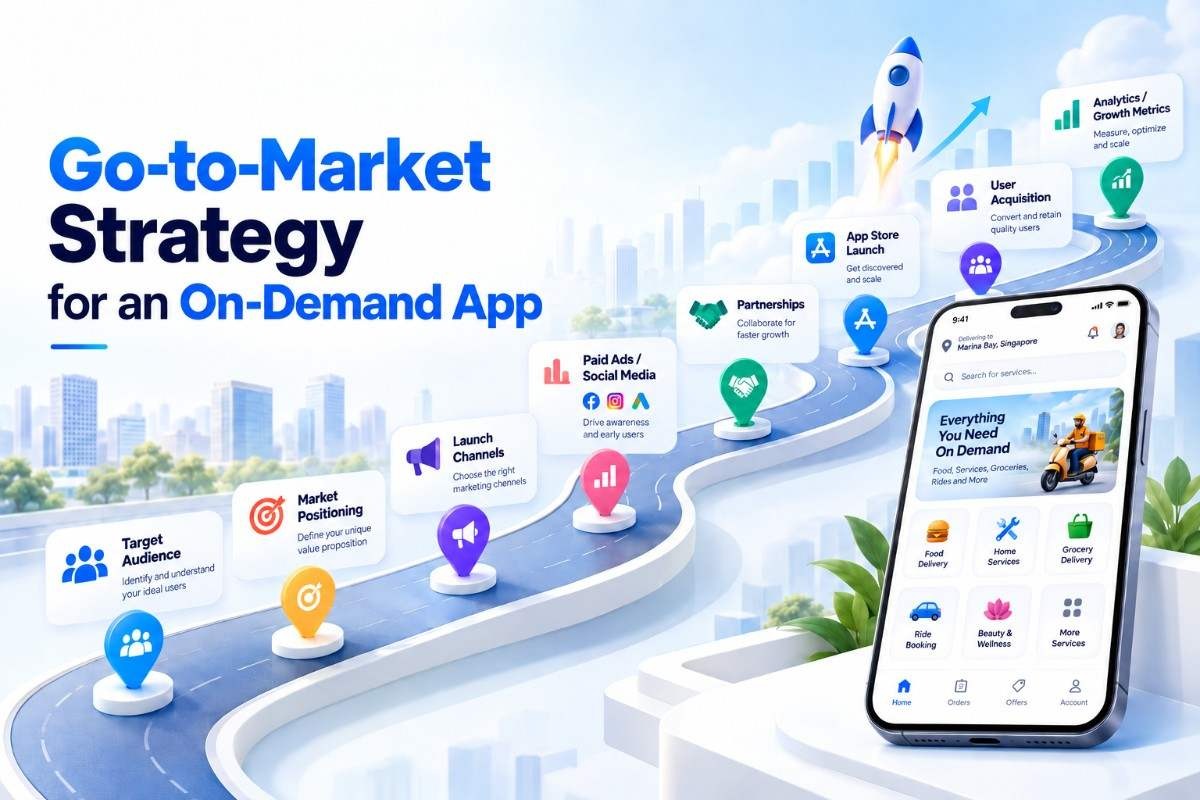
Launching an app is only one part of building an on-demand business. The harder work is building enough local supply, winning the first customers, keeping service quality high, and reaching repeatable unit economics.
A strong go-to-market strategy for an on-demand app connects product decisions with marketing, operations, partnerships, and measurable launch targets. This guide walks through an 8-step launch plan, a 90-day timeline, channel choices by app type, the KPIs to track, and the mistakes that sink most launches.
Quick answer: An on-demand app go-to-market strategy starts with one service in one small area. Recruit and test providers before promoting to customers, run a controlled pilot, launch through low-cost local channels such as partnerships, referrals, and WhatsApp, and scale paid ads only after you see completed, repeat orders at a positive margin. Expand to new cities or services only when the first zone runs reliably.
An on-demand app go-to-market (GTM) strategy is a plan for taking a service platform from MVP to active, repeat use in a specific market. It defines the target customer, service area, supply model, product scope, pricing, acquisition channels, operating processes, and success metrics.
Unlike a standard app launch, an on-demand platform serves three groups at once:
Treat the platform as a local operating system, not just a consumer app. A high download count means little if customers can't find a provider or providers get too few jobs.
Many on-demand businesses fail because they treat launch as a one-day event: publish the app, run broad ads, and expect customers and providers to appear together. Marketplaces don't work that way. They need a sequence that gives each side enough activity to see value.
Choose one customer problem, service category, and geographic area. "Everyone in the country" is too broad. Better examples: office workers needing scheduled rides in a business district, families ordering groceries in one suburb, or landlords booking vetted repair professionals.
Assess population density, smartphone use, payment habits, provider availability, regulations, competitors, average order value, and how often customers need the service. If you haven't tested demand yet, start by learning how to validate an on-demand app idea.
State what you will do better or differently: transparent pricing, a specialist category, reliable scheduled service, local-language support, verified professionals, or a faster booking flow.
The promise must be operationally possible. Don't advertise short arrival times your provider density can't support, and don't promise wide coverage before supply is in place.
Map the customer, provider, and admin journeys before development.
Plan for Android and iPhone users, backend reliability, analytics, and security from day one. Apporio's on-demand app development covers coordinated customer, provider, and admin workflows.
Recruit providers before opening the app to a large audience. Explain earnings, service standards, onboarding requirements, working areas, support, and payout timing. Match verification to the risk of the category: license and vehicle checks for drivers, identity and qualification checks for home-service providers.
Run test jobs with a small provider group. Review acceptance rates, response times, cancellations, navigation accuracy, payouts, and support escalations. Fix issues before you buy reach.
Document how you earn (commissions, booking fees, delivery charges, subscriptions, provider fees, business accounts) and what each order costs (payment processing, promotions, support, refunds, provider incentives, delivery operations).
Track contribution margin per completed order, not gross booking value. A customer acquired through a big discount can look active while losing you money. Change one pricing variable at a time.
Start with invited users, selected neighborhoods, limited hours, or a small catalog. Keep a shared issue log for failed payments, missed bookings, provider no-shows, wrong addresses, delays, and refunds.
Before the public launch, verify app store listings, privacy disclosures, support contacts, payment flows, analytics events, crash reporting, and account deletion. Plan data protection early; Apporio's cyber security service can help with risk assessment.
Use channels that reach your segment and can be measured: local partnerships, provider-led referrals, community groups, search content, and small geo-targeted ad tests with dedicated landing pages and conversion tracking. Apporio's digital marketing team can support campaign planning and measurement. Channel options by app type are covered below.
Review performance weekly. Separate acquisition problems from fulfillment problems. High sign-ups with low completed orders point to onboarding, pricing, supply, or trust issues. Strong first orders with weak repeat use point to service quality, availability, or support.
Expand only after the first zone shows stable operations and repeat demand. Every new city or category adds recruitment, marketing, support, and compliance work.
Timelines vary by category and market, but most focused launches follow three phases.
Customers won't use an app with no providers, and providers won't join an app with no customers. These tactics help you break the loop.
The best channels depend on who your customers are and when they need the service.
Track these metrics weekly from the pilot onward. Targets vary by category, so set your own thresholds before launch.
The right launch model depends on capital, operational experience, product complexity, and how much differentiation you need.
| Launch option | Best suited to | Main advantage | Main risk |
|---|---|---|---|
| White-label platform | Founders testing a defined service and market | Faster access to established workflows and core marketplace roles | May require configuration and additional work for unique processes |
| Custom MVP | Businesses with a differentiated operating model | Greater control over workflows, integrations, and product priorities | More discovery, development, testing, and maintenance effort |
| Full-scale custom platform | Companies with validated demand and complex requirements | Can support deeper automation, multiple markets, and specialized systems | Higher initial complexity and a longer path to learning |
| Manual or no-code pilot | Teams validating demand before technical investment | Useful for testing messaging, service area, and basic customer behavior | Manual fulfillment may not represent scalable operations |
A white-label platform is a practical starting point, but it still needs market-specific configuration, provider onboarding, payment setup, branding, and testing. Custom development makes sense when your service depends on unusual pricing, complex logistics, specialized compliance, or proprietary workflows. See custom app development.
A successful on-demand app launch starts with one clear customer problem, one focused service area, and enough providers to fulfill demand reliably. Build only the essential journeys, test payments and support, measure completed orders, and expand once the first zone produces solid evidence.
Apporio Infolabs helps founders launch with white-label platforms including an Uber clone for ride-hailing, a food delivery app, and a Gojek clone for multi-service platforms, or through fully custom development.
Book a free demo to plan your launch with our team.
Select a specific customer problem, service category, and geographic area. Interview customers and providers, study existing alternatives, and confirm the problem is frequent and valuable enough to support a business.
With a white-label platform, the app itself can be ready in days to a few weeks. A complete go-to-market launch, including provider recruitment, a pilot, and the first public campaigns, usually takes around 90 days. A custom build adds several months of development before that.
Most early-stage platforms should begin with one focused service zone or city. Concentrating supply, support, marketing, and learning makes it easier to improve fulfillment before adding the complexity of new markets.
Recruit providers through direct outreach, local associations, referrals, partnerships, and category-specific networks. Explain earnings, service standards, verification, support, working areas, and payout timing before onboarding them. Short-term earnings guarantees can help retain early providers while demand builds.
Start with low-cost, targeted channels: local partnerships, referral programs, provider-led referrals, community groups, WhatsApp, app store optimization, and local search content. Add geo-targeted Google and Meta ads once you know which messages produce completed orders.
Track completed order rate, provider acceptance, fulfillment time, cancellation rate, payment success, customer acquisition cost, repeat usage, support contacts, ratings, and contribution margin. Downloads alone do not show whether the marketplace works.
A white-label solution suits founders who want to test a defined service model with ready customer, provider, and admin workflows. It still requires configuration, branding, payment setup, operational testing, and local launch planning.
Expand after the first market shows repeat demand, reliable fulfillment, enough provider supply, manageable support volume, and positive contribution margin. Expanding before these are in place multiplies operational problems.

