OUR PRODUCTS
Uberr Clone AppGojek Clone AppSuper App DevelopmentUberr Eats Clone AppGrocery App DevelopmentHandyman App Like Uberr
inDriver Clone AppDelivery App DevelopmentGlovo Clone AppBolt Clone AppLyft Clone AppCareem Clone App
OUR PRODUCTS

← Back to Blog
October 2, 2026
A practical guide to payment gateway integration for global on-demand apps, covering provider selection, currencies, security, webhooks, refunds, and market expansion.
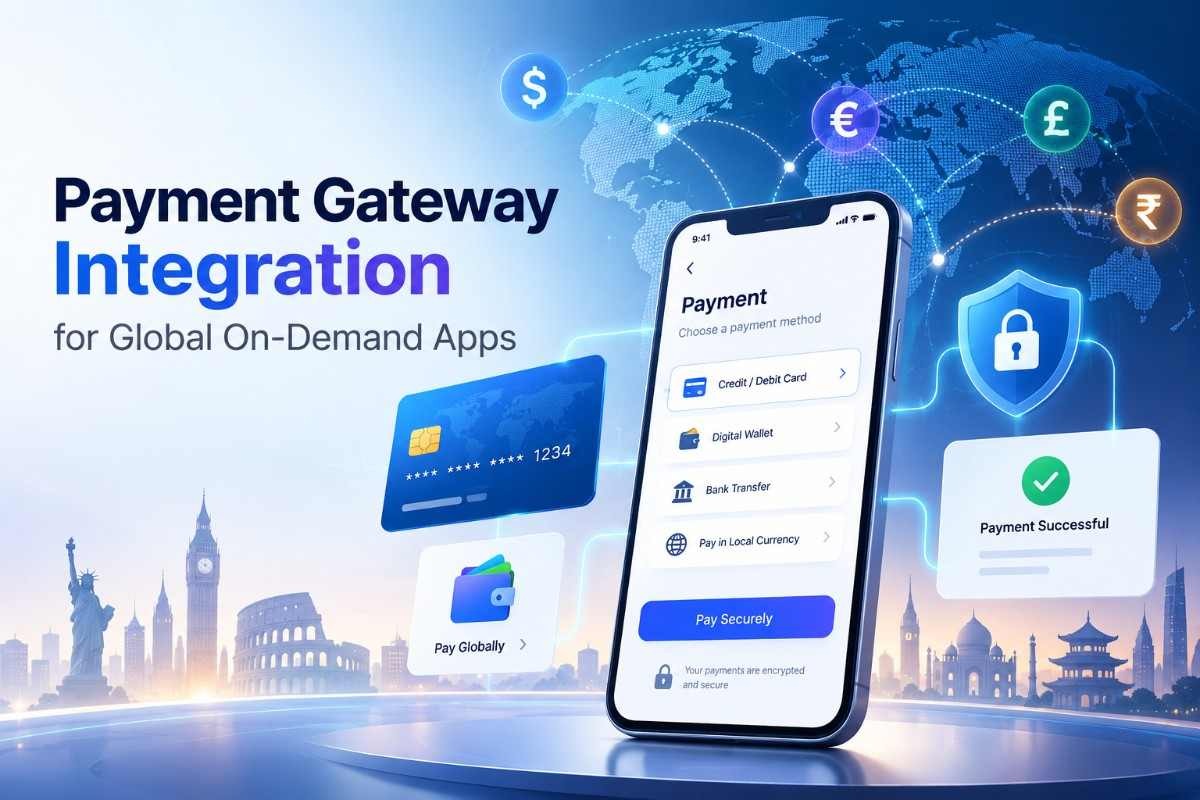
Payment gateway integration for on-demand app projects requires more than adding a card form to checkout. A global platform must handle different currencies, payment methods, settlement rules, tax requirements, refund workflows, failed transactions, and local customer expectations without disrupting the booking or ordering process.
For a ride-hailing, food delivery, grocery, handyman, or multi-service platform, payment processing sits inside the core transaction flow. A customer authorizes a charge, the platform records the order, a provider completes the service, and the business may later split, refund, adjust, or reconcile that transaction. Each step needs a clear technical state and an auditable record.
This guide explains how to plan and implement payment processing for international on-demand products. It covers gateway selection, regional payment methods, cash and wallet handling, architecture, security, compliance, testing, operational controls, and common mistakes that create revenue leakage or customer support problems. Apporio teams working on on-demand app development can use these principles when configuring a white-label product for different markets.
A payment gateway connects an app or website to a financial service that authorizes, captures, declines, refunds, or otherwise processes a customer payment. The gateway does not replace the platform's order or booking system. It communicates with that system so the financial status of a transaction matches the service status.
In a typical flow, the mobile app sends a payment request to the platform backend. The backend communicates with the selected provider, and the provider returns a result or sends a later notification through a webhook. The backend then updates the order, ride, delivery, or service record. This server-side confirmation is important because a user closing the app must not cause the platform to lose the true payment status.
The correct implementation depends on the market, business model, service category, and provider coverage. A taxi platform may authorize a payment before the trip and capture the final fare afterward. A food delivery app may collect the order amount immediately but calculate commissions and provider payouts later.
International expansion changes the payment problem from a single integration into a market-by-market operating model. Customers in one country may prefer cards, while another market may depend on bank transfers, mobile money, cash collection, or locally recognized digital wallets. Supporting only one method can reduce conversion even when the underlying service is available.
Currency handling also affects the customer experience and finance team. The amount displayed before checkout should be clear, and the amount charged should be recorded with the currency, exchange-rate rule, gateway reference, and settlement currency. Mixing display values with accounting values creates disputes and makes revenue reporting unreliable.
Regulatory obligations add another layer. Requirements can involve payment data protection, customer authentication, tax invoices, electronic receipts, data residency, identity verification, and restrictions on moving funds between customers and providers. The exact obligation varies by country and business structure, so technical planning should be reviewed with legal, tax, and payment specialists before launch.
For businesses building a multi-service product, payment design should be included in the platform architecture from the beginning. It is difficult to retrofit reliable financial states after separate services have already created their own payment logic.
The fastest way to lose a new market is to launch with payment methods that local customers do not use. Before choosing a provider, list the methods your target customers already trust, then confirm which gateways support those methods, your settlement currency, and provider payouts in that country.
| Region | Commonly used methods | Gateways often evaluated |
|---|---|---|
| Africa | Mobile money, cards, bank transfer, cash | Paystack, Flutterwave, M-Pesa, MTN MoMo |
| Southeast Asia | E-wallets, QR payments, cards, bank transfer | Xendit, 2C2P, GCash, GrabPay |
| Latin America | Instant bank transfer (PIX), cards, installments, cash vouchers | Mercado Pago, dLocal, EBANX |
| Middle East | Cards, Apple Pay, cash on delivery | Checkout.com, Tap Payments, PayTabs, HyperPay |
| Europe | Cards with strong authentication, wallets, bank debits | Stripe, Adyen, PayPal, Mollie |
| North America | Cards, Apple Pay, Google Pay | Stripe, Braintree, Square, Authorize.net |
| India | UPI, cards, wallets, net banking | Razorpay, PayU, Cashfree |
Treat this table as a starting point, not a final recommendation. Provider coverage, onboarding requirements, and supported methods change, and a gateway that accepts customer payments in a country may not support payouts to drivers or merchants there. Confirm current availability directly with each provider before committing. Apporio's payment gateways page shows integration options available for its white-label platforms.
Many on-demand markets still rely heavily on cash, especially for rides and deliveries in Africa, South Asia, Latin America, and parts of the Middle East. Supporting cash is often necessary for adoption, but it reverses the normal flow of money: the provider collects the full amount and owes the platform its commission.
For digital payments, the platform must separate each customer charge into its parts: provider earnings, platform commission, delivery or service fees, taxes, tips, and gateway fees. Marketplace payment products can split funds automatically in some countries, while other markets require the platform to collect funds and pay providers on a schedule.
Payout design should define the schedule (instant, daily, or weekly), minimum payout amounts, supported payout methods such as bank transfer or mobile money, identity verification requirements, and how adjustments, refunds, and chargebacks are deducted from future earnings.
A customer wallet can hold refunds, referral credits, promotions, and prepaid balances. It improves repeat purchasing, especially in multi-service apps, but it introduces stored-value accounting and, in some countries, regulatory requirements. Keep wallet entries in an append-only ledger rather than overwriting a single balance field.
A properly designed payment layer improves more than checkout. It supports service fulfillment, financial control, customer retention, and market operations. The benefit comes from consistent transaction handling rather than from the number of payment buttons shown to users.
Customers are more likely to complete a purchase when the app presents familiar methods, local currency, transparent fees, and a short confirmation flow. The interface should show the service price, taxes, tips, discounts, and total before authorization. A failed method should not force the user to restart the entire booking or cart process.
Every transaction should have explicit states such as initiated, authorized, captured, failed, cancelled, refunded, partially refunded, disputed, or pending review. This prevents teams from treating every provider response as a simple success or failure. It also helps the order service decide what action is safe.
A provider abstraction allows the business to add or replace gateways without rewriting the customer, provider, and admin applications. The platform can route transactions according to country, currency, service category, risk rules, or provider availability while retaining one internal transaction model.
Separating gross customer charges, gateway fees, platform commissions, taxes, tips, refunds, and provider payouts produces clearer financial reports. This is useful when the business operates several services, has multiple legal entities, or settles money on different schedules.
Receipts, refund updates, payment history, and transparent cancellation charges reduce confusion. Providers also benefit from accurate earning records that show completed jobs, deductions, adjustments, and payout status.
Tokenized payment details, restricted administrative access, encrypted communication, audit logs, and monitored webhooks reduce exposure. Security is not only a payment-provider responsibility; the app, backend, infrastructure, staff accounts, and support processes all affect risk. Apporio's cyber security services are relevant when reviewing these controls.
Payment compliance depends on the countries served, the payment methods offered, and whether the platform holds or moves money on behalf of providers. The following requirements appear in most global on-demand projects.
These points are general guidance. Confirm the exact obligations for each launch country with qualified legal, tax, and payment advisers.
Implementation should begin with business rules, not with a provider's software development kit. The team needs to understand how money moves through each service before deciding how the integration will work.
For mobile coverage, teams may need separate release testing for Android and iPhone applications. The payment interface, redirect handling, deep links, keyboard behavior, and authentication screens can behave differently across devices. Apporio provides Android app development and iPhone app development services for these platform-specific requirements.
Strong payment systems are designed around failure, change, and auditability. The following practices reduce risk as transaction volume, service categories, and geographic coverage grow.
Keep gateway-specific code behind a common internal interface. Functions such as create payment, authorize, capture, refund, verify webhook, and fetch status should have consistent inputs and outputs. This approach does not remove provider differences, but it prevents those differences from spreading across every application module.
These terms describe different financial events. Authorization checks or reserves funds, capture requests the charge, and settlement is the later movement of funds to a merchant account. A ride or service marketplace may need to delay capture until the final amount is known. The business rules should determine the sequence.
Some payment results arrive later because of bank processing, authentication, provider review, or network delays. Show a pending state when needed and provide a controlled retry path. Never treat a timeout as proof that the payment failed.
Use hosted checkout components or tokens where supported. Keep secret keys on the server, rotate credentials, restrict access by role, and remove sensitive values from application logs. Production and sandbox credentials should be fully separated. Review infrastructure and deployment controls with a documented security process.
Refunds should reference the original payment and record the reason, amount, initiator, provider response, and completion state. Partial refunds, fee reversals, tips, cancellation charges, and post-service adjustments should not be handled through manual database edits.
Display currency symbols and decimal rules correctly, format receipts for the local market, and explain any additional charges before confirmation. The app should also support local language and payment terminology where the target audience expects it.
Track authorization rate, decline reasons, webhook failures, pending transactions, refund age, duplicate attempts, gateway latency, cash debt balances, and reconciliation differences. Alerts should identify patterns by country, provider, app version, and payment method. A deployment pipeline supported by DevOps consulting can help teams manage configuration and release controls.
Define what happens when a gateway is unavailable. Depending on the service, the platform may offer another supported method, route to a backup provider, allow cash collection, or pause new bookings. Automatic failover should be carefully controlled because retrying a request without checking its original status can cause duplicate charges.
Most payment incidents are caused by incomplete business rules or weak state management, not by the absence of a payment button. Teams should review these mistakes before production launch.
These issues become more expensive in a multi-service product because each service can apply different pricing, commission, cancellation, and payout rules. A modular architecture should centralize shared payment controls while allowing service-specific policies.
There is no single correct provider model for every on-demand business. The right choice depends on the number of markets, the need for provider payouts, transaction volume, risk profile, and the technical capacity of the operating team.
| Architecture model | Best fit | Main strengths | Key limitations |
|---|---|---|---|
| Single gateway | One-country or early-stage launch | Lower implementation and monitoring effort; simpler reconciliation. | Limited market coverage and greater dependency on one provider. |
| Multi-gateway routing | Several countries or currencies | Better local coverage; routing can consider currency, availability, or service type. | More provider contracts, failure scenarios, reporting differences, and maintenance work. |
| Marketplace payment platform | Businesses paying independent providers | May support connected accounts, split payments, onboarding, and payouts. | Availability and compliance rules vary by country; payout design needs careful review. |
| Gateway plus internal wallet | Frequent users, cash-heavy markets, or multi-service ecosystems | Can support credits, refunds, promotions, cash commission tracking, and repeat transactions inside one balance system. | Introduces stored-value, accounting, fraud, and regulatory considerations. |
A single gateway is often easier to operate during an MVP, but it may not support every country or preferred payment method. Multi-gateway routing offers flexibility, yet routing rules must be observable and explainable to finance and support teams.
Marketplace platforms can simplify provider onboarding and payouts, but they do not automatically solve local tax, identity, or regulatory requirements. An internal wallet can improve repeat purchasing and is often essential where cash is common, but it should not be added merely to avoid implementing refunds or payment status tracking.
For a broad service ecosystem, a super app development approach can provide a shared payment foundation for transport, delivery, grocery, and home services. The financial model still needs to be designed around each service's order lifecycle.
Planning payment gateway integration for an on-demand app should start with transaction states, market requirements, service workflows, and reconciliation, not with a checkout screen. A reliable global setup supports local payment methods, multiple currencies, cash and wallet flows, asynchronous provider events, secure token handling, refunds, provider payouts, and clear operational reporting.
Apporio Infolabs can help businesses plan and deploy white-label products such as the Uberr Clone, Gojekk Clone, Food Delivery, Grocery Delivery, and Handyman Services with payment requirements considered as part of the wider platform architecture. The relevant delivery scope may include payment gateway configuration, on-demand app development, Android and iPhone implementation, cyber security review, and DevOps support.
It is the process of connecting an on-demand app's customer checkout, backend transaction service, order or booking workflow, refund process, and reporting system to one or more payment providers. The integration should confirm payment status on the server and support secure webhooks.
Sometimes, but coverage varies by country, currency, payment method, settlement option, provider onboarding rules, and payout support. A single gateway may work for an initial market, while a multi-gateway model may be needed for broader international coverage.
A timeout should create a pending or uncertain state rather than automatically marking the payment as failed. The backend should check the provider status, process verified webhooks, prevent duplicate attempts through idempotency, and show the customer a clear next step.
Businesses should avoid storing raw card details in their own application database. Provider-hosted forms, tokenization, and server-side secrets reduce exposure, while access controls, encrypted communication, audit logs, and security reviews protect the wider system.
A refund should reference the original transaction, record its amount and reason, send the request through the provider, and track the result through verified events or status checks. Partial refunds and refund delays should be visible to customers, support staff, and finance users.
They should test successful payments, declines, authentication challenges, network failures, duplicate requests, delayed webhooks, out-of-order events, partial refunds, currency rounding, provider downtime, cash trips, cancellation charges, and reconciliation against provider reports.
It depends on the country. Mobile money is widely used in many African markets, UPI dominates in India, e-wallets and QR payments are common in Southeast Asia, and instant bank transfers such as PIX are popular in Brazil. Cash remains important in many of these regions, so most platforms combine local digital methods with cash collection.
Each cash trip or order should be recorded as a transaction. The platform's commission is tracked as a balance owed in the provider's wallet and settled from future digital earnings or a top-up. Setting a cash-debt limit prevents providers from accumulating large unpaid commission balances.
Any business that accepts card payments has PCI DSS obligations. Using provider-hosted payment fields or tokenizing SDKs keeps raw card data off the platform's servers, which greatly reduces the scope of compliance work but does not remove it entirely.

