OUR PRODUCTS
Uberr Clone AppGojek Clone AppSuper App DevelopmentUberr Eats Clone AppGrocery App DevelopmentHandyman App Like Uberr
inDriver Clone AppDelivery App DevelopmentGlovo Clone AppBolt Clone AppLyft Clone AppCareem Clone App
OUR PRODUCTS

← Back to Blog
September 3, 2026
A practical guide to onboarding and verifying professionals for home service marketplaces, covering documents, background checks, skills, safety, approvals, and ongoing monitoring.
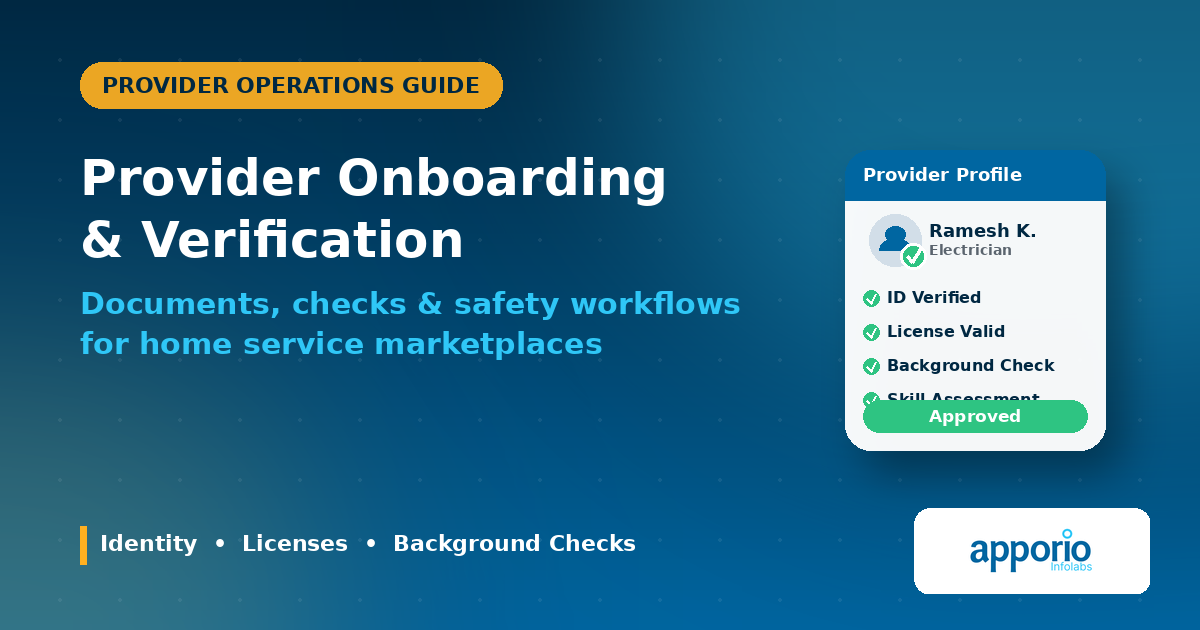
Home service marketplaces depend on a reliable supply of plumbers, electricians, cleaners, repair technicians, caregivers, and other professionals. The customer sees a booking screen, but the business must manage identity checks, qualifications, service areas, pricing, availability, payments, and complaints behind it. A weak home service provider onboarding process can create safety risks, poor workmanship, cancellations, and reputational damage.
A practical onboarding workflow does more than collect a name and phone number. It verifies that a provider is who they claim to be, has the required skills, can legally operate in a target market, and understands the platform's service standards. It should also be simple enough to complete on a mobile device, because many independent workers will register from the field rather than an office.
This guide explains how to design the process from application through approval and continued monitoring. It is written for founders and product teams building a marketplace for one city, several regions, or multiple countries.
Home service provider onboarding is the controlled process of registering, screening, approving, training, and activating professionals on a home service platform. It normally includes provider account creation, identity verification, document collection, skill assessment, service-area setup, payment details, contract acceptance, and access to the provider app.
Verification is one part of onboarding, not the entire workflow. Verification answers questions about identity, eligibility, and evidence. Onboarding also covers the operational steps required before a provider can receive a job. For example, a technician may pass an identity check but still need to submit a trade license, select supported services, define working hours, and complete a platform orientation.
Most home service platforms need three connected experiences. Customers browse categories, compare profiles, request services, and provide ratings. Providers submit information, accept jobs, update status, and receive earnings. Administrators review applications, request missing evidence, approve or reject accounts, resolve disputes, and monitor provider quality.
Keeping these roles separate protects sensitive information and prevents unauthorized changes. A provider should not be able to edit an approved license without triggering a new review. An administrator should be able to see the review history, but access to identity documents should be limited to authorized staff.
A home visit carries different risks from a standard retail transaction. The professional may enter a customer's home, handle valuable equipment, work with gas or electricity, or provide a service involving children or vulnerable people. The platform therefore has a duty to establish a reasonable level of trust before making a provider discoverable.
Verification also protects the supply side. Genuine professionals are less likely to join a marketplace if unqualified competitors can create profiles with no meaningful checks. Clear requirements help establish consistent service quality and make it easier to explain decisions when an application is delayed or rejected.
The platform should avoid presenting verification as a guarantee of perfect service. It is evidence that specific checks were completed at a particular time. That distinction should appear in provider terms, customer-facing messages, and internal policies.
A well-designed system creates value for customers, providers, and the marketplace operator. The benefit comes from connecting evidence with marketplace operations rather than storing documents in isolation.
Customers receive more useful information before booking. Profiles can show service categories, years of experience where verified, response history, customer ratings, completed checks, and areas served. This reduces uncertainty without forcing every customer to contact support before choosing a professional.
Professionals get a clear path to activation. A progress indicator can show which documents are accepted, which items need correction, and what remains before approval. Mobile capture, saved drafts, and specific rejection reasons reduce unnecessary back-and-forth. Providers should also be able to update expired documents through the same account rather than starting again.
These benefits depend on accurate data and disciplined review. Adding more fields does not automatically improve trust. Each field should support a real decision, compliance requirement, safety control, or customer expectation.
The following workflow can be adapted to different service categories and legal environments. A cleaning professional may need a simpler path than an electrician, while a provider working with vulnerable customers may require additional screening.
Every status should have an owner, a next action, and a service-level target. If an application remains under review, the provider should see what is happening instead of receiving a generic message.
Not every provider needs the same depth of screening. Build a risk matrix using factors such as service type, access to private spaces, use of hazardous equipment, work with vulnerable people, transaction value, and local regulation. Apply stronger checks where the potential harm is higher, while keeping low-risk categories practical for independent workers.
Provider registration should work on common Android and iPhone devices, with clear image instructions and the ability to save progress. Compress uploads without making documents unreadable. Show accepted file types, maximum sizes, and examples of acceptable images before submission. A provider who repeatedly uploads an unclear license is a product problem as much as a user problem.
Automation can check missing fields, expired dates, duplicate phone numbers, image quality, and inconsistent information. It should not silently make high-impact decisions when the evidence is ambiguous. Send unclear cases to a trained reviewer, record the decision, and provide an appeal route.
Teams building a wider marketplace can review handyman app features for the provider, customer, and admin relationship. The same operational model can support cleaning, repairs, beauty services, and other categories with different requirements.
Identity documents, addresses, tax records, and screening results require strict access controls. Use encryption in transit and at rest, role-based permissions, retention limits, audit logs, and secure deletion procedures. A documented cyber security service approach can help teams identify weaknesses before launch, but security also requires ongoing patching and staff discipline.
Publish a provider checklist before registration begins. Explain why each requirement exists and how long review normally takes without promising a fixed approval outcome. When policies change, notify active providers and allow a reasonable path to submit updated information.
Approval is the start of monitoring, not the end. Track cancellation rates, late arrivals, repeat complaints, refunds, low ratings, safety reports, and document expiry. Use a documented escalation process that distinguishes coaching, temporary restrictions, suspension, and permanent removal.
Build the workflow as part of broader on-demand app development rather than adding it after the customer booking flow is complete. Provider supply, marketplace trust, and dispatch logic are connected product problems.
Another common mistake is treating the admin dashboard as an afterthought. Reviewers need filters, document previews, comparison history, notes, assignment controls, and clear next actions. Without these tools, teams revert to spreadsheets, email, and informal decisions that are difficult to audit.
There is no single verification model for every marketplace. The right approach depends on risk, budget, market availability, and the number of applications expected.
| Approach | How it works | Best fit | Main limitation |
|---|---|---|---|
| Manual review | Staff inspect submitted records and approve applications through an admin panel. | Early marketplaces, local launches, and categories needing judgment. | Can become slow and inconsistent as application volume increases. |
| Automated document checks | Software checks fields, dates, image quality, and selected data sources before routing exceptions to staff. | Growing platforms with repeatable requirements and higher application volume. | Ambiguous or unusual records still require human review. |
| Third-party screening | An external provider performs identity, background, or license checks according to its coverage. | Markets where reliable screening partners and lawful data access are available. | Coverage, cost, processing time, and privacy obligations vary by location. |
| Hybrid verification | Automation handles routine checks while trained staff review exceptions and higher-risk cases. | Multi-category marketplaces operating across several regions. | Requires careful integration, escalation rules, and quality control. |
For most businesses, a hybrid model is the practical long-term direction. Manual review gives an early team control while requirements are still changing. Automation can then handle predictable checks, but the platform should preserve human oversight for identity conflicts, sensitive categories, appeals, and unusual documents.
Provider trust is built through a repeatable process that combines identity evidence, category-specific qualifications, lawful screening, clear terms, mobile-friendly submission, and post-approval monitoring. The most effective marketplaces treat onboarding as an operating system for supply quality, not merely a sign-up form.
When planning home service provider onboarding, start with the risks and decisions that matter in each service category. Then connect the workflow to provider profiles, job matching, payments, support, reporting, and account controls. Apporio's Handyman Services solutions, on-demand app development, and Cyber Security services can support teams planning a marketplace with customer, provider, and admin applications. Payment operations can also be reviewed through the available payment gateways resource.
Start with one market, validate the review process with real operational cases, and expand requirements as the platform adds categories or regions.
Common requirements include government-issued identity evidence, contact details, proof of address where needed, trade licenses or certifications for regulated work, insurance evidence where required, bank or payment details, and relevant work history. The exact list should reflect the service category and local law.
An app can combine contact verification, identity document review, license or certification checks, lawful background screening, references, skills assessments, and post-activation performance monitoring. Automated checks can handle routine validation, while trained staff review exceptions and higher-risk applications.
No. Requirements should be risk-based. A provider working with electricity, gas, high-value equipment, or vulnerable customers may need more evidence than a provider offering a lower-risk service. The platform should document why different categories have different checks.
Processing time depends on document quality, reviewer capacity, third-party checks, local data access, and application completeness. The platform should show status updates, request corrections quickly, and avoid promising a fixed approval time when external checks are involved.
Approval should be followed by an orientation, profile activation, service-area and availability setup, and monitoring of early jobs. The platform should track complaints, cancellations, ratings, incidents, and document expiry, with defined coaching, restriction, suspension, and appeal procedures.

