OUR PRODUCTS
Uberr Clone AppGojek Clone AppSuper App DevelopmentUberr Eats Clone AppGrocery App DevelopmentHandyman App Like Uberr
inDriver Clone AppDelivery App DevelopmentGlovo Clone AppBolt Clone AppLyft Clone AppCareem Clone App
OUR PRODUCTS

← Back to Blog
September 21, 2026
A practical comparison of Shopify mobile apps and custom ecommerce apps, covering cost, control, scalability, integrations, security, and long-term business fit.
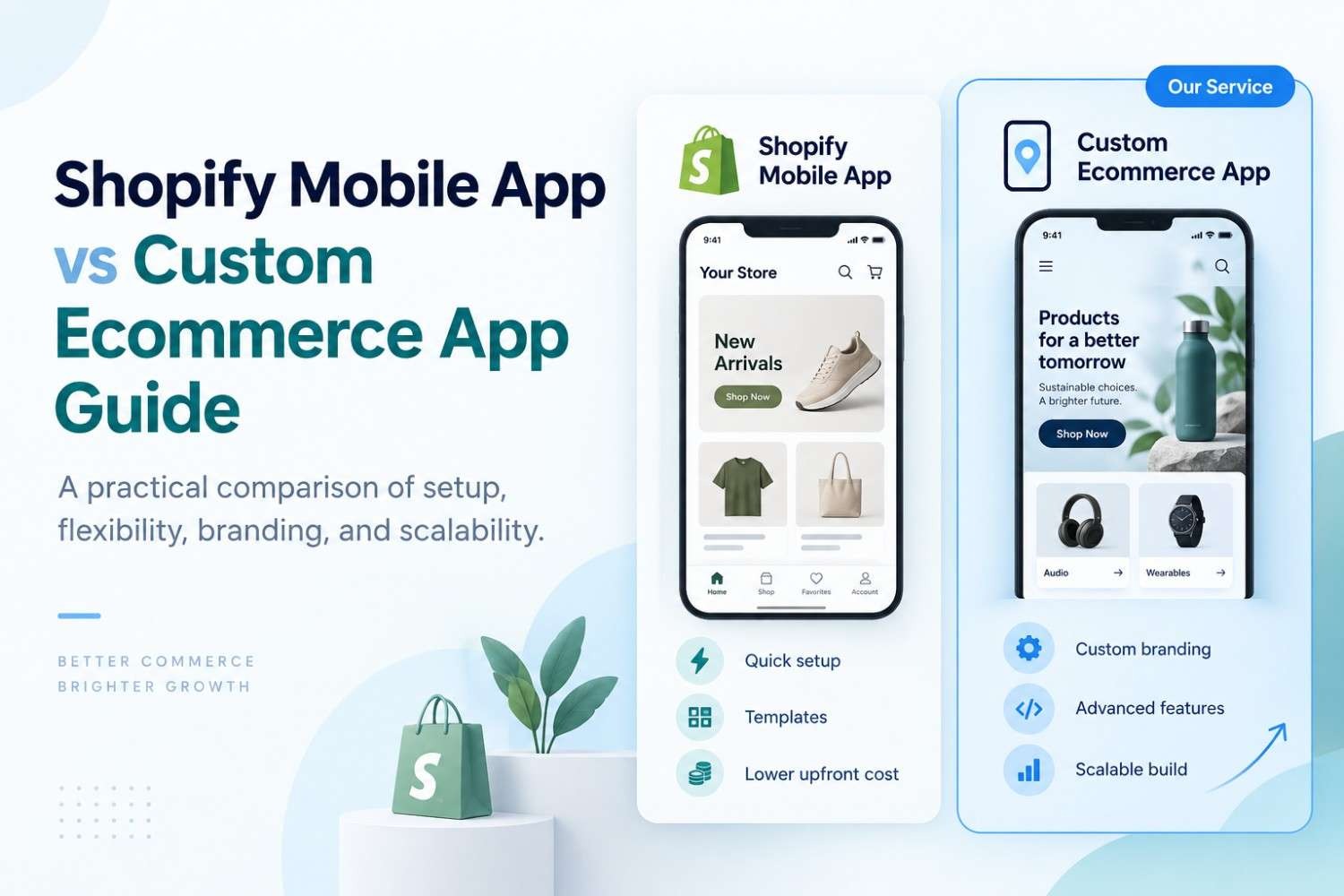
Choosing between a Shopify mobile app and a custom ecommerce product affects more than your launch timeline. It determines how much control you have over the customer journey, how easily you can support complex operations, and how much technical ownership your business builds over time. The right choice depends on your catalog, sales channels, fulfillment model, budget, and growth plans.
The phrase Shopify mobile app vs custom ecommerce app usually reflects a commercial decision: should a business extend an existing Shopify store into a mobile experience, or invest in software designed around its own workflows? A Shopify-based route can be practical for a standard catalog and a fast initial release. A custom build can be better for marketplaces, multi-vendor operations, unusual pricing, advanced loyalty programs, or region-specific requirements.
This guide compares both approaches using product and operational criteria rather than treating one option as universally better. It also explains the questions a founder or ecommerce director should answer before signing with a technology provider.
A Shopify mobile app is a mobile shopping application connected to a Shopify store. Products, inventory, customer accounts, orders, and many commerce operations continue to be managed through the Shopify ecosystem. The mobile layer gives customers another buying channel, often with app-specific navigation, notifications, saved preferences, and mobile checkout flows.
A custom ecommerce app is designed and developed around a company’s own business rules. It may connect to an existing ecommerce platform, an enterprise resource planning system, warehouse software, payment services, customer relationship management tools, or proprietary databases. The application can be built for one retailer, a marketplace, a subscription business, or a multi-country operation.
The distinction is not simply “template versus bespoke.” It is about where the core logic lives and who controls future changes. With a Shopify-connected product, the store platform remains central. With a custom product, the business can define the architecture, data model, workflows, interfaces, and integration strategy more precisely.
Businesses often begin with the first option and move toward the third as their requirements become more specialized. Others start with custom software because their business model cannot be represented effectively through standard commerce workflows.
The commerce platform sits at the center of customer acquisition, conversion, payment, fulfillment, support, and retention. A poor technology decision can create operational workarounds that become expensive as order volume and market coverage increase. For example, a retailer with several warehouses may need inventory allocation rules that differ by location, while a marketplace may need seller onboarding, commission calculation, disputes, and vendor settlements.
Cost also needs to be assessed over the full ownership period. A faster initial release does not automatically mean a lower total cost if the business later needs extensive workarounds, additional apps, or migration. Conversely, a custom build may require more planning and testing before launch but provide a better foundation for specific capabilities.
Mobile behavior is another important factor. A mobile app can support push notifications, saved carts, app-only promotions, biometric sign-in, personalized recommendations, and device-level experiences. However, simply placing a store inside an app does not create a strong mobile product. Navigation, performance, checkout reliability, accessibility, analytics, and support workflows all need deliberate planning.
Both approaches can support a credible mobile commerce experience, but they serve different business conditions. The best comparison considers speed, control, operational complexity, and the cost of change.
These benefits are strongest when the store already operates successfully, its workflows are conventional, and the business wants an additional customer channel rather than a new commerce operating system.
Custom development does not remove responsibility. The owner must plan product management, testing, security, hosting, maintenance, analytics, release management, and support. Those activities should be included in the business case from the beginning.
A structured evaluation prevents the decision from being driven only by development quotations. Follow these steps before choosing the technical route.
For businesses that need a dedicated shopping platform rather than only a store extension, Apporio’s ecommerce application development service is a relevant reference point. For companies already committed to Shopify operations, Shopify development can help assess the store, integrations, and extension requirements before mobile work begins.
Score each requirement by business importance, technical difficulty, and urgency. A product requirement that is essential to revenue should not be treated the same as a cosmetic preference. The matrix should show which capabilities are available through the existing commerce stack, which need configuration, and which require custom services.
Many commerce projects focus first on attractive product pages. Operational failures usually appear later: a payment succeeds but stock does not update, an order splits between warehouses, a refund is not reflected in the customer account, or a delivery status remains stale. Define the states, events, failure handling, and staff actions before finalizing the interface.
A global audience does not mean one universal implementation. Payment preferences, currencies, tax rules, delivery coverage, language, address formats, and consumer protection requirements vary by market. Confirm these details early, particularly if the app will serve Africa, Southeast Asia, Europe, or North America.
Limit access to personal, payment, order, and operational data according to staff roles. Use secure authentication, encrypted connections, safe token handling, logging, backup procedures, and a process for responding to incidents. Apporio’s cyber security service is relevant when the project requires a formal review of application and infrastructure risks.
Do not select a payment provider only because it is familiar to the development team. Check settlement timing, supported currencies, refunds, recurring payments, fraud controls, local availability, and reconciliation requirements. The payment gateways resource can support early planning, but final provider selection should reflect the launch countries and business model.
Mobile checkout should minimize unnecessary typing, preserve cart state, handle weak connections clearly, and provide useful order updates. Test on different screen sizes and operating system versions rather than relying only on a high-end development device. Separate Android and iPhone release requirements should be included in the delivery plan; Apporio provides Android app development and iPhone app development services for these platforms.
Track product views, search usage, add-to-cart rate, checkout completion, payment failures, repeat purchase rate, refund requests, notification engagement, support contacts, and delivery-related complaints. These measures show whether the app improves commerce operations and customer behavior.
These mistakes are avoidable when the business treats the project as an operating system for commerce rather than a collection of app screens.
| Decision factor | Shopify mobile app | Custom ecommerce app |
|---|---|---|
| Initial delivery | Often faster when the store and catalog already exist | Requires discovery, architecture, design, backend work, and testing |
| Upfront scope | Usually narrower for standard retail workflows | Can be broad because the product is designed around specific requirements |
| Customization | Limited by platform capabilities, APIs, extensions, and app design choices | Higher control over workflows, interfaces, data, and integrations |
| Operations | Existing store teams may continue using familiar administration tools | May require new dashboards, staff training, and support processes |
| Integrations | Works well when required connections are supported by the platform or available extensions | Better suited to proprietary systems and complex multi-system workflows |
| Scalability | Suitable for many standard retail growth paths, subject to platform boundaries | Can be architected for specialized growth, but requires ongoing technical management |
| Best fit | Established stores seeking a mobile channel with conventional commerce requirements | Retailers, marketplaces, and service-led commerce businesses with differentiated processes |
The comparison should not be reduced to a simple price question. A standard retailer may gain more value from a controlled Shopify extension, while a marketplace or multi-region operator may pay more in the beginning to avoid restricting its operating model later. A hybrid path can also be sensible when the existing store is strong but customer engagement, delivery, or loyalty requires custom development.
The best choice in the Shopify mobile app vs custom ecommerce app decision depends on the complexity of your business and the level of control you need. A Shopify-connected product can suit a store with standard catalog, checkout, and fulfillment requirements. A custom ecommerce product is more appropriate when your competitive advantage depends on unique workflows, specialized integrations, marketplace operations, or a differentiated customer journey.
Apporio Infolabs can support the evaluation through Shopify development, Ecommerce Application Development, Android App Development, and iPhone App Development. Review the current store, map the order lifecycle, identify the capabilities that drive revenue, and select the architecture that can support the next stage without unnecessary complexity.
Neither option is universally better. A Shopify mobile app can suit a store with conventional catalog, checkout, and fulfillment needs, while a custom ecommerce app is better suited to specialized workflows, complex integrations, marketplaces, or a highly differentiated customer journey.
Yes. A business can retain Shopify for catalog, customer, and order operations while developing a custom mobile experience or additional services. The feasibility depends on the required workflows, available integrations, API capabilities, and the amount of custom business logic.
A Shopify-connected mobile product is often faster to launch when the store already exists and the business requirements are standard. A custom ecommerce app normally needs more discovery, architecture, backend development, interface design, integration work, and testing before release.
A custom ecommerce app generally gives the business more control over workflows, data structures, interfaces, integrations, and future product decisions. A Shopify mobile app provides less control over the underlying commerce platform but can reduce the amount of infrastructure and store administration the business must manage.
Compare development, design, testing, hosting, third-party services, payment processing, maintenance, security reviews, analytics, app store operations, support, and future feature changes. A lower initial cost does not always represent a lower total ownership cost over several years.
Custom development is worth evaluating when the business requires marketplace features, complex pricing, subscriptions, multiple warehouses, region-specific workflows, proprietary integrations, advanced loyalty rules, or a customer experience that standard store capabilities cannot support efficiently.

