OUR PRODUCTS
Uberr Clone AppGojek Clone AppSuper App DevelopmentUberr Eats Clone AppGrocery App DevelopmentHandyman App Like Uberr
inDriver Clone AppDelivery App DevelopmentGlovo Clone AppBolt Clone AppLyft Clone AppCareem Clone App
OUR PRODUCTS

← Back to Blog
August 26, 2026
A practical guide to designing a modular multi-service platform with independent service modules, shared infrastructure, secure APIs, scalable operations, and staged launches.
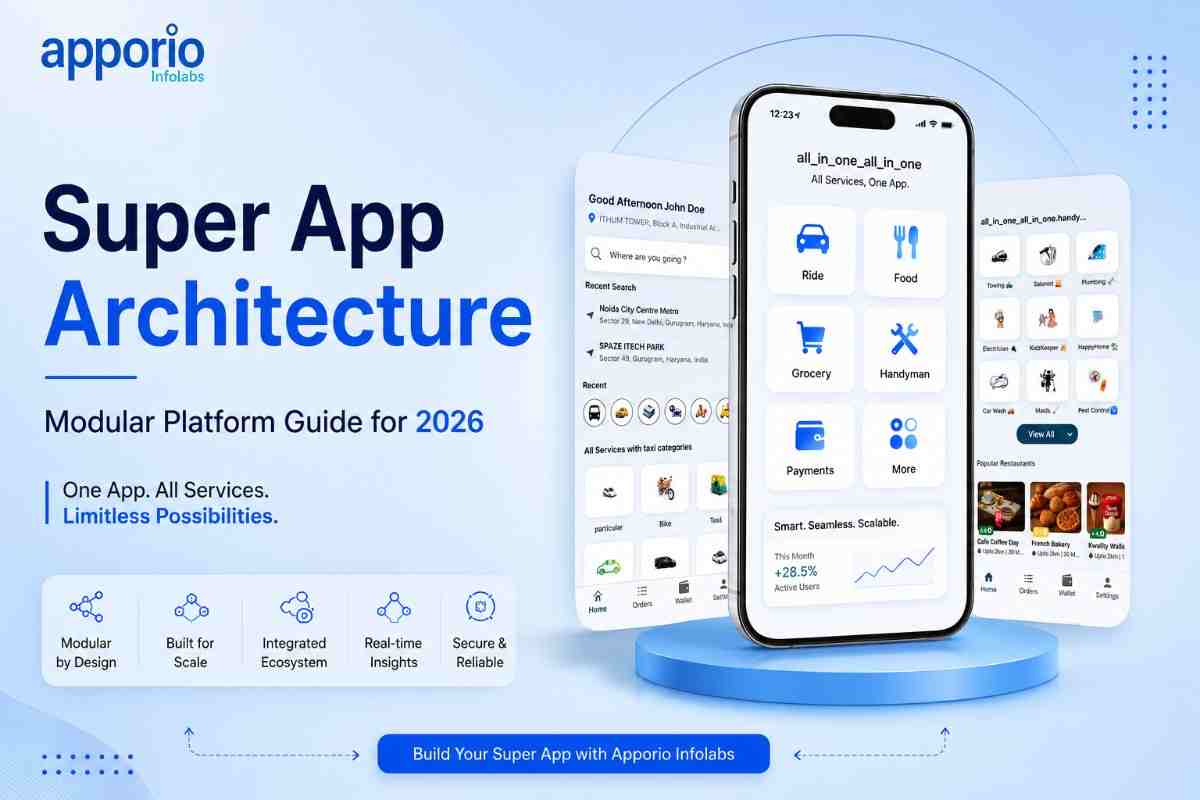
Super app architecture determines how a multi-service platform handles different customer journeys without becoming one difficult-to-maintain codebase. A ride booking flow, food order, grocery basket, home service request, and payment transaction may look unrelated to users, but they often share identity, location, notifications, payments, support, and reporting infrastructure.
The architecture must support that shared foundation while keeping each business service independent enough to change, test, scale, or pause without affecting the rest of the platform. This is the central product and engineering challenge behind a modular super app.
This guide explains the main architectural layers, the role of APIs and service modules, the decisions required before development, and the operating practices that help a platform expand across regions. It is written for founders, product leaders, and technical teams evaluating a new build, a white-label foundation, or a broader super app development program.
The right design is not the one with the most services on launch day. It is the one that gives the first service a reliable operating base and provides a controlled path for adding the next service.
Super app architecture is the technical structure used to operate several on-demand or digital services within one application and one connected backend. It combines shared platform capabilities with separate service modules. Users may see one account and one mobile interface, while the backend coordinates several domains, workflows, databases, and external integrations.
A modular platform usually contains four broad layers:
Each service should expose clear interfaces rather than directly modifying another service's internal data. For example, food delivery may request a payment authorization and delivery estimate from shared capabilities, but it should not rewrite the internal rules of the taxi module.
This distinction matters because a super app is not simply several unrelated apps placed behind one login. It is a coordinated platform with common identity and operational standards, while each service still needs domain-specific behavior.
Adding services increases operational and technical dependencies. A single-service application can often make assumptions about users, orders, locations, and payments. A multi-service platform cannot rely on those assumptions because each service uses the same concepts differently.
A taxi booking requires driver availability, trip states, live location, fare calculation, and dispatch. A grocery order requires inventory, substitutions, store fulfillment, delivery slots, and basket rules. A handyman request may require service duration, provider credentials, quotes, scheduling, and completion evidence. Treating these workflows as one generic order creates confusing logic and weak operational control.
Good architecture helps teams manage five practical concerns:
Architecture also affects commercial decisions. It determines how quickly a new service can be tested, how much shared infrastructure must be rebuilt, and how much technical debt accumulates when product teams work under launch pressure.
Account creation, authentication, saved addresses, payment records, notification preferences, customer support, and reporting are often needed across every service. Building these capabilities once creates a consistent customer experience and reduces duplicated maintenance.
Shared infrastructure also improves governance. A privacy request, account suspension, or notification preference can be handled through common rules rather than separate implementations that may behave differently.
Each domain can have its own workflow and release cadence. The team responsible for grocery operations can improve substitutions or delivery slots without rebuilding ride-hailing logic. This does not remove the need for integration testing, but it limits unnecessary coupling.
Module boundaries should reflect business responsibilities. A service that has distinct providers, pricing rules, fulfillment steps, and support needs deserves its own domain model.
A common account allows customers to maintain one profile, address book, wallet or payment record, and support history. The platform can show relevant services based on a user's market and current availability instead of asking customers to manage separate applications.
This convenience should not become forced bundling. Users need clear service choices, transparent charges, and separate order or booking histories where the workflows differ.
A global platform may need different currencies, tax calculations, payment gateways, languages, operating hours, provider documents, and service boundaries. Those rules should be configurable by market, not embedded throughout the codebase.
Regional configuration is especially important for entrepreneurs launching in Africa, Southeast Asia, Europe, and North America, where payment availability and operating practices can vary significantly.
Shared analytics can show how users move between services, where they abandon a booking, and which operational events cause support contacts. Domain-level reporting can then explain the reason behind those patterns.
Data should be collected with clear purpose, appropriate consent, retention rules, and access controls. A larger data set is not automatically better if definitions are inconsistent or personal information is exposed unnecessarily.
Start with one target market, one primary customer problem, and a limited group of services. Document the customer, provider, admin, and support journeys for the initial release. Include edge cases such as cancellations, refunds, failed payments, unavailable providers, incorrect addresses, and service-area restrictions.
A launch scope should identify what will not be included. This prevents teams from designing infrastructure for every possible future service before the first workflow has been validated.
Create a capability map with two categories. Shared capabilities may include identity, location, payments, notifications, promotions, support, and analytics. Service-specific capabilities may include trip dispatch, restaurant menus, grocery inventory, or handyman scheduling.
Do not make every capability shared simply because it appears in several services. A common concept can still require different domain rules. For example, an address service may be shared, but a delivery service may need its own delivery-zone and time-slot logic.
For each module, define the data it owns, the events it publishes, the APIs it exposes, and the actions other modules may request. Ownership means one service is responsible for the accuracy and lifecycle of its records.
Use plain business terms for entities and statuses. A taxi trip, food order, grocery basket, and handyman booking should not all be forced into one universal object if their states and actions differ.
APIs handle direct requests, such as creating a booking or retrieving a service catalog. Events communicate that something happened, such as a payment being authorized, a provider accepting a request, or an order being delivered.
Contracts should define required fields, error responses, authentication rules, versioning, retry behavior, and idempotency. Idempotency means repeating the same request does not accidentally create two bookings or charge a customer twice.
A modular monolith can be a sensible starting point when the team is small and the first service has limited operational complexity. It can preserve clear modules inside one deployable application. Separate services may become appropriate when teams, scaling requirements, release schedules, or reliability needs differ.
Microservices are not automatically more scalable or more reliable. They add network calls, deployment overhead, observability requirements, data consistency challenges, and operational work. Select the model based on actual boundaries rather than industry fashion.
Implement identity, roles, location handling, payment orchestration, notifications, audit logging, support access, and analytics definitions early. These components affect nearly every service and are expensive to redesign after multiple modules are live.
Connect external providers through adapters so that a payment or mapping provider can be changed without rewriting every service. Review the available payment gateways for the target markets before finalizing the payment flow.
A vertical slice includes the complete journey for one service: discovery, request, provider action, fulfillment, payment, notification, support, and reporting. It is more useful than building isolated screens because it tests the real operational chain.
Run internal pilots and controlled market tests. Measure completion, failure, cancellation, support, and reconciliation events before expanding the service catalog.
When adding food, grocery, or handyman services, reuse the shared foundation but keep service-specific workflows separate. Create a checklist for identity, payment, notifications, analytics, support, admin permissions, and operational training.
A new module is ready only when its business process, provider operations, exception handling, and reporting are ready. A polished customer interface cannot compensate for weak fulfillment processes.
Organize code, teams, documentation, and ownership around business domains. A module should have a clear purpose and a limited set of dependencies. If every feature can call every database, the platform may look modular while remaining tightly coupled.
Use architecture reviews to identify circular dependencies. For example, the payment component may confirm a transaction, but it should not contain the full business rules for food order preparation or driver dispatch.
One login does not mean one permission level. Customers, drivers, couriers, shoppers, restaurants, stores, technicians, administrators, finance staff, and support agents need different access rights.
Apply least-privilege access, meaning each user and service receives only the permissions required for its work. Record administrative actions and review unusual access patterns.
External services fail, networks time out, providers reject requests, and users close applications midway through a transaction. Use timeouts, retries with limits, fallback states, queues, and clear customer messages.
Financial operations need special care. A payment timeout should not be treated as a confirmed failure until the payment provider's final status is checked. Reconciliation jobs should compare platform records with provider records and flag differences for review.
Monitoring should cover technical and business signals. Track API latency, error rates, queue depth, database health, notification delivery, payment status, booking completion, provider acceptance, cancellations, refunds, and fulfillment delays.
Use correlation identifiers so a support or engineering team can trace one customer action across the gateway, service module, payment provider, and notification system. Logs should avoid unnecessary personal data.
Protect authentication credentials, payment references, location data, provider documents, and support records. Apply encryption in transit and at rest where appropriate, rotate secrets, separate production access, and test common API risks.
A dedicated cyber security review can assess authentication, authorization, data exposure, dependency risks, audit trails, and incident response. Privacy requirements should also be mapped to the countries where the platform operates.
Automated testing, repeatable builds, infrastructure configuration, staged deployments, and rollback procedures reduce avoidable release errors. A DevOps consulting service can help define deployment environments, monitoring practices, and release controls.
Automation should support review, not bypass it. Production changes involving payments, identity, pricing, or permissions should have clear approval and rollback ownership.
Agree on the meaning of active user, completed order, cancelled booking, refunded payment, provider acceptance, and delivery completion. Store domain data with the service that owns it, then publish approved events or reporting views for wider analysis.
This approach prevents different teams from reporting conflicting numbers and makes future migrations less disruptive.
Launching transport, food, grocery, home services, payments, subscriptions, and financial products at once creates operational complexity before the business has learned which workflows work. Begin with a clear service wedge and add modules using evidence from customer demand and provider capacity.
A single database can appear convenient because every module can read every record. Over time, this creates hidden dependencies, unclear ownership, risky schema changes, and difficult access control. A shared reporting layer is different from allowing every service to modify every table.
Universal models often hide important differences. A ride has a route and driver location; a grocery order has inventory and substitutions; a handyman booking may have a schedule, quote, and completion evidence. Use shared primitives where appropriate, but preserve domain-specific state machines.
Admin tools are not an afterthought. Teams need controls for provider onboarding, service areas, pricing, refunds, disputes, promotions, user restrictions, content, and operational exceptions. Without these tools, staff rely on manual database changes or scattered spreadsheets.
Currency, tax, language, operating hours, provider requirements, and payment methods change by market. Hard-coded rules make expansion slow and increase regression risk. Put variable rules into tested configuration with appropriate permissions and audit history.
Separating a codebase into many services does not fix poor queries, inefficient workflows, missing indexes, weak caching, or inadequate capacity planning. First identify the bottleneck. Then choose the smallest architectural change that addresses it.
Late security work can force major changes to identity, data storage, API design, and admin access. Threat modeling, permission reviews, dependency scanning, and incident procedures should begin before the first production release.
There is no universal deployment model for a multi-service platform. The best option depends on team size, service complexity, expected traffic, release independence, and operational maturity.
| Architecture Option | Best Fit | Advantages | Trade-offs |
|---|---|---|---|
| Modular Monolith | Early-stage platform with a focused team | Simple deployment, fast local development, and fewer network failures | Requires strict internal boundaries; independent scaling is limited |
| Service-Oriented Platform | Several domains with moderate independence | Clear service ownership and controlled integration points | Needs API governance, monitoring, and integration testing |
| Microservices | Large teams and high domain or scaling separation | Independent deployment and targeted scaling | Higher infrastructure, data consistency, and operational complexity |
| White-Label Foundation with Customization | Businesses validating a market with an existing product base | Faster starting point and established service workflows | Customization boundaries and long-term ownership must be reviewed carefully |
A modular monolith can later be split if the boundaries are well defined. Conversely, starting with many microservices can make a small team spend more time operating infrastructure than improving the customer and provider journeys.
For businesses comparing a ready foundation with a fully custom build, review source ownership, API access, deployment control, data migration options, security practices, documentation, and post-launch support. The decision should be based on the platform's expected operating model, not only the initial development estimate.
Strong super app architecture starts with clear service boundaries, shared platform capabilities, secure integrations, reliable operational workflows, and a staged expansion plan. The platform should make common functions consistent while allowing taxi, food, grocery, and handyman domains to retain their own business rules.
Apporio Infolabs can support this model through its Gojek Clone App, on-demand app development, Food Delivery, Grocery Delivery, and Handyman Services offerings. Teams should evaluate the required modules, market rules, provider operations, integrations, deployment ownership, and security controls before selecting an implementation path.
A practical next step is to map the first vertical service, define the shared foundation, identify the integration contracts, and decide which components need independent scaling. Book Free Demo
Super app architecture is the technical structure for running several digital or on-demand services in one connected platform. It combines shared capabilities such as identity, payments, location, notifications, support, and analytics with independent service modules for domains such as taxi, food, grocery, and handyman operations.
Not necessarily. A modular monolith may be more practical for an early-stage team because it reduces deployment and network complexity. Microservices become more suitable when domains require independent scaling or releases, or when separate teams need clear service ownership.
Identity, authentication, user profiles, addresses, notifications, payment orchestration, support access, promotions, audit logging, and analytics definitions are common candidates. Service-specific rules such as dispatch, inventory, substitutions, provider scheduling, and fulfillment should remain within their relevant domains.
Use market-level configuration for currencies, languages, taxes, operating hours, service areas, provider requirements, and payment methods. Regional rules should be tested, permission-controlled, and auditable rather than hard-coded throughout the application.
It needs strong authentication, role-based permissions, least-privilege access, encrypted data transmission, protected secrets, audit logs, dependency reviews, API security testing, incident procedures, and careful handling of location, payment, identity, and provider data.
Compare time to market, customization needs, source and deployment ownership, API access, data migration, security practices, documentation, scalability, support, and the workflows already required by the target market. A white-label foundation can reduce initial build work, but its extension boundaries must be understood before adoption.

