OUR PRODUCTS
Uberr Clone AppGojek Clone AppSuper App DevelopmentUberr Eats Clone AppGrocery App DevelopmentHandyman App Like Uberr
inDriver Clone AppDelivery App DevelopmentGlovo Clone AppBolt Clone AppLyft Clone AppCareem Clone App
OUR PRODUCTS

← Back to Blog
August 25, 2026
Explore the main revenue streams for multi-service platforms, from commissions and subscriptions to advertising, delivery fees, partnerships, and financial services.
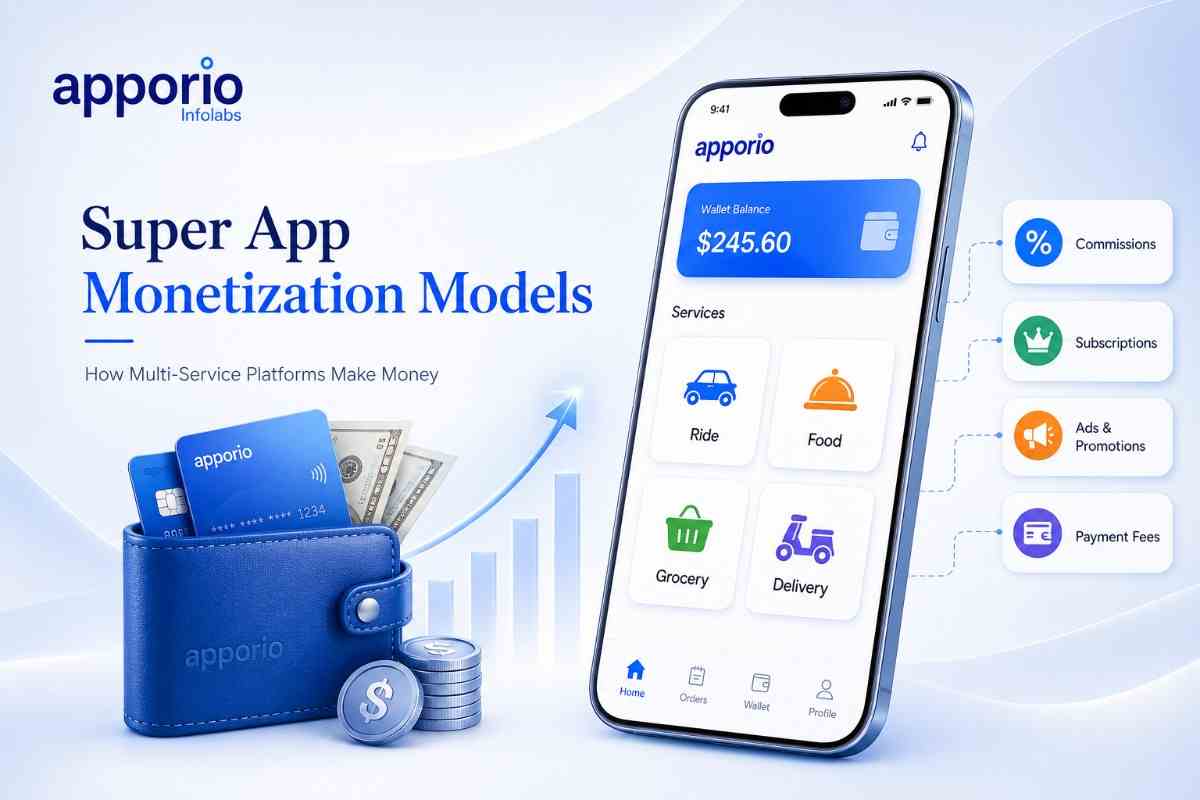
Understanding super app monetization models is essential before launching a platform that combines transport, food delivery, grocery, payments, and local services. A large service catalog does not automatically create a profitable business. Each service has different order values, operating costs, partner expectations, customer frequency, and regulatory considerations.
The strongest platforms usually combine several revenue streams instead of depending on one commission. Ride bookings may generate a marketplace fee, grocery orders may include delivery charges, and frequent users may pay for a membership plan. Advertising, business software, payment processing, and strategic partnerships can add further income once the platform has enough activity.
This guide explains how multi-service applications generate revenue, how to select a practical model, and which operational metrics should be monitored. It is written for founders and operators planning a global launch, including businesses entering markets where cash payments, local wallets, fragmented merchants, and regional pricing affect the business case.
A monetization model defines how a platform converts user activity into revenue. In a multi-service application, that activity may be a completed ride, a restaurant order, a grocery purchase, a home-service booking, an advertisement view, or a recurring membership payment.
A super app is not simply a collection of unrelated mini-apps. Its services share identity, customer support, payment infrastructure, notifications, location data, and often a common wallet or account balance. This shared foundation can reduce duplicated acquisition and service costs, but it also creates a need for careful financial tracking.
Revenue should be measured separately for every service line. A ride-hailing operation may earn a percentage of the fare, while a handyman marketplace may charge a lead or booking fee. Food delivery can involve restaurant commissions, customer delivery charges, and promotional placement fees. Treating all transactions as one pool hides the actual contribution of each category.
Revenue is the money collected by the business before expenses. Profit is what remains after driver incentives, delivery operations, payment fees, refunds, customer support, marketing, taxes, technology, and administrative costs. A platform can show high transaction volume while losing money on every order if fees and operating costs are not controlled.
Revenue design affects nearly every product decision. It influences checkout screens, merchant contracts, driver payouts, subscription benefits, advertising inventory, refund rules, and the way promotions are funded. Choosing a model after development has finished can result in expensive changes to pricing logic, invoices, dashboards, and payment flows.
It also determines who carries the cost of the service. A customer may accept a transparent delivery fee for a grocery order but react negatively to a high platform fee on a short ride. A restaurant may tolerate a commission when the platform generates new demand, but it may resist the same rate when the service mainly processes existing customers.
Regional conditions make planning even more important. Payment availability differs across countries, as do tax requirements, cash usage, courier wages, fuel costs, and consumer expectations around delivery charges. A model that works in a dense European city may not suit a low-density African market where cash collection and driver supply require different controls.
Using several income sources gives a multi-service platform more flexibility, but the benefits only appear when each stream supports a clear customer or partner value. Adding charges without a reason can reduce trust and order frequency. The following advantages explain why founders often combine transaction, recurring, and business-to-business income.
A customer who uses transport, food delivery, and grocery services can generate more annual value than a customer limited to one category. Shared account data and saved payment details can reduce friction between services, provided the user has clear control over permissions and communications.
Acquiring one customer for several categories can be more efficient than running separate campaigns for each service. The platform can introduce a grocery service to an existing ride user or present a home-service option after a relevant interaction. This requires careful consent management and relevant messaging rather than indiscriminate notifications.
Memberships and business subscriptions can make revenue less dependent on daily order volume. A paid plan may include reduced delivery fees, priority support, loyalty benefits, or bundled access to selected services. Benefits must be financially tested so heavy users do not create losses under the plan.
Merchants, drivers, and professionals may pay for promoted placement, advanced reporting, booking tools, or access to business software. These charges are easier to justify when they produce measurable value, such as more qualified leads or better operational visibility.
Different categories have different demand patterns. A platform may experience strong food orders at mealtimes, grocery demand during weekends, and transport demand across commuting periods. A varied service mix can balance activity, although each category still needs independent profitability analysis.
Monetization should be designed alongside the operating model, not added as a final pricing screen. The following process helps founders move from a broad service idea to a testable commercial plan.
Technology planning should include separate ledgers for customer charges, provider payouts, commissions, taxes, refunds, promotional credits, and payment settlements. A shared account does not mean every service should use identical financial rules.
Customers should know what they will pay before confirming an order. Show the item or service price, platform charge, delivery or booking fee, taxes where applicable, discounts, and final total in a readable breakdown. Hidden charges may increase short-term revenue but can harm repeat usage and create support volume.
Commissions work well when the platform creates measurable demand for providers. Delivery fees help cover fulfillment costs, especially when distance and order size vary. Subscriptions suit services with frequent repeat usage. Advertising is more appropriate after the platform has enough search activity and partner demand to create useful placements.
Drivers, couriers, merchants, and professionals are part of the product experience. Monitor their net earnings, payment timing, cancellation exposure, and incentive burden. A fee structure that looks attractive in a spreadsheet can fail if supply leaves the platform or declines orders because the payout is not workable.
Specify who funds every discount. A promotion may be paid by the platform, a merchant, a provider, or jointly. The financial dashboard should show promotional cost separately from ordinary revenue so managers can distinguish organic demand from subsidized transactions.
Payment infrastructure should support the methods customers actually use in each target market. Apporio’s payment gateways resource can help teams consider payment options as part of the commercial design rather than as a late integration task.
Subscriptions, digital wallets, and recurring billing require clear renewal notices, cancellation controls, receipts, and refund handling. Security also matters when one account connects multiple categories and payment methods. Review access controls, data retention, fraud monitoring, and account recovery before expanding the service catalog.
A practical starting point may combine one high-frequency service with one complementary category. A ride service and food delivery can share location and payment infrastructure, while grocery or handyman services can be added after operations are stable. A super app development plan should therefore include phased releases, not an assumption that every category must launch at once.
Compare customers acquired in different months, locations, and channels. Track first-order margin, repeat purchases, cross-service adoption, membership renewal, and support contacts. Cohort analysis shows whether revenue quality is improving or whether growth is being purchased through discounts.
Many platforms do not fail because they lack possible revenue streams. They struggle because fees are introduced without a clear operating rationale or because reporting does not expose the cost of fulfillment. These mistakes are common during rapid expansion.
These errors are easier to prevent when the product team, finance team, operations managers, and local market specialists review the model together. Commercial logic should be tested in the admin system before public release.
No single model fits every service. The right choice depends on transaction frequency, fulfillment cost, provider competition, customer price sensitivity, and the platform’s stage of growth.
| Revenue Model | Primary Payer | Best Fit | Main Risk |
|---|---|---|---|
| Commission | Merchant or provider | Marketplaces that generate bookings or orders | Provider resistance when demand is weak |
| Customer service fee | Customer | Rides, deliveries, and bookings with visible fulfillment costs | Lower conversion if the fee appears late |
| Subscription | Customer or business | Frequent users and repeat service categories | Benefits may cost more than recurring revenue |
| Advertising | Merchant, brand, or provider | Platforms with meaningful search and transaction volume | Low value when audience activity is limited |
| Partner software fees | Merchant or provider | Businesses needing operational tools and reporting | Partners may reject fees without clear business value |
| Financial service revenue | Customer, merchant, or financial partner | Markets with suitable regulation and payment usage | Compliance, fraud, and licensing complexity |
A platform may combine a commission with a customer fee, but the combined burden should be tested against conversion and provider retention. Subscriptions can reduce visible per-order charges for frequent users, while advertising and partner software can diversify income without adding a fee to every transaction.
The comparison should be revisited as the business matures. Early-stage operators may prioritize adoption and supply density, whereas an established platform can introduce paid placement, business accounts, or premium membership after it has reliable activity data.
Successful super app monetization models begin with service-level economics, transparent pricing, and a clear understanding of who receives value from each transaction. Commissions, customer fees, subscriptions, advertising, partner software, and financial services can work together, but each requires separate measurement and regional testing.
Founders planning this type of platform can evaluate Apporio’s Gojekk Clone, on-demand app development, Food Delivery, and Grocery Delivery capabilities against their launch market and operating plan. The implementation should start with a focused service mix, configurable pricing, reliable payment handling, and reporting that shows contribution margin rather than only transaction volume.
Book Free Demo
Commission is one of the most common models because the platform can charge merchants or providers after a completed order or booking. Many businesses combine it with customer service fees, subscriptions, or advertising after they have validated demand and operating costs.
Yes. A membership can charge customers or businesses on a recurring basis in exchange for benefits such as reduced delivery fees, selected discounts, priority support, or access to business tools. The benefits should be limited and tested against actual usage so the plan remains financially viable.
There is no universal answer. Customers may pay a visible booking or delivery fee, while merchants and providers may pay a commission for demand generation. The decision should reflect price sensitivity, fulfillment cost, competitive conditions, and the net earnings required to retain supply.
Advertising is usually more useful after the platform has enough search activity, completed transactions, and active merchants or providers. Before that point, the audience may be too small to create meaningful placement value, and poorly targeted promotions can reduce user trust.
Track gross bookings, commissions, customer fees, provider payouts, taxes, payment costs, refunds, discounts, incentives, fulfillment costs, and support costs separately for each category and location. This shows net platform revenue and contribution margin instead of treating all transaction value as profit.
They should define the first service category, identify every paying participant, calculate unit economics, choose a primary charge, plan regional pricing and payment methods, and specify the reporting needed to test the model. These decisions should be reflected in the product and admin architecture from the start.

