OUR PRODUCTS
Uberr Clone AppGojek Clone AppSuper App DevelopmentUberr Eats Clone AppGrocery App DevelopmentHandyman App Like Uberr
inDriver Clone AppDelivery App DevelopmentGlovo Clone AppBolt Clone AppLyft Clone AppCareem Clone App
OUR PRODUCTS

← Back to Blog
August 31, 2026
Compare three app business models by operating complexity, monetization, scalability, and launch requirements before choosing a platform strategy.
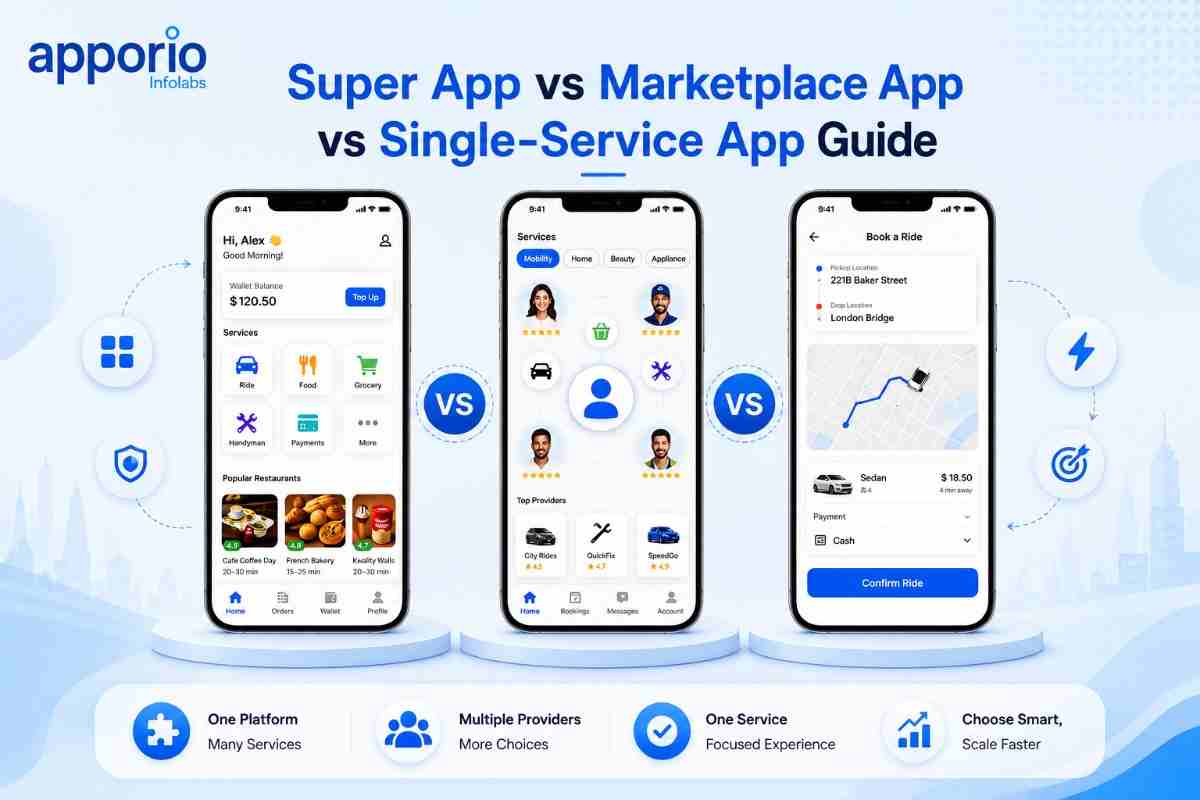
Choosing between a super app, marketplace platform, and focused service application affects product scope, operating costs, partner management, and the speed at which a business can test demand. The right decision depends less on the number of features and more on the customer problem, supply model, launch market, and resources available to operate the platform.
This guide explains super app vs marketplace app decisions alongside the single-service model. It is written for founders, established businesses, and regional operators assessing an on-demand app development project. The comparison covers how each model works, when it fits, what it costs operationally, and which product decisions should be made before development begins.
A taxi operator may need one reliable booking workflow, while a new digital platform may want to combine transport, food, grocery, and home services. These are different businesses even when they use similar mobile technology. Treating them as the same product often creates unnecessary complexity and weakens the initial customer experience.
These three models differ mainly in the relationship between services, providers, and customers. Understanding that structure is more useful than comparing feature checklists.
A super app brings multiple services into one customer account and application. The services may include ride booking, food ordering, grocery delivery, payments, logistics, or handyman bookings. Its value comes from shared identity, shared communication, common support, and the ability to cross-sell services. A modular approach is essential because each vertical has different workflows, providers, pricing rules, and fulfillment requirements.
For founders planning this route, super app development typically requires a central platform with separate service modules. A user may use the same wallet or profile across services, but each operational team still needs appropriate dashboards and controls.
A marketplace connects customers with multiple independent providers within one category or a closely related group of categories. Examples include restaurants and diners, retailers and shoppers, or local professionals and households. The platform usually manages discovery, ordering or booking, payments, reviews, commissions, and dispute handling. The provider remains responsible for delivering the underlying service or product.
A single-service app focuses on one core use case, such as taxi booking, grocery delivery, food ordering, or handyman appointments. It may still have customer, provider, and administrator interfaces, but the business logic is concentrated around one fulfillment journey. This narrower scope often makes it easier to validate demand, recruit supply, measure service quality, and improve the product from real usage data.
The application model determines more than the user interface. It shapes your supply acquisition plan, support structure, technology roadmap, marketing message, and unit economics. A platform that serves several categories must support different service-level expectations. A grocery order may require inventory accuracy and substitutions; a ride booking needs driver location and dispatch logic; a handyman booking may require scheduling, estimates, and proof of completion.
Launching several verticals at once can also split management attention. Each category needs provider onboarding, quality control, local pricing, customer support scripts, and operational reporting. If demand is not strong across every category, the wider platform may carry costs before it has enough transaction volume to justify them.
A marketplace can be more focused than a super app but still has two-sided growth challenges. Customers need enough provider choice, and providers need enough customer demand. A single-service platform has a simpler message, but its revenue depends heavily on the performance of one category and one set of operational assumptions.
The decision also affects expansion. A single-service product can later add adjacent services if its account, payment, notification, and analytics foundations are designed carefully. Starting narrow does not prevent a broader roadmap. It can provide a clearer path to expansion than building every possible module before the first market test.
A multi-service platform can increase the number of situations in which a customer opens the application. Shared registration and account data can reduce repeated onboarding, while cross-service visibility may support retention when one category has seasonal demand. It can also give operators a wider data set for understanding purchase patterns, service frequency, and geographic demand.
The model is particularly relevant for businesses with an existing customer base, strong local partnerships, or a regional brand that can introduce several services under one identity. Apporio’s Gojekk Clone App is a relevant reference point for entrepreneurs evaluating a multi-service product structure. The business still needs to decide which services belong in the first release rather than copying every possible vertical.
A marketplace concentrates resources around one category while allowing supply to grow through independent providers. The operator does not need to own every restaurant, store, vehicle, or professional asset. Instead, its product value comes from demand generation, discovery, transaction management, trust controls, and service coordination.
This model can support commission revenue, listing fees, advertising, subscriptions, booking fees, or a combination of these methods. The best choice depends on provider economics and customer sensitivity to added charges. A marketplace also creates room for specialization, such as a regional food platform, a business travel booking network, or a vetted home-services directory.
A focused application is easier to position and test. Product teams can prioritize the core journey, measure conversion at each step, and identify service failures without interpreting data across unrelated categories. Provider training and customer support are also more consistent because the team handles one main workflow.
For example, a taxi business can begin with booking, dispatch, driver verification, payments, ratings, and trip support. A grocery operator will need catalog, inventory, fulfillment, substitutions, and delivery tracking instead. A focused product makes those category-specific requirements visible instead of hiding them inside a broad feature list.
For a business that needs several transaction types, on-demand app development should include product discovery and operational mapping before implementation. For a focused taxi product, Apporio’s Uberr Clone direction may be more appropriate than commissioning unrelated service modules at the start.
Even a broad platform should have a clear entry point. Select the service with the strongest demand, most accessible supply, and simplest path to a completed transaction. A focused first release gives the team a baseline for activation, fulfillment time, cancellation rate, repeat usage, and support volume.
Document what happens when a provider rejects an order, a driver is late, an item is unavailable, a customer cancels, or a payment fails. These cases determine the needed statuses, notifications, administrator controls, refund rules, and audit records. Product teams that skip this work often produce attractive screens without workable back-office processes.
Modular architecture means separating service-specific business rules while allowing common capabilities to be shared. Authentication, customer profiles, notifications, payment records, and support tickets may be common. Pricing, dispatch, catalog management, scheduling, and fulfillment status should remain adaptable to each category.
Global audiences do not use one universal payment or compliance pattern. Consider local currencies, tax treatment, payment methods, language, address formats, identity checks, and data obligations in each target market. Apporio provides a dedicated payment gateways resource for evaluating transaction connectivity as part of the platform plan.
Provider adoption depends on practical workflows. They need clear order or booking status, earnings visibility, availability controls, communication, navigation where relevant, and a reliable way to report problems. A marketplace with a polished customer experience but poor provider tooling will struggle to maintain supply quality.
Do not evaluate a multi-service platform only through total revenue. Track orders or bookings, commission or service revenue, refunds, incentives, payment costs, support costs, fulfillment costs, and repeat behavior by category and market. A popular service can still be unattractive if the cost to fulfill each transaction remains high.
Role-based access, secure payment handling, provider verification, fraud monitoring, data retention rules, and incident response should be included in the initial plan. Security is not limited to the mobile app; administrator dashboards, APIs, storage, third-party integrations, and operational accounts also need controls.
Another frequent mistake is assuming that a marketplace and a super app have the same monetization structure. A marketplace may earn from provider commissions and listings, while a multi-service platform may combine transaction fees, subscriptions, advertising, and service-specific margins. These options should be modeled separately.
The following comparison is a planning tool, not a universal ranking. The best model depends on the category, market, supply conditions, and operating capabilities of the business.
| Criterion | Super App | Marketplace App | Single-Service App |
|---|---|---|---|
| Primary Purpose | Combines several services under one platform | Connects customers with providers in a category | Solves one focused customer need |
| Operational Complexity | High because each vertical has distinct rules | Medium to high depending on provider and fulfillment model | Lower initial complexity, with category-specific exceptions |
| Supply Model | Multiple provider groups or business units | Independent sellers, professionals, restaurants, or fleets | One main provider network or operating team |
| Customer Proposition | Convenience across related services | Choice, discovery, and trusted transactions | Speed, clarity, and specialization |
| Technology Scope | Shared platform plus separate service modules | Discovery, provider tools, transactions, and administration | Deep optimization of one principal workflow |
| Best Initial Fit | Established brands or operators with several demand channels | Businesses that can build provider density in one category | Startups testing a clear problem or specialized operator |
| Main Risk | Spreading resources across weak or unrelated verticals | Failing to balance provider supply and customer demand | Dependence on one category and its margins |
For food businesses, a restaurant marketplace may need menus, availability, order acceptance, delivery coordination, and commissions. A grocery platform needs catalog and inventory controls in addition to delivery. For service businesses, a handyman platform needs professional profiles, service areas, estimates, scheduling, and job completion records. These differences should guide the model choice.
The decision between a super app, marketplace platform, and single-service product should follow the operating model rather than a preference for a larger feature list. A focused product is often the clearest way to validate one category. A marketplace fits businesses that can coordinate independent providers. A super app becomes more practical when the business has sufficient demand, supply relationships, and operational capacity across multiple services.
Apporio Infolabs can support different stages of this decision through Super App Development, the Gojekk Clone product, Food Delivery, Handyman Services, and white-label on-demand app development. The immediate next step is to define the first market, service, provider model, transaction flow, and expansion criteria before selecting the product scope.
If your business case specifically requires a multi-service platform, super app vs marketplace app planning should be tied to real supply and fulfillment requirements, not only the customer-facing menu. Review the operational assumptions with your product and development team before committing to a build path.
Book Free Demo
A super app combines several services within one platform and account experience. A marketplace usually connects customers with multiple independent providers in one category or closely related category. The first emphasizes service breadth; the second emphasizes provider choice and transaction coordination.
It can be a practical starting point when the startup has one clearly defined customer problem and limited operational resources. The narrower scope supports clearer positioning, simpler provider training, and more focused measurement. It is not automatically better if the business already has strong demand and supply across several categories.
Yes. The product can be expanded if its foundational account, payment, notification, analytics, and support systems are designed with modular service additions in mind. Expansion should follow validated demand, reliable fulfillment, provider capacity, and a workable financial model.
The main challenge is balancing both sides of the platform. Customers need enough reliable providers, while providers need enough demand to justify their participation. Verification, quality control, dispute handling, commissions, and provider retention are central operating responsibilities.
None is universally easiest. A marketplace may use commissions, listing fees, advertising, or subscriptions. A single-service app may use service fees, commissions, or direct operating margins. A super app can combine several revenue streams, but it also requires category-level financial tracking because each service has different costs.
Define the first customer problem, target market, provider model, service workflow, payment process, support responsibilities, compliance requirements, launch metrics, and conditions for expansion. These decisions determine whether the product should begin as a focused service, marketplace, or modular multi-service platform.

