OUR PRODUCTS
Uberr Clone AppGojek Clone AppSuper App DevelopmentUberr Eats Clone AppGrocery App DevelopmentHandyman App Like Uberr
inDriver Clone AppDelivery App DevelopmentGlovo Clone AppBolt Clone AppLyft Clone AppCareem Clone App
OUR PRODUCTS

← Back to Blog
August 7, 2026
A practical guide to building a Talabat-style food delivery platform for the Middle East, covering features, costs, monetization, localization, and launch planning.
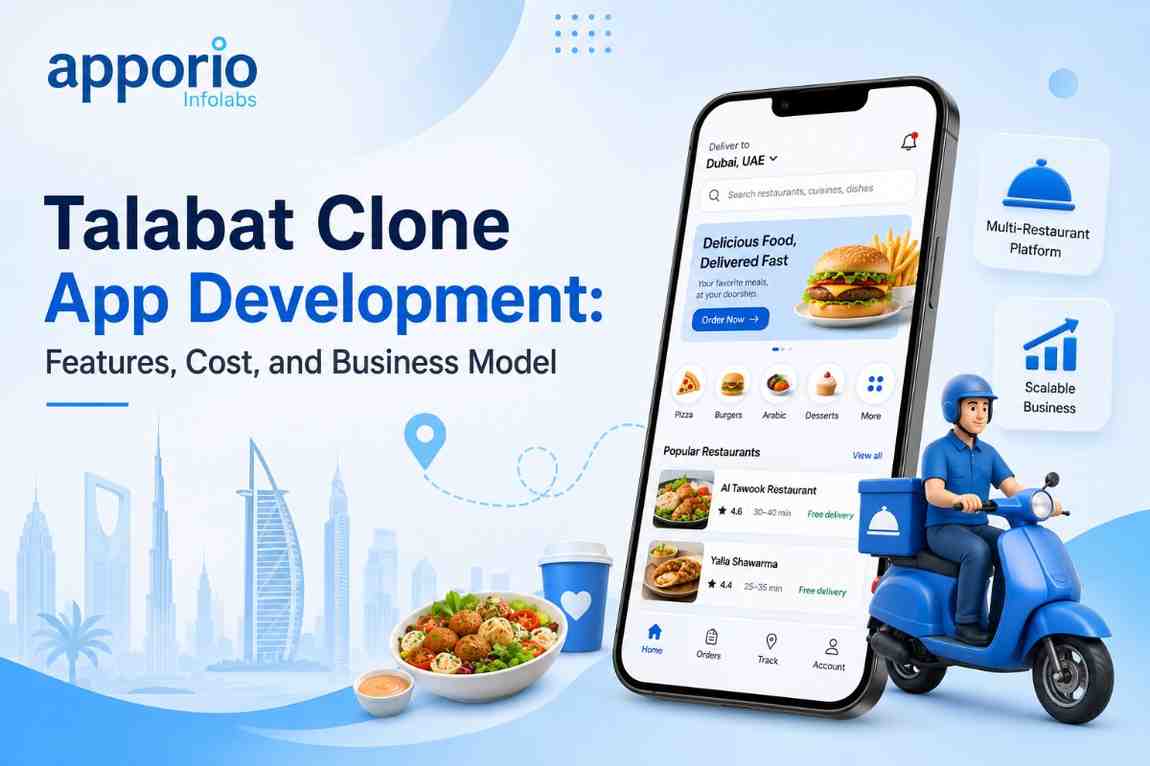
Talabat clone app development is a commercial opportunity for entrepreneurs who want to launch a branded food delivery marketplace in the Middle East. The business is not simply a restaurant ordering app. It requires coordinated software for customers, restaurants, delivery partners, and administrators.
A viable platform must handle menus, delivery zones, order status, commissions, refunds, driver availability, Arabic and English interfaces, and local payment preferences. These operational details have a direct effect on repeat orders and contribution margin.
This guide explains what the platform includes, how the business model works, what affects the build cost, and how to plan a practical launch. It focuses on decisions that matter before signing a development agreement rather than presenting a generic feature checklist.
For a ready-made starting point, Apporio’s Talabat Food Delivery App can be assessed against your market, service area, and required customizations.
A Talabat-style platform is a multi-sided marketplace that connects customers with restaurants and delivery partners through mobile and web applications. The platform owner manages discovery, ordering, payment collection, dispatch, customer support, promotions, and settlement reporting.
The system usually has four operational layers:
Unlike a single-restaurant ordering app, a marketplace must balance three supply-side concerns: restaurant acquisition, delivery capacity, and customer demand. The product should therefore be designed around local operating rules before development begins.
Food delivery demand varies significantly by city, neighborhood, cuisine, income group, and delivery distance. A platform intended for Dubai, Riyadh, Doha, Kuwait City, or another Middle Eastern market should not assume that one operating model will work everywhere.
Localization affects more than translation. Arabic requires right-to-left interface support, including menus, checkout screens, notifications, and driver workflows. Address capture may need building names, landmarks, apartment details, and delivery notes rather than relying only on conventional street addresses.
Payment design also needs local research. Customers may prefer different combinations of cards, digital wallets, cash on delivery, or regional payment providers. The selected gateway must support the target country, settlement requirements, refund handling, and marketplace payment flows. Apporio’s payment gateway integration resource is relevant when mapping these requirements.
Operational density is another major factor. A marketplace with too few restaurants offers limited choice, while too few drivers create late deliveries. Launch planning should begin with a defined city or service zone, a manageable cuisine mix, and a delivery policy that the operations team can monitor.
Regulatory review is also necessary. The business owner should confirm requirements for commercial registration, food handling responsibilities, consumer protection, tax invoices, driver contracts, data protection, and electronic payments in each target jurisdiction. These matters should be checked with local legal and financial advisers.
A branded marketplace gives the operator control over customer relationships and business rules. It does not remove the hard work of acquiring users and restaurants, but it provides a product foundation that can be adapted to a specific market.
The strongest benefit is not the number of screens. It is the ability to coordinate supply, delivery, payments, and customer support using one operating model.
The customer application should make the complete order journey clear. Registration can support email, phone number, or social sign-in, but verification and account recovery must be reliable. Location permission should be requested at an appropriate point and should not prevent manual address entry.
Restaurant tools should reduce manual work during busy periods. Staff need to accept or reject orders quickly, pause unavailable items, adjust preparation times, and communicate exceptions to support teams.
Driver workflows should be simple because delivery partners often use the application while moving between pickup and drop-off points. The app should minimize unnecessary taps and provide clear status rules.
The administration layer needs permission controls so finance, support, operations, and marketing teams see only the functions relevant to their roles. It should also maintain audit trails for refunds, commission edits, account actions, and order changes.
Important technical areas include payment integration, push notifications, maps, location services, analytics, cloud deployment, backups, and data protection. Apporio’s cyber security services can be considered during the security planning stage, particularly for authentication, sensitive data, and administrative access.
Apporio’s on-demand mobile app development service can support this type of multi-party product planning and implementation.
There is no responsible single price for this type of platform without a defined scope. Cost depends on whether the owner selects a ready-made white-label product, requests modifications to an existing system, or commissions a fully custom build.
| Cost driver | What it includes | Why it changes effort | Questions to ask |
|---|---|---|---|
| Platform scope | Customer, restaurant, driver, and admin applications | More user roles require more workflows, permissions, and testing | Which roles are essential at launch? |
| Localization | Arabic, English, RTL layouts, currency, tax, and local payment options | Each market variation affects design, content, integration, and quality assurance | Which countries and languages are included? |
| Dispatch complexity | Manual assignment, automated matching, zones, batching, and driver rules | Advanced dispatch requires more logic and operational testing | Who controls assignment during peak periods? |
| Customization | Branding, workflows, reports, promotions, and business rules | Custom changes may affect multiple applications and future maintenance | Which changes are essential rather than cosmetic? |
| Infrastructure and support | Hosting, monitoring, maintenance, security updates, and support | These are continuing operating costs after the first release | What is included after deployment? |
A useful budget process separates one-time product work from recurring costs. One-time work may include discovery, UI design, configuration, development, integrations, testing, and deployment. Recurring expenses may include hosting, third-party services, support, marketing, payment processing, driver operations, and compliance work.
Request a written scope that lists every application, integration, language, payment method, admin report, deployment responsibility, and post-launch service. This makes vendor proposals easier to compare and reduces disputes caused by vague terms such as “full-featured.”
Launch in one city before expanding regionally. Dubai, Riyadh, Doha, and Kuwait City each have different customer expectations, delivery infrastructure, and competitive platforms, so proving the model in a single market first reduces risk before scaling.
Secure restaurant and delivery partner supply before spending on customer acquisition. A marketplace with too few restaurants or riders in a zone creates a poor first impression that is difficult to reverse through marketing alone.
Plan operations around Ramadan and daily prayer times. Order volume, delivery windows, and restaurant availability shift significantly during these periods, and the platform's scheduling and notifications should account for this rather than treating every day as standard.
Offer the payment methods customers already use. Cash on delivery remains significant across the region alongside cards and digital wallets, so the checkout flow should support multiple options rather than defaulting to a single method.
Confirm licensing and courier regulations for each country before launch, since delivery, data handling, and business registration rules differ by market and are not interchangeable across the GCC.
Treating the Middle East as one uniform market is a common error. A configuration that works in Dubai will not automatically fit Riyadh or Cairo, since language needs, payment preferences, and delivery norms vary by country and even by city.
Underestimating delivery logistics is another frequent issue. Owners sometimes focus on the app while giving little attention to rider zoning, delivery time estimates, and peak-hour capacity, which affects customer experience more than app features do.
Treating Arabic support as a simple translation task causes problems later. Right-to-left layout needs to be tested across menus, checkout, and notifications, not just translated, or the interface can feel broken to Arabic-speaking users.
Launching without confirmed payment and compliance requirements creates delays. Some operators build the product first and address licensing, payment gateway approval, or data residency rules only after development is complete, which can push back the launch date significantly.
The right approach depends on the owner’s market knowledge, available budget, desired control, and launch urgency. None of these approaches removes the need for local operations and customer acquisition.
For many first-time operators, a customized ready-made platform offers a practical middle path. It can reduce the amount of foundational work while preserving room for market-specific changes. However, the owner should verify source-code rights, deployment access, security practices, documentation, integrations, and ongoing maintenance before committing.
Businesses focused on a narrower delivery proposition can also review Apporio’s delivery app development option before selecting a broader marketplace scope.
Talabat clone app development should be treated as a marketplace operations project, not only a mobile application build. The core decisions involve city selection, restaurant supply, delivery capacity, payment design, Arabic localization, customer support, and unit economics.
A realistic plan begins with a focused service zone, a defined first release, tested restaurant and driver workflows, and a written cost scope. Apporio Infolabs can help evaluate a Talabat Food Delivery App, Food Delivery product, and on-demand app development requirements for a Middle Eastern launch. The final choice should reflect the operator’s local model, not a generic feature list.
Book Free Demo
It typically includes customer, restaurant, delivery partner, and admin applications. Core functions cover restaurant discovery, menu management, ordering, payments, dispatch, tracking, notifications, refunds, support, commissions, and reporting.
There is no fixed cost without a confirmed scope. The budget changes according to the number of applications, localization, payment gateways, dispatch rules, customization, integrations, infrastructure, testing, and post-launch support.
A white-label or customized ready-made platform can be practical when the business needs standard marketplace workflows and a controlled first launch. Custom development is more suitable for unusual logistics, complex integrations, or requirements that cannot be handled through configuration.
For many Middle Eastern markets, Arabic and right-to-left support are important parts of localization. The requirement should cover customer, restaurant, driver, and admin interfaces, as well as notifications, help content, forms, and error messages.
Common revenue sources include restaurant commissions, customer delivery charges, sponsored restaurant placement, advertising, subscriptions, corporate ordering, and selected service fees. The operator should test each model against restaurant acceptance and customer retention.

