OUR PRODUCTS
Uberr Clone AppGojek Clone AppSuper App DevelopmentUberr Eats Clone AppGrocery App DevelopmentHandyman App Like Uberr
inDriver Clone AppDelivery App DevelopmentGlovo Clone AppBolt Clone AppLyft Clone AppCareem Clone App
OUR PRODUCTS

← Back to Blog
September 1, 2026
A practical guide to launching a local services marketplace with provider onboarding, customer bookings, payments, scheduling, reviews, and admin controls.
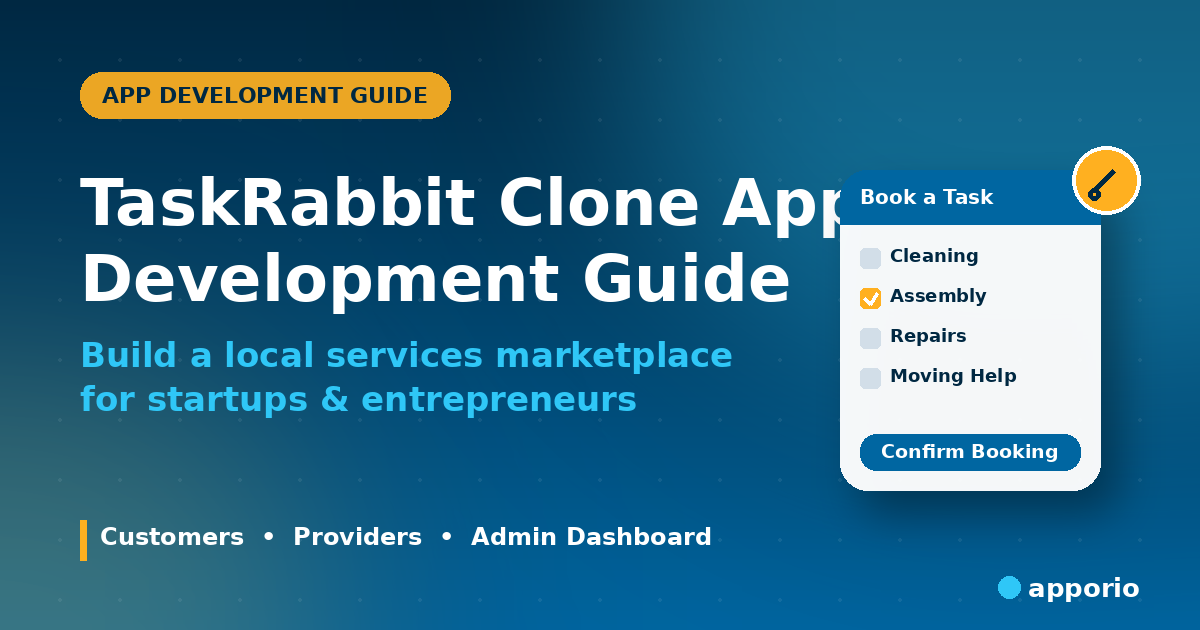
TaskRabbit clone app development helps entrepreneurs create a local services marketplace where customers can find, compare, book, and pay independent professionals. The model can support home cleaning, furniture assembly, moving help, repairs, painting, gardening, personal assistance, and other scheduled services.
For a commercial launch, the main challenge is not copying a familiar interface. It is designing reliable marketplace operations. The platform must handle two-sided onboarding, service discovery, availability, location-based matching, quotes or fixed pricing, payment collection, cancellations, reviews, disputes, and provider payouts.
A ready-made foundation can reduce the amount of work required for standard marketplace functions, while business-specific changes can focus on service categories, local regulations, payment methods, pricing rules, and brand identity. This guide explains the product decisions to make before selecting a technology partner or requesting a proposal.
A TaskRabbit-style marketplace connects people who need a task completed with local professionals or independent service providers. Customers create a request, select a category, describe the work, share a location, choose a time, and either receive offers or book a listed provider.
The platform normally has three working areas:
The marketplace can use different fulfillment models. A fixed-price model is suitable for clearly defined jobs such as basic cleaning or assembly. An offer-based model works better when the work varies by size, materials, urgency, or location. A hybrid model can support both approaches in separate categories.
Apporio’s Taskrabbit Clone App is directly relevant for businesses assessing this type of product. The important evaluation point is not the label “clone,” but how easily the foundation can be configured for the target market and operating model.
Local services are operationally fragmented in many markets. Customers often rely on search engines, social networks, classified listings, personal referrals, or informal messaging to find help. That creates uncertainty around availability, pricing, identity, quality, and payment protection.
A dedicated platform organizes these interactions into a measurable workflow. The business can see where requests originate, which categories have demand, how quickly providers respond, which bookings are cancelled, and how much revenue each service area generates. Those insights are more useful than simply counting app downloads.
Customers get a structured way to describe their needs and compare service providers. Profiles, ratings, completed-job counts, response times, service descriptions, and estimated prices help them make a more informed decision. Appointment reminders and in-app status updates also reduce missed visits.
Professionals receive a digital channel for acquiring work without building their own booking infrastructure. A provider can define working hours, accept suitable jobs, manage travel time, collect payments, and build a reputation through completed assignments.
The operator earns by facilitating transactions and controlling the marketplace rules. It can test categories, adjust commissions, introduce subscriptions, offer featured placement, or expand into neighboring service areas after the initial workflow is stable.
The model still requires local supply development. A marketplace with strong software but too few approved providers will produce slow responses and poor customer retention. Provider acquisition, verification, quality control, and category selection should be planned before development begins.
A focused first release can test whether customers will submit requests and whether providers will accept them. Instead of starting with every possible category, the business can launch in one city with a limited set of high-frequency services. This produces clearer evidence about demand, pricing, and operational bottlenecks.
The same customer, provider, payment, and review infrastructure can support different categories. A business may begin with cleaning and assembly, then add moving assistance, maintenance, painting, or outdoor work. Each category can still have its own fields, pricing rules, equipment requirements, and cancellation policy.
Digital onboarding makes it possible to collect identity details, qualifications, insurance information, work samples, and service preferences before approval. Admins can suspend accounts, review complaints, investigate unusual activity, and monitor provider performance.
In-app requests, estimates, messages, invoices, receipts, refunds, and payout records create an auditable history. This helps the operations team resolve disputes and identify recurring problems such as inaccurate estimates, late arrivals, or incomplete tasks.
The operator can apply a commission to completed bookings, charge providers for qualified leads, add customer service fees, sell promoted listings, or introduce provider subscriptions. The right mix depends on local competition and the cost of acquiring both sides of the marketplace.
Notifications, scheduling rules, provider matching, payment status updates, and support workflows can reduce manual coordination. Automation should assist the operations team, not hide important exceptions. High-value or disputed jobs still need human review.
Start with a specific geography and a manageable category set. Document the customer problem, the type of provider required, typical job duration, expected travel radius, price range, and any license or insurance requirements. A service marketplace for apartment cleaning has different needs from one for electrical repairs.
Decide whether customers will book fixed packages, request quotes, invite offers, or use a combination. Fixed packages simplify conversion but may not suit complex work. Provider offers create flexibility but add comparison and negotiation steps. Define how taxes, travel fees, materials, tips, discounts, platform fees, and refunds will be represented.
Write the complete journey for customers, providers, and administrators before designing screens. Include account creation, category selection, task details, location, time slot, provider response, confirmation, arrival, completion, payment, rating, cancellation, dispute, and payout. Mapping exceptions at this stage prevents costly redesign later.
The first release should contain the functions needed to complete a real booking. These usually include registration, profiles, service categories, request creation, availability, booking management, chat or contact controls, payment processing, notifications, ratings, support, and admin moderation. Advanced analytics and broad automation can follow after usage data is available.
Set the documents and checks required for each category and region. The dashboard should show pending, approved, rejected, and suspended accounts. It should also store document expiry dates when relevant, so the operations team can request updates rather than relying on scattered spreadsheets.
Choose payment methods used by the target customers and define when funds are authorized, captured, refunded, or released to providers. Payment integration should also account for failed transactions, partial refunds, chargebacks, tips, taxes, and payout holds. Apporio’s payment gateway resource can help during early integration discussions.
Test more than the happy path. Create scenarios for an unavailable provider, a late arrival, a changed task scope, a no-show, a failed payment, a customer cancellation, a provider cancellation, a duplicate request, and a disputed completion. Test location permissions, weak network conditions, push notifications, and different screen sizes.
Begin with a limited service area and a supply target that the operations team can support. Track request-to-booking conversion, provider response time, completion rate, cancellation rate, refund volume, repeat bookings, and support contacts. These measures reveal product and process problems more clearly than downloads alone.
Each category should capture information that affects fulfillment. A moving request may need floor numbers, elevator access, item quantity, and vehicle requirements. A cleaning request may need property size, number of rooms, pets, supplies, and recurring frequency. Structured fields improve estimates and reduce repeated messaging.
A provider should be able to set working hours, blackout dates, travel limits, and the maximum number of jobs accepted in a period. Showing availability before the request is submitted reduces avoidable cancellations. For complex assignments, allow providers to review the task before confirming a time.
Customers need to know whether a request is awaiting responses, confirmed, en route, started, completed, cancelled, or under review. Providers need a similar status flow, but with actions that reflect their responsibilities. Clear states reduce support tickets and prevent conflicting assumptions.
Show the customer what is included in the quoted amount and which items may change the price. If the final cost depends on inspection or additional materials, explain the approval process before work begins. Hidden charges can create disputes even when the underlying service is good.
Display relevant verification markers, service areas, experience descriptions, ratings, review counts, response information, and completed work where appropriate. Do not display a trust badge unless the business can explain what checks it represents.
Use role-based access so providers cannot view unrelated customer information and support staff cannot change financial records without authorization. Add secure authentication, audit logs, input validation, encrypted data transfer, and careful handling of payment details. Apporio’s cyber security service is relevant when defining these controls.
Search, map loading, provider availability, messaging, and checkout are sensitive to delays. Use efficient APIs, pagination, caching where appropriate, background processing for non-urgent tasks, and monitoring for failed requests. Performance testing should reflect peak booking periods rather than only internal test traffic.
Categories, pricing rules, notification templates, commissions, and service areas should be configurable where practical. A modular design lets the business add services without rewriting the booking engine. Apporio’s on-demand app development service can support planning across customer, provider, and admin workflows.
A wide catalog can make the app look complete, but it also spreads provider recruitment, support capacity, marketing spend, and quality checks across too many areas. Start with categories that have clear demand and repeat potential, then expand based on actual booking data.
A visual imitation does not solve provider verification, scheduling conflicts, pricing changes, refunds, or dispute handling. The product specification should describe business rules and exceptions, not only screen designs.
Service providers may need licenses, background checks, insurance, tax documentation, or specific terms depending on the jurisdiction and category. Obtain local legal advice before launch. Software settings cannot replace regulatory review.
Verification requirements should reflect the risk of the service. A basic assembly provider and a specialist handling regulated work may require different evidence. A uniform process can create unnecessary friction in one category and insufficient controls in another.
Write rules for late cancellations, no-shows, partial work, damaged property, unsafe conditions, and disagreements over scope. Tell customers and providers how evidence is submitted, when refunds are considered, and how payouts can be paused during review.
Payment timing affects confirmation, cancellation, refunds, provider earnings, taxes, and reporting. Selecting a gateway after the workflow is built can force changes to the booking state model and accounting logic.
Downloads do not show whether the marketplace works. Track qualified requests, provider response rates, confirmed bookings, completed work, repeat usage, average support effort, and contribution by category. These figures help identify where investment is justified.
Operators need filters, search, exportable records, moderation tools, payout visibility, notification controls, and role permissions. Without these tools, routine work moves into email and spreadsheets, making errors harder to find.
There is no single correct route for every services marketplace. The best choice depends on budget, launch urgency, product complexity, internal technical capability, and the amount of differentiation required.
| Approach | Best fit | Main advantage | Main limitation | Key evaluation point |
|---|---|---|---|---|
| Ready-made marketplace foundation | Startups validating a focused local model | Standard workflows are already structured | Deeply unusual rules may require customization | Review configuration and source-code access |
| White-label deployment | Businesses needing branded customer and provider apps | Branding and market-specific setup can be applied to an existing base | Scope boundaries must be documented clearly | Confirm included apps, dashboard, integrations, and support |
| Custom development | Businesses with unique workflows or complex integrations | Maximum control over product behavior | More discovery, engineering, testing, and maintenance work | Assess technical architecture and long-term ownership |
| Hybrid implementation | Operators combining a standard booking flow with custom modules | Focuses custom work on differentiating functions | Integration boundaries can add technical complexity | Define APIs, data ownership, and release responsibilities |
Ask prospective vendors to demonstrate the full booking lifecycle, including rejected providers, refunds, schedule changes, payout holds, and admin intervention. Request a written scope that separates included functionality, configuration, custom development, third-party charges, deployment, maintenance, and future enhancements.
Also assess mobile coverage. A customer-facing experience may require both Android and iPhone applications, while providers may need fast access to job alerts, navigation, availability, and earnings. Apporio offers Android app development and iPhone app development services that are relevant to this product scope.
A local services marketplace succeeds when product design and field operations support each other. The booking interface must be simple, but the underlying system also needs provider verification, category-specific task details, availability management, payment rules, transparent pricing, dispute handling, reporting, and secure access control.
For founders evaluating taskrabbit clone app development, the practical route is to define one launch market, select a focused set of categories, choose the right pricing model, validate provider supply, and test the complete transaction workflow before expanding. Apporio’s Taskrabbit Clone App, Handyman App Like Uber, On Demand Mobile App Development, and Cyber Security services can support different parts of that planning and implementation process.
It is a platform that connects customers who need local tasks completed with independent service providers. Customers can describe work, compare providers or offers, schedule a visit, pay, and leave a review, while providers manage jobs and earnings through a separate workspace.
The first version should include customer and provider registration, profiles, service categories, task requests, availability, booking management, notifications, payment processing, ratings, support, and an admin dashboard. Advanced automation can be added after the core booking workflow is validated.
Use fixed prices for clearly defined services with predictable scope. Use provider quotes when job size, materials, travel, or complexity varies. A hybrid model can apply fixed packages to simple categories and quote-based requests to more complex work.
The business can collect identity details, category-specific qualifications, insurance information, work samples, and other required documents before approval. The admin dashboard should track pending, approved, rejected, suspended, and expired verification records.
Common options include commissions on completed bookings, customer service fees, provider lead fees, promoted listings, and provider subscriptions. The right model depends on local competition, customer acquisition costs, provider economics, and the level of support supplied by the operator.
Test registration, location permissions, provider matching, availability conflicts, notifications, payment failures, refunds, cancellations, no-shows, changed task scope, disputes, payout holds, weak network conditions, and admin intervention. Testing should cover both mobile applications and the management dashboard.

