OUR PRODUCTS
Uberr Clone AppGojek Clone AppSuper App DevelopmentUberr Eats Clone AppGrocery App DevelopmentHandyman App Like Uberr
inDriver Clone AppDelivery App DevelopmentGlovo Clone AppBolt Clone AppLyft Clone AppCareem Clone App
OUR PRODUCTS

← Back to Blog
Mobile App Development
October 30, 2026
Learn how to extend a taxi platform with courier and goods transport services, from vehicle selection and pricing to dispatch, tracking, payments, and proof of delivery.
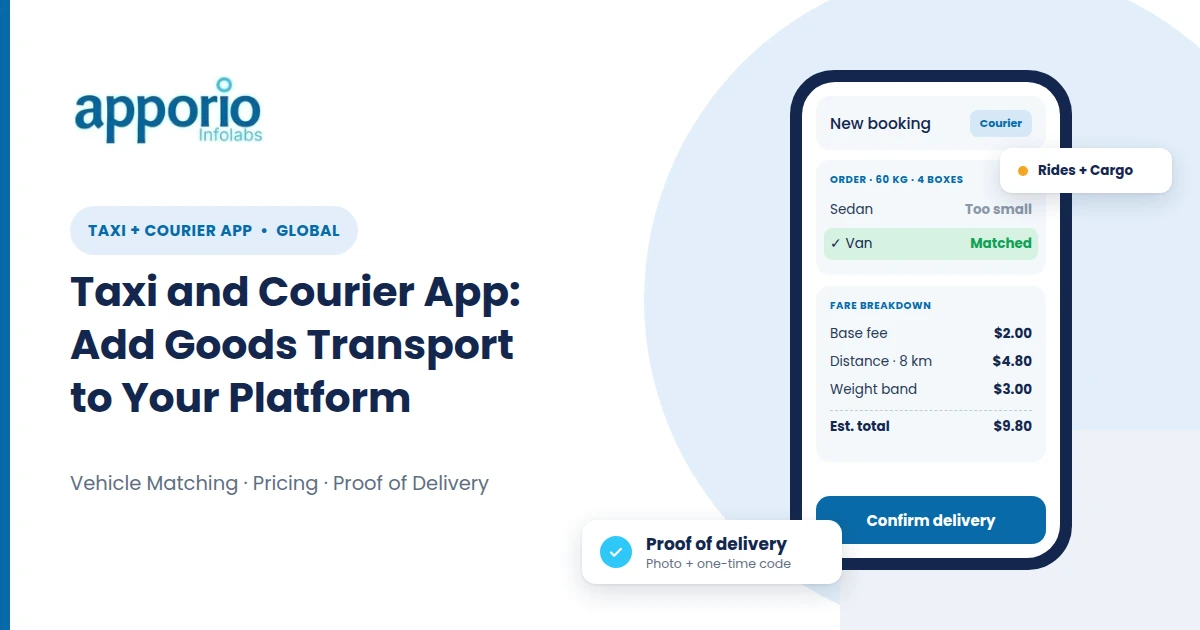
A taxi and courier app can serve more than passenger trips. The same dispatch foundation can support parcel delivery, small-business shipments, local documents, groceries, and bulky goods when the product is designed around different transport requirements.
Adding goods transport is not simply a matter of changing the word “passenger” to “package.” A goods workflow needs item details, vehicle capacity, pickup instructions, delivery contact information, packaging rules, delivery confirmation, and a pricing model that accounts for distance, size, waiting time, and handling risk.
For a taxi operator, the opportunity is practical: use existing driver supply, dispatch knowledge, location tracking, and customer acquisition channels to serve another demand category. The challenge is operational separation. Passenger trips and cargo jobs may use the same platform, but they should not always use the same matching rules, vehicles, pricing logic, or support process.
This guide explains how to evaluate the model, design the core workflow, avoid common launch errors, and decide between extending a taxi product or adopting a broader logistics app solution.
A taxi and courier app is a multi-service mobility platform that lets users book passenger rides and request the movement of goods through one digital system. Customers use a common account, payment flow, and order history, while the platform applies different service rules to each booking type.
The passenger side usually includes pickup and destination locations, driver matching, fare estimates, live trip status, and trip completion. The courier side adds information that does not matter for a normal ride: package category, dimensions, weight, quantity, sender and recipient details, pickup notes, delivery time preferences, and delivery evidence.
The operating model can include several provider types:
The platform therefore acts as a shared marketplace and dispatch layer. It must show only the services a user can actually receive in a selected area. A motorcycle courier, sedan, van, and passenger taxi should not appear as interchangeable options when their capacity and operating permissions differ.
Passenger demand often changes by time of day, weekday, weather, events, and local travel patterns. Goods demand follows a different cycle. Businesses may need morning stock transfers, afternoon document deliveries, or evening customer orders. A combined platform can create more opportunities for drivers and improve the utilization of vehicles that would otherwise remain idle.
For customers, one account is easier to manage than separate systems for rides and local deliveries. They can store addresses, review invoices, contact support, and track active jobs from a familiar interface. For businesses, the value is stronger when the platform supports repeat delivery requests, business profiles, multiple recipients, and a clear record of completed jobs.
The model matters most when the operator has a defined local advantage. That advantage could be an existing driver network, strong relationships with merchants, knowledge of a city’s neighborhoods, or access to vehicle types that delivery aggregators do not serve well.
However, adding cargo should be treated as a new operating line, not a minor app feature. The platform owner needs answers to practical questions before development:
Clear answers reduce disputes and help the product team create the right booking fields, driver controls, admin tools, and customer support procedures.
Drivers can accept eligible delivery jobs during periods when ride requests are low. This does not mean every driver should carry packages. It means the platform can create a separate service category for approved drivers and vehicles, giving operators more control over supply allocation.
A customer who downloads the platform for a ride may later need to send keys, documents, retail items, or a small package. A merchant may need staff transportation and local delivery in the same week. Supporting both needs can increase the practical value of the account without requiring a second customer relationship.
Location services, driver onboarding, dispatch, notifications, payment processing, support tools, and reporting can serve both categories when the underlying system is modular. A white-label model can provide a starting point, but cargo-specific workflows still require proper configuration and testing.
Goods transport can support per-order fees, distance-based pricing, vehicle-category pricing, waiting charges, scheduled delivery fees, business accounts, or negotiated rates for recurring customers. The final model should reflect local competition, operating costs, driver incentives, and regulatory requirements.
Restaurants, pharmacies, retailers, wholesalers, and online sellers often need dependable local fulfillment. A delivery service can create business demand that is less dependent on individual consumer ride bookings. It can also lead to recurring shipment patterns that are easier to forecast than occasional passenger trips.
Start with a narrow service catalog. Decide if the first release will support documents, parcels, groceries, retail goods, or larger cargo. Define maximum weight and dimensions, prohibited items, operating zones, delivery hours, and vehicle eligibility. A focused launch is easier to train, price, and support than a platform that accepts every kind of shipment.
The sender should select a delivery service, enter pickup and drop-off points, add recipient details, describe the item, and review the estimated charge. Include optional fields for package photos, special handling notes, multiple stops, and scheduled pickup times where the operating model can support them.
The recipient should receive delivery status and relevant contact options without exposing unnecessary personal information. The driver should see the information needed to complete the job, including pickup instructions, item category, vehicle requirements, and recipient details.
Passenger trips and cargo orders should not be matched in exactly the same way. Dispatch may need to consider cargo capacity, vehicle body type, driver certification, current load, route suitability, scheduled pickup windows, and the number of stops. A small parcel can go to an eligible sedan, while bulky goods may require a van or fleet partner.
A basic delivery fare can combine a base fee, distance, time, vehicle category, and applicable service charges. Cargo jobs may also require weight or size bands, waiting time, loading assistance, extra stops, tolls, stairs, or return-trip charges. Show the pricing inputs clearly so senders and drivers understand how the amount was calculated.
Completion should require more than a driver pressing a button. Depending on the service, the platform can capture a recipient signature, one-time delivery code, photo evidence, recipient name, timestamp, and location. The correct method depends on privacy rules, item sensitivity, and the level of proof merchants require.
Support the payment methods used in the launch market, including cards, bank-based methods, digital wallets, or cash if the business can manage the reconciliation risk. Payment processing should distinguish passenger trips from cargo jobs so refunds, taxes, invoices, commissions, and driver payouts remain understandable.
Apporio provides a dedicated payment gateway integration reference point for businesses evaluating payment requirements across markets.
Test more than the successful booking path. Simulate an incorrect address, unavailable recipient, damaged package claim, driver cancellation, vehicle breakdown, partial delivery, payment failure, and customer support escalation. These scenarios reveal gaps that are difficult to fix after commercial launch.
Users can have one login and one wallet while the platform keeps ride and delivery rules distinct. This structure reduces unnecessary duplication but avoids forcing cargo assumptions into passenger workflows. Use service-specific fields, status labels, notifications, receipts, and support categories.
Vehicle matching should consider more than driver proximity. Record vehicle type, available cargo space, approved weight range, and any restrictions. A nearby vehicle that cannot safely carry the item is not a useful match. Capacity data should be visible to operations staff and reviewed during driver onboarding.
Commercial buildings, gated communities, markets, hospitals, and apartment complexes often create delays because the map pin does not identify the correct entrance. Let senders add access notes, contact numbers, floor information, and loading instructions. Use a waiting-time policy that is visible before confirmation.
Record the key events from pickup request to delivery completion: who accepted the job, when the driver arrived, when the item was collected, which status changes occurred, and how the recipient confirmed delivery. These records help resolve disputes and provide useful operational data.
Scheduled jobs require supply planning. Do not promise a time window unless the platform can reserve suitable capacity and communicate delays. Begin with practical windows rather than overly precise arrival promises. Add reminders for drivers, senders, and recipients so missed pickups do not become routine.
Delivery orders can contain addresses, phone numbers, business information, and item descriptions. Limit access based on role, protect account credentials, secure payment data, and define retention rules. A review of cyber security services should be part of the technical and operational planning process.
Monitor ride and delivery performance independently. Useful measures include acceptance rate, cancellation rate, pickup delay, delivery completion, support contacts, average order value, driver earnings, refund volume, and repeat business usage. Combined totals can hide a weak cargo operation behind strong ride performance.
If the long-term vision includes food, grocery, handyman, or other services, use modular service design from the beginning. Apporio’s Super App Development offering is relevant when several service categories need to operate within one platform while retaining distinct workflows.
| Approach | Best fit | Main advantage | Main consideration |
|---|---|---|---|
| Extend the existing taxi platform | Operators with active drivers and a working dispatch system | Shared accounts, supply, tracking, and support infrastructure | Requires careful separation of passenger and cargo workflows |
| Launch a dedicated delivery product | Businesses focused mainly on parcels, logistics, or merchant fulfillment | Purpose-built shipment, fleet, and proof-of-delivery processes | Requires separate customer acquisition and provider operations |
| Use a multi-service platform | Businesses planning rides, delivery, and additional on-demand categories | Modular foundation for multiple service lines | More governance, configuration, and operational complexity |
| Start with a limited MVP | Founders validating demand in one city or service zone | Lower initial scope and faster learning cycle | Some automation and advanced shipment features may come later |
The right choice depends on existing assets and the first commercial use case. If the operator already has drivers, a taxi dispatch operation, and a known customer base, extending the platform may be efficient. If the main customer is a merchant shipping many orders each day, dedicated delivery workflows may deserve priority.
Apporio’s Delivery App Development offering can be evaluated alongside its taxi products when the business needs to compare a combined model with a delivery-first launch.
Adding goods transport can turn a passenger-focused platform into a broader local mobility and delivery business, but success depends on operational detail. Define allowed items, match orders to suitable vehicles, price handling time correctly, protect shipment data, and create verifiable delivery completion. Start with a service category that fits the available driver network instead of attempting every type of cargo from day one.
For businesses assessing this model, Apporio can support the planning and product direction through the Apporio Taxi Uber Clone Script, Logistics App Development, Delivery App Development, and On-Demand Mobile App Development. The right combination depends on whether the priority is extending an existing taxi operation, launching a delivery-first service, or building a broader multi-service platform.
A well-scoped taxi and courier app gives operators a practical way to test goods transport while keeping passenger mobility at the center of the platform.
See how Apporio’s taxi platform handles ride and cargo bookings, vehicle matching, and delivery pricing. In a free 30-minute session, Apporio’s team will walk you through the passenger, driver, and admin apps and map them to your launch market.
Yes. A taxi platform can support parcel and goods delivery when it adds cargo-specific booking fields, vehicle eligibility rules, delivery pricing, recipient information, tracking, and proof of delivery. Passenger and cargo workflows should share core infrastructure but remain operationally distinct.
Vehicle eligibility depends on the item category, size, weight, local rules, and the operator’s insurance and safety policies. Sedans may handle compact parcels, while vans or fleet vehicles may be required for bulky or heavier shipments.
Delivery pricing can combine a base fee, distance, time, vehicle category, and service charges. Depending on the operation, the model may also include package size or weight, waiting time, extra stops, loading assistance, tolls, and return-trip fees.
Important features include service selection, location tracking, driver and vehicle matching, package details, sender and recipient information, delivery status updates, payment processing, support tools, delivery confirmation, driver payouts, and admin controls for pricing and service zones.
Starting in one city or a limited service zone is usually easier for testing vehicle supply, pricing, delivery times, customer support, and local compliance. Expansion can follow after the operating process and unit economics are understood.