OUR PRODUCTS
Uberr Clone AppGojek Clone AppSuper App DevelopmentUberr Eats Clone AppGrocery App DevelopmentHandyman App Like Uberr
inDriver Clone AppDelivery App DevelopmentGlovo Clone AppBolt Clone AppLyft Clone AppCareem Clone App
OUR PRODUCTS

← Back to Blog
Mobile App Development
November 23, 2026
A practical guide to operating vehicles on another company's ride-hailing platform, covering ownership, drivers, agreements, costs, technology, and risk control.
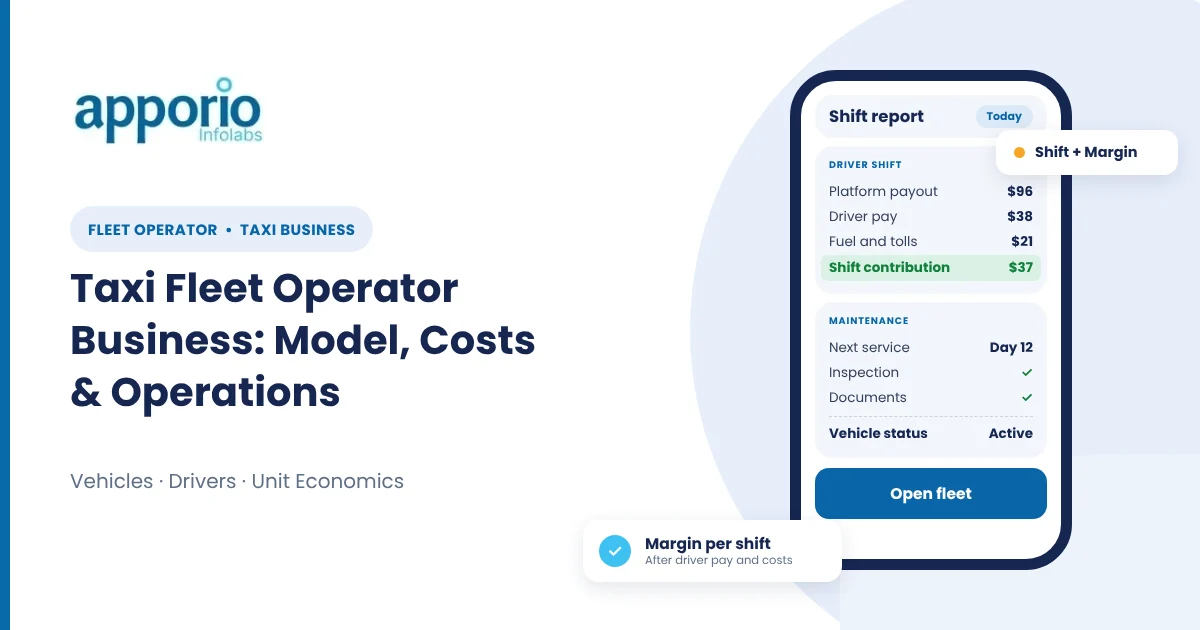
A taxi fleet operator business allows an individual or company to manage several vehicles and drivers while receiving bookings through another company's ride-hailing platform. The platform usually supplies customer demand, booking technology, payment processing, and dispatch. The operator focuses on vehicles, driver recruitment, maintenance, compliance, and daily service quality.
This model sits between owning a traditional taxi company and becoming an independent driver. It can suit entrepreneurs who want to build transport capacity without creating a consumer marketplace from the ground up. It can also work for existing transport companies that need more bookings and better vehicle utilization.
The commercial result depends on the agreement between the platform and fleet operator. Important terms include commission, vehicle requirements, driver standards, payment cycles, insurance responsibilities, data access, and termination rights. A strong operating plan must evaluate these details before vehicles are purchased or leased.
This guide explains how the model works, where the money is made, what the operator controls, what the costs look like, and how to build a reliable fleet operation around a third-party platform.
A fleet operator model is a transport arrangement in which one business owns, leases, or controls multiple vehicles and places them on a separate company's booking platform. The platform connects passengers with available vehicles. The operator supplies the physical capacity needed to complete those trips.
The two businesses perform different jobs. The platform manages marketplace activity, including passenger acquisition, trip requests, driver or vehicle matching, fare collection, and customer communication. The fleet operator manages the supply side. That includes vehicle procurement, registration, inspections, driver hiring, shift planning, fuel or charging, repairs, and local supervision.
The operator may work with a well-known ride-hailing marketplace, a corporate transport provider, an airport transfer service, or a locally owned taxi application. The technology arrangement varies. Some platforms provide a driver application and fleet dashboard. Others accept fleet partners through an API, dispatch panel, or business account.
Ownership is not always the same as operation. A fleet can contain vehicles owned by the operator, vehicles financed through a lender, or vehicles rented from third parties. The contract should clearly state who carries responsibility for insurance, accidents, fines, servicing, depreciation, and vehicle replacement.
A passenger pays the platform for a completed trip. The platform deducts its commission, payment processing charges, refunds, or other agreed deductions. The remaining amount is paid to the fleet operator according to the settlement schedule. The operator then pays driver compensation and operating expenses.
This means revenue is not the same as profit. A vehicle can generate regular bookings and still lose money if idle time, financing, maintenance, insurance, and driver turnover are not measured correctly.
Starting a ride-hailing marketplace requires customer acquisition, driver acquisition, software, payment infrastructure, support operations, and local compliance. A fleet operator avoids part of that burden by joining a platform that already has passenger demand and dispatch processes. The trade-off is reduced control over pricing, branding, customer relationships, and platform policy.
The model is particularly relevant in markets where vehicle ownership is fragmented. A platform may have many independent drivers but still need professionally managed supply for airports, hotels, business accounts, events, and high-demand periods. A fleet operator can provide consistent availability instead of relying only on individual drivers.
It also creates a path for transport companies to modernize. A company that previously accepted bookings by phone can add app-based demand without immediately building its own marketplace. However, the company should treat the platform as a commercial channel, not as the entire business. Depending on one channel creates concentration risk.
Local conditions affect the economics. Fuel prices, import duties, financing rates, insurance premiums, traffic, road quality, mobile payment adoption, licensing rules, and driver wages can change the result. A fleet plan should therefore use local operating assumptions rather than generic global estimates.
The central decision is how much control the operator is willing to exchange for access to demand. A third-party platform may deliver trips quickly, but it can change commission rates, suspend accounts, alter service standards, or introduce competing fleet partners. The operator needs a written agreement, clear financial records, and a contingency plan before scaling.
The model offers practical advantages, but each benefit depends on the quality of the contract and the operator's execution.
The benefits are strongest when management treats each vehicle as an operating unit. Track revenue, productive hours, kilometers, fuel, maintenance, downtime, and driver payouts per vehicle rather than reviewing only total fleet revenue.
The title question most operators ask is what it costs to run a fleet. There is no universal figure, because fuel prices, financing rates, insurance, taxes, wages, and platform terms differ by country and agreement. What every operator can do is list each cost category, know whether it is fixed or variable, and track it per vehicle. Use quotes from local lenders, insurers, and workshops, and refresh them regularly.
| Cost category | Fixed or variable | What to track | Common blind spot |
|---|---|---|---|
| Vehicle purchase, finance, or lease | Fixed | Monthly payment, deposit, interest, expected resale value | Choosing a vehicle by monthly payment without counting downtime |
| Insurance | Fixed, may vary with usage | Premium, deductible, claims history, coverage while on trip | Gaps between the platform's cover and the operator's own policy |
| Registration, permits, and taxes | Fixed, periodic | Fees, renewal dates, inspection deadlines | A missed renewal taking a vehicle off the platform |
| Fuel or charging | Variable | Cost per kilometer, fuel economy, charging cost | Cash fuel purchases that are never recorded |
| Maintenance and tires | Scheduled and variable | Service intervals, repairs, days off the road | Deferring service until a breakdown |
| Driver compensation | Variable or fixed, by model | Pay per trip or shift, bonuses, fines, deductions | Unclear pay rules that cause disputes |
| Platform deductions | Variable | Commission, fees, refunds, chargebacks | Not reconciling settlement statements |
| Administration and compliance | Fixed | Staff, accounting, software, training, document reviews | Leaving management time out of the numbers |
| Idle time and downtime | Variable | Online hours without trips, days off the road | Measuring revenue instead of net contribution |
A simple way to combine these is to calculate net contribution per vehicle per month: platform payout, minus driver compensation, fuel or charging, maintenance, insurance, finance or lease payments, registration and taxes, administration, and the cost of downtime. If that number is negative or thin for a typical vehicle in the pilot, adding more vehicles will multiply the problem rather than fix it.
Launching a fleet partnership involves more than registering vehicles and downloading a driver app. The following sequence reduces avoidable commercial and operational problems.
A pilot is also the right time to identify non-financial issues. Drivers may struggle with app workflows, passengers may have trouble finding vehicles, and managers may lack visibility into cancellations or offline activity. Fixing these problems with five vehicles is easier than fixing them with fifty.
Operational discipline determines whether the arrangement becomes a scalable transport business or a collection of expensive vehicles. These practices are useful across most platform partnerships.
Do not rely on verbal assurances about commission, incentives, account access, or settlement timing. Keep the signed agreement, operational policies, pricing schedules, and support contacts in one controlled location. Review changes before accepting updated terms.
Gross trip revenue can hide weak performance. Build a monthly report for every vehicle showing completed trips, online hours, productive hours, kilometers, earnings, driver payments, fuel, repairs, insurance, finance, platform deductions, and net contribution. Compare similar vehicles and shifts rather than averages alone.
Waiting for a vehicle to fail creates lost trips, passenger complaints, and emergency repair bills. Schedule inspections based on time, mileage, and vehicle condition. Keep a replacement or backup plan for vehicles that are undergoing major work.
GPS or telematics devices can show location, idle time, mileage, harsh driving, and unauthorized use, and they make maintenance scheduling and cost-per-kilometer reporting more accurate. Tell drivers what is collected and why, and confirm the local rules on location tracking and driver privacy before installing devices.
Drivers should know how to handle passenger no-shows, accidents, lost property, fare disputes, route changes, safety concerns, and app outages. Procedures should include who to contact and what evidence to record. Training is more effective when it uses realistic examples from the local operating environment.
Fleet managers may handle identity documents, location information, phone numbers, payment details, and trip history. Use role-based access, strong passwords, device controls, and prompt removal of access when an employee leaves. A dedicated cyber security service can help assess technical and procedural weaknesses.
Do not assume that a platform will always provide the same trip volume or commercial terms. Develop relationships with hotels, companies, travel agencies, event organizers, and local institutions where lawful. A second channel improves resilience, but it must be managed without breaching platform exclusivity clauses.
If the operator expects to build its own branded service later, record the data and workflows required for that transition. A taxi dispatch software solution can support direct allocation and fleet visibility, while a broader taxi app development project may be considered when the business needs its own passenger channel.
Most failures are caused by weak assumptions rather than a lack of demand. The following mistakes appear frequently when new operators scale too quickly.
Another common error is treating the platform's app as a complete management system. It may show trips and payouts but not provide maintenance scheduling, driver documents, internal approvals, payroll records, or detailed profitability. Plan for those gaps from the beginning.
There is no single correct structure. The right option depends on capital, operational capability, customer access, and the level of control the entrepreneur wants.
| Operating approach | Demand source | Control level | Main responsibility | Best suited for |
|---|---|---|---|---|
| Independent driver | Third-party platform | Low to moderate | One vehicle and personal service delivery | Individuals testing the market |
| Fleet operator partner | Third-party platform and direct accounts | Moderate | Vehicles, drivers, compliance, and maintenance | Small and medium transport businesses |
| Own taxi platform | Company-owned marketplace | High | Technology, passenger acquisition, dispatch, and fleet supply | Businesses seeking brand and pricing control |
| Traditional taxi company | Street demand, phone, contracts, or dispatch | High operational control | Vehicles, drivers, bookings, and local relationships | Established local operators |
A fleet partnership usually needs less marketplace infrastructure than an owned platform, but it gives the operator less influence over passenger relationships and pricing. An owned platform requires more investment in technology, support, marketing, and compliance, yet it can support a distinct brand and broader commercial strategy.
Some operators use a staged approach: begin with a third-party platform, learn the local economics, build operating capacity, and later introduce a branded booking channel. That sequence is not automatic or risk-free, but the information gained from daily operations can improve later product decisions.
A taxi fleet operator business works when the operator manages supply with the same discipline used by any asset-heavy company. The platform may provide bookings, but profitability depends on vehicle utilization, driver performance, maintenance, compliance, cash flow, and contract quality.
Start with a defined service area, a small pilot, written commercial terms, verified drivers, vehicle-level reporting, and clear incident procedures. If the operation later needs more control, Apporio can support the next stage through the Apporio Taxi Uber Clone Script, taxi app development, and taxi dispatch software. Businesses expanding beyond transport can also evaluate Super App Development for a broader multi-service platform.
The technology decision should follow proven operating requirements, not come before them.
A fleet operator supplies and manages multiple vehicles and drivers while another company provides the booking platform. The operator normally handles recruitment, vehicle compliance, maintenance, scheduling, driver support, and service quality.
No. Vehicles may be owned, financed, leased, or sourced through another approved arrangement. The contract should clearly identify responsibility for insurance, repairs, registration, accidents, depreciation, and replacement.
The operator receives the trip value remaining after the platform's commission and other agreed deductions. Profit comes from the difference between that settlement and driver payments, fuel, maintenance, insurance, financing, taxes, administration, and downtime.
Review commission, settlement timing, pricing control, incentives, vehicle standards, driver requirements, insurance, refunds, chargebacks, data access, suspension rules, dispute procedures, and termination rights. Confirm local licensing and tax obligations as well.
A partnership can provide faster access to demand with less marketplace technology work, but it offers less control over branding, pricing, customer data, and platform policy. An own-branded app requires more investment but gives the operator greater control over the customer channel.
There is no universal number. Start with a manageable pilot that allows the team to test demand, driver attendance, maintenance, settlements, safety procedures, and vehicle-level profitability before committing to a larger fleet.
The main costs include vehicle financing or leasing, insurance, registration and taxes, fuel or charging, maintenance, driver compensation, platform deductions, administration, and downtime. Amounts depend on the country, vehicle, and platform agreement, so use local quotes and track net contribution per vehicle.