OUR PRODUCTS
Uberr Clone AppGojek Clone AppSuper App DevelopmentUberr Eats Clone AppGrocery App DevelopmentHandyman App Like Uberr
inDriver Clone AppDelivery App DevelopmentGlovo Clone AppBolt Clone AppLyft Clone AppCareem Clone App
OUR PRODUCTS

← Back to Blog
September 11, 2026
Explore courier delivery platform models, revenue streams, operating costs, launch steps, best practices, and common mistakes for building a profitable delivery business.
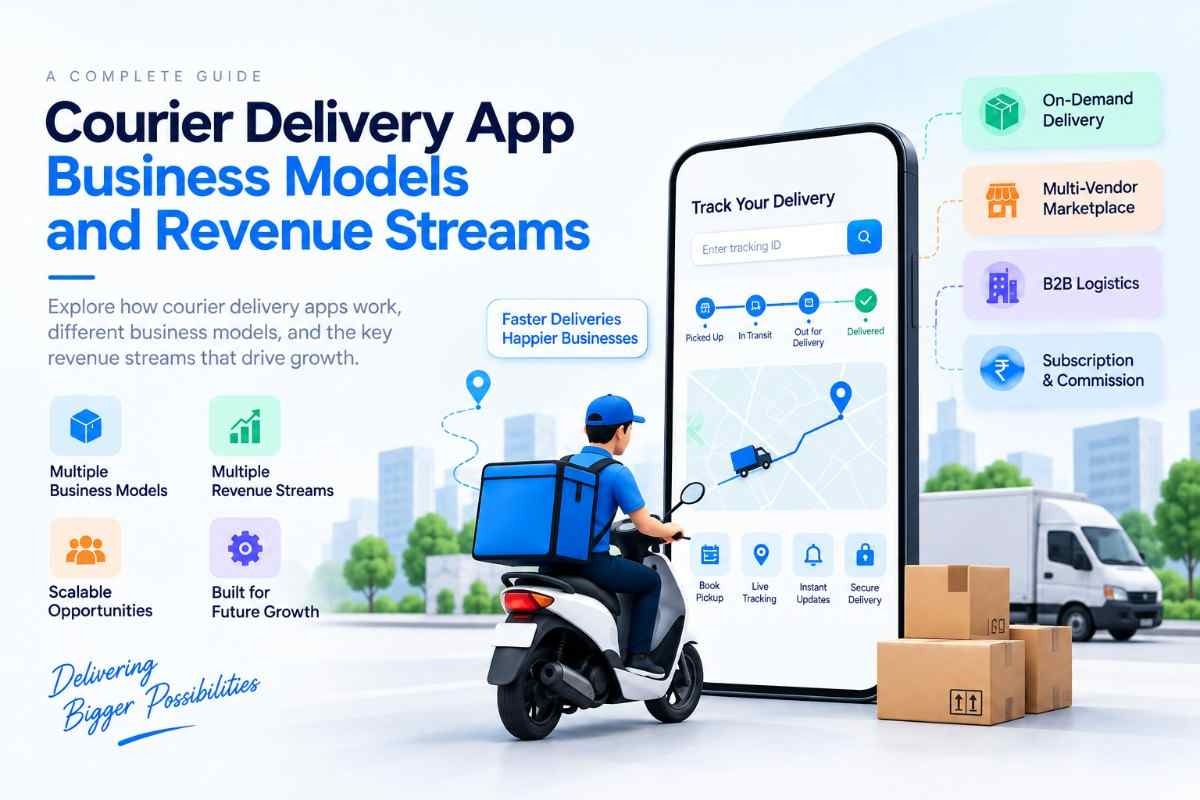
A courier app business model determines who uses the platform, who performs deliveries, how orders are assigned, and where revenue comes from. The primary keyword, courier app business model, covers more than a customer-facing mobile application. It includes pricing rules, courier onboarding, merchant relationships, route operations, payment collection, support, and unit economics.
Courier businesses can serve individuals, online sellers, retailers, restaurants, pharmacies, offices, and larger enterprises. Some platforms operate as marketplaces that connect customers with independent couriers. Others manage their own fleet or provide delivery software to businesses that already have drivers.
The strongest model depends on delivery density, vehicle availability, local regulations, average order value, service radius, and customer expectations. This guide explains the main operating models and revenue streams so founders can select a practical structure before investing in product development.
A courier delivery app business model is the commercial and operational framework used to arrange, track, and charge for parcel or document deliveries through digital software. It defines the relationship between senders, recipients, couriers, merchants, fleet managers, and the platform owner.
Most platforms include at least three interfaces: a customer or sender app, a courier app, and an administrator dashboard. A business-focused platform may also include a merchant portal, API access, billing tools, and fleet controls. The software coordinates order creation, pickup details, delivery addresses, pricing, status updates, communication, and proof of delivery.
These structures can be combined. For example, a platform may start with business deliveries in one city, add independent couriers during peak periods, and later provide software access to external fleets.
Delivery volume alone does not prove that a platform is financially healthy. A business can process many orders and still lose money if customer acquisition, courier payments, refunds, support, and failed delivery attempts exceed contribution margin. The model must connect pricing with the actual cost of serving each route.
Local conditions make this especially important. A dense urban market may support short trips and fast courier utilization, while a regional market may require higher minimum fees because drivers travel farther between jobs. Cash-on-delivery operations create reconciliation work and collection risk. International markets may also require local payment methods, tax handling, address formats, and compliance procedures.
Documenting these decisions before development prevents a common product failure: building a large feature set without a clear economic purpose. Your delivery workflow should support the pricing and operational rules selected for the launch market.
A well-designed courier platform creates value by coordinating several parties through one operational system. Its benefits are not limited to booking convenience. The real advantage comes from improving visibility, reducing manual coordination, and making delivery performance measurable.
Customers, dispatchers, merchants, and couriers can work from the same order record. Pickup instructions, recipient details, payment status, delivery notes, and order history remain connected. This reduces dependence on phone calls, spreadsheets, and informal messaging.
Dispatch rules can consider courier location, vehicle type, availability, delivery zone, capacity, and current workload. Better assignment reduces idle time and limits unnecessary travel. Manual dispatch can still be used for exceptions, but routine orders should not require constant human intervention.
Location updates, status changes, estimated arrival information, and notifications give senders and recipients a clearer view of the order. Visibility also helps support teams identify delays before customers report them.
The same platform can support individual parcel bookings, merchant deliveries, scheduled business routes, returns, and recurring corporate orders. Serving several segments can reduce dependence on one source of demand, provided each workflow remains operationally manageable.
Administrators can monitor completed deliveries, cancellation rates, delivery time, courier acceptance, failed attempts, customer ratings, support tickets, and revenue by zone. These measurements help determine which areas, customer types, and pricing rules deserve further investment.
Digital invoices, automated notifications, delivery histories, and electronic proof of delivery reduce repetitive back-office work. A logistics app solution can also connect delivery activity with broader fleet and fulfillment processes.
Selecting the right structure should be treated as a market and operations exercise, not only a software decision. The following process helps founders test assumptions before committing to a full launch.
Specify what will be delivered, who will book the service, how quickly delivery must happen, and which locations will be covered. Documents, retail parcels, groceries, food, medical items, and bulky goods have different handling and timing requirements.
Individual users can create frequent small orders, but they may require more marketing and support. Merchants and businesses may provide repeat volume but expect invoices, service-level reporting, integrations, and negotiated pricing. Start with the segment that has the clearest unmet need and reachable acquisition channels.
Document each step from booking to completion: address entry, pricing, courier assignment, pickup confirmation, transit updates, recipient verification, delivery evidence, payment settlement, and issue resolution. Include alternative paths for cancellation, rescheduling, failed attempts, and returned parcels.
Calculate revenue and variable cost per order. Include courier payout, payment processing, support time, incentives, refunds, insurance where applicable, and the cost of failed or repeated attempts. Do not treat the delivery charge as profit.
An asset-light courier network can scale coverage faster, but it requires recruitment, screening, incentives, and quality monitoring. A managed fleet offers more control but adds vehicle, staffing, maintenance, and scheduling costs.
The first release should support the essential booking, dispatch, tracking, payment, notification, and administration workflows. A focused delivery app development plan can leave advanced automation, complex integrations, and extra service categories for later validation.
Launch in a limited service area with defined delivery hours and measurable targets. Review order density, average route distance, courier utilization, cancellation reasons, failed attempts, support volume, and gross margin before expanding coverage.
Using several revenue sources can improve resilience, but adding charges without understanding customer willingness to pay can reduce order frequency. Each stream should be tied to a specific value or cost created by the platform.
A customer pays a fixed or variable amount for each completed delivery. Pricing may consider distance, package size, vehicle type, urgency, pickup complexity, and delivery zone. A transparent base fee plus clearly explained additions is easier to test than a pricing formula that customers cannot understand.
Retailers, restaurants, pharmacies, and online sellers may pay a percentage or fixed amount for each delivery generated through the platform. This can work when the service provides incremental sales or removes the need for the merchant to manage its own delivery operation. Commission terms should account for refunds, failed orders, and promotional discounts.
Businesses with repeat delivery needs can sign monthly or annual agreements. Contracts may include a committed order volume, fixed service zones, scheduled routes, priority support, reporting, or negotiated rates. This revenue is often more predictable than relying only on consumer bookings.
Frequent customers may pay a recurring fee for reduced delivery charges, a set number of deliveries, or priority service. The subscription must be designed around actual usage. If heavy users consume more delivery capacity than the membership price supports, margin can deteriorate quickly.
Higher prices can apply during peak demand, adverse weather, holidays, or urgent delivery windows. The rules should be communicated clearly and reviewed against courier availability and customer complaints. Priority pricing is more defensible when it corresponds to a shorter delivery window or special handling requirement.
Merchants may pay to appear in search results, service recommendations, or promotional areas. Advertising should not interfere with delivery information or make important options difficult to find. Sponsored placement works best after the platform has enough relevant merchant and customer activity.
Businesses or logistics partners may pay to use dispatch tools, tracking pages, reporting, or delivery APIs. This approach separates software revenue from individual consumer orders and can serve companies that already have customers but need better delivery coordination.
Additional charges may apply when a recipient is unavailable, an address is incorrect, or a parcel must be returned. These fees need fair rules and evidence. Charging for every exception without considering the cause can damage merchant relationships and customer trust.
Possible services include scheduled collection, multi-stop routes, packaging support, cash collection, reconciliation, and specialized handling. Each add-on should be priced according to the extra labor, equipment, risk, or administrative work it creates.
Payment design matters across all of these streams. Local wallets, cards, bank transfers, and cash workflows may need different settlement and reconciliation processes. Apporio’s payment gateway options can be evaluated alongside the target market’s payment habits and compliance needs.
Courier technology performs well when product decisions reflect real dispatch conditions. The following practices address the areas that most often affect reliability and margin after launch.
Senders need fast booking and clear pricing. Couriers need practical pickup instructions, navigation support, status controls, earnings visibility, and low-battery or poor-network tolerance. Administrators need order intervention, zone controls, pricing management, user verification, dispute handling, and reporting. One generic interface rarely serves all three groups effectively.
Incomplete or inaccurate addresses create late deliveries, extra calls, refunds, and wasted courier time. Use map-based selection where suitable, allow delivery notes, capture landmarks when local addressing is inconsistent, and provide a clear mechanism for correcting an address before dispatch.
Proof can include a recipient signature, photo, one-time code, timestamp, or location record, depending on the service and local rules. It should be easy for couriers to capture and easy for support teams to retrieve. A dedicated proof of delivery workflow reduces ambiguity during disputes.
Revenue reports show what was billed, but operational dashboards explain why the result occurred. Track order acceptance, dispatch time, pickup lateness, delivery duration, route distance, failed attempts, cancellations, refunds, and support contacts by zone and customer segment.
Couriers may work in areas with unstable mobile data. The app should preserve important information locally, retry status updates, prevent duplicate actions, and show the last successful synchronization time. Network behavior deserves testing on real devices rather than only on a strong office connection.
Courier platforms handle names, phone numbers, addresses, location data, order contents, and payment records. Apply role-based access, secure authentication, minimal data exposure, audit logs, and an appropriate retention policy. Security testing should occur before production release, not after a customer complaint.
Merchant dashboards, accounting tools, ecommerce stores, customer relationship systems, and fleet software may need data exchange. Define which system owns each record and how failed synchronization is resolved. Good integration planning prevents duplicate orders and billing disputes.
Run controlled tests on delivery zones, minimum order values, urgency charges, and business rates. Compare conversion with contribution margin. A price that increases bookings but creates a loss on every route is not a successful test.
Many courier ventures fail because they treat the app as the business. Software can coordinate activity, but it cannot compensate for weak service areas, unclear pricing, poor courier supply, or unmanaged exceptions.
No operating model is best for every market. The right choice depends on how much control the company needs and how much operational cost it can carry.
| Model | Primary customer | Main revenue source | Operational profile |
|---|---|---|---|
| Marketplace | Consumers and small merchants | Delivery fee and commission | Flexible capacity with strong courier supply and quality controls |
| Owned or managed fleet | Consumers, retailers, and enterprises | Per-order fees and contracts | Higher control with vehicle, staffing, and maintenance responsibility |
| Corporate delivery service | Businesses with repeat delivery needs | Contracts, monthly fees, and negotiated rates | Predictable demand with reporting and service-level expectations |
| Courier software platform | Courier companies and retailers | Setup, subscription, or usage fees | Technology-focused operation with client onboarding and support |
| Hybrid model | Multiple customer groups | Combined fees, commissions, and contracts | Broader revenue potential with greater product and process complexity |
A hybrid approach can be useful once the core workflow is stable. For example, consumer bookings can fill unused courier capacity while enterprise contracts provide planned routes. However, different customer groups should not be combined without separate pricing, permissions, billing, and service policies.
A sustainable courier app business model connects customer demand with courier capacity, transparent pricing, reliable delivery evidence, and disciplined cost tracking. Start with one use case and service area, validate order economics, then expand into merchant contracts, subscriptions, software access, or specialized handling when the operation can support them.
Apporio Infolabs can support this roadmap through On-Demand Mobile App Development for the core marketplace and delivery workflows. Businesses planning a broader multi-service platform can also evaluate the Gojek Clone, while AI-powered operational improvements can be considered as the platform gathers useful delivery data.
The product should be shaped around the launch market’s payment behavior, courier supply, regulations, delivery density, and customer expectations. A focused build, careful pilot, and regular unit-economics review provide a stronger foundation than adding features without operational evidence.
The most common approach is charging a delivery fee for each completed order. Platforms may also earn merchant commissions, corporate contract fees, subscription revenue, advertising income, software fees, and charges for returns or failed delivery attempts.
A marketplace can reduce vehicle ownership and maintenance responsibility, but it requires reliable courier recruitment, verification, incentives, and quality monitoring. An owned or managed fleet provides more control over service quality but carries higher staffing, vehicle, scheduling, and maintenance costs.
Calculate revenue per completed order and subtract courier payout, payment processing, support time, incentives, refunds, failed-attempt costs, and other variable expenses. Review the result by zone, customer segment, delivery distance, and order type rather than relying only on overall revenue.
The first release should support customer booking, address capture, pricing, courier assignment, status updates, notifications, payment handling, administrator controls, and delivery evidence. Advanced automation and additional service categories can be added after the core workflow is tested with real orders.
Offer dependable delivery windows, account-level pricing, invoices, reporting, bulk order tools, user permissions, support procedures, and integration options. Business customers usually evaluate operational consistency and total delivery cost, not only the appearance of the mobile app.
Proof of delivery provides evidence that a parcel reached the intended recipient or location. Signatures, photos, one-time codes, timestamps, and location records can help resolve disputes, support merchant billing, and identify delivery process failures.

