OUR PRODUCTS
Uberr Clone AppGojek Clone AppSuper App DevelopmentUberr Eats Clone AppGrocery App DevelopmentHandyman App Like Uberr
inDriver Clone AppDelivery App DevelopmentGlovo Clone AppBolt Clone AppLyft Clone AppCareem Clone App
OUR PRODUCTS

← Back to Blog
Mobile App Development
November 2, 2026
A practical guide to designing driver loyalty tiers and referral systems that improve retention, control incentive costs, and strengthen ride-hailing operations.
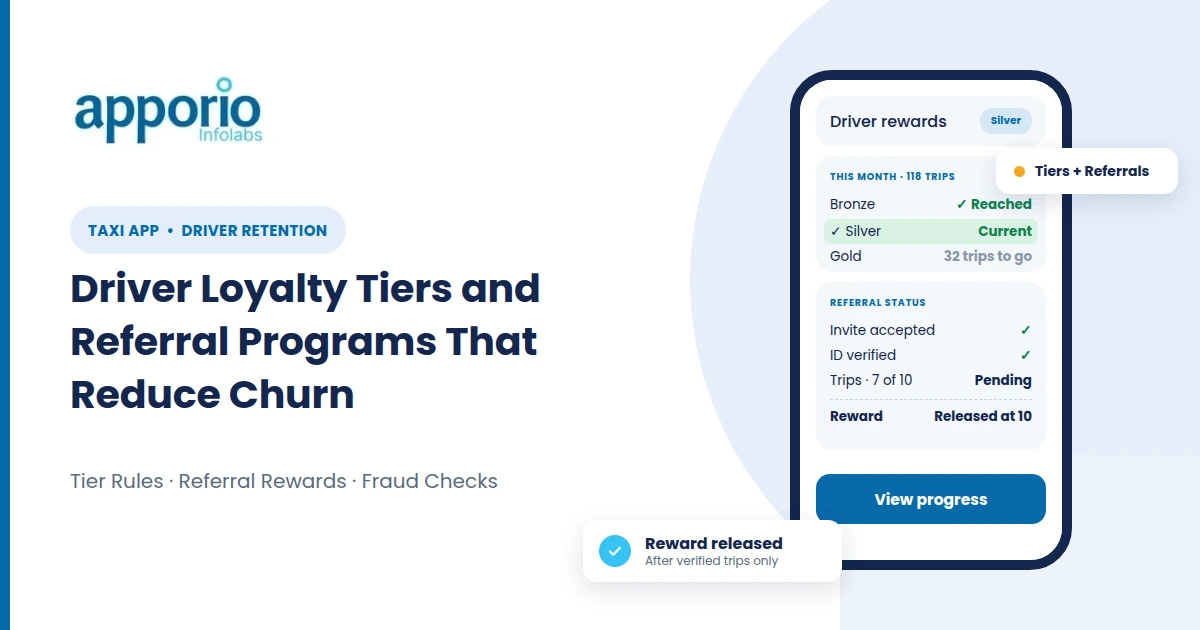
Quick answer: Driver loyalty tiers reward existing drivers for sustained, verified activity, such as completed trips, reliability, and safety compliance, with benefits like priority support or targeted bonuses. Referral systems pay existing drivers to bring in qualified new ones, but only after the new driver is verified and completes a set number of trips. Together they reduce churn when the rules are transparent and the rewards sit on top of fair earnings, reliable payouts, and good dispatch. Track 30-, 60-, and 90-day retention, referral activation, and reward cost to see whether the program works.
Driver churn creates an operational problem long before it becomes a recruitment problem. When experienced drivers leave a ride-hailing platform, service coverage weakens, passenger wait times can rise, and the company must spend more time onboarding replacements. A thoughtful driver retention strategy for ride-hailing apps should therefore focus on the daily experience of active drivers, not only on sign-up bonuses.
Loyalty tiers and referral systems can support retention when they are tied to transparent rules, achievable milestones, and useful rewards. They should not be treated as a blanket discount on commission or a permanent cash giveaway. The strongest programs connect driver activity with business outcomes such as completed trips, reliable availability, safety compliance, passenger ratings, and long-term participation.
This guide explains how to structure the program, select meaningful metrics, prevent referral abuse, and build the required workflows into a taxi platform. It is written for founders, fleet operators, and product teams launching or improving a ride-hailing business in markets where driver economics, payment preferences, and local competition vary widely.
For the technology foundation, operators can review Apporio’s taxi app development services and then adapt the retention model to their launch city, vehicle categories, and commercial agreement with drivers.
A driver loyalty tier program assigns drivers to levels based on defined performance or participation criteria. For example, a platform may create Bronze, Silver, and Gold levels using completed trips, accepted bookings, online availability, cancellation behavior, passenger feedback, and safety requirements. Each level can provide practical benefits, such as priority support, access to selected trip types, lower commission for a limited period, or eligibility for a performance bonus.
A referral system allows an existing driver to invite another qualified driver to join the platform. The referring driver usually receives a reward after the new driver completes specific onboarding and trip milestones. The new driver may also receive a joining benefit, but payment should be delayed until the referral produces verified activity. This protects the business from paying for duplicate accounts, inactive sign-ups, or low-quality leads.
These mechanisms work best as separate but connected tools. Loyalty tiers reward sustained contribution from an existing driver. Referrals help expand supply through trusted professional networks. Combining them in one dashboard gives drivers a clear view of their progress, pending rewards, referral status, and account requirements.
The program should be configured around the platform’s actual operating model. A service that relies on scheduled airport transfers may value punctuality and advance acceptance. A city taxi marketplace may focus on peak-hour coverage and completed trips. The rules should reflect those needs instead of copying a competitor’s reward table.
Ride-hailing is a two-sided marketplace. Passenger demand is only useful when enough qualified drivers are available at the right time and location. High driver turnover can create supply gaps during morning commutes, evenings, weekends, or weather events. Those gaps affect the passenger side through longer matching times, more cancellations, and lower confidence in the service.
Retention also protects operational knowledge. Experienced drivers understand local roads, pickup points, airport procedures, neighborhood demand, and passenger expectations. New drivers need time to learn these details. Replacing an experienced driver with a newly onboarded driver can increase support workload and raise the risk of service errors.
There is also a financial reason to monitor churn. Recruitment campaigns, document verification, training, background checks, onboarding support, and incentive payments all consume resources. A referral program may reduce some acquisition effort, but it does not remove the cost of preparing drivers to operate safely and productively.
Retention cannot be improved with rewards alone. Drivers may leave because of unclear earnings, delayed payouts, poor dispatch quality, weak support, excessive idle time, safety concerns, or app performance problems. A loyalty program should sit beside transparent fare calculations, reliable payment processing, responsive issue resolution, and fair dispatch policies.
Product teams should track retention by cohort and market. Compare drivers who joined in the same month, the same service area, or the same vehicle category. Useful measures include active days, completed trips, earnings per online hour, cancellation rate, support contacts, and the percentage of drivers active after 30, 60, and 90 days.
Clear milestones give drivers a reason to remain active beyond a single promotional period. A driver who can see progress toward the next tier has a concrete target. The target should be realistic for the market and should not require unsafe driving, excessive working hours, or behavior that conflicts with local labor and platform regulations.
Instead of offering the same bonus to every driver, the operator can direct benefits toward behaviors that improve marketplace performance. For instance, a reward may support coverage during a difficult time window or recognize consistent completion quality. This approach makes incentive spending easier to measure, although it still requires careful financial review.
Existing drivers often understand the standards, routes, and earning conditions better than a general advertising audience. Their referrals may be more relevant because they can explain the platform honestly to colleagues. The business should still verify every applicant independently rather than treating a referral as proof of suitability.
A visible progress screen encourages drivers to review trip history, incentive status, document reminders, and referral activity. That creates useful product touchpoints without relying only on promotional notifications. The interface should show how progress is calculated and identify which conditions remain incomplete.
Tier activity and referral trends provide operational signals. If many drivers are close to reaching a reward level, the platform can estimate likely availability. If referral volume rises but activation remains low, the onboarding journey may have a verification or communication problem. These signals support better planning when combined with demand and dispatch data.
The platform needs administrative controls behind these steps. Operations staff should be able to configure thresholds, approve exceptions, pause a campaign, review suspicious referrals, and export reward records. These controls are as important as the driver-facing screens because incentive disputes often arise from edge cases rather than normal transactions.
Drivers should be able to estimate what a completed trip contributes to a tier or reward. Explain whether the calculation uses gross fare, net fare, completed trips, online hours, or another measure. If the platform changes a rule, display the effective date and describe how existing progress will be handled.
A trip-count-only program may favor drivers who work the longest hours while ignoring cancellations, passenger complaints, or unsafe conduct. A balanced model can consider completed trips alongside service quality and compliance. Any quality metric should include a fair review process because ratings may be affected by factors outside the driver’s control.
Rolling 30-day or 90-day calculations can keep drivers engaged, but they are harder to understand than fixed monthly periods. If a rolling window is used, show the calculation in plain language and provide a progress history. A driver should not lose a tier unexpectedly because an old trip moved outside the measurement window.
Referral links, payout information, identity documents, and performance history require controlled access. The app should avoid exposing unnecessary personal information to the referring driver. Operators should also review authentication, account recovery, and permission controls as part of the program design. Apporio’s cyber security service is relevant when the incentive workflow handles sensitive account and payment data.
Notifications should explain a real action: a driver is close to a tier, a referral has passed verification, a reward is pending, or a requirement is incomplete. Avoid sending frequent generic reminders. The message should lead to the relevant screen and show the deadline or next step when one exists.
Drivers may prefer bank transfers, mobile money, digital wallets, or another approved payment method depending on the operating market. Reward timing should be stated clearly, and failed payouts should create a visible support case. Apporio’s payment gateway options can help teams assess payment requirements during product planning.
Automated rules are useful for normal cases, but drivers need a way to challenge an incorrect cancellation count, a duplicate referral flag, or a delayed reward. Give support agents access to the relevant trip and referral event history. Human review is especially important when a reward affects a driver’s expected income.
Do not reward activity that does not address a supply problem. If the business has enough vehicles in central areas but lacks coverage at suburban pickup points, the program can focus on verified availability in those zones. The dispatch team and incentive team should use compatible location and time definitions.
For operators evaluating the wider technology base, Apporio’s Apporio Taxi Uber Clone Script provides a starting point for a taxi marketplace that can be adapted to the operator’s commercial model. The loyalty logic still requires market-specific configuration, testing, and policy decisions.
Another common error is treating loyalty as a substitute for fair operating conditions. If fares are unclear, payouts are late, trip allocation appears biased, or the app regularly fails, extra points will not solve the underlying issue. Product leaders should use driver feedback, support tickets, and cohort data to address these problems directly.
| Approach | Primary purpose | Best use | Main risk |
|---|---|---|---|
| Loyalty tiers | Encourage sustained participation | Recognizing reliable drivers over a defined period | Complex rules or unreachable thresholds |
| Referral systems | Acquire new qualified drivers | Expanding supply through professional networks | Fraud, duplicate accounts, and inactive sign-ups |
| Direct bonuses | Change short-term behavior | Addressing a specific zone or demand peak | High cost and weak long-term retention |
| Non-cash benefits | Improve the driver experience | Support access, recognition, and operational convenience | Benefits may have little value if poorly selected |
The right mix depends on the marketplace problem. Loyalty tiers are suited to sustained activity, referrals are suited to qualified supply acquisition, and direct bonuses are useful for limited operational gaps. Non-cash benefits can support the program when they reduce friction for drivers, but they should not be presented as a replacement for clear earnings and reliable payouts.
Driver loyalty tiers and referral systems work when they are built around transparent economics, verified activity, fair review, and a measurable operational purpose. Start with the reasons drivers leave, define a small number of understandable milestones, and test the program in one market before expanding it. Monitor active-driver retention, completed trips, referral quality, reward cost, support volume, and safety outcomes together.
A taxi operator planning this capability can evaluate the Taxi Dispatch Software foundation, Apporio Taxi Uber Clone Script, and white-label on-demand app development support as part of the broader product plan. These tools can provide the marketplace structure, while the loyalty policy must reflect local regulations, driver economics, and service priorities.
A well-designed driver retention program for a ride-hailing app is not simply a rewards screen. It is an operating system for recognizing reliable participation, acquiring qualified supply, and finding friction before drivers disengage.
See how Apporio’s taxi platform handles driver onboarding, dispatch, and payout statements. In a free 30-minute session, Apporio’s team will walk you through the passenger, driver, and admin apps and map them to your launch market and driver incentive model.
The best reward depends on what drivers value in the target market. Useful options may include priority support, access to selected trip categories, limited commission adjustments, targeted bonuses, or faster issue resolution. Test the perceived value with drivers and compare the reward cost with retention and service improvements.
Release the reward only after the referred driver completes verification, approval, and a defined number of qualifying trips. This prevents payment for duplicate accounts or inactive sign-ups. The referring driver should be able to view each stage, including pending review and the expected payment timing.
Useful metrics can include completed trips, active days, acceptance behavior, cancellation behavior, passenger ratings, document validity, and safety compliance. The final set should match the operating model and be visible to drivers. Avoid relying only on trip volume because it can encourage poor service or unsafe behavior.
No. Loyalty tiers cannot compensate for unclear fares, delayed payouts, weak support, poor dispatch quality, or frequent application failures. They work best as a supporting mechanism alongside fair commercial terms, reliable operations, and a driver experience that makes the platform practical to use.
Use multiple checks, including identity verification, duplicate account detection, device and payment signals, trip completion records, and manual review for suspicious cases. Do not rely on a single signal that could incorrectly block a legitimate driver. Make the eligibility rules clear and maintain an audit trail for every reward decision.