OUR PRODUCTS
Uberr Clone AppGojek Clone AppSuper App DevelopmentUberr Eats Clone AppGrocery App DevelopmentHandyman App Like Uberr
inDriver Clone AppDelivery App DevelopmentGlovo Clone AppBolt Clone AppLyft Clone AppCareem Clone App
OUR PRODUCTS

← Back to Blog
Mobile App Development
November 6, 2026
A technical guide to designing fare engines for taxi platforms operating with inflation, currency volatility, changing fuel prices, and uneven driver supply.
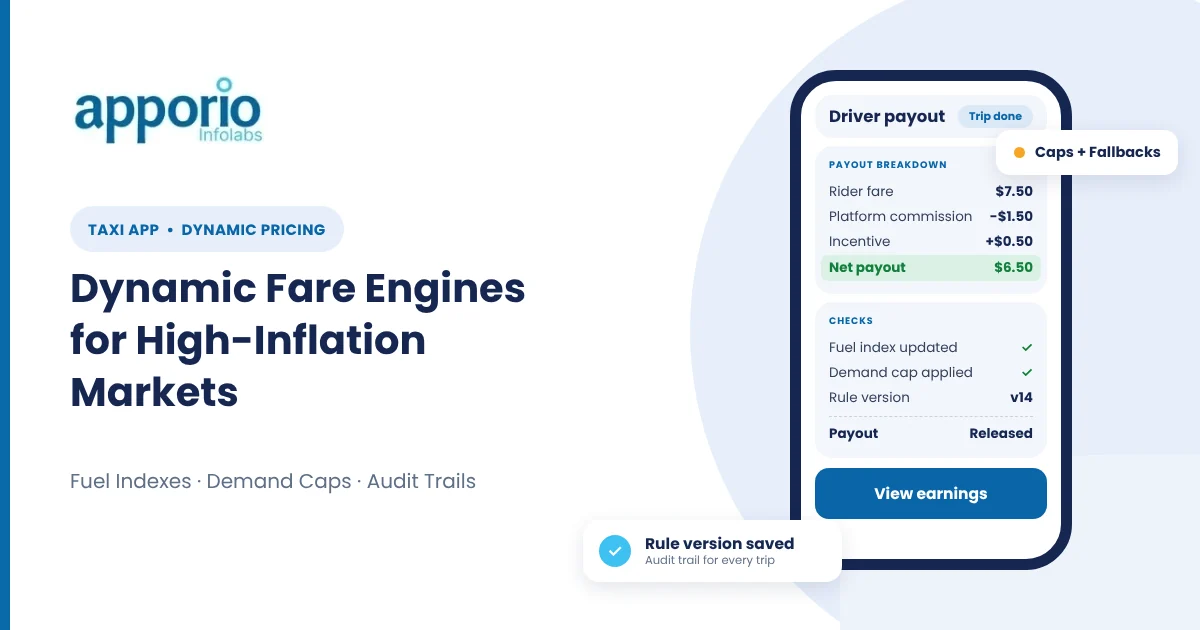
For a taxi platform operating in a high-inflation market, a fare that was commercially viable last month can become loss-making after a fuel increase, currency movement, or driver cost adjustment. A well-designed dynamic pricing engine for taxi apps helps the platform update fares using controlled rules instead of relying on manual changes or broad percentage increases.
The objective is not to charge the highest possible price. It is to calculate a fare that reflects trip distance, travel time, operating costs, local demand, available drivers, payment charges, and regulatory limits. The engine must also explain the price to riders and show drivers how earnings are calculated.
This guide covers the data model, pricing formula, inflation controls, technical architecture, testing process, and operational safeguards needed for ride-hailing businesses in Africa, Southeast Asia, Latin America, and other volatile markets.
A dynamic fare engine is a pricing service that calculates the expected trip price at the time of booking. It receives trip and market inputs, applies business rules, and returns a fare estimate with a clear breakdown. The calculation can be performed before a booking is confirmed and recalculated when the trip begins or when approved conditions change.
Unlike a fixed fare table, the engine separates the variables that change frequently from the rules that should remain stable. Base fares, minimum charges, waiting fees, and cancellation rules can be configured by market, vehicle type, service area, or time period. Fuel indexes, exchange rates, demand signals, and driver availability can be updated more frequently.
A production system should preserve the input values and rule version used for every fare. This creates an audit trail for customer support, driver disputes, finance reconciliation, and regulatory reviews.
Inflation creates a timing problem for mobility operators. Costs can change faster than a traditional tariff review process. If fares remain fixed for too long, drivers may reject requests or leave the platform because their net income no longer covers fuel and operating expenses. If fares are raised without clear rules, riders may see the service as unpredictable or unfair.
A controlled pricing engine creates a middle layer between changing market conditions and the customer-facing fare. It can update cost-sensitive components while preserving a stable experience for riders. For example, a platform may review its base tariff monthly but adjust a fuel surcharge according to a documented index and a defined review schedule.
Technical teams should treat pricing as a financial control system, not only as a feature inside the passenger app. A pricing change can affect marketplace liquidity, driver earnings, tax calculations, refunds, and financial reporting across the business.
A properly governed fare service gives operators flexibility without placing every pricing decision in the hands of developers or support staff. Business teams can manage approved parameters through an administrative interface, while engineering teams retain control over permissions, validation, versioning, and deployment.
The platform can account for fuel and operational cost changes through specific components instead of applying an unexplained increase to every trip. This makes the model easier to test and easier to communicate to drivers and riders.
Fare rules can respond to genuine shortages in a defined zone and time window. A temporary incentive or demand adjustment may improve availability, but it should be measured against acceptance rate, completed trips, pickup time, and driver net earnings.
Riders should see the estimated fare, the conditions that may change it, and the main components included in the calculation. A transparent breakdown reduces disputes, especially when the final amount differs because of waiting, route changes, tolls, or approved adjustments.
One platform can support multiple cities with different currencies, distance units, tax rules, fare floors, payment methods, and vehicle categories. This is useful for operators expanding across regions where inflation and purchasing power differ significantly.
Versioned pricing records allow finance teams to compare fares, driver payouts, platform commissions, promotions, and refunds against the rule set active at booking time. Without this history, reconciling old trips after a pricing change becomes difficult.
Teams evaluating a taxi platform can review a taxi dispatch software approach alongside the fare service. Dispatch and pricing are connected: a fare change that attracts more requests can create pressure on driver allocation, location tracking, and support operations.
A fare engine should be designed around a complete booking lifecycle rather than a single calculation endpoint. The following workflow covers the main stages required for a production implementation.
A simplified structure can be represented as:
Estimated fare = base fare + distance charge + time charge + service fees + approved adjustments + taxes − discounts
The distance and time rates may be zone-specific. An approved adjustment can include a fuel surcharge or bounded demand factor. The formula should not hide multiple unrelated changes inside one large multiplier because that makes errors difficult to identify.
The strongest implementations combine pricing logic with governance, observability, and clear communication. The following practices are especially important when costs and exchange rates move quickly.
Every fare rule should have a version, effective time, market scope, author, approval status, and rollback option. A configuration change should not require a full mobile app release. However, it should pass validation and approval before affecting live bookings.
The estimate service should be fast and available during search. The settlement service should be authoritative at trip completion. Keeping those responsibilities separate helps the system explain why a final fare differs from an estimate without losing the original booking terms.
Use a minimum fare, maximum permitted adjustment, maximum daily movement, and zone-level limits where appropriate. Rate limits on configuration changes can prevent an operator or compromised account from changing prices repeatedly within a short period.
External feeds can fail, location data can be delayed, and payment providers can return temporary errors. Define a last-known-good value, a safe default, and an alert path for each critical dependency. A stale demand signal should not create an unlimited fare increase.
Drivers need to understand the payout calculation, deductions, incentives, and any commission. A payout breakdown inside the driver application can reduce disputes and help the operations team identify whether pricing changes are improving supply.
Test fuel-price changes, currency depreciation, offline driver devices, sudden demand spikes, route deviations, duplicate booking requests, payment retries, and a pricing service outage. Simulate multiple cities at once because a configuration intended for one market can affect another if tenancy boundaries are weak.
For the application layer, the core ride-booking workflow of the Apporio Taxi Uber Clone Script can be adapted to local fare and operating rules. Pricing data should also be protected through access controls, secure APIs, and audit logs. Apporio's Cyber Security service can support that work.
Most pricing failures are caused by weak process design rather than an inability to write the formula. These mistakes can create financial losses, driver dissatisfaction, and regulatory complaints.
A single multiplier applied across every city ignores differences in fuel, congestion, purchasing power, driver supply, and regulation. Use market-level parameters and document why a factor exists.
If a rider accepts an estimate and a new rule is deployed seconds later, the platform should not silently apply the new rule to that booking. Store the accepted estimate, expiry, and applicable conditions.
A demand feed or exchange-rate API may be unavailable. Without a fallback, the system can return errors at the exact moment riders need to book. A safe, tested default is part of the pricing design.
Payment fees, settlement delays, mobile money charges, cash collection, and currency conversion can materially affect the trip margin. The financial model should distinguish the rider charge from the amount ultimately settled to the platform.
Labels such as busy period, fuel adjustment, toll, or waiting time are more useful than an unexplained surcharge. The wording must match the actual calculation and remain consistent across receipts, support tools, and driver statements.
Pricing configuration should use role-based permissions, two-person approval for sensitive changes, audit logs, and rollback controls. An operator who can edit a rate should not automatically be able to delete the history of that change.
A higher fare may increase revenue per completed trip while reducing booking conversion, driver acceptance, and repeat usage. Evaluate the whole marketplace and use controlled experiments with clear stop conditions.
Different operating models require different levels of pricing complexity. A small local fleet may begin with scheduled tariffs, while a multi-city marketplace may need real-time inputs and a dedicated pricing service.
| Pricing model | Best fit | Main inputs | Primary limitation |
|---|---|---|---|
| Fixed tariff table | Stable markets and regulated routes | Distance, time, vehicle type | Slow response to inflation and supply changes |
| Scheduled index adjustment | Markets with periodic cost reviews | Fuel, inflation index, currency, tax | May not respond quickly to short demand spikes |
| Bounded dynamic pricing | Multi-zone ride-hailing platforms | Supply, demand, time, location, cost index | Needs monitoring, governance, and customer communication |
| Custom predictive pricing | Large platforms with reliable historical data | Forecast demand, driver behavior, route, weather, events | Higher data, testing, explainability, and compliance requirements |
Most new platforms do not need predictive pricing on the first day. A transparent tariff with scheduled cost adjustments and bounded demand rules is easier to validate. The architecture should still allow a future pricing service to add more inputs without rewriting the passenger, driver, and admin applications.
Payment design also matters. A fare engine can calculate the correct amount, but the platform still needs dependable collection and reconciliation across cards, wallets, cash, and local payment methods. Review available payment gateways before finalizing the settlement workflow.
High-inflation markets need more than a percentage increase applied to a fixed taxi tariff. They need a versioned fare engine that separates cost inputs, demand controls, driver payouts, taxes, payment charges, and customer-facing explanations. Floors, caps, fallbacks, audit trails, and clear booking-state rules are as important as the pricing formula itself.
Apporio Infolabs can support this type of mobility product through the Taxi App Development service, Apporio Taxi Uber Clone Script, and Taxi Dispatch Software. For operators planning a broader service ecosystem, Gojek Clone App can provide a foundation for a multi-service platform, while Cyber Security services can support protection of pricing, payment, and user data. The right implementation depends on the target market, regulations, payment environment, and operating model.
A dynamic fare engine is a pricing service that calculates a trip estimate using inputs such as distance, duration, vehicle category, operating costs, supply, demand, taxes, and approved business rules. It should return a fare breakdown and preserve the rule version used for the booking.
Platforms should separate inflation-sensitive components such as fuel or currency adjustments from stable components such as the base fare. Changes should use documented indexes, effective dates, approval controls, floors, caps, and customer-facing explanations.
Yes. A demand adjustment should have geographic, time-based, and multiplier limits. The platform should also define fallback behavior for stale or missing demand data and monitor conversion, acceptance, cancellations, pickup time, and driver earnings.
The accepted estimate should normally remain tied to the pricing-rule version and conditions shown at booking. A final fare may include clearly defined changes such as waiting time, tolls, cancellation charges, or route differences, but unrelated rule updates should not silently change the booking.
The system should store the origin and destination, route inputs, estimate, final fare, currency, taxes, adjustments, driver payout, commission, discount, payment status, rule version, timestamps, and reason codes for material changes. These records support reconciliation, disputes, audits, and regulatory reviews.