OUR PRODUCTS
Uberr Clone AppGojek Clone AppSuper App DevelopmentUberr Eats Clone AppGrocery App DevelopmentHandyman App Like Uberr
inDriver Clone AppDelivery App DevelopmentGlovo Clone AppBolt Clone AppLyft Clone AppCareem Clone App
OUR PRODUCTS

← Back to Blog
August 3, 2026
A practical guide to planning a non-emergency medical transportation platform for US providers, including features, workflows, compliance, monetization, and launch decisions.
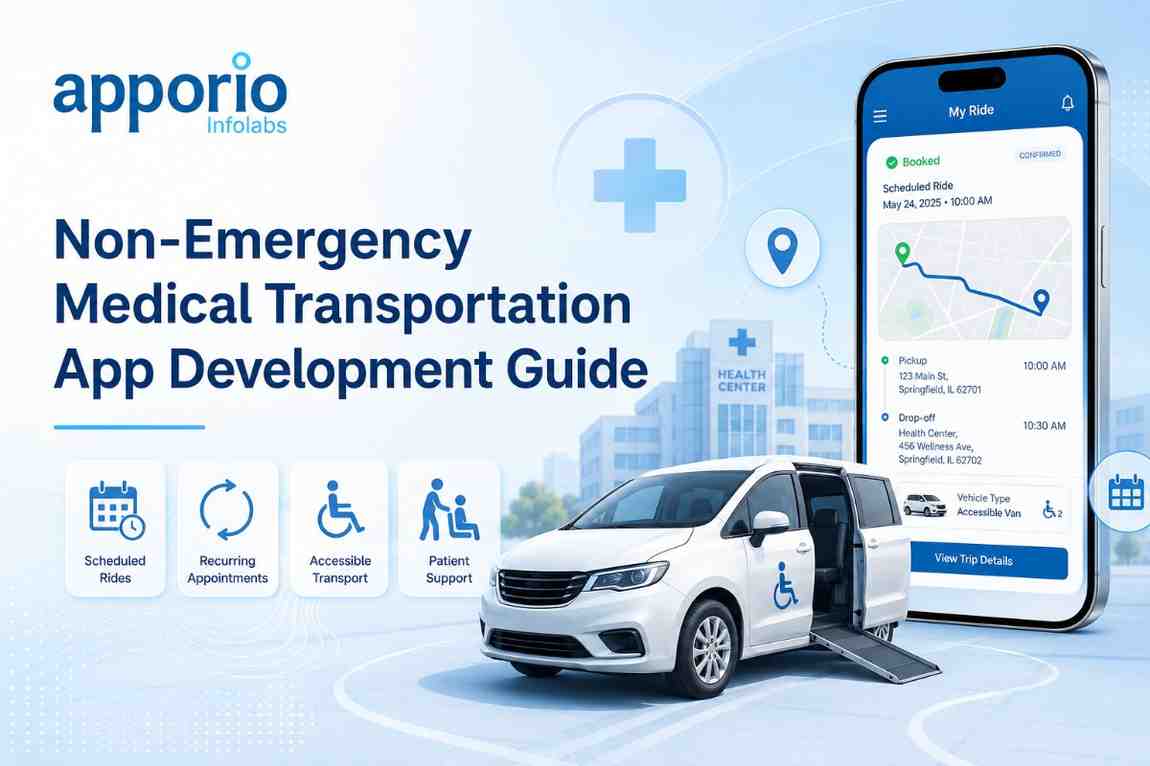
Non-emergency medical transportation helps patients reach medical appointments, dialysis sessions, rehabilitation centers, pharmacies, and other healthcare locations when they cannot drive or use standard public transport. For providers in the USA, NEMT app development can bring scheduling, dispatching, rider communication, and trip records into one operational system.
This is not simply a taxi booking product with a healthcare label. A medical transportation platform must support recurring trips, wheelchair-accessible vehicles, stretcher requirements, caregiver details, authorization workflows, driver credentials, no-show handling, and accurate billing records. The right product scope depends on whether the business serves private-pay riders, healthcare facilities, brokers, Medicaid-related programs, or a combination of these customers.
This guide explains how to evaluate the opportunity, define the product, select core features, plan the build, avoid costly mistakes, and assess a white-label or custom delivery model for the US market.
NEMT app development includes the planning and delivery of a digital platform that coordinates riders, transportation providers, drivers, dispatchers, facilities, and administrators. It may include mobile applications, a web-based operations dashboard, APIs, payment tools, notifications, reporting, and integrations with external systems.
A typical product has several role-based interfaces rather than one application for everyone. Riders need a simple booking and trip-status experience. Drivers need a safe workflow for accepting assignments, navigating to pickup points, recording trip milestones, and reporting issues. Dispatchers require a live view of vehicles, schedules, cancellations, delays, and unassigned requests. Administrators need control over users, service areas, pricing rules, documents, payments, and reports.
The platform should also distinguish between different ride requirements. A passenger may need ambulatory transport, a wheelchair-accessible vehicle, a stretcher vehicle, an escort, additional waiting time, or a recurring appointment schedule. These details affect vehicle assignment, driver eligibility, pricing, and service quality.
For an operator considering a ready-made foundation, the most practical approach is to confirm which workflows are already available and which must be configured or developed. Generic ride-hailing functionality can help with dispatch and tracking, but medical transportation rules must be mapped carefully before launch.
Medical transportation is an operational coordination problem. A provider may receive requests through phone calls, spreadsheets, email, broker portals, and facility referrals. That fragmentation creates avoidable work for dispatch teams and makes it harder to keep riders, caregivers, facilities, and drivers informed.
A centralized platform gives the operator a consistent record for each trip. It can show who requested the ride, where the passenger must go, what assistance is required, which driver was assigned, when pickup occurred, and whether the trip was completed or cancelled. The exact information collected should be determined by the operator’s contracts, policies, and legal advisers.
The US market also has geographic and payer differences. A transportation company serving one county may have very different service-area rules, broker relationships, appointment patterns, and vehicle needs from a provider operating across several states. Product decisions should therefore begin with the operating territory rather than with a long generic feature list.
Digital tools are especially valuable when an operator handles recurring appointments. A dialysis or rehabilitation passenger may need a repeating schedule with different pickup windows and return-trip requirements. Automating the repeat-booking process reduces manual entry, while still giving dispatchers the ability to review and change individual trips.
For founders entering this sector, the commercial question is not only how many rides an app can process. It is whether the system can reduce dispatch friction, improve communication, produce reliable records, and support contracts with facilities or transportation networks.
Dispatchers can view upcoming assignments, recurring trips, vehicle categories, driver availability, and service areas in one place. This makes it easier to identify gaps, reduce avoidable empty miles, and assign suitable vehicles without relying on several disconnected tools.
Booking confirmations, driver details, pickup reminders, delay alerts, and completion messages can be delivered through push notifications, SMS, email, or in-app updates. Communication preferences should be configurable because some passengers may need a caregiver or facility coordinator to receive trip information.
Digital trip records can capture booking data, status changes, timestamps, cancellation reasons, driver notes, and payment information. A structured record is easier to review than handwritten notes or conversations spread across phone logs.
The booking flow can ask only the questions needed to assign the correct service. Options may include mobility aid type, vehicle requirement, escort details, return-trip needs, and pickup instructions. These fields should be tested with dispatchers and drivers before they are made mandatory for every rider.
An operator may charge private-pay riders, work with healthcare facilities, receive broker-referred trips, charge a platform fee to partner providers, or combine several models. The product should keep these workflows separate where pricing, invoicing, or reporting requirements differ.
Dashboards can show completed trips, cancellations, no-shows, average assignment time, service-area activity, driver utilization, and outstanding payments. These metrics help managers identify process problems, but they should not be treated as a substitute for safety reviews or regulatory guidance.
The rider interface should allow one-time and recurring reservations, pickup and drop-off details, appointment time, mobility requirements, rider contact information, and special instructions. A caregiver or facility representative may need to book on behalf of another person, so the account model should support authorized booking roles.
Administrators need a process for adding transportation companies, drivers, vehicles, service areas, and operating documents. The system can include document expiry reminders and approval states. However, the business remains responsible for defining its qualification standards and verifying documents according to applicable requirements.
A dispatcher dashboard should support manual assignment, reassignment, cancellation, waitlist handling, recurring-trip review, and visibility into vehicle type. A map view can help, but the schedule view is equally important because medical trips are tied to appointment windows rather than only immediate pickup demand.
Drivers should see assignment details, passenger assistance notes, navigation support, contact options, and clear trip-status actions. Common milestones include accepted, en route, arrived, passenger picked up, arrived at destination, and completed. The interface should minimize distraction while the vehicle is moving.
Location sharing can help dispatchers estimate arrival times and respond to delays. Operators should explain what is tracked, when tracking starts and ends, who can view it, and how long records are retained. Location features must be designed with privacy and operational necessity in mind.
Private-pay bookings may need card payments, saved payment methods, receipts, refunds, and cancellation rules. Facility or broker arrangements may require invoices instead of immediate card collection. Connecting to suitable payment gateways is only one part of the work; pricing rules, reconciliation, refunds, and reporting must also be defined.
Automated alerts should cover booking confirmation, assignment, driver arrival, delay, cancellation, and completion. A support feature can route questions to dispatch staff, but it should not encourage riders to share unnecessary medical information through unsecured chat messages.
Administrators should be able to manage roles, service zones, vehicle categories, fare rules, user accounts, cancellations, complaints, and access permissions. Reports may cover trip volume, revenue, payment status, driver activity, no-shows, and recurring bookings. Export options are useful when operations or accounting teams work in external systems.
Collect the minimum information needed to arrange and complete a trip. A rider may need to identify mobility assistance or pickup instructions, but the platform should not request a detailed diagnosis when it is not operationally necessary. Work with qualified legal and compliance professionals to determine obligations for the business model.
Role-based permissions should limit what each user can view or change. A driver may need assignment and contact details, while an accountant may need invoices and payment records. Administrative actions should be logged so the business can review changes to bookings, users, prices, and documents.
Security planning should cover encryption, password policies, session management, secure APIs, backups, monitoring, vendor access, and incident response. An experienced cyber security service can help identify technical risks, but compliance decisions should still be reviewed by the operator’s legal and healthcare advisers.
Some passengers may be older adults, caregivers, or people with disabilities. Use readable text, clear labels, large touch targets, strong contrast, simple confirmation steps, and a phone-assisted booking option. Do not assume every rider will install an app or manage a password without help.
Automation should assist dispatchers rather than remove their ability to intervene. Staff need to override assignments, edit pickup instructions, change vehicle requirements, contact drivers, and record explanations for exceptions. A system that cannot handle operational judgment will create workarounds outside the platform.
Drivers may work in areas with weak mobile coverage. The driver application should communicate clear sync states and preserve essential trip actions when a connection drops, subject to the security and technical design approved for the product. Dispatchers should know when a driver’s status is stale.
Track completed trips, late arrivals, cancellations, no-shows, reassignment frequency, support contacts, and complaints by service type. These measures reveal whether the product is improving the actual transportation operation. Revenue reporting can be added alongside them, but financial figures alone do not show whether riders are receiving dependable service.
When more service categories or cities are added, use modular configuration for zones, pricing, vehicle types, and permissions. Apporio’s on-demand mobile app development services can be evaluated for a broader dispatch-based platform, while the final scope should be based on the operator’s workflows rather than on a generic clone.
| Decision factor | White-label foundation | Custom build |
|---|---|---|
| Initial product scope | Starts with existing on-demand workflows that can be configured | Designed around the operator’s documented processes |
| Brand and market positioning | Branding, service area, and operating rules can be adapted where supported | Offers deeper control over the product experience and business logic |
| Specialized integrations | Depends on available APIs and customization options | Can be planned around required broker, facility, accounting, or scheduling connections |
| Operational fit | Strong when the business resembles a dispatch-based service platform | Better when the workflow has unusual payer, compliance, or facility requirements |
| Maintenance responsibility | Requires agreement on customization, updates, hosting, and support | Requires an ongoing engineering and product maintenance plan |
The best choice depends on the gap between the available foundation and the operator’s actual workflow. A ready-made product is not automatically suitable, and a fully custom build is not automatically necessary. Ask the development partner to demonstrate recurring trips, rider proxies, dispatch overrides, vehicle categories, reporting, payment exceptions, and role permissions before selecting an approach.
For businesses already familiar with fleet scheduling, taxi dispatch software concepts may provide useful operational reference points. However, medical transportation requires additional discovery around passenger assistance, facility coordination, privacy, and non-emergency service boundaries.
A successful medical transportation platform begins with operational mapping, not with a list of popular app features. US operators should define their service area, passenger categories, payer relationships, recurring-trip rules, driver controls, data requirements, and escalation procedures before development starts.
Apporio Infolabs can be assessed for a branded, dispatch-led product using its white-label approach, On-Demand Mobile App Development service, Taxi Dispatch Software, and Cyber Security service as relevant building blocks. The final scope should be validated through demonstrations, technical discovery, privacy review, and a controlled pilot. For a practical evaluation of NEMT app development, contact Apporio Infolabs to discuss the workflows your transportation business needs. Book Free Demo
It is a digital platform for arranging and managing scheduled transportation for passengers travelling to healthcare-related destinations when they do not require emergency medical care. It can connect riders, caregivers, facilities, dispatchers, drivers, and administrators.
Core features commonly include one-time and recurring booking, caregiver booking, mobility and vehicle requirements, driver and vehicle management, dispatch assignment, trip-status updates, notifications, payments or invoicing, administration, reporting, and support workflows.
Some dispatch, mapping, driver, notification, and payment workflows can be adapted. However, medical transportation also requires recurring appointments, passenger assistance details, facility coordination, vehicle categories, privacy controls, and clear non-emergency boundaries.
Only if a confirmed business workflow requires them. Start by documenting the integration’s purpose, data fields, authorization, security requirements, owner, and failure process. A pilot can reveal which connections are essential before the product expands.
The operator should collect only necessary data, use role-based access, protect data in transit and at rest, log administrative actions, control vendor access, define retention rules, and obtain legal and compliance advice appropriate to its contracts and operations.
It can be suitable when the business needs a branded dispatch platform and its workflows fit the available foundation. The provider should demonstrate recurring trips, rider proxies, vehicle requirements, dispatcher overrides, payment exceptions, reporting, and security controls before a decision is made.

