OUR PRODUCTS
Uberr Clone AppGojek Clone AppSuper App DevelopmentUberr Eats Clone AppGrocery App DevelopmentHandyman App Like Uberr
inDriver Clone AppDelivery App DevelopmentGlovo Clone AppBolt Clone AppLyft Clone AppCareem Clone App
OUR PRODUCTS

← Back to Blog
Mobile App Development
October 23, 2026
How zero-commission taxi apps replace trip commissions with driver subscriptions, with Indian market examples, a worked earnings example, and a practical build checklist.
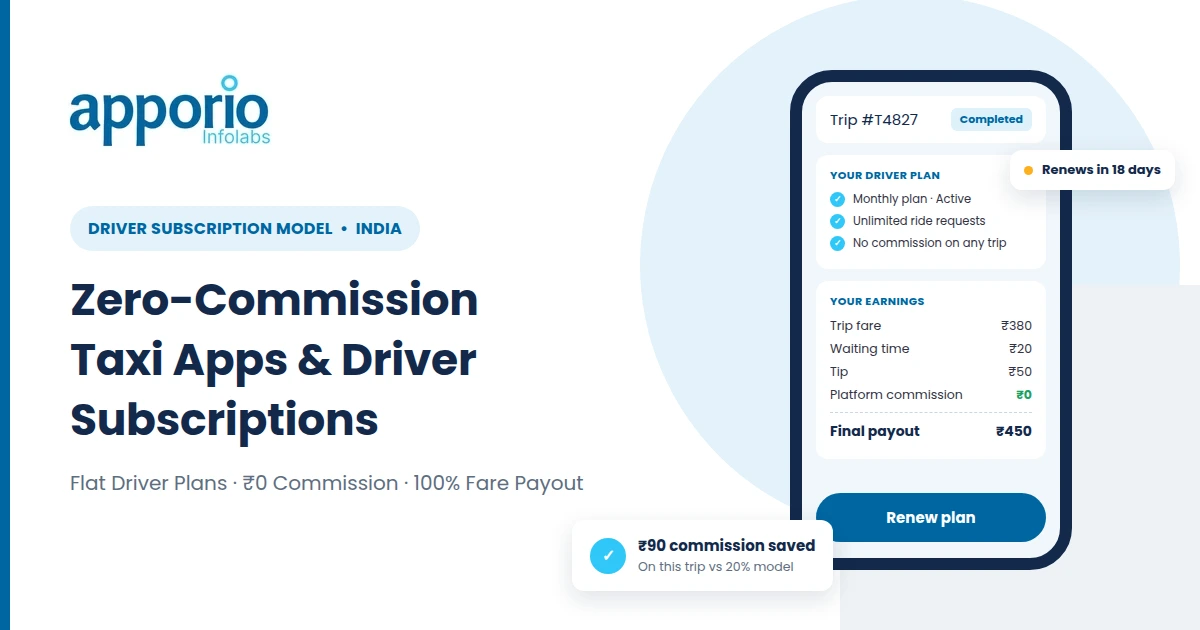
Quick answer: A zero-commission taxi app charges drivers a flat subscription fee, daily, weekly or monthly, instead of taking a percentage of every fare. Drivers keep the full trip fare, and the platform earns from active paid subscriptions. India is the clearest example: Namma Yatri, Rapido, Uber and Ola have all moved some or all of their drivers to subscription plans since 2023. The model works only when drivers get enough rides to justify the fee, so demand, dispatch quality and transparent plan rules matter more than the fee itself.
This guide explains how the model works, who is already using it, what it means for driver earnings and platform revenue, and what to build into a zero commission taxi app before launch.
A zero-commission taxi app is a ride-hailing platform that does not retain a percentage of each driver’s fare as its primary revenue mechanism. Drivers pay a recurring fee, weekly, monthly, or linked to a defined access period, and the platform then allows eligible drivers to receive ride requests under the agreed terms.
The passenger side works like a conventional ride-hailing service. A passenger enters a pickup point and destination, reviews the fare, confirms the trip, tracks the vehicle, and pays through an available method. The driver app receives nearby requests, provides navigation and trip controls, and records completed rides.
The difference is in settlement logic. In a commission-led marketplace, the system deducts a platform share from each trip. In a subscription-based taxi app, the fare goes to the driver, while the platform records the driver’s subscription status separately.
India is where the zero-commission model moved from experiment to industry standard. The timeline below uses figures reported in 2025; plans and prices change frequently, so check current terms before using them as benchmarks.
| Platform | When it moved to subscriptions | Reported driver fee |
|---|---|---|
| Namma Yatri | Launched in Bengaluru in 2022 as a zero-commission auto app; introduced a subscription fee in mid-2023 | Varies by region and vehicle type |
| Rapido | Shifted auto captains from commission to a subscription access fee in 2024 | ₹9–29 per day, as reported |
| Uber India | Launched a subscription-based, zero-commission option for auto drivers in February 2025, later extended to cabs | Flat plan fee by city |
| Ola | Piloted with autos in 2024, then extended to cab drivers in 2025 | 30-day pass of ₹2,010 (₹67 per day), as reported |
Two lessons matter for new operators. First, drivers respond strongly to the model: incumbents changed their pricing because newer apps were winning driver supply. Second, it is not automatically profitable. Namma Yatri, the pioneer of the model, had not broken even as of 2025, and driver unions have also questioned subscription fees. The model shifts the risk from the driver to the platform.
Tax treatment needs attention too. In Karnataka, an Authority for Advance Ruling found Rapido was still liable for GST after adopting a subscription model, because it was treated as an e-commerce enabler. Get local tax advice before assuming a subscription removes tax obligations.
Sources: MediaNama on Ola’s cab subscription (June 2025), Outlook Business on Rapido and Ola fees, Rest of World on Namma Yatri, and Inc42 on the zero-commission shift.
Commission is one of the most visible costs for drivers. When fares vary with distance, traffic and demand, a percentage deduction makes weekly earnings hard to predict. A fixed subscription turns it into a known operating expense, which matters most where drivers work across several platforms or track fuel, maintenance and vehicle financing closely.
For the platform, subscriptions create a recurring revenue line that is easier to forecast than trip-based income. But recurring revenue depends on retention. If drivers pay and get too few bookings, they cancel quickly. A subscription model makes marketplace liquidity even more important: passengers must find vehicles, and drivers must see enough demand to justify renewing.
Introductory plans can help recruit drivers in a new market, but drivers should understand the trial duration, renewal date, access conditions and any separate payment or tax charges before subscribing.
The example below compares a 20% commission with a flat ₹67-per-day plan, the daily equivalent of the 30-day pass Ola reportedly introduced in 2025. Fare levels are illustrative.
| Driver’s daily fares | Paid at 20% commission | Paid on ₹67/day plan | Driver saves |
|---|---|---|---|
| ₹1,000 | ₹200 | ₹67 | ₹133 |
| ₹2,000 | ₹400 | ₹67 | ₹333 |
| ₹3,000 | ₹600 | ₹67 | ₹533 |
For the driver, the subscription costs more than commission only on days when fares fall below about ₹335. For full-time drivers it is clearly better, which explains its popularity.
For the operator, the picture is different. With 1,000 paid drivers averaging ₹2,000 a day, a 20% commission would bring in about ₹1.2 crore a month, while a ₹67-per-day plan brings in about ₹20 lakh. The subscription model needs a much leaner cost base, low customer acquisition costs, and high driver renewal rates to work. This is the single most important number to model before choosing it.
Document these as business rules rather than leaving them for developers to interpret. For example, decide whether an expired driver can complete a trip already assigned, whether a refund extends the subscription, and whether a driver can switch plans mid-period.
Do not copy a competitor’s fee. Estimate active drivers, trip frequency, local fares, support costs, payment charges, verification work, marketing and technology maintenance, then pilot a plan before a wider rollout.
Drivers should see plan name, payment status, renewal date, invoice history and access conditions without contacting support. Administrators need the same view with filters for active, expired, failed, paused and suspended accounts.
A subscription payment and a passenger trip are different financial events. Store them separately so renewals, refunds, fares, cash collections and gateway charges can be reconciled and reported accurately.
Payment habits differ by market: UPI and wallets in India, mobile money in parts of Africa, cards elsewhere. Review recurring payment permissions, currency handling and tax invoices for each target market. Apporio’s payment gateways page covers supported integrations.
The operator needs controls for driver availability, service zones, vehicle categories, cancellations, emergency escalation, fare adjustments, complaints and manual reassignment. Taxi dispatch software helps teams handle daily exceptions instead of depending entirely on automated rules.
The platform handles location data, identity documents, trip history and payment events. Apply role-based admin access, secure authentication, controlled document access, audit logs and sensible data retention across passenger, driver, admin and payment workflows.
A first release can focus on one city, one or two vehicle categories, booking, driver onboarding, subscriptions, payments, dispatch, support and reporting. It should not drop mandatory safety, identity, data protection or transport requirements to reduce scope.
Both models can support a ride-hailing marketplace. The right choice depends on driver preferences, demand density, regulation, fare levels and payment behavior. Some operators test a hybrid, such as a lower subscription plus a small service charge, which must be communicated precisely. In markets with commission caps, regulation may shape the decision too; see our guide to taxi app commission caps in East Africa.
| Factor | Driver Subscription | Trip Commission | Hybrid Structure |
|---|---|---|---|
| Primary platform revenue | Recurring driver plan fees | Percentage or fixed deduction per ride | Subscription plus selected trip charges |
| Driver cost visibility | Easy to forecast before trips | Changes with trip volume and fare value | Requires review of both fee types |
| Platform revenue risk | Higher retention and demand risk if drivers cancel | Revenue follows completed trip activity | Diversifies income but adds complexity |
| Best operational focus | Renewals, driver value and demand generation | Trip volume, fare accuracy and settlement | Transparent pricing and detailed reconciliation |
| Real-world examples | Namma Yatri, Rapido, Ola and Uber subscription plans in India | Traditional Uber, Bolt and most global ride-hailing apps | Plans that pair a lower fee with a booking charge |
A subscription-led operation should track churn and driver utilization closely. A commission-led operation should track completed rides and take rate. A hybrid must explain every charge on the driver earnings screen.
A zero commission taxi app gives drivers predictable platform costs and gives operators a recurring revenue base. India shows that drivers respond strongly to it, and also that the model only works with fair plan design, verified drivers, local payment support, transparent access rules, reliable dispatch, accurate accounting, and enough passenger demand to make the subscription worth renewing.
Apporio Infolabs supports this with its Apporio Taxi Uber Clone Script, taxi app development, and on-demand app development services, covering passenger, driver and admin apps with configurable subscription plans, white-labelled under the operator’s own brand.
Define the city, driver segment, payment methods, plan rules, compliance requirements and success metrics before development. A focused pilot will show whether drivers see enough value in paid access before you expand.
See how Apporio’s taxi platform handles driver subscription plans, renewals, dispatch access and earnings statements. In a free 30-minute session, Apporio’s team will walk you through the passenger, driver and admin apps and map them to your launch market and pricing model.
Drivers pay a fixed recurring fee for access to the platform instead of giving the operator a percentage of every completed ride. The platform still manages bookings, dispatch, support and trip records, while the plan terms define how fares are settled.
Namma Yatri pioneered the model in 2022–2023. Rapido moved to a subscription access fee in 2024, Uber launched a subscription option for auto drivers in February 2025, and Ola extended a 30-day subscription pass to cab drivers in 2025. Plans and prices vary by city and change often.
It can be, but it is harder than it looks. A flat daily fee usually earns the platform far less per driver than a 20% commission, so profitability depends on a lean cost base, high driver renewal, low acquisition costs and strong passenger demand. Model monthly revenue per paid driver before choosing the model.
No. A subscription provides access under stated plan conditions, but bookings depend on passenger demand, coverage, driver availability and location. A platform should never present a fixed number of rides or income as guaranteed.
A platform can test daily, weekly, monthly, part-time, premium, vehicle-category or fleet plans. Each plan should state its price, billing interval, access rules, renewal date, grace period, cancellation process and any taxes or payment charges.
The system can send renewal reminders, provide a grace period, and restrict new ride requests after expiry. The exact behavior should be configured in advance, including whether the driver can finish an assigned trip and view previous earnings.
Essential capabilities include driver verification, subscription plan management, recurring payment records, passenger booking, real-time dispatch, trip status tracking, fare and settlement records, renewal notifications, support workflows, reporting, and admin controls for suspension or reactivation.