OUR PRODUCTS
Uberr Clone AppGojek Clone AppSuper App DevelopmentUberr Eats Clone AppGrocery App DevelopmentHandyman App Like Uberr
inDriver Clone AppDelivery App DevelopmentGlovo Clone AppBolt Clone AppLyft Clone AppCareem Clone App
OUR PRODUCTS

← Back to Blog
Business Ideas
October 28, 2026
A practical guide to building driver-owned ride-hailing platforms, covering cooperative governance, driver economics, technology, compliance, and growth.
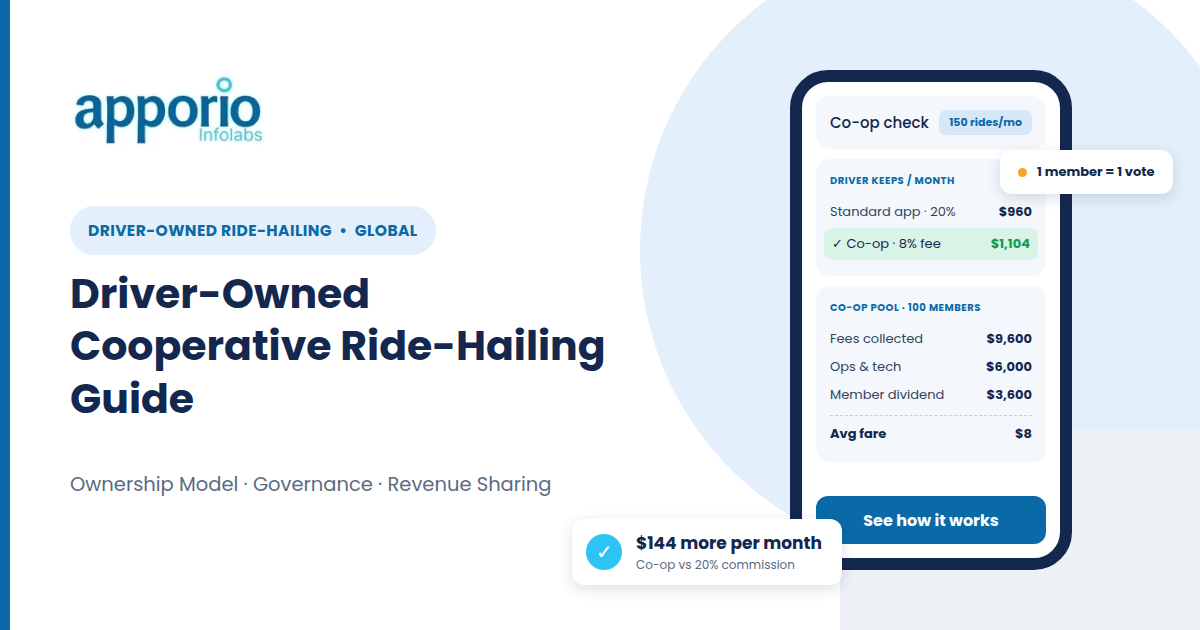
A cooperative taxi app is a ride-hailing platform that drivers own and govern together. Instead of an outside company setting commissions and rules, members vote on fares, fees, and how any surplus is shared. Riders still get a normal booking experience: request a trip, track the car, pay, and rate the driver.
The model is attracting attention from driver associations, transport unions, and local entrepreneurs who want an alternative to centrally controlled platforms. It also brings extra work. Before launch, a cooperative must settle voting rights, member eligibility, financial reporting, service standards, and who owns the technology.
This guide covers how the model works, real examples, legal and funding options, the technology you need, a step-by-step launch plan, and the mistakes to avoid.
A cooperative taxi app is a digital ride-booking platform owned or governed by its participating drivers, a registered cooperative entity, or a combination of drivers and community stakeholders. Riders use the passenger application to request trips, while drivers use a separate application to receive requests, navigate, update trip status, and view earnings.
The platform normally includes three operational layers:
The cooperative itself sits above these software layers. It determines who can become a member, how surplus is distributed, how board members are elected, and which decisions require a member vote. Ownership does not mean every driver manages every daily task. A practical structure separates strategic governance from professional operations while keeping management accountable to members.
This differs from a conventional ride-hailing marketplace, where one company owns the brand, software, customer relationship, and pricing authority. In a cooperative, the software may be licensed, customized, or owned outright, but the governance rules should state clearly who controls data, accounts, pricing policies, and future product changes.
Both show the same pattern: an organized driver base came first, and the app followed. In many African and Asian markets, existing boda boda associations, taxi unions, and savings and credit cooperatives (SACCOs) already provide that base.
Ride-hailing platforms depend on a two-sided marketplace. Riders need short wait times and reliable service; drivers need sufficient trip volume, predictable earnings, and reasonable operating costs. A cooperative structure attempts to align these interests by giving drivers a formal role in the business rather than treating them only as supply-side contractors.
That alignment matters in markets where drivers are concerned about commission levels, sudden policy changes, limited access to support, or unclear fare calculations. A member-owned platform can publish the rules under which commissions, subscriptions, deductions, and surplus distributions are calculated, and give members a defined process for changing them.
Local ownership also helps a platform adapt to regional conditions. A cooperative often understands cash payments, mobile money, driver association practices, licensing requirements, vehicle categories, and peak travel patterns better than an external operator entering the market. Those insights shape service zones, dispatch rules, language support, and customer support workflows.
The trade-off is speed and discipline. Decision-making slows down if every product or pricing choice needs a full membership vote, and financial controls weaken if responsibilities are unclear. Founders should therefore define the relationship between ownership and operations before development begins: a board sets policy, a management team handles daily execution, and the application reflects those agreed rules.
A cooperative needs a legal entity before it can sign driver agreements, open payment accounts, or license software. The right structure depends on who will own the platform and how much outside capital you need.
Cooperative law differs by country. Before writing the bylaws, check registration requirements, minimum membership numbers, rules on distributing surplus, and how drivers are classified for tax and labor purposes. A local cooperative lawyer is worth the cost at this stage.
Budget for more than development. Launch marketing, driver onboarding, customer support, and at least 6–12 months of operating costs before trip volume covers expenses all need funding.
A well-run cooperative can create benefits for drivers, riders, and the organization operating the technology, provided it has clear rules, sufficient trip demand, reliable software, and financial discipline.
Here is an illustrative split for a 10.00 fare (in any currency) on a cooperative charging a 10% contribution. Actual percentages are set by each cooperative, and taxes are excluded here because they vary by market.
At year end, any surplus left from cooperative contributions after costs can be returned to members, for example in proportion to trips completed. Showing drivers this breakdown on every trip is one of the clearest advantages a cooperative can offer.
A cooperative platform needs everything a standard ride-hailing app has, plus a layer that records ownership, governance, and how money is distributed.
Before signing with a vendor, settle these questions:
Building from scratch gives you full control, but it takes longer and costs more. A ready-made platform like the Apporio Taxi Uber Clone Script provides the passenger, driver, and admin apps from day one. That leaves your budget for the cooperative-specific features above.
Launching this type of mobility service requires legal, commercial, operational, and technical work in parallel. The following sequence helps reduce rework and prevents software development from starting before the business rules are agreed.
During planning, also decide whether the mobile apps need native or cross-platform development, how location updates will be handled under weak network conditions, and how the admin panel will restrict sensitive information by role.
Members should control major cooperative matters without voting on every dispatch rule or support decision. Use a board or elected committee for policy and oversight, then assign daily responsibilities to trained managers. Publish which decisions are reserved for members and which are delegated to management.
Every completed trip should produce a record showing the gross fare, discounts, taxes where relevant, payment fees, cooperative deductions, and driver payout. A driver-facing earnings view should use plain language and allow members to review historical transactions. Reconcile the application, payment processor, and accounting records regularly.
Drivers may challenge a system that appears to favor certain vehicles or locations. Document the factors used in dispatch, such as proximity, vehicle type, availability, service area, or driver status. Where automated decisions affect access to trips or account restrictions, provide a review path and keep an audit record. Our guide to algorithmic transparency for gig apps covers what regulators increasingly expect. Apporio’s artificial intelligence services can help if the cooperative later introduces data-assisted matching, as long as automation stays reviewable.
Do not assume cards are the only viable payment method. Depending on the market, the product may need cash, bank transfers, mobile money, or other approved methods. Payment status must be visible to both the passenger and administrator, with clear handling for failed, reversed, pending, or disputed transactions. See our guide to payment gateway integration for on-demand apps and Apporio’s supported payment gateways.
The platform may store identity documents, phone numbers, location histories, payment references, vehicle information, and complaint records. Apply role-based access, secure storage, audit logging, retention rules, and controlled exports. Security testing should cover authentication, account recovery, administrative privileges, APIs, and third-party integrations. Apporio’s cyber security services can support a structured review.
Membership count alone does not show whether the service works. Monitor request-to-trip conversion, driver online hours, acceptance and cancellation rates, pickup time, completed trips per active driver, payment failure rate, support resolution time, repeat usage, and payout accuracy. Review these metrics by zone and time period to find weak points in the marketplace.
Use in-app feedback, driver forums, support categories, periodic member meetings, and documented policy reviews. Each piece of feedback should lead to an assigned action, owner, and deadline where appropriate; otherwise collecting opinions increases frustration rather than improving the service.
Most cooperative mobility platforms fail because of unclear rules, weak operations, or a mismatch with local market conditions, not because of a missing feature.
The following comparison highlights the structural differences. Actual results depend on local regulations, management quality, pricing, driver supply, and product execution.
| Area | Driver-Owned Cooperative | Conventional Platform | Product Implication |
|---|---|---|---|
| Ownership | Drivers or a cooperative entity hold defined ownership or governance rights. | A private company or investor group usually controls the platform. | Membership, voting eligibility, and ownership records may require additional workflows. |
| Decision-making | Members influence specified policies through elections, votes, or committees. | Company leadership generally sets product and commercial policies. | The admin system should distinguish member decisions from operational decisions. |
| Decision speed | Slower on major policy, which needs a vote or board approval. | Faster, with central decisions. | Publish which decisions are delegated so daily operations are not blocked. |
| Revenue | Income may come from commissions, subscriptions, fees, or surplus distribution. | Revenue commonly supports company operations, investors, and growth spending. | Driver statements and cooperative accounting need detailed transaction records. |
| Access to capital | Limited: member shares, loans, grants, and non-voting investment. | Venture and equity funding. | Start lean with a prebuilt platform and add cooperative features in phases. |
| Driver relationship | Drivers may be both service providers and members of the organization. | Drivers usually participate under platform terms set by the company. | Onboarding must cover both service eligibility and membership status. |
| Local adaptation | Regional members can influence service rules and market priorities. | Local teams may implement policies set centrally. | Configuration should support city-level pricing, zones, vehicles, and payments. |
| Technology control | Control may sit with the cooperative, a vendor, or a shared arrangement. | The platform company normally controls the software and data policy. | Contracts should define data access, licensing, portability, support, and exit terms. |
| Main risk | Slow decisions and weak financial controls. | Driver churn, regulatory pressure, and trust issues. | Build audit logs, reporting, and clear role permissions from the start. |
Illustrative comparison. Actual results depend on local regulations, management quality, pricing, driver supply and product execution.
Neither structure suits every market. The right choice depends on available capital, driver organization, regulatory conditions, management capacity, and how much control the founders want to keep.
A driver-owned ride-hailing platform combines marketplace technology with cooperative governance. Its success depends on clear membership rules, transparent financial records, practical voting procedures, secure data handling, reliable dispatch, local payment support, and a disciplined pilot in one market.
The fastest path is usually to agree the business rules first, then build on a proven ride-hailing foundation. The Apporio Taxi Uber Clone Script provides passenger, driver, and admin apps that can be configured for cooperative contributions, transparent payout statements, and city-level pricing, while the cooperative keeps control of its ownership and governance policies.
See how Apporio’s taxi platform handles driver payouts, commission and subscription settings, and earnings statements. In a free 30-minute session, Apporio’s team will walk you through the passenger, driver, and admin apps and map them to your cooperative’s launch market and revenue model.
A cooperative taxi app is a ride-booking platform owned or governed by participating drivers, a registered cooperative, or both. It includes passenger, driver, and administration applications, while the cooperative defines membership, voting, revenue, and service policies.
Drivers receive trip payouts after applicable commissions, payment fees, taxes, discounts, or cooperative contributions are recorded. The organization may also distribute surplus according to its approved membership and financial rules.
Most cooperatives ask each driver to buy a fixed membership share, often payable in instalments deducted from trip earnings. Some also charge a recurring membership or subscription fee. The bylaws should state what happens to a driver’s share if they leave.
Cost depends on whether you build from scratch or start with a ready-made platform. A prebuilt taxi app script with passenger, driver, and admin apps is usually far cheaper and faster than custom development, leaving budget for cooperative features such as a member registry, payout statements, and voting. Also budget for legal setup, launch marketing, driver onboarding, and several months of operating costs.
Not always. The first release can manage membership status, eligibility, policy documents, decision logs, and controlled voting within the administration system. A separate governance module may be added when the cooperative’s member processes require it.
The essential scope normally includes passenger and driver accounts, driver verification, location tracking, dispatch, trip status, fare calculation, payments, notifications, support workflows, and administrative reports. Cooperative membership and financial transparency should also be included where they affect daily operations.
It should define evidence requirements, response times, escalation routes, and the authority responsible for final decisions. The platform should retain relevant trip, payment, communication, and account-action records while restricting access to authorized reviewers.
Yes, but expansion should follow a stable pilot. Each new city may require different licenses, vehicle categories, payment methods, fare rules, support coverage, and driver verification procedures. The technology should support city-level configuration without creating inconsistent governance or reporting.
Sources: CBS News on The Drivers Cooperative (March 2024), P2P Foundation on Eva Coop.